1 / 7Use ← → to flip
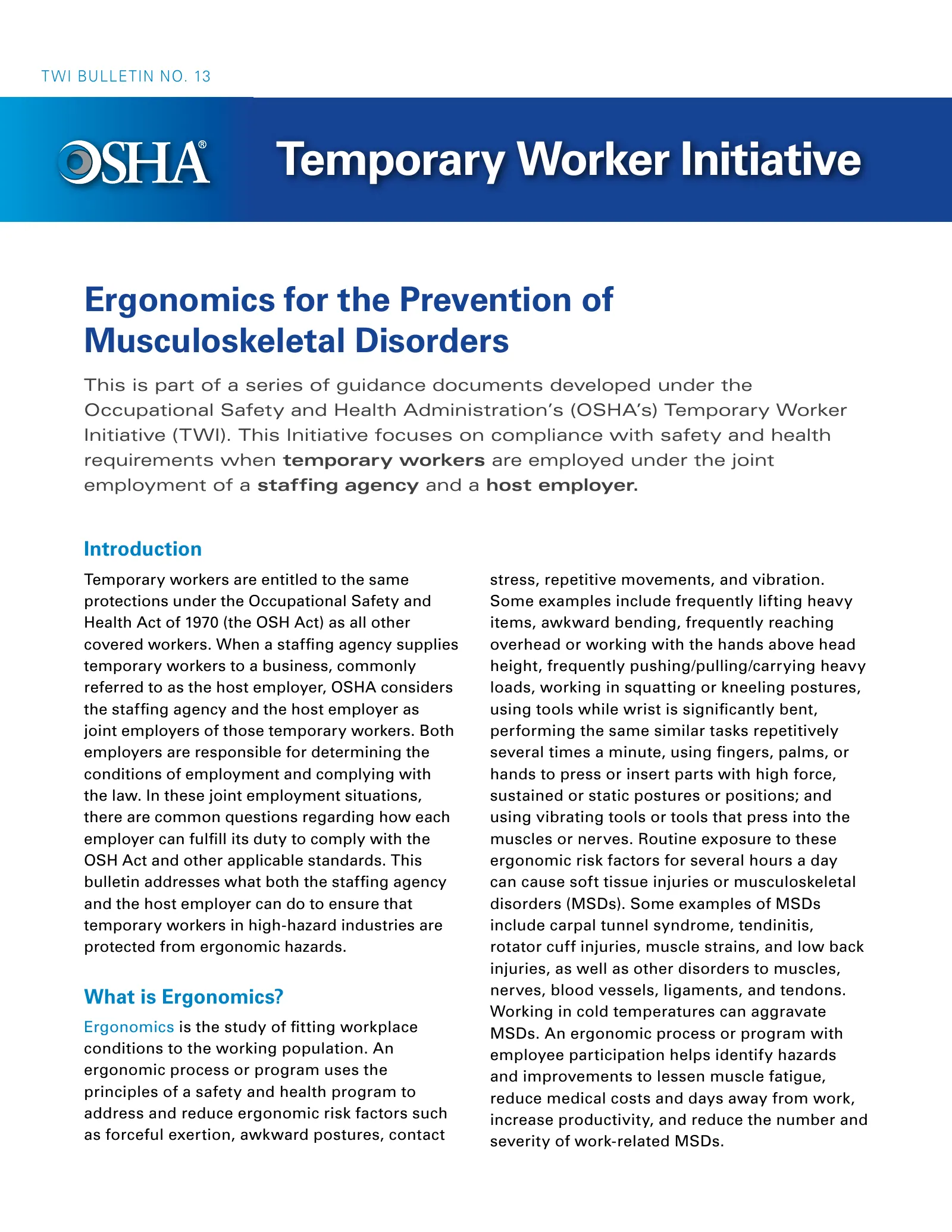
Temporary Worker Initiative (TWI) Bulletin No. 13 – Ergonomics for the Prevention of Musculoskeletal Disorders (OSHA 4382)
OSHA fact sheet or bulletin, for General Industry classes.
Page text
· 7 pages · by U.S. Department of Labor, OSHA
The words on each page as the author wrote them, read from the file by software so they can be searched. Layout, pictures and tables are not shown here: the pages above and the download are the original.
- Page 1
Temporary Worker Initiative
- T WI BULLETIN NO. 13
- Ergonomics for the Prevention of Musculoskeletal Disorders
- This is part of a series of guidance documents developed under the Occupational Safety and Health Administration’s (OSHA’s) Temporary Worker Initiative (TWI). This Initiative focuses on compliance with safety and health requirements when temporary workers are employed under the joint employment of a staffing agency and a host employer.
- Introduction
- Temporary workers are entitled to the same protections under the Occupational Safety and Health Act of 1970 (the OSH Act) as all other covered workers. When a staffing agency supplies temporary workers to a business, commonly referred to as the host employer, OSHA considers the staffing agency and the host employer as joint employers of those temporary workers. Both employers are responsible for determining the conditions of employment and complying with the law. In these joint employment situations, there are common questions regarding how each employer can fulfill its duty to comply with the OSH Act and other applicable standards. This bulletin addresses what both the staffing agency and the host employer can do to ensure that temporary workers in high-hazard industries are protected from ergonomic hazards.
- What is Ergonomics?
- Ergonomics is the study of fitting workplace conditions to the working population. An ergonomic process or program uses the principles of a safety and health program to address and reduce ergonomic risk factors such as forceful exertion, awkward postures, contact stress, repetitive movements, and vibration. Some examples include frequently lifting heavy items, awkward bending, frequently reaching overhead or working with the hands above head height, frequently pushing/pulling/carrying heavy loads, working in squatting or kneeling postures, using tools while wrist is significantly bent, performing the same similar tasks repetitively several times a minute, using fingers, palms, or hands to press or insert parts with high force, sustained or static postures or positions; and using vibrating tools or tools that press into the muscles or nerves. Routine exposure to these ergonomic risk factors for several hours a day can cause soft tissue injuries or musculoskeletal disorders (MSDs). Some examples of MSDs include carpal tunnel syndrome, tendinitis, rotator cuff injuries, muscle strains, and low back injuries, as well as other disorders to muscles, nerves, blood vessels, ligaments, and tendons. Working in cold temperatures can aggravate MSDs. An ergonomic process or program with employee participation helps identify hazards and improvements to lessen muscle fatigue, reduce medical costs and days away from work, increase productivity, and reduce the number and severity of work-related MSDs.
- Page 2
General Employer Responsibilities
- Workers in many different industries and occupations can be exposed to risk factors at work. Biennially, the U.S. Bureau of Labor Statistics
- (BLS) releases MSD data specific to industries and occupations, including the days away from work (DAFW) incident rate and median DAFW. Review of the latest available data reported by
- BLS (for illness and injuries reported by employers during calendar year 2020) indicates that the transportation and warehousing industry had the highest incident rate of MSD injuries (see Appendix A for tables of BLS data). Other industries having an incident rate of MSD injuries higher than 30% included health care and social assistance, retail trade, wholesale trade, and the industry group that included agriculture, forestry, fishing, and hunting. BLS categories of occupations with the highest incident rates of MSDs included material moving; installation, maintenance, and repair; production; and healthcare practitioners and technical.
- aware of ergonomics and its benefits, informed about ergonomics-related concerns in the workplace, and understand the importance of reporting early symptoms of MSDs. Provide on-the-job training for new workers to become conditioned to the physical demands of the job. y Encourage Early Reporting of MSD Symptoms: Early reporting can accelerate the job assessment and improvement process, helping to prevent or reduce the progression of symptoms, the development of serious injuries, and subsequent lost-time claims. Ensure injured workers receive care from a healthcare provider who is trained and experienced in treating MSDs within the scope of their license. OSHA’s injury and illness recording and reporting regulation (29 CFR Part 1904) require employers to record and report work-related fatalities, injuries and illnesses.
- y Evaluate the Ergonomic Process and Progress: Evaluation and corrective action procedures are needed to periodically assess the effectiveness of the ergonomic process and to ensure its continuous improvement and long-term success.
- Currently, OSHA does not have a specific standard addressing ergonomic hazards. However, all employers covered under the OSH Act must ensure that workers are protected from recognized hazards that may cause death or serious physical harm, which includes ergonomic hazards. To protect their workers, employers should implement an ergonomic process with the following elements:
- Host Employer Responsibilities
- The host employer is usually in the best position to develop an ergonomic process in the facility because it generally controls the means, methods, and processes by which the work is accomplished. The host employer should take the lead on the worksite hazard assessment or job hazard analysis because it is most familiar with the associated hazards of each task or job. The results of the assessments should be shared with the staffing agency, and the staffing agency should have the ability to conduct its own assessment as necessary. Any controls to mitigate ergonomic hazards should be instituted and installed by the host employer. The host employer is responsible for ensuring temporary employees are trained on the purpose and proper use of the controls in place to mitigate the ergonomic hazards.
- y Management Commitment: Management should define the goals, objectives and steps for the ergonomic process, discuss them with their workers, assign responsibilities to designated staff, and communicate openly with the workforce.
- y Involve Workers: Encourage workers to participate in worksite assessments, solution development and implementation.
- y Hazard Assessments: Identify ergonomic risk factors at each task or job through hazard assessments or job hazard analyses.
- y Implement Solutions to Control Hazards:
- There are many possible solutions that can be implemented to reduce, control, or eliminate workplace MSDs.
- y Provide Training: A program of initial and refresher training ensures that workers are
- Staffing Agency Responsibilities
- The staffing agency shares responsibility for its workers’ safety and health and has an obligation to become familiar with the various tools mentioned above and to review the host
- Page 3
Joint Responsibilities
- employer’s worksite policies and procedures to control ergonomic hazards prior to assigning workers. The staffing agency should be permitted by the host employer to conduct a walkthrough of the worksite to identify tasks temporary employees will be conducting and controls in place to mitigate ergonomic hazards. The staffing agency can conduct a hazard assessment for tasks that temporary employees will be performing or review the hazard assessments conducted by the host employer. Any controls to mitigate ergonomic hazards instituted by the host employer should be verified by the staffing agency prior to assigning workers and at various later times to ensure the controls are maintained.
- Ergonomic training is best provided by individuals who have experience with ergonomic hazards and controls within the particular industry. The specific type of training to be performed by the host employer and staffing agency can be clearly stated in the language of the contract between the employers. Both employers should ensure that the other is providing effective and proper training so that the employees have the basic knowledge listed above.
- Both the host employer and staffing agency should conduct thorough investigations of reported
- MSDs that occur on the job, including injuries, illnesses, and symptoms, in order to determine the root cause(s) and what opportunities exist to improve injury and illness prevention programs. It is critical that both the host employer and staffing agency are jointly engaged and communicating when conducting these investigations. For OSHA’s requirements on reporting and recording injuries and illnesses, see TWI Bulletin #1 - Injury and Illness Recordkeeping Requirements.
- The OSH Act under section 5(a)(1) requires employers to provide a safe and healthful workplace for all workers. When OSHA’s investigations reveal that a temporary worker is exposed to a recognized hazard, and the worker is employed by both a staffing agency and a host employer, we will consider issuing citations to either or both of the employers, depending on the specific facts of the case. OSHA will make an assessment of whether both employers have fulfilled their respective compliance responsibilities in each individual case.
- State Plans
- Twenty-nine states and U.S. territories operate their own OSHA-approved occupational safety and health programs, called State Plans. These State
- Plans have and enforce their own occupational safety and health standards that must be at least as effective as OSHA’s but may have different or additional requirements. For a list of the State
- Plans and more information, see this webpage:
- State Plans.
- Training is an important element in the ergonomic process. In most cases, the host employer is responsible for site-specific training and the staffing agency is responsible for generic safety and health training. Training must be conducted in a language and vocabulary that all workers understand. Effective training should at least include:
- How Can OSHA Help?
- Workers have a right to a safe workplace. If you think your job is unsafe or you have questions, contact OSHA at 1-800-321-OSHA (6742) or visit OSHA’s website. It’s confidential. We can help.
- y The principles of ergonomics and their applications to the assigned tasks.
- y The proper use of equipment, tools, and machine controls.
- y Good work practices, including proper lifting techniques.
- y Recognition of early symptoms of MSDs.
- y Understanding the importance of reporting and addressing early indications of MSDs before serious injuries develop.
- y The procedures for reporting work-related injuries and illnesses.
- For other valuable worker protection information, such as Workers’ Rights, Employer Responsibilities, and other services OSHA offers, see this webpage: OSHA Worker Rights and Protections.
- For information on Temporary Workers, see this webpage: Protecting Temporary Workers.
- Page 4
Example Scenarios*
- HEALTHCARE:
- A long-term nursing home provides 24-hour care to many residents in their buildings. Employees who assist residents include nurses and certified nursing assistants (CNAs). The job duties of the CNAs include ensuring residents in the facility complete daily activities of living (bathing, brushing hair and teeth, toileting, dressing, eating, etc.) and assisting residents out of bed or rotating residents in bed. The host employer, Best Nursing Home, has a Patient Handling Program for ergonomics that includes hazard assessments, controls, employee training, and a no-lift policy. Employee training is provided to new employees and annually thereafter during their safety week in July. Best Nursing Home has sit-to-stand lifts, full-body lifts, and transfer boards to assist CNAs with their required job duties.
- Due to recent employee departures, Best Nursing Home contracted with CNA Staffing Agency to have CNAs work in the facility for about two weeks. Best Nursing Home requested that CNA Staffing Agency ensure that the CNAs have their appropriate certifications prior to starting at the facility. When the temporary workers arrived, Best Nursing Home provided the CNAs with a brief tour of the facility and instructed them that they each had 10 residents to assist in the morning prior to their 9 am breakfast. This included toileting and getting them to the dining room if the resident was able to. After breakfast, the residents were transferred to a bed or chair. The same routine was repeated before lunch. On the fourth day of working at the facility, a CNA felt a sharp pain in his back while transferring a resident from the bed to a wheelchair without using any of the lift assist devices. The CNA continued to work because he thought he could work through it, and the pain would go away. At the end of the shift, the CNA was unable to stand or walk without significant pain in his lower back.
- Analysis
- Best Nursing Home supervises and controls the day-to-day work of the temporary workers in its facility and was aware of the ergonomic hazards because they had established an ergonomic program. Best Nursing Home verified that all the CNAs had certifications prior to arriving at the facility but as the host employer, they should have verified the temporary workers’ prior work histories and experiences on the use of the specific ergonomic equipment available at this facility. As the host employer, Best Nursing Home was responsible for providing site-specific training on preventing ergonomic hazards, including but not limited to, the no-lift policy, the ergonomic equipment available at the site, how and when to use the equipment, as well as how to report early signs and symptoms of ergonomic injuries. An effective ergonomic program includes a planned method of employee oversight. The host employer has a basic obligation to have a reasonable method and frequency of inspecting/observing work to determine if safety and health work rules and procedures are being followed and is in the best position to correct any observed activities that do not follow their ergonomic program and reinforce the use of any ergonomic controls they have in place. In this scenario, Best Nursing Home may be subject to OSHA citations for not implementing their ergonomic controls and failure to provide site-specific ergonomic training.
- CNA Staffing Agency did provide their temporary workers with general safety and health training such as hazard communication and how to report injuries. CNA Staffing Agency ensured that all the CNAs had the appropriate certifications but did not ensure they were provided with general ergonomic training, including signs and symptoms of MSDs and the reporting requirements. Since the staffing agency was aware the workers would be exposed to ergonomic hazards while conducting their daily duties, it should have inquired about what provisions the host employer had in place so that the temporary workers would be adequately protected. CNA Staffing Agency failed to ensure and confirm that Best Nursing Home had provided sitespecific training and the use of the ergonomic controls was enforced for the temporary workers. In this scenario, CNA Staffing Agency may be subject to OSHA citations for not providing general ergonomic training to employees.
- Page 5
Warehousing:
- A general warehousing facility stored non-perishable grocery items on pallets in a racking system and picked orders that are sent to local stores. A picker was required to operate a high-low powered industrial truck and pick individual items from the pallets and boxes in the racking system. The picking job task occurred during the 10-hour overnight shift so trucks were ready to leave in the morning. A picker was expected to meet a standard pace of work and was only retrained or coached if they did not meet that pace. The host employer, Greater Foods Warehousing, has an ergonomics program including employee participation, hazard assessments, equipment, and training. Pick sticks are available on the powered industrial trucks for employees to use when applicable. New employees are provided initial ergonomic training and periodic training during pre-shift meetings throughout the year.
- Recently Greater Foods Warehousing acquired some new accounts and stores that require additional pickers. Because the accounts are short-term, Greater Foods Warehousing contracts with Work Ready Staffing Agency (WRSA) to have 25 additional employees to pick each night for at least 3 months. Upon arrival, the temporary employees were given a tour of the facility and general training on the job tasks required. WRSA employees were expected to meet a standard pace of work by the second week. After the third week of working at the facility, a WRSA employee told his supervisor from Greater Foods Warehousing that he had pain in his lower back and difficulty standing up. The WRSA employee stated that the pain had been gradually building since the second day of work and was treating it by using ice at night and over-the-counter pain medications.
- Analysis
- Greater Foods Warehousing supervises and controls the day-to-day work of the temporary workers in its facility and was aware of the ergonomic hazards because they had established an ergonomic program. Greater Foods Warehousing verified that all WRSA employees had powered industrial truck certifications prior to arriving at the facility and watched the employees operate the powered industrial trucks onsite. But as the host employer, Greater Foods Warehousing was also responsible for providing site-specific training on preventing ergonomic hazards, including but not limited to, the ergonomic equipment available at the site, how and when to use the equipment, as well as how to report early signs and symptoms of ergonomic injuries. The host employer has an obligation to exercise oversight of work and determine if safety and health rules and procedures are being followed. In this scenario, Greater Foods Warehousing may be subject to OSHA citations for not implementing their ergonomic controls, and failure to provide site-specific ergonomic training.
- WRSA did provide their temporary workers with general safety and health training such as hazard communication and how to report injuries. WRSA ensured that all the temporary employees had the appropriate certifications but did not ensure they were provided with general ergonomic training, including signs and symptoms of MSDs and the reporting requirements. Since the staffing agency was aware the workers would be exposed to ergonomic hazards while conducting their daily duties, it should have inquired about what provisions the host employer had in place so that the temporary workers would be adequately protected. WRSA failed to ensure and confirm that Greater Foods Warehousing had provided site-specific training and the use of the ergonomic controls was enforced for the temporary workers. In this scenario, WRSA may be subject to OSHA citations for not providing general ergonomic training to employees.
- *Note: The company names in these scenarios are fictitious. Any resemblance to real companies is entirely coincidental.
- Page 6
- The OSH Act prohibits employers from retaliating against their employees for exercising their rights under the OSH Act. These rights include raising a workplace health and safety concern with either employer, reporting an injury or illness, filing an OSHA complaint, and participating in an inspection or talking to an inspector. If workers have been retaliated or discriminated against for exercising their rights, they must file a complaint with OSHA within 30 days of the alleged adverse action to preserve their rights under section
- 11(c). For more information, see this webpage: Whistleblower Protection Program.
- OSHA also provides help to employers. OSHA’s On-Site Consultation Program offers free and confidential advice to small and medium-sized businesses in all states and several territories, with priority given to high-hazard worksites. On-Site consultation services are separate from enforcement and do not result in penalties or citations. Consultants from state agencies or universities work with employers to identify workplace hazards, provide advice on compliance with OSHA standards, and assist in establishing and improving safety and health management systems. To locate the OSHA On-Site Consultation Program nearest you, call 1-800- 321-6742 (OSHA) or see this webpage: On-Site Consultation Program.
- Page 7
- Appendix A: Excerpts from the U.S. Bureau of Labor Statistics (BLS) Data on Musculoskeletal Disorders (MSDs) for Calendar Year 2020
- Table 1: Top Ten Industries with the Highest MSD Incident Rates
- Number of DAFW
- MSD Cases
- Incidence rate of DAFW MSD
- Cases
- Median DAFW
- All Industries
- 247,620
- 25.4
- 48-49
- Transportation and warehousing
- 36,360
- 70.2
- Health care and social assistance
- 60,320
- 44-45
- Retail trade
- 35,090
- 32.1
- Wholesale trade
- 16,810
- 30.5
- NAICS
- Industry
- Agriculture, forestry, fishing and hunting
- 2,990
- 30.1
- 31-33
- Manufacturing
- 33,100
- 27.6
- Construction
- 18,480
- 26.9
- Arts, entertainment, and recreation
- 2,520
- 22.1
- Utilities
- 1,100
- 20.3
- Real estate and rental and leasing
- 3,910
- Table 2: Top Occupations with the Highest MSD Incident Rates
- Number DAFW
- MSD Cases
- Incident rate of DAFW MSD Cases
- Transportation and material moving
- 70,730
- 71.5
- Installation, maintenance, and repair
- 21,170
- Production
- 27,780
- 37.3
- Healthcare practitioners and technical
- 21,500
- 36.4
- Construction and extraction
- 15,910
- 32.6
- Service
- 54,080
- 32.5
- Farming, fishing, and forestry
- 2,500
- Sales and related
- 15,680
- 15.6
- Office and administrative support
- 8,820
- 7.1
- Educational instruction and library occupations
- 2,710
- 5.5
- Management, business, financial
- 5,530
- 4.2
- Computer, engineering, and science
- 1,090
- 1.7
- Occupation
- Reference: See U.S Bureau of Labor Statistics webpage for Injuries, Illnesses, and Fatalities Databases.
- OSHA 4382-10 2023
- Disclaimer: This bulletin is not a standard or regulation, and it creates no new legal obligations. It contains recommendations as well as descriptions of mandatory safety and health standards. The recommendations are advisory in nature, informational in content, and are intended to assist employers in providing a safe and healthful workplace. The Occupational Safety and Health Act requires employers to comply with safety and health standards and regulations promulgated by OSHA or by a state with an OSHA-approved state plan. In addition, the OSH Act’s General Duty Clause, Section 5(a)(1), requires employers to provide their employees with a workplace free from recognized hazards likely to cause death or serious physical harm.
More on Ergonomics
pptx
57 slidesIntroduction to Ergonomics (OSHA 10-Hour General Industry Outreach)
OSHA's general industry outreach ergonomics deck (2017): risk factors, MSDs and controls.
U.S. Department of Labor, OSHAPublic domain
pdf
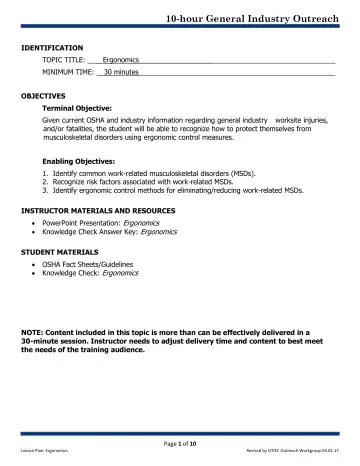
10 slidesIntroduction to Ergonomics: Lesson Plan (OSHA 10-Hour General Industry Outreach)
Instructor lesson plan (objectives, timing, teaching steps) for the OSHA General Industry introduction to ergonomics outreach deck.
U.S. Department of Labor, OSHA (with the OTIEC Outreach Workgroup)Public domain
pdf
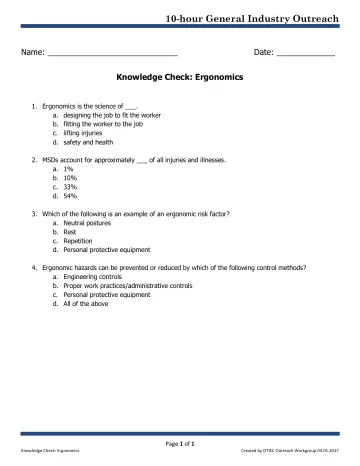
1 slidesIntroduction to Ergonomics: Knowledge Check (OSHA 10-Hour General Industry Outreach)
Student knowledge-check quiz for the OSHA General Industry introduction to ergonomics outreach deck.
U.S. Department of Labor, OSHA (with the OTIEC Outreach Workgroup)Public domain