1 / 2Use ← → to flip
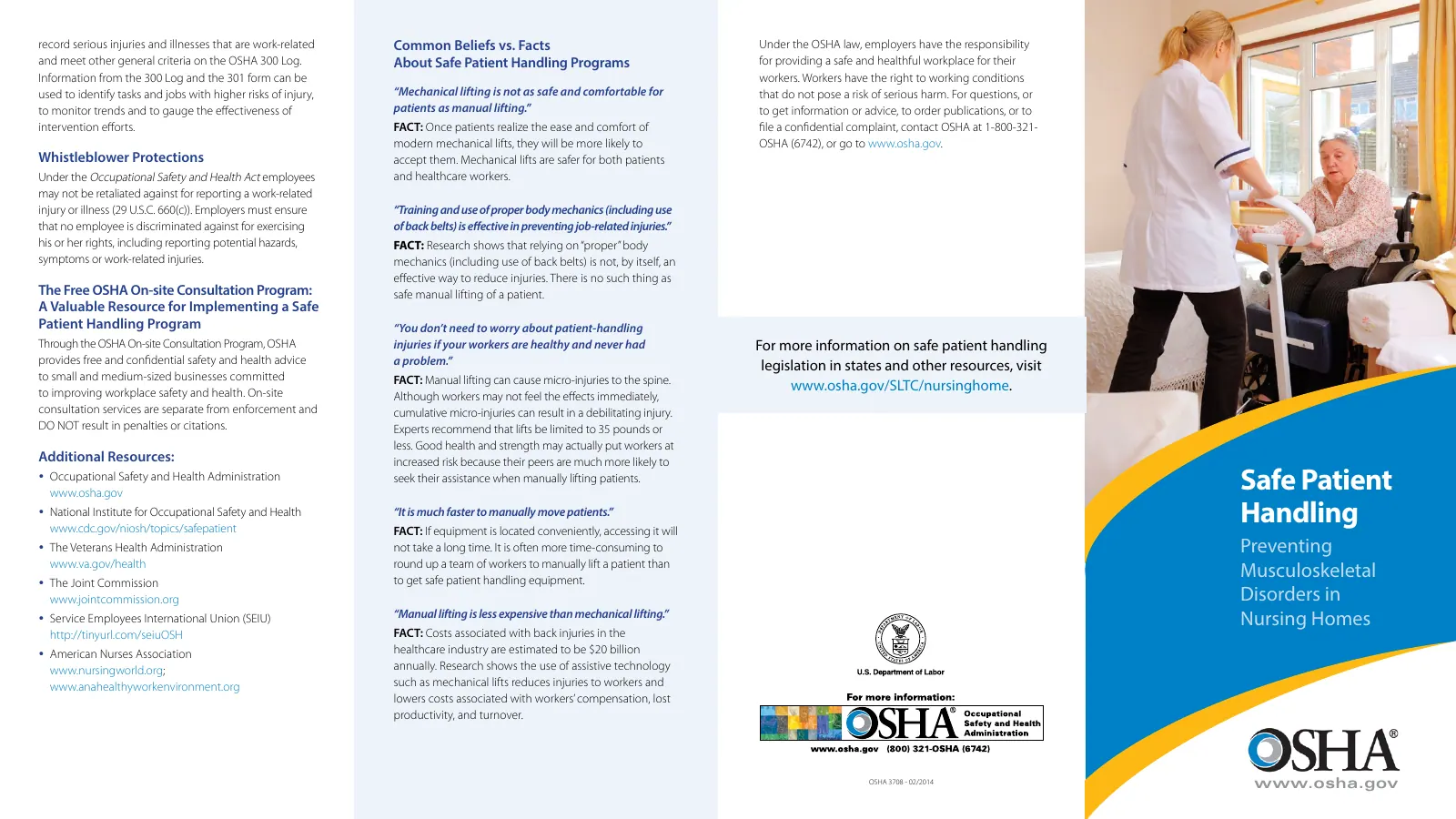
Safe Patient Handling-- Preventing Musculoskeletal Disorders in Nursing Homes (OSHA 3708)
OSHA booklet, for General Industry classes.
Page text
· 2 pages · by U.S. Department of Labor, OSHA
The words on each page as the author wrote them, read from the file by software so they can be searched. Layout, pictures and tables are not shown here: the pages above and the download are the original.
- Page 1
Whistleblower Protections
- record serious injuries and illnesses that are work-related and meet other general criteria on the OSHA 300 Log. Information from the 300 Log and the 301 form can be used to identify tasks and jobs with higher risks of injury, to monitor trends and to gauge the effectiveness of intervention efforts.
- Under the Occupational Safety and Health Act employees may not be retaliated against for reporting a work-related injury or illness (29 U.S.C. 660(c)). Employers must ensure that no employee is discriminated against for exercising his or her rights, including reporting potential hazards, symptoms or work-related injuries.
- The Free OSHA On-site Consultation Program: A Valuable Resource for Implementing a Safe Patient Handling Program
- Through the OSHA On-site Consultation Program, OSHA provides free and confidential safety and health advice to small and medium-sized businesses committed to improving workplace safety and health. On-site consultation services are separate from enforcement and DO NOT result in penalties or citations.
- Additional Resources:
- y y Occupational Safety and Health Administration www.osha.gov y y National Institute for Occupational Safety and Health www.cdc.gov/niosh/topics/safepatient y y The Veterans Health Administration www.va.gov/health y y The Joint Commission www.jointcommission.org y y Service Employees International Union (SEIU) http://tinyurl.com/seiuOSH y y American Nurses Association www.nursingworld.org;www.anahealthyworkenvironment.org
- Common Beliefs vs. Facts
- About Safe Patient Handling Programs
- “Mechanical lifting is not as safe and comfortable for patients as manual lifting.”
- FACT: Once patients realize the ease and comfort of modern mechanical lifts, they will be more likely to accept them. Mechanical lifts are safer for both patients and healthcare workers.
- Under the OSHA law, employers have the responsibility for providing a safe and healthful workplace for their workers. Workers have the right to working conditions that do not pose a risk of serious harm. For questions, or to get information or advice, to order publications, or to file a confidential complaint, contact OSHA at 1-800-321- OSHA (6742), or go to www.osha.gov.
- “Training and use of proper body mechanics (including use of back belts) is effective in preventing job-related injuries.”
- FACT: Research shows that relying on “proper” body mechanics (including use of back belts) is not, by itself, an effective way to reduce injuries. There is no such thing as safe manual lifting of a patient.
- “You don’t need to worry about patient-handling injuries if your workers are healthy and never had a problem.”
- FACT: Manual lifting can cause micro-injuries to the spine. Although workers may not feel the effects immediately, cumulative micro-injuries can result in a debilitating injury. Experts recommend that lifts be limited to 35 pounds or less. Good health and strength may actually put workers at increased risk because their peers are much more likely to seek their assistance when manually lifting patients.
- For more information on safe patient handling legislation in states and other resources, visit www.osha.gov/SLTC/nursinghome.
- Safe Patient Handling
- “It is much faster to manually move patients.”
- FACT: If equipment is located conveniently, accessing it will not take a long time. It is often more time-consuming to round up a team of workers to manually lift a patient than to get safe patient handling equipment.
- Preventing Musculoskeletal Disorders in Nursing Homes
- “Manual lifting is less expensive than mechanical lifting.”
- FACT: Costs associated with back injuries in the healthcare industry are estimated to be $20 billion annually. Research shows the use of assistive technology such as mechanical lifts reduces injuries to workers and lowers costs associated with workers’ compensation, lost productivity, and turnover.
- OSHA 3708 - 02/2014
- www.osha.gov
- Page 2
Disabling Injuries
- Nurses and other healthcare workers face many safety and health hazards in their work environments. In fact, healthcare workers experience some of the highest rates of non-fatal occupational injuries and illnesses of any industry sector.
- Injuries & Illnesses Resulting in Days Away from Work, 2012
- Cases per 10,000 Full-time Workers
- Nursing & Residential
- Care Facilities
- Retail
- Manufacturing
- Safe patient handling programs reduce the risk of injury for both healthcare workers and patients while improving the quality of patient care. Use of lifting equipment is essential to a successful safe patient handling program and has been shown to reduce exposure to manual lifting injuries by up to 95%.
- y y More satisfying work environment and professional status;
- y y Improved nursing recruitment and retention;
- y y Increased patient satisfaction and comfort;
- Professional &
- Business Services
- y y Decreased patient falls and pressure ulcers; and
- Data Source: Bureau of Labor Statistics
- In 2012, injuries and illnesses reported for nursing and residential care workers were significantly higher than those in construction, and 2-3 times higher than in retail or manufacturing. Almost half of the injuries and illnesses reported for nurses and nursing support staff were musculoskeletal disorders (MSDs). Rates of MSDs for nursing assistants (225.8) were almost four times as high as the average for all workers (37.8).
- MSDs affect the muscles, nerves and tendons. Workrelated MSDs (including those of the neck, upper extremities and low back) are a leading cause of lost workday injuries and illnesses for healthcare and social assistance workers, particularly in nursing homes and residential care facilities. Examples of MSDs include muscle strains and low back injuries, rotator cuff injuries (shoulder problems), and tendinitis.
- Research has identified that the risk factors for MSDs include the repeated and forceful movements associated with patient care such as lifting, transferring, and repositioning.
- Program Evaluation: Regular program evaluation within the environment of care is critical to the success of the program. Establish evaluation procedures necessary to assess the effectiveness of the safe patient handling program and to ensure its continuous improvement and long-term success. Credible data sources, including the OSHA Recordkeeping Log 300, and forms 301 and 300A, can be used to track and analyze injuries and trends related to the ongoing implementation of the program.
- Benefits of Safe Patient Handling
- In addition to reducing healthcare worker injuries and related lost work time, safe patient handling programs have other benefits, including:
- Construction
- Work-related MSDs can be prevented. Safe patient handling programs employ the use of mechanical equipment and other elements to reduce the number and severity of work-related MSDs.
- y y Reduced costs associated with injuries.
- Elements of a Successful Safe Patient
- Handling Program
- The elements of a successful safe patient handling program include:
- Commitment from Management at All Levels: Gaining management support, as well as assembling a team for a safe patient handling program, are critical to program success. Management can provide visible support by consistently communicating the importance of safe patient handling; assigning roles for various aspects of a safe patient handling program to appropriate managers, supervisors, and other employees; and providing appropriate resources for implementing and sustaining the program over time.
- A Safe Patient Handling Committee that Involves Frontline Workers: To design and implement a safe patient handling program, as well as to evaluate and sustain the program into the future, the frontline (non-managerial) employees who provide direct care to patients should be well-represented on the safe patient handling committee.
- Hazard Assessment: Address high-risk units, areas, and patient-handling tasks. Hazard evaluation should consider factors such as types of nursing units, the physical environment of patient care areas, and existing equipment and its utilization. It is important to consider characteristics of the patient population such as level of patient mobility and cognition.
- Technology & Prevention Through Design: Implement methods to control hazards such as lifting, transferring, and repositioning patients. Manual lifting should be minimized in all cases and eliminated when feasible. For example, a “zero-lift“ program or policy minimizes direct patient lifting by using specialized lifting equipment and transfer tools.
- Establish safe patient handling policies that are based on patients’ physical and medical conditions and the availability of lifting equipment and lift teams.
- Select appropriate lifting equipment in accord with the hazard assessment, and install and maintain lifting devices according to manufacturer recommendations. The best proactive approach is through proper design of the work environment, including incorporating health hazard controls into the design of facilities during construction and remodeling.
- Education & Training: Provide sufficient education and training so that each worker understands the elements of the safe patient handling program and how to participate. The education and training of healthcare workers should be geared toward the assessment of hazards, selection and use of the appropriate patient lifting equipment and devices, and review of evidencebased practices for safe patient handling. Training should include when and how to report injuries.
- OSHA Emphasizes the Importance of Safe
- Patient Handling Programs
- Reducing the number of musculoskeletal disorders in healthcare workers is a priority for OSHA. The agency revised its Guidelines for Nursing Homes, Ergonomics for the Prevention of Musculoskeletal Disorders and launched an educational outreach and enforcement program to address hazards specific to nursing homes. OSHA promotes a safety culture of prevention of harm for both patients and workers through Injury and Illness Prevention Programs.
- Use the OSHA 300 Log for Recordkeeping
- In addition to a thorough worksite hazard analysis, the OSHA 300 Log can be a useful tool to assess the health and safety needs of facilities and to evaluate the effectiveness of specific interventions and overall safe patient handling programs. The OSHA Recordkeeping Rule (29 CFR 1904) requires healthcare facilities to
More on Ergonomics
pptx
57 slidesIntroduction to Ergonomics (OSHA 10-Hour General Industry Outreach)
OSHA's general industry outreach ergonomics deck (2017): risk factors, MSDs and controls.
U.S. Department of Labor, OSHAPublic domain
pdf
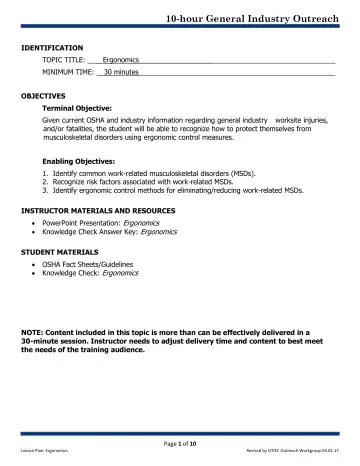
10 slidesIntroduction to Ergonomics: Lesson Plan (OSHA 10-Hour General Industry Outreach)
Instructor lesson plan (objectives, timing, teaching steps) for the OSHA General Industry introduction to ergonomics outreach deck.
U.S. Department of Labor, OSHA (with the OTIEC Outreach Workgroup)Public domain
pdf
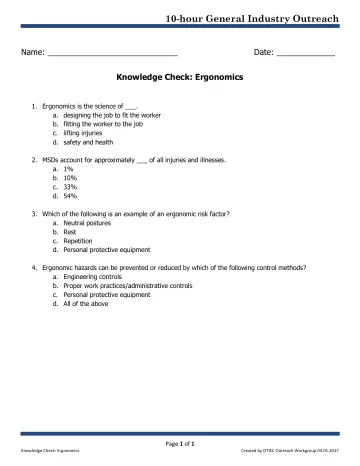
1 slidesIntroduction to Ergonomics: Knowledge Check (OSHA 10-Hour General Industry Outreach)
Student knowledge-check quiz for the OSHA General Industry introduction to ergonomics outreach deck.
U.S. Department of Labor, OSHA (with the OTIEC Outreach Workgroup)Public domain