1 / 40Use ← → to flip
Poultry: Prevention of Musculoskeletal Disorders in Poultry Processing (Updated Guidelines) (OSHA 3213)
OSHA booklet, for General Industry classes.
Page text
· 38 of 40 pages · by U.S. Department of Labor, OSHA
The words on each page as the author wrote them, read from the file by software so they can be searched. Layout, pictures and tables are not shown here, and long pages are shortened: the pages above and the download are the original.
- Page 1
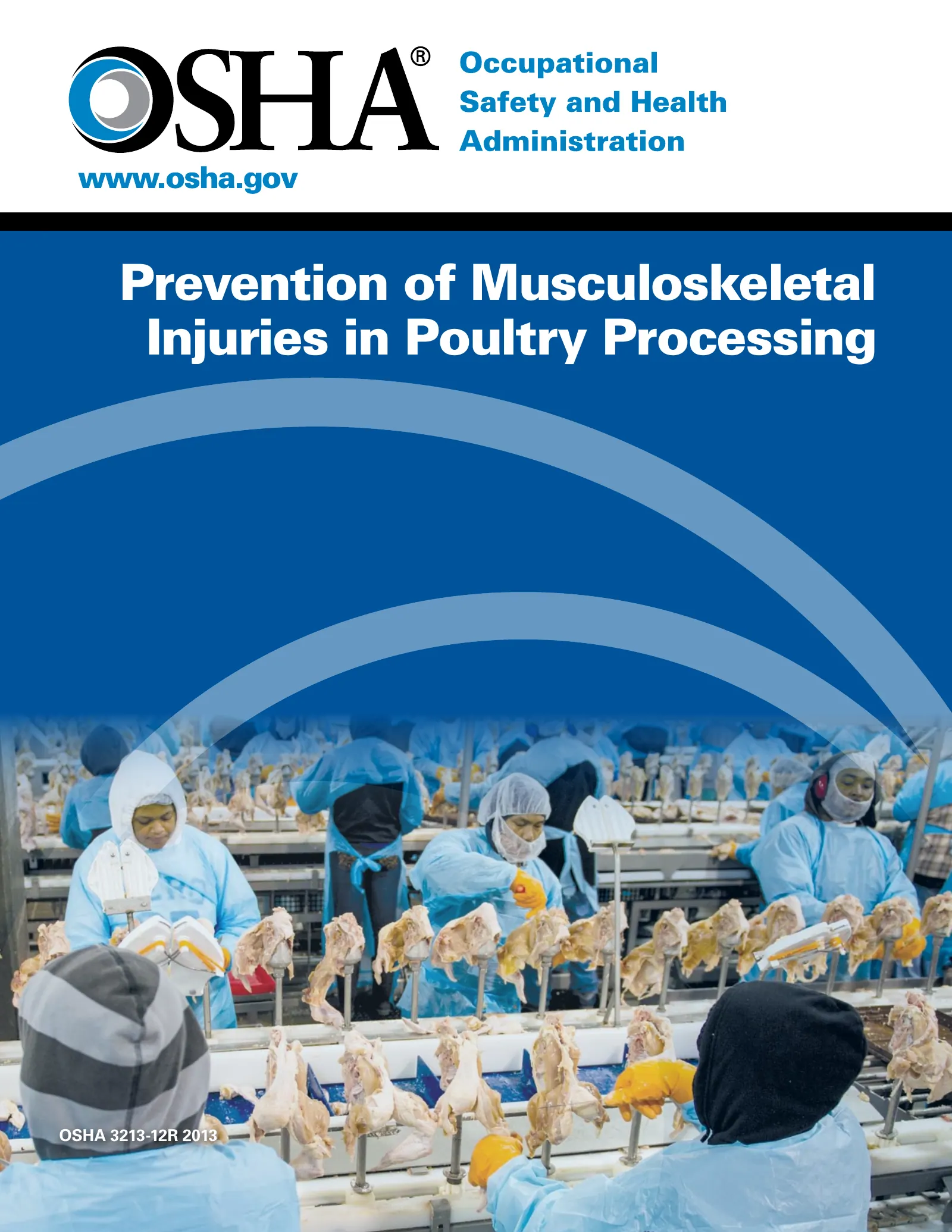
Prevention of Musculoskeletal Injuries in Poultry Processing
- OSHA 3213-12R 2013
- Page 2
Occupational Safety and Health Act of 1970
- “To assure safe and healthful working conditions for working men and women; by authorizing enforcement of the standards developed under the Act; by assisting and encouraging the States in their efforts to assure safe and healthful working conditions; by providing for research, information, education, and training in the field of occupational safety and health.”
- Material contained in this publication is in the public domain and may be reproduced, fully or partially, without permission. Source credit is requested but not required.
- This information will be made available to sensoryimpaired individuals upon request.
- Voice phone: (202) 693-1999;
- teletypewriter (TTY) number: 1-877-889-5627.
- …
- Page 3
Prevention of Musculoskeletal Injuries in Poultry Processing
- Occupational Safety and Health Administration
- U.S. Department of Labor
- OSHA 3213-12R 2013
- Page 5
TABLE OF CONTENTS
- Foreword … 1
- Introduction … 2
- A Process for Protecting Workers … 3
- Provide Management Support … 3
- Involve Workers … 3
- Provide Training … 4
- Identify Problems … 5
- Encourage and Utilize Early Reports of Injuries … 6
- Implement Solutions … 7
- Evaluate Progress … 8
- Engineering Solutions … 9
- Additional Sources of Information … 26
- References … 26
- Workers’ Rights … 28
- OSHA Assistance, Services and Programs … 28
- Establishing an Injury and Illness Prevention Program … 28
- Compliance Assistance Specialists … 28
- Free On-site Safety and Health Consultation Services for Small Business … 28
- Cooperative Programs … 29
- Occupational Safety and Health Training … 29
- OSHA Educational Materials … 29
- NIOSH Health Hazard Evaluation Program … 30
- Getting Help with Health Hazards … 30
- …
- Page 6
- vi
- Page 7
FOREWORD
- Originally published in 2004, these updated guidelines provide recommendations for poultry processing facilities to reduce the number and severity of work-related musculoskeletal disorders (MSDs). In preparing the following recommendations, OSHA reviewed existing practices and programs as well as available scientific information on ergonomic-related risk factors in poultry processing facilities. OSHA’s guidelines are designed specifically for the poultry processing industry; however, other industries may find the recommendations and solutions presented useful.
- The heart of these guidelines is the process for protecting workers and the description of various solutions that have been implemented by poultry processors. …
- …
- Page 8
INTRODUCTION
- In the mid-1980s, the poultry processing industry began to focus on the problem of work-related musculoskeletal disorders (MSDs). MSDs include injury to the nerves, tendons, muscles and supporting structures of the hands, wrists, elbows, shoulders, neck and low back (1, 2). In 1986, members of the poultry processing industry developed a guideline advocating training, identifying ergonomic hazards, and developing solutions to reduce ergonomic risk factors and early medical intervention as a means to reduce the occurrence of MSDs and their associated costs (3).
- In August 1993, OSHA published its Ergonomics Program Management Guidelines for Meatpacking Plants [meatpacking guidelines] (4). …
- …
- Page 9
- conduction testing on employees to evaluate their median nerve function in the hands and wrists. The researchers also conducted a job hazard analyses and collected information from employees by questionnaire. NIOSH found that 42% of employees who worked on the production line and who participated in the study had evidence of carpal tunnel syndrome. Carpal tunnel syndrome was defined by decrements in nerve conduction and hand and wrist symptoms (8).
- Employers should consider an MSD to be workrelated if an event or exposure in the work environment either caused or contributed to the MSD, or significantly aggravated a pre-existing MSD as required by OSHA’s recordkeeping rule. For more information, see OSHA’s recordkeeping web page at www.osha.gov/recordkeeping.
- …
- Page 10
- Form employee groups to help identify problems, analyze tasks and recommend solutions; and
- ■ Assure that no employee is retaliated against for exercising his or her rights under OSHA law, including reporting a potential hazard, symptoms or work-related injury.
- Provide Training
- Training is also an important element of the ergonomics process. Effective training ensures that all employees, including contract and temporary workers, are aware of ergonomics and its benefits, are able to identify ergonomicsrelated concerns in the workplace, are taught how to minimize the risk of injury, and understand the importance of reporting early symptoms of musculoskeletal disorders (14). …
- …
- Page 11
Identify Problems
- An important part of the ergonomic process is a periodic review of the facility, including specific workstation designs and work practices, and the overall production process, from an ergonomics perspective. This process includes reviewing the company’s injury and illness records and worker reports of symptoms and problems to identify existing problem areas. However, a more effective approach, in combination with reviewing injury and illness records, is to be proactive and identify potential ergonomic issues that may have gone unnoticed or have resulted from facility changes, before they result in MSDs. OSHA recommends that poultry facilities establish a two-step process to systematically identify ergonomic-related risk factors and their potential problems. …
- …
- Page 12
- or workstations to determine which risk factors are present. Jobs and tasks that have multiple risk factors have a higher probability of causing MSDs (2).
- Job hazard analyses should be routinely performed on all tasks that are identified as having the potential to cause injury. Analysis should include body posture evaluation, force measurements, tools selection and their maintenance, PPE availability, and dimensions and adjustability of the workstations. An adequate analysis would be expected to identify all risk factors present in each job or workstation studied.
- Another effective method to identify ergonomic risk factors is to observe whether workers are: making modifications to their tools, equipment, or work areas to address potential risk factors; shaking their arms and…
- …
- Page 13
- Systematic monitoring of employees’ health. Monitoring employee health will help to prevent MSDs. Employers should consider instituting a medical surveillance program for musculoskeletal disorders to monitor employee health and determine the effectiveness of exposure prevention and medical management strategies. The following source provides information on medical monitoring and surveillance (www.osha.gov/Publications/ OSHA3123/3123.html; (8)).
- ■ Additional use of medical resources. Healthcare professionals play a number of important roles as ergonomic team members. Systematic follow-up of employee reports of injury provides an opportunity to reinforce good work practices, modify conservative treatment plans, adjust work restrictions, or refer the employee for medical attention…
- …
- Page 14
- risk factors. The following are some examples of administrative solutions used effectively by poultry processors:
- Institute a sharpening and maintenance program that ensures that knives, scissors and other tools used for cutting are sharp. Using dull knives or other cutting tools result in workers having to apply more force than necessary to get the job done.
- ■ Use a rotation schedule to address high-risk tasks (e.g., using vibrating hand tools or deboning activities) or to minimize exposure to cold. Design a job rotation schedule in which workers rotate between jobs that use different muscle groups. Job rotation may alleviate physical fatigue and stress to a particular set of muscles and tendons. …
- …
- Page 15
ENGINEERING SOLUTIONS
- As an MSD prevention process matures, assessments should include:
- Determining whether initial goals set for the ergonomic process have been met;
- ■ Determining the success of the implemented ergonomic solutions;
- ■ Evaluating objective measures, such as whether:
- — The time between hazard identification and implementation of appropriate solutions has been reduced;
- — The number of jobs analyzed and risk factors reduced or eliminated has increased;
- — More workers have been trained on preventing MSDs;
- Reviewing facility first-aid reports, injury trends, workers’ compensation cases, absenteeism rates, job transfer requests, or other similar indicators to determine if ergonomics-related efforts have made an impact; and
- …
- Page 16
TOOLS - Handle and Design
- DESCRIPTION:
- Designs of hand tools such as knives, pliers, and scissors that minimize bending of the wrist either side-to-side or up and down and minimize the finger force and contact stress to fingers and the palm.
- WHEN TO USE:
- For all hand tool applications especially those that are used repeatedly or for long periods of time.
- POINTS TO REMEMBER:
- To maintain neutral wrist postures:
- Handles should be perpendicular to the line of action, extend at least the length of the palm, and have a non-slip surface.
- Angled and pistol grip handles help keep the wrist in a neutral posture while performing slicing-type cuts.
- When used with an angled cutting surface a handle with about a 45 degree bend will minimize wrist bending.
- …
- Page 17
TOOLS - Selection
- DESCRIPTION:
- Selection of powered and manual tools for cutting, deboning, and other operations can reduce finger force and encourage neutral postures.
- WHEN TO USE:
- For nearly all tasks in poultry processing, including evisceration, venting, deboning, filleting, peeling gizzards, and separation of internal organs.
- POINTS TO REMEMBER:
- Hand tools should be selected so that the handle angle allows the wrist to work in a neutral posture.
- Powered hand tools must adhere to the same principles of sizing and orientation recommended for manual tools.
- Spring-loaded handles eliminate thumb force required to open blades for sequential cuts.
- Spring force should be designed to minimize hand fatigue.
- …
- Page 18
TOOLS and MAINTENANCE - Use and Care of Knives, Saws, and Scissors
- DESCRIPTION:
- Procedures for maintaining knives, saws, and scissors in optimal functioning condition.
- WHEN TO USE:
- For working with knives, saws, and scissors.
- POINTS TO REMEMBER:
- Implement knife-sharpening and maintenance program to assure that
- knives, scissors, and other tools used for cutting are sharp.
- The sharper the edge, the lower the force (and possibly repetitions) required to complete the task. Sharpening blades is a highly skilled task that requires specialized training. Options for maintaining a sharp edge include having several knives assigned to a worker, trading out knives quickly and easily, and keeping the blade free of metal fragments or burrs.
- …
- Page 19
TOOLS - Spray Nozzles
- DESCRIPTION:
- Designs that minimize hand force and keep the wrist in a straight posture.
- WHEN TO USE:
- For all sanitation operations using spray nozzles for long periods.
- POINTS TO REMEMBER:
- Avoid single finger activation, especially using the index finger.
- Investigate options for hand actuators that are compatible with the shape, width, and size of the hand.
- Provide swivel handles for hoses such as those used for water which are hand-held.
- Provide pistol grip handles for hand spraying using high-pressure hoses.
- Use the entire finger rather than just the fingertip to activate the trigger, minimizing tendon irritation.
- WORKSTATIONS - Cutouts
- Removal of a section of work surface to allow the employee to get closer to items located at the workstation.
- …
- Page 20
WORKSTATIONS - Baggers and Other Packaging Systems
- DESCRIPTION:
- Mechanisms and fixtures used to minimize manual handling of product by placing whole birds or poultry products into packaging, and packages into shipping containers.
- WHEN TO USE:
- When packaging finished product.
- POINTS TO REMEMBER:
- Auto baggers allow whole birds or parts to be pushed or dropped into bags. These systems may automatically count or weigh parts for inventory needs.
- Semi-automated systems may require manual placement of the bag while products drop or slide into the bag, and may use a stream of air to automatically open bags in preparation for loading.
- Filled bags may be automatically crimped or fastened closed.
- Many semi-automated systems are designed to allow workers to alternate hands.
- …
- Page 21
WORKSTATIONS - Chutes
- DESCRIPTION:
- Tunnel-type mechanism attached to a hole in the workstation surface into which poultry parts or other items can be dropped and transported.
- WHEN TO USE:
- For transport of separated poultry parts or other items. Items may drop directly to a container, conveyor, auger, or into a vacuum system for transport.
- POINTS TO REMEMBER:
- Chute openings should be appropriate to the size of the part handled, so it does not interfere with the processing task, and does not require excessive force to push the parts into the chute.
- Chutes should be placed so they do not interfere with the task being performed but close enough so workers can access them with minimal reaching and bending. Maximum reach should not exceed arm’s length with the torso upright.
- …
- Page 22
WORKSTATIONS - Scales
- DESCRIPTION:
- Embedded scales that incorporate weighing into the production process to eliminate unnecessary handling of poultry, poultry parts, processed meats, and waste.
- WHEN TO USE:
- When operations require that materials be weighed.
- POINTS TO REMEMBER:
- A scale can be recessed into the floor so that carts can be rolled onto it for weighing without pushing carts uphill.
- Locate scales within easy reach, in the work area rather than at another work area behind the employee. Recess the scale to the same height as the countertop so that poultry can be placed on and removed from the scale without lifting.
- For boxed goods, a scale incorporated into the packing station can determine weight during initial loading and eliminate reweighing later. …
- …
- Page 23
- WORKSTATIONS - Jigs, Fixtures, Mandrills, and Other Devices for Positioning Product
- DESCRIPTION:
- Mechanical devices used to position and stabilize poultry parts for processing.
- WHEN TO USE:
- In cutting and deboning operations where proper positioning of the product will minimize excessive use of force or awkward postures.
- POINTS TO REMEMBER:
- Use a clamping device to hold the bird’s breast securely when cutting or deboning, ensuring that the device does not damage the product. Once the bird has been stabilized, the worker is able to use a 2-handed method to pull meat off the bone. The device may be of mechanical or vacuum design.
- Clamps reduce gripping with the non-cutting hand. Height adjustability within the clamp allows the worker to work without awkward arm postures. …
- …
- Page 24
WORKSTATIONS - Seats, Stools, and Backrests
- DESCRIPTION:
- Seating and support devices for employees at fixed workstations to reduce prolonged periods of standing. These may vary depending on the nature of the workstation. A chair or stool may be appropriate for off-line processes where there is limited movement. Sit/stand stools or lean bars may be more appropriate for line positions where there is need to reach, grab, and throw product.
- WHEN TO USE:
- At all appropriate stationary sitting and standing positions.
- POINTS TO REMEMBER:
- Selecting the most appropriate support device promotes neutral body postures and reduces fatigue during seated, sit/stand, and standing tasks.
- The use of these devices should not result in extended forward or elevated reaching, bending, or trunk…
- …
- Page 25
WORKSTATIONS - Seats, Stools, and Backrests
- Recommendations for Sit-Stand Stools:
- A high stool or angled seat provides a surface on which the worker can lean, shift weight, and change trunk angle.
- With an angled seat, only leaning can occur. With a flat seat, the worker may plant one foot on the floor and rest the other thigh on the seat for support.
- The base should be fixed so that it does not move unintentionally.
- Recommendations for Backrests or Leaning Devices:
- Another type of leaning device is an independent back support without a seat that is stationary, stable, and height-adjustable. It should provide adequate support for both the upper and lower back. Provide clearance for required cleaning and sanitation.
- Position the device to prevent forward trunk bending.
- …
- Page 26
WORKSTATIONS – Work Height and Angle
- DESCRIPTION:
- Work surfaces or work stands that adjust to fit the worker and the task performed.
- WHEN TO USE:
- At all workstations.
- POINTS TO REMEMBER:
- Proper workstation height minimizes excessive forward trunk-bending and lifting of the arms when cleaning, preparing, and packing whole birds and poultry parts.
- Proper hand height improves comfort by reducing wrist deviation, forward reaches and elbow bending.
- Tilting the cutting block can reduce bending of the wrist.
- Table height recommendations:
- Employees should have height-adjustable work tables or height-adjustable work stands so they can properly position themselves in relation to the work. Work surface height should attempt to minimize neck and torso bending and minimize, if possible, wrist…
- …
- Page 27
MANUAL MATERIALS HANDLING - Hoppers and Augers
- DESCRIPTION:
- Hoppers are containers used to accumulate, hold and dispense contents into a machine, a new container, or onto a workstation through a restricted gate or using a screw-type auger mechanism. These facilitate the use of bulk loading and automated discrete transfer instead of manually loading, carrying, and emptying many individual boxes or bags. Augers use a screw-type device placed in a chute or trough to move and distribute items. An auger placed in a bulk storage container can remove a defined amount of product (depending on the size of screw) and move it to a new area where it can be deposited. …
- …
- Page 28
MANUAL MATERIALS HANDLING – Carts, Hand Trucks, Pallet Jacks and Lift Tables
- DESCRIPTION:
- Wheeled devices designed to transport materials.
- WHEN TO USE:
- For transporting containers of whole birds, bird parts, processed meats, waste products, or supplies between work areas.
- POINTS TO REMEMBER:
- A small lip around the edges of shelves on carts is helpful to prevent
- items from slipping off.
- Ensure that the top stack height does not obstruct vision.
- Optimal shelf height range should be between knuckle (with arms at side) and shoulder height.
- Pushing is preferred to pulling.
- Balance loads and keep loads within manufacturer’s weight restrictions. Handles that are vertical allow all workers to place their hands at optimal positions on the handle so they can push with hands at about chest…
- …
- Page 29
MANUAL MATERIALS HANDLING - Racks and Shelves
- DESCRIPTION:
- Rack and shelf design to optimize manual access.
- WHEN TO USE:
- Shelf systems can be configured to minimize excessive lifting, carrying, and awkward postures associated with storage of any item used or produced at a workstation.
- POINTS TO REMEMBER:
- For items that will be manually lifted, shelf height should be from approximately knuckle (with arms at side) to shoulder height. Store heavy and frequently used items in this range. Storage of lightweight and infrequently used items above and below this range is acceptable. Labels on shelves may help to quickly and easily identify materials to be lifted or carried.
- Bulk packages of supplies that are transported by mechanical devices can be stacked and stored as needed. …
- …
- Page 30
MANUAL MATERIALS HANDLING - Vacuum Systems
- DESCRIPTION:
- Vacuum systems for lifting and transport of materials.
- WHEN TO USE:
- Vacuum systems can be used for lifting and transporting poultry parts, boxes of product, spice bags, ice, and other materials. Applications of vacuum systems include:
- Vacuum systems can be attached to a lifting device. The vacuum is used to secure the load to the lifting device and the device is used to provide an assist for lifting and placement of items onto racks or pallets for storage or transport.
- Vacuum systems can be connected to chutes or transport tubes which use an air stream to transport lighter individual poultry parts.
- POINTS TO REMEMBER:
- Vacuum entry points can be placed at individual work areas to gather product for transport to chillers or…
- …
- Page 31
MANUAL MATERIALS HANDLING - Roller Tables
- DESCRIPTION:
- Tabletop or work surface embedded with rollers or ball bearings which allow product to be turned or repositioned. The rollers or ball bearings reduce friction and force when sliding items.
- WHEN TO USE:
- Recommended for transporting and repositioning boxes, bins, and other containers over relatively short distances.
- POINTS TO REMEMBER:
- Rollers are preferred for transport in a linear direction whereas ball bearings are preferred when change of direction is required.
- Pushing or sliding containers eliminates lifting and carrying that can be strenuous to the hands, arms, and back.
- Appropriate for product in containers, but not loose parts due to sanitation issues.
- Page 32
ADDITIONAL SOURCES OF INFORMATION
- The following training materials for the Poultry Processing Industry were developed under Susan Harwood training grants: “Safe and Secure: Safety Training Series” by the Telamon Corporation (2010), “Safety in Meatpacking, Poultry Processing and Food Processing” by the United Food and
- Commercial Workers International Union (2010), and “Sanitation Worker Safety and Health in the Poultry Industry” by the Georgia Tech Applied Research Corporation (2007). All of these materials can be found on the OSHA web site at: www.osha.gov/dte/grant_materials.
- REFERENCES
- (1) National Research Council and Institute of Medicine. Musculoskeletal Disorders and the Workplace — Low Back and Upper Extremities. National Academy of Sciences. …
- …
- Page 33
- (13) Jones, Ronald J. Corporate Ergonomics Program of a Large Poultry Processor. AIHA Journal (58). February 1997.
- (14) GAO. Workplace Health and Safety: Safety in the meat and poultry industry, while improving, could be further strengthened. U.S. Government Accountability Office, GAO-05-96. 2005.
- (15) Elements of Ergonomics Programs: A Primer
- Based on Evaluations of Musculoskeletal Disorders.
- Cincinnati, OH: U.S. Department of Health and
- Human Services, Public Health Service, Centers for Disease Control and Prevention, National Institute for Occupational Safety and Health, DHHS. (NIOSH Publication No. 97-117). 1997.
- (16) Silverstein B and Evanoff B. Chapter 16 – Musculoskeletal Disorders. In Levy, Barry S.; Wegman, David H.; Baron, Sherry L. …
- …
- Page 34
WORKERS’ RIGHTS
- Under OSHA law, workers are entitled to working conditions that do not pose a risk of serious harm. To help assure a safe and healthful workplace, the law provides workers with the right to:
- File a confidential complaint with OSHA to have their workplace inspected.
- ■ Receive information and training about hazards, methods to prevent harm, and the OSHA standards that apply to their workplace. The training must be done in a language and vocabulary workers can understand.
- ■ Receive copies of records of work-related injuries and illnesses that occur in their workplace.
- ■ Receive copies of the results from tests and monitoring done to find and measure hazards in their workplace.
- Receive copies of their workplace medical records.
- …
- Page 35
health management programs, OSHA’s On-site
- Consultation Program conducts over 29,000 visits to small business worksites covering over 1.5 million workers across the nation.
- On-site consultation services are separate from enforcement and do not result in penalties or citations. Consultants from state agencies or universities work with employers to identify workplace hazards, provide advice on compliance with OSHA standards, and assist in establishing safety and health management programs.
- For more information, to find the local On-site
- Consultation office in your state, or to request a brochure on Consultation Services, visit www.osha. gov/consultation, or call 1-800-321-OSHA [6742].
- Under the consultation program, certain exemplary employers may request participation in OSHA’s…
- …
- Page 36
NIOSH HEALTH HAZARD EVALUATION PROGRAM
- Online Safety and Health Topics pages; Posters;
- ■ Small, laminated QuickCards™ that provide brief safety and health information; and
- ■ QuickTakes, OSHA’s free, twice-monthly online newsletter with the latest news about OSHA initiatives and products to assist employers and workers in finding and preventing workplace hazards. To sign up for QuickTakes visit
- OSHA’s web site at www.osha.gov and click on QuickTakes at the top of the page.
- To view materials available online or for a listing of free publications, visit OSHA’s web site at www.osha.gov. You can also call 1-800-321-OSHA [6742] to order publications.
- OSHA’s web site also has a variety of eTools. These include utilities such as expert advisors, electronic compliance assistance, videos…
- …
- Page 37
OSHA REGIONAL OFFICES
- Region I
- Boston Regional Office
- (CT*, ME, MA, NH, RI, VT*)
- JFK Federal Building, Room E340 Boston, MA 02203
- (617) 565-9860 (617) 565-9827 Fax
- Region II
- New York Regional Office
- (NJ*, NY*, PR*, VI*)
- 201 Varick Street, Room 670
- New York, NY 10014
- (212) 337-2378 (212) 337-2371 Fax
- Region III
- Philadelphia Regional Office
- (DE, DC, MD*, PA, VA*, WV)
- The Curtis Center
- 170 S. Independence Mall West
- Suite 740 West
- Philadelphia, PA 19106-3309
- (215) 861-4900 (215) 861-4904 Fax
- Region IV
- Atlanta Regional Office
- (AL, FL, GA, KY*, MS, NC*, SC*, TN*)
- 61 Forsyth Street, SW, Room 6T50
- Atlanta, GA 30303
- (678) 237-0400 (678) 237-0447 Fax
- Region V
- Chicago Regional Office
- (IL*, IN*, MI*, MN*, OH, WI)
- 230 South Dearborn Street
- Room 3244
- Chicago, IL 60604
- …
- Page 38
HOW TO CONTACT OSHA
- For questions or to get information or advice, to report an emergency, report a fatality or catastrophe, order publications, sign up for OSHA’s e-newsletter QuickTakes , or to file a confidential complaint, contact your nearest
- OSHA office, visit www.osha.gov or call OSHA at 1-800-321-OSHA (6742), TTY 1-877-889-5627.
- For assistance, contact us. We are OSHA. We can help.
- Page 40
U.S. Department of Labor
- For more information:
- Occupational
- Safety and Health Administration www.osha.gov (800) 321-OSHA (6742)
More on Ergonomics

pptx
57 slidesIntroduction to Ergonomics (OSHA 10-Hour General Industry Outreach)
OSHA's general industry outreach ergonomics deck (2017): risk factors, MSDs and controls.
U.S. Department of Labor, OSHAPublic domain
pdf
10 slidesIntroduction to Ergonomics: Lesson Plan (OSHA 10-Hour General Industry Outreach)
Instructor lesson plan (objectives, timing, teaching steps) for the OSHA General Industry introduction to ergonomics outreach deck.
U.S. Department of Labor, OSHA (with the OTIEC Outreach Workgroup)Public domain
pdf
1 slidesIntroduction to Ergonomics: Knowledge Check (OSHA 10-Hour General Industry Outreach)
Student knowledge-check quiz for the OSHA General Industry introduction to ergonomics outreach deck.
U.S. Department of Labor, OSHA (with the OTIEC Outreach Workgroup)Public domain