1 / 60Use ← → to flip
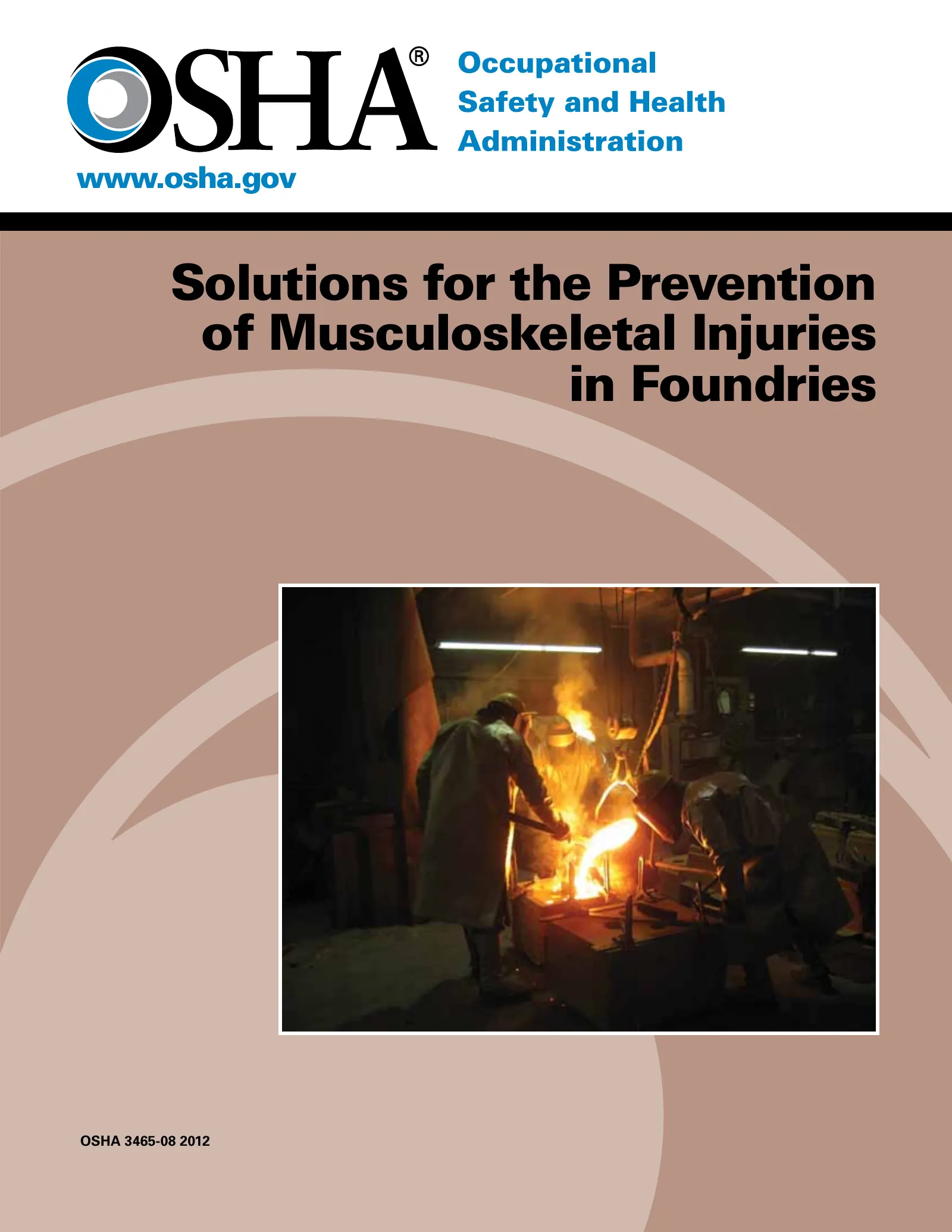
Ergonomics: Solutions for the Prevention of Musculoskeletal Injuries in Foundries (OSHA 3465)
OSHA booklet, for General Industry classes.
Page text
· 60 pages · by U.S. Department of Labor, OSHA
The words on each page as the author wrote them, read from the file by software so they can be searched. Layout, pictures and tables are not shown here, and long pages are shortened: the pages above and the download are the original.
- Page 1
Solutions for the Prevention of Musculoskeletal Injuries in Foundries
- OSHA 3465-08 2012
- Page 2
Occupational Safety and Health Act of 1970
- “To assure safe and healthful working conditions for working men and women; by authorizing enforcement of the standards developed under the Act; by assisting and encouraging the States in their efforts to assure safe and healthful working conditions; by providing for research, information, education, and training in the field of occupational safety and health.”
- Material contained in this publication is in the public domain and may be reproduced, fully or…
- …
- Page 3
Solutions for the Prevention of Musculoskeletal Injuries in Foundries
- Occupational Safety and Health Administration
- U.S. Department of Labor
- OSHA 3465-08
- 2012
- OSHA would like to thank the following foundries for their hospitality, time, and effort during OSHA’s site visits to the plants: Neenah Foundry, ThyssenKrupp Waupaca Foundry, Brillion Iron Works, Roloff Manufacturing, Manitowoc
- Grey Iron Foundry, and Wisconsin Aluminum Foundry in Wisconsin, as well as the Clow Valve Foundry in Iowa. …
- …
- Page 4
Contents
- Executive Summary . . . 3
- Introduction . . . 5
- A Process for Protecting Workers . . . 6
- Providing Management Support . . . 6
- Involving Workers . . . 6
- Providing Training . . . 7
- Identifying Problems . . . 7 encouraging and utilizing Reports of Injuries . . . 8
- Implementing Solutions . . . 9
- Evaluating Progress . . . 9
- Solutions . . . 10
- Facility-Wide Solutions . . . 11
- Melting Solutions . . . 25
- Mold Preparation Solutions . . . 26
- Casting Solutions . . . 33
- …
- Page 5
M any proactive initiatives undertaken by the
- Executive Summary
- foundry activities that may benefit from implementing ergonomic solutions.
- foundry industry, including establishing ergonomic processes, incorporating ergonomic principles into new projects, and conducting facility walkthroughs to identify injury risks have resulted in a reduction in worker injuries and illnesses (1). …
- …
- Page 6
- This guidance is advisory in nature and informational in content. It is not a standard or regulation, and it neither creates new legal obligations nor alters existing obligations created by OSHA standards or the Occupational Safety and Health Act of 1970 (OSH Act.) Pursuant to the OSH Act, employers must comply with safety and health standards and regulations issued and enforced either by OSHA or by an OSHA-approved state plan. …
- …
- Page 7
A foundry is a site where castings are made
- Introduction
- from molten metal, according to an end user’s specifications. Foundry work often includes the following processes: creating casting patterns, making and assembling molds, melting and refining the metal, pouring the metal into molds, and cleaning the finished part (i.e., removing adhering sand and redundant metal from the casting) (5).
- Numerous potential hazards are present in a foundry work environment. …
- …
- Page 8
F or many foundry operations, the number
- A Process for Protecting
- Workers
- and severity of MSDs resulting from physical overexertion, as well as their associated costs, can be substantially reduced by applying ergonomic principles (9). OSHA recommends that employers develop a process to systematically address ergonomic issues in their work environments and incorporate it into their existing safety and health programs. …
- …
- Page 9
- Workers can identify and provide important information about hazards in their workplaces. Their opinions and suggestions for change also are valuable, particularly in such a difficult and complex work environment. As such, employees should be included in the early stages of planning an ergonomic process. …
- …
- Page 10
- Observations of workplace conditions and work processes, ergonomic job analyses, workplace surveys, and worker interviews are common proactive methods for identifying ergonomicsrelated injury risks. Risk factors that may lead to the development of MSDs include:
- Exerting excessive force (4) – Using high levels of physical effort to perform a task, such as manually pouring molds or pushing a loaded rack, or to maintain control of equipment or tools, such as breaking risers from castings.
- …
- Page 11
Implementing Solutions
- “The new automated grinders have eliminated the vibration and stress on my wrists and forearms that used to be a problem when we did it the old way on stand grinders. I now go home and my arms don’t hurt and I am also cleaner than before.”
- Dale Faris, Barinder Grinding Operator, Brillion Iron Works, Inc.
- There are several types of ergonomic solutions that are not only feasible, but have already been implemented within foundry operations. …
- …
- Page 12
M any foundries have successfully implemented
- Solutions
- ergonomic solutions in their facilities as a way to address their workers’ MSD injury risks. These interventions have included purchasing new equipment or modifying existing equipment, making changes in work practices, and purchasing new tools or other devices to assist in the production process. …
- …
- Page 13
Facility-Wide Solutions
- Hoists/Balancers to Transfer Heavy Loads
- Devices (powered or non-powered) used to lift and reposition heavy objects
- Advantages:
- Replace manual handling of heavy objects
- Reduce the manual force needed to lift and position heavy objects or tools throughout the work area
- Reduce fatigue from frequent lifting
- Notes:
- Workers must be trained on proper hoist/ balancer use
- Safer hoist/balancer use may initially slow down transfer time
- …
- Page 14
Facility-Wide Solutions
- Powered Trolleys or Roller Conveyors
- Systems that use mechanical means to transfer heavy or hot items from one location to another
- Advantages:
- Minimize forceful pushing, pulling, and carrying
- Move workers farther away from high heat areas or dangerous pinch points
- Notes:
- Gravity-fed conveyors may also assist with transfers but will require more handling and effort by workers
- May require a rearrangement of surrounding work areas
- …
- Page 15
Facility-Wide Solutions
- Lift Tables
- Devices used to raise or lower the height of materials for easier handling
- Advantages:
- Vertically adjust materials to minimize bending and keep the load close to the body
- Help keep neutral body posture
- May reduce task cycle time
- May increase productivity
- Notes:
- A wide variety of lift tables with different features are available:
- Tables on springs or inflatable bladders that automatically adjust height; good when the weight of items is consistent
- …
- Page 16
Facility-Wide Solutions
- Tilters
- Mechanical devices that lift and tilt to adjust materials for easier handling
- Advantages:
- Move the load closer to the worker, which reduces extended reaches
- Reduce the forward bending required to handle castings
- May increase productivity
- Notes:
- Tilting features minimize access restrictions caused by bin sides
- Workers will require training on using the powered device to lift/tilt heavy containers (e.g., with scrap and ingots)
- Reduce bending and reaching
- Page 17
Facility-Wide Solutions
- Modifications of Work Heights to Raise Workers to More Comfortable Heights
- Continuously adjustable elevation of workers to more comfortable heights
- Advantage:
- Reduce the amount of above-shoulder reaching required to do work
- Notes:
- Any height adjustments should consider both the facility’s workforce and the products being manufactured
- Precautions should be taken to make certain that trip hazards are not created
- Reduce reaching
- Page 18
Facility-Wide Solutions
- Permanently Raised Standing Work Areas
- Modification of the work surface to raise the worker
- Advantages:
- Allow workers to work at their preferred height
- Allow working in a neutral body posture
- Eliminate or reduce extended reaching in front of the body
- Provide stability
- May be made in-house using inexpensive materials
- Notes:
- The platform should not present a trip or fall hazard
- Should be implemented in locations where shorter workers must work with raised arms
- …
- Page 19
Facility-Wide Solutions
- Platforms or Stack of Pallets to Increase the Height at Which Items are Handled
- A permanently raised area or stacks of pallets that serve as a low-cost replacement for lift tables
- Advantages:
- Allow workers to work in a more upright position
- Reduce the amount of bending by workers
- Reduce forward reach distance
- May shorten task time
- May increase productivity
- Are less expensive than lift tables
- Notes:
- This solution works best when work height does not change
- …
- Page 20
Facility-Wide Solutions
- Height-Appropriate Work Surfaces
- Work tables and benches that can be easily raised or lowered to accommodate workers of different heights
- Advantage:
- Reduce awkward working postures of the arms and trunk
- Notes:
- For proper height adjustment, workers should focus on the height of the work being done, not the height of the work surface
- If a workstation is shared, height adjustment should be possible without the use of special tools or devices
- …
- Page 21
Facility-Wide Solutions
- Fixtures that Rotate Parts during Production
- Devices that allow parts to be easily turned in multiple directions
- Advantages:
- Are adjustable for varying work processes on the same part or for differing work preferences
- Introduce more flexibility for performing tasks
- Reduce extended reaching and awkward postures
- Notes:
- This solution may be limited to smaller or lighter-weight items
- The loading and unloading of parts onto the fixture may impact work cycle time
- …
- Page 22
Facility-Wide Solutions
- Powered Dollies
- Worker-controlled, motorized devices to move loads
- Advantages:
- Require less manual effort to push/pull loads
- Shorten task time
- May increase productivity
- Notes:
- Many types of dollies are commercially available
- Consider dolly features that allow it to be used for the:
- Heaviest loads
- Frequently moved loads
- Powered dollies may be especially useful when loads must be moved up or down ramps or when loads are moved long distances
- Reduce physical effort
- Page 23
Facility-Wide Solutions
- Systems to signal the location of materials that need to be moved using powered equipment
- Before
- After
- A signaling method, which uses lights installed at the end of each workstation. These lights turn on to alert forklift drivers that racks/carts need to be moved
- Advantages:
- Reduce the amount of manual pushing and pulling
- Reduce the amount of forklift traffic
- Notes:
- Workers should receive training to learn how to use the alert system most effectively
- …
- Page 24
Facility-Wide Solutions
- Sit-Stand Stools
- Devices that workers can lean against, which are taller than chairs
- Advantages:
- Reduce fatigue
- Allow workers at standing workstations to easily change their work postures (e.g., from standing to leaning on stool)
- Workers can get closer to the work since space for the knees is not required
- Promote more comfortable body posture and reduce extended reaches
- Improve blood circulation
- Are relatively low cost
- Reduce fatigue and extended reaches
- Notes:
- …
- Page 25
Facility-Wide Solutions
- Floor Mats in Areas Where Workers
- Stand for Long Periods of Time
- Cushioned material that softens hard standing surfaces
- Advantages:
- Reduce worker fatigue
- Improve overall worker comfort
- Notes:
- Provide beveled edge mats to eliminate a trip or fall hazard
- Secure the mats in place
- Regularly clean around and under floor mats
- Replace worn out mats
- Care must be taken where sparks or hot metal may fall on cushioning material
- …
- Page 26
Facility-Wide Solutions
- Grabbers to Handle Full Barrels
- Mechanical devices, usually attached to fork trucks, that can move and manipulate full barrels
- Advantages:
- Reduce the physical demands required to perform tasks
- Minimize the chance of dropping or spilling
- Note:
- Workers need to be trained on proper use of the grabbers
- Reduce physical effort
- Handles or Hand Grip Materials on Tools that are Difficult to Hold
- Before
- After
- Description:
- …
- Page 27
MELTING Solutions
- Mechanical Devices to Dump Raw Materials into Top-Loading Furnace
- Handling system to assist with top-loading furnaces
- Advantages:
- Reduce the manual handling of materials and the physical demands
- Eliminate manual lifting and tossing of materials
- Reduce back and shoulder injuries
- Reduce exposure to heat
- Minimize the potential for hand contusions, fractures, and burns
- May increase productivity
- Note:
- Equipment costs may be recouped in one year or less
- Mechanical Devices to Load
- …
- Page 28
MOLD PREPARATION Solutions
- “Lazy Susan” Type Turntable Systems for Inspecting and Finishing Cores
- A device that allows cores to be easily inspected and finished during the work process
- Advantages:
- Reduce the amount of force to repeatedly move the cores
- Reduce physical demands on worker’s hands/ wrist and shoulders
- Can reduce the number of times a core is lifted for finishing and inspection
- Can place the part closer to the worker
- …
- Page 29
MOLD PREPARATION Solutions
- Shorter and Wider Product Storage Racks
- Shorter and wider racks to improve access to the molds
- Advantages:
- Reduce overhead reaching
- Reduce extended forward reaching
- Notes:
- Redesigned racks should hold the same amount of molds as those racks being replaced
- Redesigned racks may need more storage space
- Introduce an administrative control rack loading policy to minimize the use of long reach distances to place products on the rack shelves
- Rack Shelves with Roller Wheels
- …
- Page 30
MOLD PREPARATION Solutions
- Automatic Molding Machine
- Machine to join mold halves together
- Advantages:
- Reduces awkward postures and pinching hazards associated with moving, flipping and joining mold halves together
- Substantially reduces the amount of physical effort needed to lift and carry molds
- May improve productivity and quality
- Notes:
- This system may require reconfiguration of the work area
- Automation requires machine guarding and development of hazardous energy control procedures
- …
- Page 31
MOLD PREPARATION Solutions
- Grab Bar on Hook Used to Remove
- Mold from Core
- Grab bar added to the handling hook, which provides better mechanical support to disengage mold from the core when using an overhead hoist
- Advantages:
- Allows workers to use a more secured grip while removing mold from core
- Provides greater control of the hoisted material
- May increase productivity
- Notes:
- Grab bar should be oriented so the hand/wrist is in a neutral position
- …
- Page 32
MOLD PREPARATION Solutions
- Motorized Hand Carts for Racks
- Worker-controlled, powered devices that mechanically maneuver heavy, wheeled carts or racks
- Advantages:
- Reduce the manual force needed to push/pull wheeled carts
- Reduce back and shoulder injuries
- Reduce travel time to perform task
- May improve productivity
- Notes:
- Many types of powered hand carts are commercially available
- Priority should be given to frequently moved racks or racks moved over long distances
- …
- Page 33
MOLD PREPARATION Solutions
- Handles Added to Mold Weights
- Hand grips on weights used on molds as they cool. The old weights were simply metal plates, which were difficult to lift and place on molds.
- Advantages:
- Reduce the amount of bending needed to reach weights
- Make moving weights easier, because the handle allows workers to use a comfortable power grip
- Notes:
- Handles for the weights can be made in-house
- Ensure that handle openings are wide enough to fit gloved hands
- …
- Page 34
MOLD PREPARATION Solutions
- Pistol Grip Air Guns to Clean the Mold Patterns
- Right-angle shaped tools with a trigger to activate air flow in a horizontal direction
- Advantage:
- Reduce the awkward positioning of hand/wrist when performing task
- Notes:
- The shape or orientation of the mold being cleaned may determine the appropriate air gun
- Using an overhead balancer to hang the air gun can further reduce the physical effort
- Reduce awkward hand/wrist postures
- …
- Page 35
CASTING Solutions
- Ceramic Ladles
- Ceramic ladles, which are lighter than iron ladles
- Advantages:
- Lighter-weight ceramic ladles are easier to lift
- Reduce physical exertion of the back and arms
- Notes:
- The cost of ceramic ladles is comparable to iron ladles
- The cost of ceramic ladles may be recouped in one day
- Reduce physical effort
- Balancer Systems to Bear the Weight of the Pot/Ladle
- Before
- After
- Description:
- Overhead devices to support the weight of the pouring pot/ladle
- Advantages:
- …
- Page 36
CASTING Solutions
- Powered Devices to Raise and Lower Ladles
- Mechanical equipment to replace using hand wheels to manually reposition ladles
- Advantages:
- Reduce repetitive movements of the arms and shoulders
- Reduce the physical demands of ladle handling
- Note:
- Controls should be properly located to minimize awkward shoulder positions
- Reduce physical effort and repetitive movements
- Slip-Resistant Ladle-Pouring Handles
- Description:
- …
- Page 37
CASTING Solutions
- Spout Extensions Used to Fill Ladles
- An extension to the spout on brass furnaces
- Advantages:
- Reduce forward reaching needed to move worker away from heat
- Reduce awkward shoulder postures
- Reduce stress on shoulders
- Note:
- Ensure that the extension does not produce an impact hazard
- Reduce forward reaching distance and awkward postures
- Rounded Handles on Metal Pouring Ladles
- Description:
- Ball-shaped handle securely attached to the current lever
- Advantages:
- …
- Page 38
CASTING Solutions
- Elevated Platforms along Pour Lines
- Stable platforms to elevate workers while pouring
- Advantages:
- Reduce the amount of vertical reaching required to pour molds
- May lower the amount of molten metal spillage
- Notes:
- Precautions should be taken to make certain that trip hazards are not created
- If platforms are higher than 4 ft. from the floor, rails should be installed
- Reduce over-shoulder reaching
- Elevated Locations to Rake Slag
- Description:
- …
- Page 39
Shakeout and Core Knockout Solutions
- Impactors for Shakeout Work
- Mechanical impactors supported by balancers that can remove sand, gating, and metal from castings
- Advantages:
- Reduce manual force needed for spruing and eliminate sledge hammer use
- A balancer supports the weight and makes it more maneuverable
- May increase productivity
- Note:
- Workers will require training on using impactors/wedges
- Reduce physical exertion and fatigue
- Page 40
Shakeout and Core Knockout Solutions
- Hydraulic, Pressure-Powered Wedges to Remove Risers
- Mechanical impact tools supported on tool balancers that replace sledgehammers
- Advantages:
- Reduce awkward shoulder and trunk postures
- Eliminate the forces needed to grasp, swing, and hold sledgehammer
- May reduce task cycle time
- Notes:
- Different wedges may be needed for different castings
- Wedges need to be supported on the balancer in the frequently used position
- Reduce physical exertion and awkward postures
- Page 41
Shakeout and Core Knockout Solutions
- Mechanical Devices to Open Dies
- Powered equipment to open dies, which replaces manual opening with pry bars
- Advantages:
- Eliminate manually prying apart dies
- Reduce body fatigue
- Reduce the amount of awkward postures
- Reduce the risk of burns
- May increase productivity
- Note:
- Cost to implement system may be recouped within a few months
- Reduce physical exertion and awkward postures
- Page 42
Shakeout and Core Knockout Solutions
- Mechanical Devices to Assist in Core Removal
- Powered devices that support core weights during lifting and transporting between the rack and the shakeout pan
- Advantages:
- Reduce the manual handling of cores
- Reduce physical demands on the back and shoulders by eliminating lifting and carrying
- Note:
- Workers will need training on proper use of the equipment
- Reduce manual handling and physical exertion
- Page 43
Shakeout and Core Knockout Solutions
- Diverters to Channel the Direction of Castings
- A sturdy add-on to shaker tables to guide casting movement towards the worker
- Advantage:
- Reduce the extended reaching and torso bending required to access and handle castings
- Notes:
- These guides can be installed at little cost
- Diverter may need to be adjustable for castings that differ greatly in size or shape
- Reduce reaching
- Page 44
Shakeout and Core Knockout Solutions
- Extension Slide at the Output of Shaker Table to Automatically Drop Parts into Bins
- A modification to existing equipment, which uses gravity to automatically transfer parts
- Advantages:
- Eliminates use of repeated hook and pull
- Reduces the handling of castings
- Notes:
- Workers may need to monitor bins to prevent overflow of parts
- Defective parts may still need to be handled manually
- Reduces physical exertion
- Page 45
Shakeout and Core Knockout Solutions
- Powered Conveyors to Transfer and Dump Molds to Shakeout Pans
- A motorized method to move molds to shakeout pans
- Advantages:
- Eliminate need to manually push molds along the production line
- Reduce the physical demand on the back and shoulders to manually lift molds from conveyor and break them
- Reduce work in awkward body postures
- Reduce fatigue
- Reduce burn risk to workers
- May increase productivity
- Notes:
- Existing lines need to be replaced or retrofitted
- …
- Page 46
Cleaning and Handling Solutions
- Grinders with User-Friendly Features
- Pneumatic tools with task-enhancing features such as vibration dampening properties, lighter weight and more effective grinding heads
- Advantages:
- Lighter weight may reduce grinding effort/ fatigue
- Reduce awkward postures of the hands/wrists, elbows, and shoulders during activity
- Improve control over the grinding task
- Reduce exposure to vibration
- May improve access to different areas of the casting
- …
- Page 47
Cleaning and Handling Solutions
- Mechanical Lifts to Move Cast Materials
- Hoists that bear the weight of the casting being handled
- Advantages:
- Minimize the manual transfer of parts
- Reduce physical stress on back and shoulders
- Reduce whole-body fatigue
- May lower the risk of burns
- May increase productivity
- Note:
- Custom attachments may be needed to handle different parts
- Reduce manual lifting
- Page 48
Cleaning and Handling Solutions
- Portable Conveyors to Move Materials
- Wheeled portable transfer system that can be readily moved from location to location as needed
- Advantages:
- Reduce bending and other awkward postures while handling materials
- Reduce the amount of carrying of material
- May reduce work cycle times
- May improve productivity
- Notes:
- Portable conveyors that incline can further reduce the manual handling of materials by allowing transport to different elevations
- …
- Page 49
Cleaning and Handling Solutions
- Automated Casting Trim and Finishing
- Powered machines to replace hand or stand grinders for finishing work
- Advantages:
- Minimize grinder usage and exposure to hand/arm vibration
- Decrease the time operators must work while looking down
- Reduce manual parts handling
- Reduce task cycle times
- Minimize potential exposure to flying debris and airborne metal contamination
- Improve product quality and consistency
- Reduce noise levels
- …
- Page 50
Cleaning and Handling Solutions
- Automated Finishing Equipment
- Automated equipment to replace hand grinders and finishing tools
- Advantages:
- Eliminates grinder use and exposure to hand/ arm vibration
- Improves operator work posture
- Serves as a barrier to protect operators from flying debris and sparks
- Controls noise from process
- Improves product quality and scheduling
- Notes:
- Equipment may require more floor space
- Ensure that parts loading and unloading does not require extended reaching
- …
- Page 51
Cleaning and Handling Solutions
- Fixtures to Affix Parts
- Fixture to automatically insert and affix clamps, and position castings on forging tools, which replaces manual power with machine power
- Advantages:
- Reduce physical demands on workers’ hands/ wrists and shoulders
- Utilizes mechanical force instead of muscle force
- May improve productivity
- Notes:
- A customized fixture may be needed for each assembled part
- Implementation costs may be recouped within one month
- …
- Page 52
Cleaning and Handling Solutions
- Box-Taping Machines
- Equipment that automatically tapes boxes containing finished castings
- Advantages:
- Reduce physical demands required to staple boxes manually
- Reduce awkward postures during finished castings packing
- Produce a higher quality shipping container
- May improve productivity
- Reduce physical exertion
- Notes:
- Worker will need to be trained on using the machine
- Implementation cost may be recouped within one month
- Plastic-Wrap Machines to Enclose Materials
- …
- Page 53
Additional Sources of Information
- The following sources may be useful to those seeking further information about ergonomics and the prevention of work-related MSDs in foundries.
- Elements of Ergonomics Programs, U.S. Department of Health and Human Services, National Institute for Occupational Safety and Health, (NIOSH), Publication # 97-117, 1997, http://www.cdc.gov/niosh/docs/97-117. The document describes the basic elements of a workplace program aimed at preventing workrelated MSDs. …
- …
- Page 54
References
- (1) Reports of OSHA site visits to foundries.
- (2) Bureau of Labor Statistics. U.S. Department of Labor, November 2011.
- (3) Ramsey, J., J. Eisenberg. 2008. Ergonomic Evaluation of Workers at a Piston and Cylinder Liner Manufacturing Plant. NIOSH Health Hazard Evaluation Report HETA 2007-0124- 3060.
- (4) Da Costa, B.R., E. R. Vieira. 2010. Risk factors for work-related musculoskeletal disorders: A systematic review of recent longitudinal studies. American Journal of Industrial Medicine,
- …
- Page 55
- OSHA Assistance, Services and Programs
- businesses in all states across the country, with priority given to high-hazard worksites.
- OSHA offers free compliance assistance to employers and workers. Several OSHA programs and services can help employers identify and correct job hazards, as well as improve their injury and illness prevention program.
- Each year, responding to requests from small employers looking to create or improve their safety and health management programs, OSHA’s On-site…
- …
- Page 56
- and community-based organizations and educational institutions. OSHA and the groups work together to develop compliance assistance tools and resources, share information with workers and employers, and educate workers and employers about their rights and responsibilities.
- OSHA Strategic Partnership Program (OSPP)
- The OSPP provides the opportunity for OSHA to partner with employers, workers, professional or trade associations, labor organizations, and/or other interested stakeholders. …
- …
- Page 57
NIOSH Health Hazard Evaluation Program
- Online Safety and Health Topics pages;
- Posters;
- Small, laminated QuickCards™ that provide brief safety and health information; and
- QuickTakes, OSHA’s free, twice-monthly online newsletter with the latest news about OSHA initiatives and products to assist employers and workers in finding and preventing workplace hazards. To sign up for QuickTakes visit OSHA’s website at www.osha.gov and click on QuickTakes at the top of the page.
- …
- Page 58
OSHA Regional Offices
- Region I
- Boston Regional Office
- (CT*, ME, MA, NH, RI, VT*)
- JFK Federal Building, Room E340
- Boston, MA 02203
- (617) 565-9860 (617) 565-9827 Fax
- Region II
- New York Regional Office
- (NJ*, NY*, PR*, VI*)
- 201 Varick Street, Room 670
- New York, NY 10014
- (212) 337-2378 (212) 337-2371 Fax
- Region III
- Philadelphia Regional Office
- (DE, DC, MD*, PA, VA*, WV)
- The Curtis Center
- 170 S. Independence Mall West
- Suite 740 West
- Philadelphia, PA 19106-3309
- (215) 861-4900 (215) 861-4904 Fax
- …
- Page 59
How to Contact OSHA
- For questions or to get information or advice, to report an emergency, report a fatality or catastrophe, order publications, sign up for OSHA’s e-newsletter, or to file a confidential complaint, contact your nearest OSHA office, visit www.osha.gov or call OSHA at 1-800-321-OSHA (6742), TTY 1-877-889-5627.
- For assistance, contact us. We are OSHA. We can help.
- Page 60
U.S. Department of Labor
- For more information
- Occupational
- Safety and Health Administration www.osha.gov (800) 321-OSHA (6742)
More on Ergonomics
pptx
57 slidesIntroduction to Ergonomics (OSHA 10-Hour General Industry Outreach)
OSHA's general industry outreach ergonomics deck (2017): risk factors, MSDs and controls.
U.S. Department of Labor, OSHAPublic domain
pdf
10 slidesIntroduction to Ergonomics: Lesson Plan (OSHA 10-Hour General Industry Outreach)
Instructor lesson plan (objectives, timing, teaching steps) for the OSHA General Industry introduction to ergonomics outreach deck.
U.S. Department of Labor, OSHA (with the OTIEC Outreach Workgroup)Public domain
pdf
1 slidesIntroduction to Ergonomics: Knowledge Check (OSHA 10-Hour General Industry Outreach)
Student knowledge-check quiz for the OSHA General Industry introduction to ergonomics outreach deck.
U.S. Department of Labor, OSHA (with the OTIEC Outreach Workgroup)Public domain