1 / 29Use ← → to flip
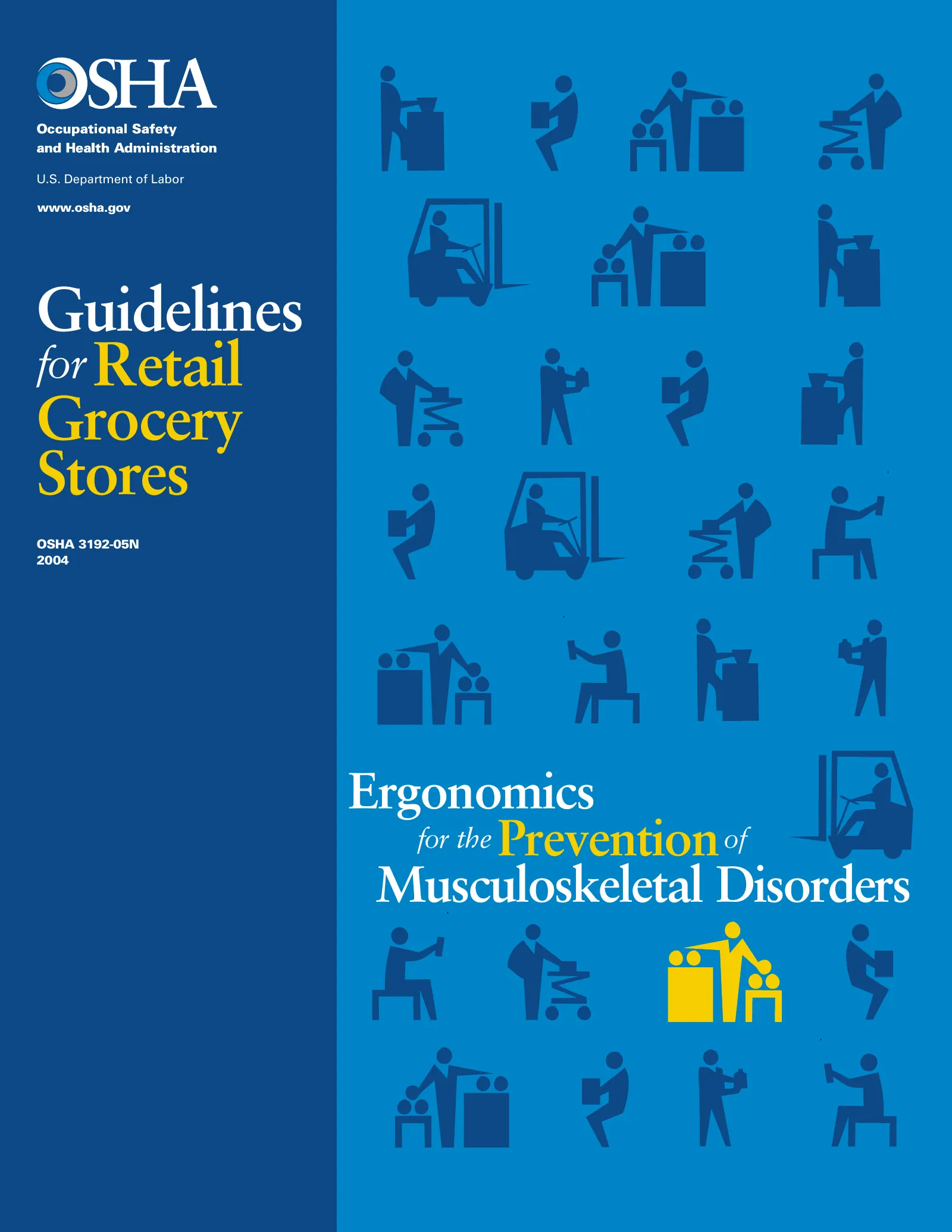
Ergonomics: Guidelines for Retail Grocery Stores - Ergonomics for the Prevention of Musculoskeletal Disorders (OSHA 3192)
OSHA booklet, for General Industry classes.
Page text
· 28 of 29 pages · by U.S. Department of Labor, OSHA
The words on each page as the author wrote them, read from the file by software so they can be searched. Layout, pictures and tables are not shown here, and long pages are shortened: the pages above and the download are the original.
- Page 1
Guidelines for Retail Grocery Stores
- U.S. Department of Labor
- www.osha.gov
- OSHA 3192-05N
- 2004
- Ergonomics
- for the Prevention of Musculoskeletal Disorders
- Page 2
Guidelines for Retail Grocery Stores
- Ergonomics for the Prevention of Musculoskeletal Disorders
- U.S. Department of Labor
- Occupational Safety and Health Administration
- OSHA 3182-3R 2009
- Guidelines for Nursing Homes
- Page 3
Contents
- Executive Summary
- Introduction
- A Process for Protecting Workers
- Provide Management Support
- Involve Employees
- Identify Problems
- Implement Solutions
- Address Reports of Injuries
- Figure 1. Checklist for Identifying Potential Ergonomics
- Risk Factors by Workplace Activity
- Figure 2. Checklist for Identifying Potential Job-
- Specific Ergonomics Concerns
- Provide Training
- Evaluate Progress
- Implementing Solutions
- Storewide Ergonomic Solutions
- Front End (Checkout, Bagging and Carryout)
- Stocking
- Bakery
- Meat and Deli
- Produce
- Additional Sources of Information
- References
- Page 4
Executive Summary
- OSHA’s Ergonomics for the Prevention of Musculoskeletal Disorders: Guidelines for Retail Grocery Stores provide practical recommendations to help grocery store employers and employees reduce the number and severity of injuries in their workplaces. Many of the workrelated injuries and illnesses experienced by grocery store workers are musculoskeletal disorders (MSDs), such as back injuries and sprains or strains that may develop from various factors, including lifting, repetitive motion disorders such as carpal tunnel syndrome, or injuries resulting from overexertion. MSDs may also be caused partly or wholly by factors outside of work.
- More remains to be learned about the relationship between workplace activities and the development of MSDs. However, OSHA believes that the experiences of many grocery stores provide a basis for taking action to better protect workers. As the understanding of these injuries develops and information and technology improve, the recommendations made in this document may be modified.
- …
- Page 5
- The heart of these guidelines is the description of various solutions that have been implemented by grocery stores. OSHA recommends that grocery stores consider these solutions in the context of a systematic process that includes the elements described in the pages that follow. Such a process will make it more likely that the solutions implemented in a particular workplace are successful in reducing injuries and are cost effective.
- To develop these guidelines, OSHA reviewed existing ergonomic practices and programs in the grocery store industry and conducted site visits to observe existing programs in action.
- In addition, the Agency reviewed available scientific information regarding work activities that may benefit from ergonomic improvements and specific solutions. OSHA also conducted one-on-one and group meetings with major stakeholder groups to gather the best available information on typical workplace activities and on practices, programs and processes that have been used successfully in the grocery store industry.
- …
- Page 6
Introduction
- Grocery stores provide a vital service to the American public, and are a major source of employment in the United States. In recent years, the efforts of grocery store managers and employees have resulted in fewer occupational injuries and illnesses. Even with these efforts, thousands of grocery store workers are still injured on the job each year (2).
- Many grocery stores have taken actions such as those recommended in this document to help reduce exposures to ergonomic risk factors in their effort to reduce workplace injuries.
- Some grocery store work can be physically demanding. Many grocery store workers handle thousands of items each day to stock shelves, check groceries, decorate bakery items, and prepare meat products. These tasks involve several ergonomic risk factors. The most important of these include force, repetition, awkward posture, and static postures (4).
- In the grocery store industry, the presence of these risk factors increases the potential for injuries and illnesses. …
- …
- Page 7
- Packing produce and other products in ice keeps them fresh and appealing. It also means handling ice – shoveling it, lifting it and shoveling it again. It’s heavy work and takes time.
- Recently a market devised a method to reduce the amount of time that it takes to put ice on products and that also cut the amount of handling in half. Originally an employee took a cart to the ice machine, scooped up enough ice to fill a cart, wheeled the cart to the display case, and finally scooped the ice from the cart into the display case.
- The new machine allows gravity flow of ice and has space underneath for a cart containing four buckets. The ice falls into the buckets and fills them, eliminating half the shoveling. The buckets are convenient to handle and can be picked up to pour the ice into the display case, eliminating the rest of the need to shovel. The net result – less strenuous work, more time saved, and an attractive display (5).
- for the job and the amount of time spent doing the activity. If an employee develops carpal tunnel syndrome, and his or her job…
- …
- Page 8
A Process for Protecting Workers
- Many of the recommendations below are practices taken from workplace ergonomics and safety programs that grocery stores have developed and that OSHA observed while performing site visits at grocery stores. They are intended to provide a flexible framework that a grocery store manager can adapt to an individual store. In many grocery stores, ergonomics, other employee safety and health efforts, workers’ compensation, and risk management are integrated into a single program that is usually administered by the same staff. OSHA recommends that employers develop a process for systematically addressing ergonomics issues in their facilities, and incorporate this process into an overall program to recognize and prevent occupational safety and health hazards.
- Store and company management personnel should consider the general steps discussed below when establishing and implementing an ergonomics program. It should be noted, however, that each store will have different needs and limitations that should be considered when identifying…
- …
- Page 9
- You can also identify ergonomic issues by talking with employees and walking through the grocery store to observe employees performing their jobs. When reviewing the various jobs in the grocery store, pay particular attention to the risk factors listed below. Force – the amount of physical effort required to perform a task (such as heavy lifting 1 , pushing or pulling), handle merchandise, or maintain control of equipment or tools;
- Repetition – performing the same motion or series of motions continually or frequently for an extended period of time;
- Awkward and static postures – assuming positions that place stress on the body, such as prolonged or repetitive reaching above shoulder height, kneeling, squatting, leaning over a counter, using a knife with wrists bent, or twisting the torso while lifting (4); and
- Contact stress – pressing the body or part of the body (such as the hand) against hard or sharp edges, or using the hand as a hammer.
- When there are several risk factors in a job, there can be a greater risk of injury. …
- …
- Page 10
- Figure 1.
- Checklist for Identifying Potential Ergonomics Risk Factors by Workplace Activity
- If the answer to any of the following questions is yes, the activity should be further reviewed.
- Force in Lifting
- Does the lift involve pinching to hold the object?
- Is heavy lifting done with one hand?
- Are very heavy items lifted without the assistance of a mechanical device?
- Are heavy items lifted while bending over, reaching above shoulder height, or twisting?
- Are most items lifted rather than slid over the scanner?
- Force in Pushing, Pulling, Carrying Are dollies, pallet jacks, or other carts difficult to get started?
- Is there debris (e.g., broken pallets) or uneven surfaces (e.g., cracks in the floor) or dock plates that could catch the wheels while pushing?
- Is pulling rather than pushing routinely used to move an object?
- Are heavy objects carried manually for a long distance?
- Force to Use Tools
- Do tools require the use of a pinch grip or single finger to operate?
- Are tools too large or too small for the employee’s hands?
- Repetitive Tasks
- …
- Page 11
- Figure 2.
- Checklist for Identifying Potential Job-Specific Ergonomics Concerns
- If the answer to any of the following questions is no, the activity may be a potential source of ergonomic concern, depending on the duration, frequency, and magnitude of the activity.
- Cashiering
- Are items within easy reach?
- Are keyboard supports adjustable?
- Can the cashier work with items at about elbow height?
- Can the display be read without twisting? Are all edges smoothed or rounded so the cashier does not come into contact with sharp or hard edges?
- Are objects easily scanned the first time? Are objects scanned without twisting hand motions?
- Can cashiers scan heavy/bulky/awkward items without lifting them?
- Are the scale, conveyor, and horizontal scanner plates all the same height?
- Is the scanner plate clean and unscratched? Does the cashier have an anti-fatigue mat and/or footrest?
- Bagging and Carry Out
- Can the bagger adjust the height of the bag stand?
- Are all edges smoothed or rounded so the bagger does not come into contact with sharp or hard edges?
- Do bags have handles?
- …
- Page 12
(Continued from page 8)
- Sometimes the muscle soreness employees experience when starting or returning to a job can be confused with symptoms of MSD injuries. In most cases muscle soreness from conditioning lasts only a few days. Temporary muscle soreness occurs most often with new employees or workers who are returning to a job after several weeks away. When the symptoms linger or gradually get worse, an MSD may be developing.
- Provide Training
- Training is critical for employers and employees to safely use the solutions identified in these guidelines. Training should be provided in a manner and language that all employees can understand. There are many ways employers can integrate ergonomics training into regular workplace activities, such as new employee orientation or at staff, department, or shift meetings. There are also many sources of training materials, including OSHA, trade associations, and insurance companies. OSHA recommends training for grocery store employees that provides:
- Knowledge of the work tasks that may lead to pain or injury;
- …
- Page 13
Implementing Solutions
- The section on ergonomic solutions for grocery stores describes changes to equipment, work practices, and procedures that can address ergonomic risk factors, help control costs, and reduce employee turnover. These changes may also increase worker productivity and efficiency because they eliminate unnecessary movements and reduce heavy manual work. OSHA recommends employers use engineering and administrative techniques, where feasible, as the preferred method of dealing with ergonomic issues in retail grocery stores. The first solutions described are those that are applicable to all or most areas of the grocery store. Then, solutions for specific grocery store departments are presented, including:
- Front end (checkout, bagging and carryout);
- Stocking;
- Bakery;
- Meat and deli department; and
- Produce department.
- OSHA is not providing specific solutions for every department of every grocery store, but the general recommendations should be useful. OSHA expects that a grocery store may need to implement a variety of solutions to address…
- …
- Page 14
Power Grips
- Loss Control Savings
- 4%
- 5%
- 6%
- 7%
- 8%
- 9%
- 10%
- 11%
- 1994
- 1993
- This section describes storewide ergonomic principles on safe work practices employees can follow to reduce their risk of injury. Employers should train employees to use these techniques and design stores to make it easy to do so.
- 1992
- Power Lifts
- A power grip uses the muscles of the hand and forearm effectively, and is less stressful than a pinch grasp. Consequently, a one- or two-handed power grip should be used whenever possible.
- When the item to be grasped is too heavy or bulky to lift with a one-hand power grip, use the two-hand power grip.
- A power grip can be described as wrapping all the fingers and the thumb around the object that is being gripped. It is sometimes described as making a fist around the object being gripped.
- Pinch Grasps
- The power grip can be used for many items, including bags, cans and small boxes.
- A pinch grasp should never be used when a power grip can be used instead. However, a pinch grasp is acceptable for small, light items (e.g., a pack of gum, etc.).
- Page 15
STOREWIDE ERGONOMIC SOLUTIONS
- Lifting Safety
- Most grocery store jobs involve some lifting. It is important that employers provide employees with help to lift heavy or bulky items. Whether a particular lift will require assistance depends on several factors, including the weight and size of the object, how frequently the object is lifted, how close the object is to the ground, how high it must be lifted, how far it must be carried and whether it has handles. Assistance can include a dolly or cart, or help from a co-worker. Employees should be trained in the use of appropriate lifting techniques for different sizes of objects as well as to when it is appropriate to seek assistance.
- When holding, lifting or carrying items
- Before lifting boxes and cases, check the weight so you can prepare to lift properly.
- Turn the body as a unit to avoid twisting at the waist.
- Keep the item close to your body.
- Keep your back straight.
- Use your leg muscles to do the lifting.
- Lift smoothly without jerking.
- Get close to where you want to set the item down.
- Page 16
STOREWIDE ERGONOMIC SOLUTIONS
- Recommended Working Postures
- Recommended Working Postures describe body positions that are neutral and comfortable to use. Using postures other than those recommended will generally waste energy and motion as well as potentially raise the risk of injury. It’s also important to change position frequently and stretch between tasks. This improves circulation and lessens fatigue.
- Head and Neck
- Avoid situations that require twisting the neck or bending it forward, backward or to the side.
- Shoulders and Arms
- Keep the shoulders relaxed – not
- “shrugged-up” or “slumped-down.”
- Keep your elbows close to your body.
- Keep work at about elbow height.
- Hands and Wrists
- Keep the hands straight and in line with the forearms – avoid twisting hands.
- Avoid working with wrists pressed against sharp or hard edges.
- Back
- Stand straight – avoid situations that require bending (forward or backward), leaning to the side or twisting.
- A sit/stand stool will allow for changes in posture.
- …
- Page 17
STOREWIDE ERGONOMIC SOLUTIONS
- Best and Preferred Work Zones
- Performing work within the best and preferred work zones shown below facilitates productivity and comfort. Work is safest when lifting and reaching is performed in these zones. Working outside these work zones results in non-neutral postures that may increase the risk of injury. It is particularly important to perform heavy lifting tasks within the best work zone.
- Best Work Zone
- Preferred Work Zone
- As far forward as your wrist when you hold your arm slightly bent.
- As far forward as your hand when you hold your arm out straight.
- As wide as the shoulders.
- A foot on either side of the shoulders.
- Upper level at about heart height.
- Upper level at shoulder height.
- Lower level at about waist height.
- Lower level at tip of fingers with hands held at the side.
- Best
- Work Zone
- Best
- Work Zone
- Preferred
- Work Zone
- Page 18
- Use a powered in-feed conveyor to help cashiers bring the items to their best work zone, rather than leaning and reaching to get items further up the conveyor.
- Provide footrests for cashiers. Alternately resting the feet helps to reduce fatigue.
- Use a “sweeper” to move items on the conveyor within the checker’s reach.
- Locate commonly used items such as the cash drawer and printer within easy horizontal reach.
- Place in-feed and take-away conveyor belts as close as possible to the cashier to minimize reaching.
- Consider using checkstands designed with an adjustable sit/stand or lumbar support against which cashiers can lean.
- Remove, round-off, or pad sharp or hard edges with which the cashier may come into contact.
- Provide adequate toe space (at least 4 inches) at the bottom of the workstation. Toe space allows cashiers to move closer to the checkstand, decreasing reaching requirements.
- Use footrests and anti-fatigue mats in areas where workers stand for prolonged periods. Standing on anti-fatigue mats, as compared to bare floors, provides a noticeable…
- …
- Page 19
- Consider using keyboards to enter the quantity of identical products rather than scanning each individual item.
- Use keyboard to enter code if item fails to scan after second attempt.
- Set scanners and conveyors at the same height so that cashiers can slide items across rather than lift them.
- Establish a regular maintenance schedule for scanners; clean dirty plates and replace scratched ones.
- Use combined scales/scanners.
- Place keyboards on supports that adjust in height, horizontal distance and tilt to keep work within the preferred work zone.
- Use front facing checkstands to reduce twisting motions and extended reaches to the side.
- Provide an adjustable-height bag stand. In bagging areas, the tops of plastic bags should be just below conveyor height.
- To avoid extended reaches when loading bags into carts, move carts closer to the employee.
- Adjust the checkstand height to match the cashier’s waist height, or use a platform.
- Place cash register displays at or slightly below eye level.
- …
- Page 20
STOCKING
- Keep cases close to the body when lifting and carrying in order to reduce stress to the back.
- CHEESE
- CHEESE
- CHEESE
- CHEESE
- CHEESE
- CHEESE
- CHEESE
- CHEESE
- CHEESE
- CHEESE
- Use a step stool to reach items on the top of pallets or on high shelves.
- Use thermal gloves when stocking frozen foods. Cold temperatures can reduce circulation, causing stress on the hands. If pricing, use a glove with textured fingertips to wipe frost from frozen foods.
- Use a kneeler or stool when working at low shelves for long periods of time. This reduces stress on the knees and legs when squatting and kneeling.
- Rotate stocking tasks to avoid prolonged kneeling, squatting, and overhead reaching.
- Use a cart to move items from the pallet to the shelving or case where they are stocked.
- Use knee pads when stocking low shelves for long periods of time. This reduces the stress on the knees and legs when kneeling.
- Keep cart wheels well maintained. Wheels that are in poor repair can be difficult to push. Racks or carts with bad wheels should be removed from service until they can be…
- …
- Page 21
- Arrange shelves so that heavy items and fastmoving items are stored within easy reach. This reduces the stress on the body caused by bending or reaching overhead.
- Use the correct safety cutter for the job. Be sure to supply a left-handed cutter if the employee is left-handed.
- If a turntable is not used, place a flat piece of stainless steel over the end section of the roller bed preferably with a non-stick coating to allow cases to be turned easily. The metal surface should allow the cases to be pushed onto the roller bed easily.
- Keep safety cutters sharp. Using dull tools requires more force. Replace cutter blades often.
- Report improperly stacked pallets to the supplier to reduce future problems.
- Ensure that the floor areas are level and free of debris and spills. Report any floor problems that need repair immediately.
- Use boxes or totes with hand holds, where suitable.
- Work with suppliers to get lower weight boxes to reduce the weight manually lifted. Industry groups such as the Grocery Manufacturers of America and Food Marketing Institute encourage all…
- …
- Page 22
- Position cake-decorating turntables so that the cake is at about elbow height for a more comfortable working position. Adjustable height tables are one solution, but you can also put a riser under the turntable, use turntables with different heights, or put in platforms for shorter people to stand on.
- B5
- Make sure that there is toe-clearance under counters and other work surfaces.
- Put buckets of icing and batter on risers (e.g., small stands or empty buckets) to raise them to the best work zone.
- Use smaller containers of flour, sugar, salt and other supplies to reduce the weights that must be handled.
- When lifting keep large bags and containers of ingredients close to the body to reduce stress on the back.
- Use small decorating bags whenever possible to reduce the stress on the worker’s hands. The larger the bag, the more force required to squeeze it.
- Have an adequate number of mixing bowls available to reduce the need to transfer icing or batters that are mixed in the store to other containers.
- …
- Page 23
- Whenever possible, break up continuous activities such as cake decorating and dough handling with
- B4
- less strenuous tasks during the shift.
- Whenever possible work from the long side of the donut glazing area to reduce reaches and forces on the back. Some glazing stations can be pulled out so that workers can work from the side.
- Use a short-handled scoop to put icing into decorating bags. Shorter handles reduce the stress to the wrist.
- Use spatulas, spoons, and other utensils that fit the worker’s hand (not too wide or too narrow) and are not slippery.
- Work from the long side of baking pans to reduce reaches when handling dough.
- Use a step stool to reach items on high shelves.
- Use ambidextrous scoops which allow workers to use either hand to dispense dough or batter.
- Use powered mixers whenever possible to mix coloring into icing or purchase colored icing. This reduces the stress to workers’ hands and arms from manually mixing colors into icing.
- Look for cases and counter designs that allow the employee to hand customers their selections without high or…
- …
- Page 24
- Many of these solutions may also be useful for the seafood and cheese departments.
- Keep wheels on racks well maintained. Wheels that are in poor repair can be difficult to push. Racks with bad wheels should be removed from service until they can be repaired.
- If overhead storage is necessary, use it for light items such as foam trays.
- Use a step stool to reach items on high shelves.
- Keep all grinders, cutters and other equipment sharp and in good repair. Dull or improperly working equipment requires more force to operate.
- Provide thermal gloves for use when handling frozen items.
- Avoid continuous cutting or grinding. Whenever possible, break up these tasks with other, less strenuous tasks throughout the shift.
- Work with suppliers to get meat and other supplies in lower weight boxes to reduce the weight manually handled.
- Keep large boxes and heavy items close to the body. This helps to reduce stress on the back.
- Use a food processor to prepare ingredients for stuffing and other items.
- …
- Page 25
- When using tongs select tongs with long handles to reach items in the front of the case.
- Whenever possible, incorporate adjustable work surfaces into the department. Examples include cutting tables, scales and deli slicers.
- Whenever possible, work from the long side of trays to reduce reaches and the resultant high stresses on the back.
- Look for cases and counters that allow workers to serve customers without excessive reaches.
- Avoid working with the hands/wrists held in a bent or twisted position.
- Use anti-fatigue mats, footrests, and sit/stand stools where workers are required to stand for long periods of time.
- Keep knives sharp. Workers should be trained in the best knife sharpening methods. Knife sharpening systems should be used regularly, and steels and mousetrap sharpeners should be used to keep knives sharp throughout the shift.
- Look for grinders that do not force the worker to bend over to catch meat or to reach too high to dump meat into the grinder.
- Try different knives to see if they are more comfortable to use. …
- …
- Page 26
- Keep manual food processing equipment (knives, slicers, etc.) sharp and in good repair. Equipment that is dull or is not working properly may require excess force to operate.
- Position scales and wrap stations so that they can be used in the best work zone. Scales that are too high or too low for a worker can cause employees to work in awkward positions. If possible, make the scale and wrap station tables adjustable so that all workers can work in comfortable postures.
- Keep boxes, melons, bags of potatoes, or other heavy items close to the body when lifting and carrying. This helps to reduce stress on the back.
- Keep heavy items, such as watermelons, in shipping containers and use pallet jacks to move them.
- Use a lightweight shorthandled plastic shovel for ice. This tool is less stressful to the body than heavy shovels. A small shovel allows the worker to move more ice in less time than a hand scoop.
- Consider using refrigeration rather than ice to cool produce in order to eliminate the need to shovel ice.
- …
- Page 27
Additional Sources of Information
- The following sources may be useful to those seeking further information about ergonomics and the prevention of work-related musculoskeletal disorders in grocery stores.
- Working Smart in the Retail Environment Ergonomics Guide, Food Marketing Institute, (202) 452-8444. FMI offers (for a fee) several different guidelines and videos, including this document. This guide instructs cashiers and front line managers how to enhance safety, comfort and productivity. The guide also includes a Working Smart Quick Reference, which summarizes the general and specific techniques employees should use and avoid. (1996, 68 pages)
- In Search of Better Checkstands, United Food and Commercial Workers International Union. This document provides detailed information on checkstand design, particularly the advantages of grocery scanners that reduce the need for cashiers to grip and lift grocery items across the scanner.
- Easy Ergonomics, A Practical Approach for Improving the Workplace; California Department of Industrial Relations. …
- …
- Page 28
References
- (1) Food Marketing Institute. 1992.
- Ergonomic Improvement of Scanning
- Checkstand Designs. Washington, D.C.
- (2) Clarke, Cynthia M., “Workplace injuries and illnesses in grocery stores,” Compensation and Working Conditions, Bureau of Labor
- Statistics, December 19, 2003.
- (3) Fall 2003 Liberty Mutual Workplace Safety Index: Identifies the direct costs and leading causes of workplace injuries. Liberty Mutual Insurance Company. September 2003.
- (4) Food Marketing Institute. 1995. Working Smart in the Retail Environment – Ergonomics Guide. Washington, D.C.
- (5) E-mail from Supervalu Supermarkets, Inc. to OSHA. 2003.
- (6) National Institute for Occupational Safety and Health (NIOSH). 1997. Musculoskeletal Disorders (MSDs) and Workplace Factors – A Critical Review of Epidemiologic Evidence for Work-Related Musculoskeletal Disorders of the Neck, Upper Extremity and Low Back. National Institute for Occupational Safety and Health (NIOSH) Publication #97-141. (3-18).
- (7) Kennedy, S. et al. 1992. “Prevalence of muscle-tendon and nerve compression disorders in…
- …
More on Ergonomics
pptx
57 slidesIntroduction to Ergonomics (OSHA 10-Hour General Industry Outreach)
OSHA's general industry outreach ergonomics deck (2017): risk factors, MSDs and controls.
U.S. Department of Labor, OSHAPublic domain
pdf
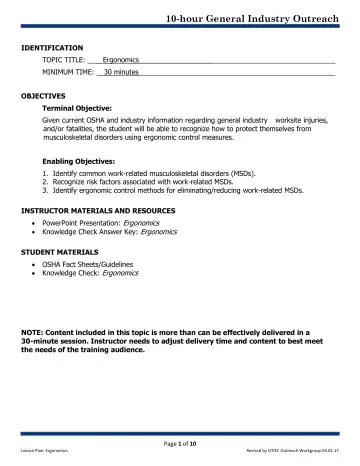
10 slidesIntroduction to Ergonomics: Lesson Plan (OSHA 10-Hour General Industry Outreach)
Instructor lesson plan (objectives, timing, teaching steps) for the OSHA General Industry introduction to ergonomics outreach deck.
U.S. Department of Labor, OSHA (with the OTIEC Outreach Workgroup)Public domain
pdf
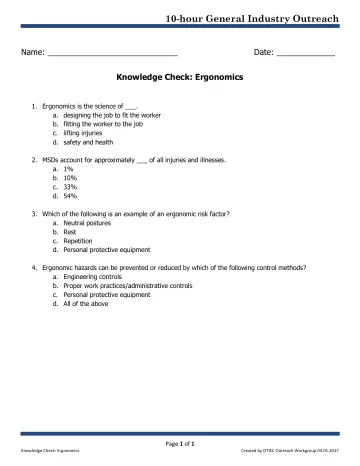
1 slidesIntroduction to Ergonomics: Knowledge Check (OSHA 10-Hour General Industry Outreach)
Student knowledge-check quiz for the OSHA General Industry introduction to ergonomics outreach deck.
U.S. Department of Labor, OSHA (with the OTIEC Outreach Workgroup)Public domain