1 / 44Use ← → to flip
Ergonomics: Guidelines for Nursing Homes: Ergonomics for the Prevention of Musculoskeletal Disorders (OSHA 3182)
OSHA booklet, for General Industry classes.
Page text
· 40 of 44 pages · by U.S. Department of Labor, OSHA
The words on each page as the author wrote them, read from the file by software so they can be searched. Layout, pictures and tables are not shown here, and long pages are shortened: the pages above and the download are the original.
- Page 1
Guidelines for Nursing Homes
- OSHA 3182 - 3R 2009
- Ergonomics
- for the Prevention of Musculoskeletal Disorders
- Page 3
Guidelines for Nursing Homes Ergonomics for the Prevention of Musculoskeletal Disorders
- U.S. Department of Labor Elaine L. Chao, Secretary
- Occupational Safety and Health Administration
- John L. Henshaw, Assistant Secretary
- OSHA 3182-3R 2009
- Page 5
Table of Contents
- Executive Summary
- SECTION I:
- Introduction
- SECTION II:
- A Process for Protecting Workers
- Provide Management Support
- Involve Employees
- Identify Problems
- Implement Solutions
- Address Reports of Injuries
- Provide Training
- Evaluate Ergonomics Efforts
- SECTION III:
- Identifying Problems and Implementing Solutions for Resident
- Lifting and Repositioning
- Identifying Problems for Resident Lifting and Repositioning
- Figure 1. Transfer to and from: Bed to Chair, Chair to Toilet,
- Chair to Chair, or Car to Chair
- Figure 2. Lateral Transfer to and from: Bed to Stretcher, Trolley
- Figure 3. Transfer to and from: Chair to Stretcher
- Figure 4. Reposition in Bed: Side-to-Side, Up in Bed
- Figure 5. Reposition in Chair: Wheelchair and Dependency Chair
- …
- Page 6
Table of Contents
- SECTION IV:
- Identifying Problems and Implementing Solutions for
- Activities Other than Resident Lifting and Repositioning
- Storage and Transfer of Food, Supplies, and Medications
- Mobile Medical Equipment
- Working with Liquids in Housekeeping
- Working with Liquids in Kitchens
- Hand Tools
- Linen Carts
- Handling Bags
- Reaching into Sink
- Loading or Unloading Laundry
- Cleaning Rooms (Wet Method)
- Cleaning Rooms (Electrical)
- SECTION V:
- Training
- 31 31 31 33
- Nursing Assistants and Other Workers at Risk of Injury
- Training for Charge Nurses and Supervisors
- Training for Designated Program Managers
- SECTION VI:
- Additional Sources of Information
- 35 36
- References
- Appendix: A Nursing Home Case Study
- Page 7
Executive Summary
- These guidelines provide recommendations for nursing home employers to help reduce the number and severity of work-related musculoskeletal disorders (MSDs) in their facilities. MSDs include conditions such as low back pain, sciatica, rotator cuff injuries, epicondylitis, and carpal tunnel syndrome. The recommendations in these guidelines are based on a review of existing practices and programs, State OSHA programs, as well as available scientific information, and reflect comments received from representatives of trade and professional associations, labor organizations, the medical community, individual firms, and other interested parties. …
- …
- Page 8
Executive Summary
- An employer’s failure to implement the guidelines is not a violation, or evidence of a violation, and may not be used as evidence of a violation, of the general duty clause. Furthermore, the fact that OSHA has developed this document is not evidence and may not be used as evidence of an employer’s obligations under the general duty clause; the fact that a measure is recommended in this document but not adopted by an employer is not evidence, and may not be used as evidence, of a violation of the general duty clause.
- In addition, the recommendations contained herein should be adapted to the needs and resources of each individual place of employment.
- …
- Page 9
Introduction
- SECTION I
- Nursing homes that have implemented injury prevention efforts focusing on resident lifting and repositioning methods have achieved considerable success in reducing work-related injuries and associated workers’ compensation costs. Providing a safer and more comfortable work environment has also resulted in additional benefits for some facilities, including reduced staff turnover and associated training and administrative costs, reduced absenteeism, increased productivity, improved employee morale, and increased resident comfort. …
- …
- Page 10
Introduction
- Excessive exposure to these risk factors can result in a variety of disorders in affected workers (3, 5). These conditions are collectively referred to as musculoskeletal disorders, or MSDs. MSDs include conditions such as low back pain, sciatica, rotator cuff injuries, epicondylitis, and carpal tunnel syndrome (6). Early indications of MSDs can include persistent pain, restriction of joint movement, or soft tissue swelling (3, 7).
- While some MSDs develop gradually over time, others may result from instantaneous events such as a single heavy lift (3). Activities outside of the workplace that involve substantial physical demands may also cause or contribute to MSDs (6). In addition, development of MSDs
- …
- Page 11
A Process for Protecting Workers
- SECTION II
- The number and severity of injuries resulting from physical demands in nursing homes — and associated costs — can be substantially reduced (2, 9). Providing an alternative to manual resident lifting is the primary goal of the ergonomics process in the nursing home setting and of these guidelines. OSHA recommends that manual lifting of residents be minimized in all cases and eliminated when feasible. OSHA further recommends that employers develop a process for systematically addressing ergonomics issues in their facilities, and incorporate this process into an overall program to recognize and prevent occupational safety and health hazards.
- …
- Page 12
A Process for Protecting Workers
- An Identify Problems
- Nursing homes can more successfully recognize problems by establishing systematic methods for identifying ergonomics concerns in their workplace. Information about where problems or potential problems may occur in nursing homes can be obtained from a variety of sources, including OSHA 300 and 301 injury and illness information, reports of workers’ compensation claims, accident and near-miss investigation reports, insurance company reports, employee interviews, employee surveys, and reviews and observations of workplace conditions. Once information is obtained, it can be used to identify and evaluate elements of jobs that are associated with problems. …
- …
- Page 13
A Process for Protecting Workers
- and evaluate ergonomic efforts. Employees may not be discriminated against for reporting a work-related injury or illness. [29 U.S.C. 660(c)]
- Provide Training
- Training is necessary to ensure that employees and managers can recognize potential ergonomics issues in the workplace, and understand measures that are available to minimize the risk of injury. Ergonomics training can be integrated into general training on performance requirements and job practices. Effective training covers the problems found in each employee’s job. More information on training can be found in Section V.
- Evaluate Ergonomics Efforts Nursing homes should evaluate the effectiveness of their ergonomics efforts and follow-up on unresolved…
- …
- Page 14
A Identifying Problems and Implementing Solutions for Resident Lifting and Repositioning
- SECTION III
- Identifying Problems
- for Resident Lifting
- and Repositioning
- Assessing the potential for work to injure employees in nursing homes is complex because typical nursing home operations involve the repeated lifting and repositioning of the residents. Resident lifting and repositioning tasks can be variable, dynamic, and unpredictable in nature. In addition, factors such as resident dignity, safety, and medical contraindications should be taken into account. …
- …
- Page 15
Identifying Problems and Implementing Solutions for Resident Lifting and Repositioning
- FIGURE 1 Transfer to and from: Bed to Chair, Chair to Toilet, Chair to Chair, or Car to Chair
- Can patient bear weight?
- Fully
- Caregiver assistance not needed; stand by for safety as needed.
- Partially
- Is the patient cooperative?
- Yes
- No
- No
- No
- Stand and pivot technique using a gait/transfer belt
- (1 caregiver) -or- powered standing assist lift
- (1 caregiver)
- Use full body sling lift and 2 caregivers.
- Yes
- Does the patient have upper extremity strength?
- No
- Yes
- Seated transfer aid; may use gait/transfer belt until the patient is profcient in completing transfer independently.
- For seated transfer aid, must have chair with arms that recess or are removable.
- …
- Page 16
Identifying Problems and Implementing Solutions for Resident Lifting and Repositioning
- for recommending procedures and equipment to be used for performing lifting and repositioning tasks. The following are some examples:
- The Resident Assessment Instrument,
- published by the Centers for Medicare and Medicaid Services (CMS), provides a structured, standardized approach for assessing resident capabilities and needs that results in a care plan for each resident. Caregivers can use this information to help them determine the appropriate method for lifting or repositioning residents. Many nursing homes use this system to comply with CMS requirements for nursing homes. Employers can access this information from www.cms.hhs.gov/medicaid/mds20/.
- …
- Page 17
Identifying Problems and Implementing Solutions for Resident Lifting and Repositioning
- FIGURE 3 Transfer to and from: Chair to Stretcher
- Is the patient cooperative?
- Use full-body sling lift and 2 or more caregivers.
- No
- Yes
- Caregiver assistance not needed; stand by for safety as needed.
- Fully
- Can the patient bear weight?
- No
- If exam table/stretcher can be positioned to a low level, use a non-powered stand-assist aid. If not, use a full-body sling lift.
- Comments:
- High/low exam tables and stretchers would be ideal.
- Source: The Patient Safety Center of Inquiry (Tampa, FL). Veterans Health Administration & Department of Defense. October 2001.
- FIGURE 4 Reposition in Bed: Side-to-Side, Up in Bed
- Fully
- …
- Page 18
Identifying Problems and Implementing Solutions for Resident Lifting and Repositioning
- FIGURE 5 Repostition in Chair: Wheelchair and Dependency Chair
- Can patient assist?
- Caregiver assistance not needed; stand by for safety as needed.
- Fully
- Partially
- No
- If patient has upper extremity strength in both arms, have patient lift up while caregiver pushes knees to reposition.
- Does chair recline?
- If patient lacks sensation, cues may be needed to remind Patient to reposition.
- Yes
- Recline chair and use a friction-reducing device and 2 caregivers.
- No
- Is patient cooperative?
- Use full-body sling lift -or- non-powered stand-assist aid and 1 to 2 caregivers.
- Yes
- No
- Comments:
- This is not a one person task: DO NOT PULL FROM BEHIND CHAIR.
- …
- Page 19
Identifying Problems and Implementing Solutions for Resident Lifting and Repositioning
- Implementing Solutions
- for Resident Lifting
- and Repositioning
- The recommended solutions presented in the following pages are not intended to be an exhaustive list, nor does OSHA expect that all of them will be used in any given facility. The information represents a range of available options that a facility can consider using. Many of the solutions are simple, common sense modifications to equipment or procedures that do not require substantial time or resources to implement. Others may require more significant efforts. …
- …
- Page 20
Identifying Problems and Implementing Solutions for Resident Lifting and Repositioning
- If the lift has a self-contained
- charging unit, what is the amount of space necessary for charging and what electrical receptacles are required? What is the minimum charging time of a battery?
- How high is the base of the lift and will it fit under the bed and various other pieces of furniture? How wide is the base of the lift or is it adjustable to a wider and lockable position?
- How many people are required to operate the lift for lifting of a typical 200-pound person?
- Does the lift activation device (pendant) have remote capabilities? How many sizes and types of slings are available? What type of sling is available for optimum infection control?
- …
- Page 21
Identifying Problems and Implementing Solutions for Resident Lifting and Repositioning
- Transfer from Sitting to Standing Position
- Resident Lifting
- Description:
- Powered sit-to-sta nd or standing assist devices.
- Portable lift device (sling type); can be a universal/ hammock sling or a band / leg sling.
- When to Use:
- Transferring
- residents who are partially dependent, have some weight-bearing capacity, are cooperative, can s it up on the edge of the bed with or without assistance, and are able to bend hips, knees, and ankles. Transfers from bed to chair (wheel chair, Geri or cardiac chair), or chair to bed, or for bathing and toileting. Can be used for repositioning where space or storage is limited.
- Points to Remember:
- …
- Page 22
Repositioning in Chair
- Ambulation
- Description: Variable position Geri and Cardiac chairs.
- Description:
- Ambulation assist device.
- When to Use:
- For residents who are weight bearing and cooperative and who need extra security and assistance when ambulating.
- Repositioning partial- or non-weight-bearing residents who are cooperative.
- Points to
- Remember:
- More than one caregiver is needed and use of a frictionreducing device is needed if resident cannot assist to reposition self in chair. Ensure use of good body mechanics by caregivers. Wheels on chair add versatility. Ensure that chair is easy to adjust, move, and steer. Lock wheels on chair before repositioning. Remove trays, footrests, and seat belts where appropriate. …
- …
- Page 23
Lateral Transfer; Repositioning
- Description:
- Devices to reduce friction force when transferring a resident such as a draw sheet or transfer cot with handles to be used in combination slippery sheets, low friction mattress covers, or slide boards; boards or mats with vinyl coverings and rollers; gurneys with transfer devices; and air-assist lateral sliding aid or flexible mattress inflated by portable air supply.
- When to Use:
- Transferring a partial- or non-weight bearing resident between 2 horizontal surfaces such as a bed to a stretcher or gurney while lying on their back or when repositioning resident in bed.
- Points to Remember:
- More than one caregiver is needed to perform this type of transfer or repositioning.
- …
- Page 24
Lateral Transfer in Sitting Position
- Transfer from Sitting to Standing Position
- Description:
- Transfer boards – wood or plastic
- (some with movable seat).
- Lift cushions and lift chairs .
- When to Use:
- Transferring (sliding)
- residents who have good
- sitting balance and are cooperative from one level surface to another, e.g., bed to wheelchair, wheelchair to car seat or toilet. Can also be used by residents who require limited assistance but need additional safety and support.
- Points to Remember:
- Movable seats increase resident comfort and reduce incidence of tissue damage during transfer. More than one caregiver is needed to perform lateral transfer. Ensure clothing is present between the resident’s skin and the transfer device. …
- …
- Page 25
- Transfer from Sitting to Standing Position;
- Ambulation
- Description:
- Gait belts/transfer belts with handles.
- When to Use:
- Transferring residents who are partially dependent, have some weight-bearing capacity, and are cooperative. Transfers such as bed to chair, chair to chair, or chair to car; when repositioning residents in chairs; supporting residents during ambulation; and in some cases when guiding and controlling falls or assisting a resident after a fall.
- Points to Remember:
- More than one caregiver may be needed. Belts with padded handles are easier to grip and increase security and control. Always transfer to resident’s strongest side. Use good body mechanics and a rocking and pulling motion rather than lifting when using a belt. …
- …
- Page 26
Repositioning
- Bathtub, Shower, and Toileting Activities
- Description:
- Pelvic lift devices (hip lift ers).
- Description: Height adjustable bathtub and easyentry bathtubs.
- When to Use:
- To assist residents who are cooperative and can sit up to a position on a special bed pan.
- Points to Remember:
- Convenience of device
- may reduce need for resident lifting during toileting. Device is positioned under the pelvis. The part of the device located under the pelvis gets inflated so the pelvis is raised and a special bedpan put underneath. The head of the bed is raised slightly during this procedure. Use correct body mechanics, lower bedrails, and adjust bed to caregivers waist height to reduce bending.
- Bathing residents
- …
- Page 27
Bathtub, Shower, and Toileting Activities
- Description:
- Bath boards and transfer benches.
- When to Use:
- Bathing residents who are partially weight bearing, have good sitting balance, can use upper extremities (have upper body strength), are cooperative, and can follow instructions. Independent residents can also use these devices.
- Points to Remember:
- To reduce friction and possible skin tears, use clothing or material between the resident’s skin and the board. Can be used with a gait or transfer belt and/or grab bars to aid transfer. Back support and vinyl padded seats add to bathing comfort. Look for devices that allow for water drainage and have heightadjustable legs. May not be suitable for heavy residents. …
- …
- Page 28
Bathtub, Shower, and Toileting Activities
- Description:
- Height adjustable shower gurney or lift bath cart with waterproof top.
- Built-in or fixed bath lifts.
- When to Use:
- Bathing residents
- who are partially
- weight bearing, have good sitting balance, can use upper extremities
- (have upper body
- strength), are cooperative, and can follow instructions. Useful in small bathrooms where space is limited.
- For bathing non-weight bearing residents who are unable to sit up. Transfer resident to cart with lift or lateral transfer boards or other friction-reducing devices.
- Points to Remember:
- The cart can be raised to eliminate bending and reaching to the caregiver. Foot and head supports are available for resident comfort. …
- …
- Page 29
SECTION IV
- A Identifying Problems and Implementing Solutions for Activities Other than Resident Lifting and Repositioning
- Some reports indicate a significant number of work-related MSDs in nursing homes occur in activities other than resident lifting. (2, 3) Examples of some of the activities that the nursing home operator may want to review are:
- bending to make a bed or feed a
- resident;
- lifting food trays above shoulder
- level or below knee level;
- collecting waste;
- pushing heavy carts;
- bending to remove items from a
- deep cart;
- lifting and carrying when receiving
- and stocking supplies;
- bending and manually cranking
- an adjustable bed; and
- removing laundry from washing
- machines and dryers.
- …
- Page 30
Storage and Transfer of Food, Supplies, and Medications
- Mobile Medical
- Equipment
- Description: Use of carts.
- Description:
- Work methods and tools to transport equipment.
- When to Use:
- When moving food trays, cleaning supplies, equipment, maintenance tools, and dispensing medications.
- When transporting assistive devices and other equipment .
- Points to Remember:
- Speeds process for accessing and storing items. Placement of items on the cart should keep the most frequently used and heavy items within easy reach between hip and shoulder height. Carts should have full-bearing wheels of a material designed for the floor surface in your facility. …
- …
- Page 31
Hand Tools
- Linen Carts
- Description:
- Select and use properly designed tools.
- Spring loaded carts that automatically bring linen within easy reach.
- When to Use:
- When selecting frequently used tools for the kitchen , housekeeping, laundry an d maintenance areas.
- Moving or storing linen.
- Points to Remember:
- Enhances tool safety, speeds process, and reduces waste. Handles should fit the grip size of the user. Use bent-handled tools to avoid bending wrists. Use appropriate tool weight. Select tools that have minimal vibration or vibration damping devices. Implement a regular maintenance program for tools to keep blades sharp and edges and handles intact. Always wear the appropriate personal protective equipment.
- …
- Page 32
Loading or Unloading
- Laundry
- Cleaning Rooms
- (Wet Method)
- Description:
- Front-loading washers and dryers.
- Work methods and tools to clean resident rooms with water and chemical produc ts.
- When to Use:
- When loading or unloading laundry from washers, dryers and other laundry equipment.
- Points to Remember:
- Speeds process for retrievin g and placing items, and minimizes wear-and-tear on linen. Washers with tumbling cycles separate clothes, making removal easier. For deep tubs, a rake with long or extendable handle can be used to pull linen closer to the door opening. Raise machines so that opening is between hip and elbow height of employees. …
- …
- Page 33
Training
- SECTION V
- Training is critical for employers and employees to safely use the suggestions identified in these guidelines. Of course, training should be provided in a manner and language that all employees can understand. The following describes areas of training for nursing home employees, their supervisors, and program managers who are responsible for planning and managing the nursing home’s ergonomics efforts. OSHA recommends refresher training be provided as needed to reinforce initial training and to address new developments in the workplace.
- Nursing Assistants and Other Workers at Risk of Injury Employees should be trained before they lift or reposition residents, or perform other work that may involve risk of injury. …
- …
- Page 34
Training
- and are usually responsible for implementing the nursing home’s work practices, they may need more detailed training than nursing assistants on:
- methods for ensuring use of
- proper work practices;
- how to respond to injury reports;
- and
- how to help other workers implement
- solutions.
- Training for Designated Program Managers
- Staff members who are responsible for planning and managing ergonomics efforts need training so they can identify ergonomics concerns and select appropriate solutions. These staff members should receive
- information and training that will allow them to:
- identify potential problems related
- to physical activities in the workplace through observation, use of checklists, injury data analysis, or other analytical tools;
- …
- Page 35
Additional Sources of Information
- SECTION VI
- The following sources may be useful to those seeking further information about ergonomics and the prevention of work-related MSDs in nursing homes.
- A Back Injury Prevention
- Guide for Health Care Providers, Cal/OSHA Consultation Programs, (800) 963-9424, www.dir.ca.gov/dosh/dosh_publications/backinj.pdf This guide discusses the scope of the back injury problem in health care, how to analyze the workplace, how to identify and implement improvements, and how to evaluate results.
- It includes checklists that can assist in analyzing the work environment. Patient Care Ergonomics
- Resource Guide: Safe Patient Handling and Movement, Patient Safety Center of Inquiry, Veterans Health Administration and…
- …
- Page 36
Additional Sources of Information
- There are many states and territories that operate their own occupational safety and health programs under a plan approved by OSHA (23 cover both private sector, state and local government employees, and three only cover public employees). See the map on www.osha.gov for information on how to contact a state plan directly for information about specific state nursing home initiatives and compliance assistance, or state standards that may apply to nursing homes.
- A free consultation service is available to provide occupational safety and health assistance to businesses. OSHA Consultation is funded primarily by federal OSHA but delivered by the 50 state governments, the District of Columbia, Guam, Puerto Rico…
- …
- Page 37
References
- (1) Documents submitted to OSHA by Wyandot County Nursing Home. (Ex. 3-12)
- (2) Garg, A. 1999. Long-Term Effectiveness of “Zero-Lift Program” in Seven Nursing Homes and One Hospital. U.S. Department of Health and Human Services, Centers for Disease Control and Prevention, National Institute for Occupational Safety and Health (NIOSH), Cincinnati, OH. August. Contract No. U60/CCU512089-02. (Ex. 3-3)
- (3) Fragala, G., PhD, PE, CSP. 1996. Ergonomics: How to Contain On-the-Job Injuries in Health Care. Joint Commission on Accreditation of Healthcare Organizations.
- (4) Occupational Safety and Health Administration, Region II. Summer, 2002. New York OSHA E-Newsletter, Vol. 1, Issue 2.
- …
- Page 38
Appendix - A Nursing Home Case Study
- Introduction
- Wyandot County Nursing Home used a process that reflects many of the recommendations in these guidelines to address safety and health concerns and phase-in its current program that entails no manual lifting of residents. First and foremost, Wyandot’s administrator provided strong commitment and support in addressing the home’s problems. He also involved Wyandot’s workers in every phase of the effort. He talked to his employees, learned about stressful parts of their jobs, and then found solutions. He and his employees identified existing and potential sources of injury at the home and worked to implement solutions.
- …
- Page 39
Appendix
- during that same time period.
- This meant that of the 45 nursing assistants working at Wyandot, on average 25 new ones had to be hired each year.
- Wyandot’s administrator began to look for more effective ways to address injuries among workers and the high turnover rate. A back injury suffered by a worker that cost Wyandot $240,000 in workers’ compensation expenses provided significant motivation to find a strategy that would work. As Wyandot’s administrator investigated that injury, he also examined other sources of potential injury within the home. In doing so, he learned that resident transfer and repositioning tasks presented high risks for injuries.
- He called on the Ohio Bureau of Workers’ Compensation (OBWC) for help because he…
- …
- Page 40
Appendix
- According to Wyandot’s administrator, it was very difficult getting workers to overcome their insistence on doing things the old way. Because many workers said it took too long to use the mechanical lifts, one of the co-charge nurses decided to do a time study. She wanted to test how long it took to lift a resident manually compared to using a mechanical lift. The mechanical lift took about 5 minutes. Meanwhile, to perform the manual lift, a nursing assistant first had to find someone to help. This took 15 minutes. Thus, the time study showed that using the equipment actually saved time.
- One worker, who admitted that she did not initially use the sit-tostand lift because it was a “hassle,” reconsidered her opinion after an outbreak…
- …
- Page 41
Appendix
- The final phase of Wyandot’s program began with the introduction of the ceiling lifts. Wyandot’s administrator evaluated several ceiling lift systems. Wyandot chose a system with a motorized lift and a ceiling mounted track. Tracks were retrofitted into the rooms at a cost of about $12,000 for two double rooms and one bathroom. The first double room had a track that extended into the bathroom. However, newer systems used a transfer between the room and bathroom, which simplified the system and reduced costs.
- Providing Training
- As Wyandot purchased and installed new equipment, workers received training on how to use it, and guidelines for equipment use were put into place. An LPN in-service director did the training. …
- …
- Page 42
Appendix
- Wyandot’s administrator, because of reduced overtime and absenteeism.
- The home estimates savings of more than $125,000 in turnover costs.
- Meanwhile, workers’ compensation costs also have fallen drastically.
- For example, Wyandot reports that, after the program was implemented workers’ compensation costs declined from an average of $140,000 per year to less than $4,000 per year.
- From the time workers began to use the sit-to-stand lifts, which were among the first to be introduced at Wyandot, the incidence of back injuries stopped. Once the fast beds were introduced only six new hires were needed in the following year.
- Worker satisfaction has increased greatly. One nursing assistant, who has spent most of her career working in nursing…
- …
More on Ergonomics

pptx
57 slidesIntroduction to Ergonomics (OSHA 10-Hour General Industry Outreach)
OSHA's general industry outreach ergonomics deck (2017): risk factors, MSDs and controls.
U.S. Department of Labor, OSHAPublic domain
pdf
10 slidesIntroduction to Ergonomics: Lesson Plan (OSHA 10-Hour General Industry Outreach)
Instructor lesson plan (objectives, timing, teaching steps) for the OSHA General Industry introduction to ergonomics outreach deck.
U.S. Department of Labor, OSHA (with the OTIEC Outreach Workgroup)Public domain
pdf
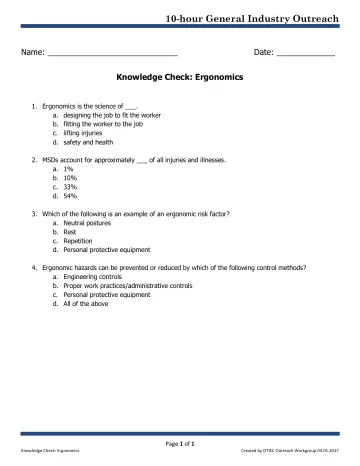
1 slidesIntroduction to Ergonomics: Knowledge Check (OSHA 10-Hour General Industry Outreach)
Student knowledge-check quiz for the OSHA General Industry introduction to ergonomics outreach deck.
U.S. Department of Labor, OSHA (with the OTIEC Outreach Workgroup)Public domain