1 / 55Use ← → to flip
Electrical (OSHA 10-Hour General Industry Outreach)
OSHA's general industry outreach electrical deck (2017); supplemental slides on shock, GFCIs, cords and lockout.
Slide text
· 55 slides · by U.S. Department of Labor, OSHA
The words on each slide as the author wrote them, read from the file by software so they can be searched. Layout, pictures and tables are not shown here: the slides above and the download are the original.
- Slide 1
Electrical
- OSHA 10-hour Outreach Training
- General Industry
- Slide 2
Electrical
- Source of photos: OSHA
- Slide 3
Introduction
- Lesson objectives:
- 1. Identify major electrical hazards
- 2. Describe types of electrical hazards
- 3. Describe electrical protection methods
- 4. Recognize employer requirements to protect workers from electrical hazards
- Source: OSHA
- Slide 4
Introduction
- Definitions:
- Electricity – movement
- of the free electrons between atoms;
- Related terms:
- Current – the movement of electrical charge
- Resistance – opposition to current flow
- Voltage – a measurement of electrical force
- Source: NIOSH
- Slide 5
Introduction
- Conductors – substances, such as metals, that have little resistance to electricity
- Insulators – substances, such as dry wood, rubber, glass and Bakelite, that have high resistance to electricity
- Grounding – a conductive connection to the earth which acts as a protective measure
- Slide 6
Electrical Hazards
- Serious injuries and death can be caused by electrical hazards such as arc flash, shocks, burns, falls, and fires. Source of graphics: OSHA
- Slide 7
Electrical Hazards
- Examples of electrical hazards that could cause workers to be electrocuted.
- https://www.osha.gov/video/shipyard_accidents/08_welder_electrocuted.ht ml
- https://www.osha.gov/video/shipyard_accidents/15_lockout_tagout_failure.html
- Slide 8
Electrical Hazards
- BE SAFE:
- Burns
- Electrocution
- Shock
- Arc flash/arc blast
- Fire
- Explosions
- Slide 9
Electrical Hazards
- Burns:
- Most common shock-related injury
- Three types of electrical burns:
- Electrical
- Arc flash
- Thermal contact
- Source: OSHA
- Slide 10
Electrical Hazards
- Electrocution:
- Is fatal
- Meaning: to kill with electrical shock
- Results when a human is exposed to a lethal amount of electrical energy
- Slide 11
Electrical Hazards
- Shock:
- Body becomes part of electrical circuit
- Reflex response to passage of electric current through the body
- Source: OSHA
- Slide 12
Electrical Hazards
- Arc Flash/Arc Blast
- Arc flash
- Sudden release of electrical energy through air when a high-voltage gap exists and there is a breakdown between conductors
- Gives off thermal radiation (heat) and bright, intense light that can cause burns
- Temperatures as high as 35,000°F
- Slide 13
Electrical Hazards
- Arc blast – high-voltage arcs can also produce considerable pressure waves by rapidly heating the air and creating a blast
- Slide 14
Electrical Hazards
- Fire:
- Most result from problems with "fixed wiring”
- Problems with cords, plugs, receptacles, and switches also cause electrical fires
- Slide 15
Electrical Hazards
- Explosions:
- Occur when electricity ignites explosive mixture of material in the air
- Note:
- Electricity is source of these hazards
- All hazards are of equal importance
- Lesson focuses on eliminating electrical hazards
- Slide 16
Electrical Hazards
- Examples of fatal accidents:
- Case #1: Worker electrocuted when the ladder came in contact with overhead power lines
- Case #2: Worker electrocuted when mast came in contact with high voltage overhead lines
- Slide 17
Electrical Hazards
- Case #3: Worker changing energized ballast on light fixture was electrocuted and fell to the concrete floor while working from an 8' fiberglass stepladder.
- Slide 18
Electrical Hazards
- U.S. Bureau of Labor Statistics:
- 156 electrocutions for 2014
- Up from 141 in 2013
- Source of graphics: OSHA
- Slide 19
Types of Electrical Hazards
- Contact with overhead power lines:
- Overhead and buried power lines carry extremely high voltage
- Risks
- Electrocution (main risk)
- Burns and falls
- Source: NIOSH
- Slide 20
Types of Electrical Hazards
- Cranes are not the only equipment that can reach overhead power lines.
- Use of ladders or suspension in a man-basket under or near power lines are risks.
- Source: OSHA
- Slide 21
Types of Electrical Hazards
- Important: the covering on an overhead power line is primarily for weather protection; therefore, workers need to know that if they touch a power line, covered or bare, death is probable.
- https://www.osha.gov/dts/vtools/construction/ladder_powerline_fnl_eng_web.ht ml
- Slide 22
Types of Electrical Hazards
- Contact with energized sources:
- Live parts
- The major hazards
- Electrical shock and burns
- Electrical shock occurs when the body becomes part of the electric circuit
- Source: OSHA
- Slide 23
Types of Electrical Hazards
- Severity and effects of an electrical shock depend on a number of factors
- Pathway through the body
- Amount of current
- Length of time of the exposure
- Whether skin is wet or dry
- Water
- Great conductor
- Allows current to flow more easily in wet conditions and through wet skin
- Slide 24
Chart
- (1,000 milliamperes = 1 amp; therefore, 15,000 milliamperes = 15 amp circuit)
- Current
- Reaction
- Below 1 milliampere
- Generally not perceptible
- 1 milliampere
- Faint tingle
- 5 milliampere
- Slight shock felt; not painful but disturbing. Average individual can let go. Strong involuntary reactions can lead to other injuries
- 6-25 milliamperes (women)
- Painful shock, loss of muscular control
- 9-30 milliamperes (men)
- The freezing current or “let-go” range. Individual cannot let go, but can be thrown away from the circuit if extensor muscles are stimulated.
- 50-150 milliampres
- Extreme pain, respiratory arrest, severe muscular contractions. Death is possible.
- 1,000-4,300 milliamperes
- Rhythmic pumping action of the heart ceases. Muscular contraction and nerve damage occur; death likely
- 10,000 milliamperes
- Cardiac arrest, severe burns; death probable
- This table shows the body’s reaction when exposed to various levels of current. Source: OSHA
- Slide 25
Types of Electrical Hazards
- Damaged or bare wires
- Fault current may travel through a body, causing electrical burns or death, if
- Power supply is not grounded
- Path has been broken
- There are live parts or bare wires
- Extreme conditions and rough treatment can change electrical equipment from safe to hazardous
- Slide 26
Types of Electrical Hazards
- Defective equipment or tools
- These photos show examples of defective equipment/tools. Source of photos: OSHA
- Slide 27
Types of Electrical Hazards
- Improper repairs
- Examples of incidents
- Ballast strap not replaced after repair = Electrocution of 11 year old boy
- Cutting off bleed resistor on capacitor= causes 370-volt shock
- Removing and leaving off terminal insulator on capacitor = causes 440-volt shock
- Slide 28
Types of Electrical Hazards
- Improper use:
- Extension and flexible cords
- Care
- Connection
- Capacity
- Source: TEEX SH 46F1-HT06
- Slide 29
Types of Electrical Hazards
- Capacity affected by
- Size of wire
- 14 gauge = 15 amps
- 12 gauge = 20 amps
- Length of the cord
- UL tag capacity
- In general any cord over 100 ft. requires one size larger cord
- (14 gauge to 12 gauge)
- Source: OSHA
- Slide 30
Types of Electrical Hazards
- Power strips:
- Can be over loaded because of multiple plug arrangement
- Most have overload protection but often malfunction causing fire
- Use fixed wiring when possible
- Source: UBATC
- Slide 31
Types of Electrical Hazards
- Portable heaters and appliances:
- Manufacturer recommendations not followed
- Do not plug into a power strip! This causes overloads and fires.
- Source of photos: UBATC
- Slide 32
Electrical Protection Methods
- Maintain safe distance from overhead power lines:
- Staying away
- Following table shows the safe power line clearance distance for various line voltages.
- https://youtu.be/Y2MwX738e1Y
- Source of graphics: OSHA
- Slide 33
Electrical Protection Methods
- Voltage
- Minimum Clearance Distance
- (nominal, kV, alternating current)
- (feet)
- Up to 50
- Over 50 to 200
- Over 200 to 350
- Over 350 to 500
- Over 500 to 750
- Over 750 to 1000
- Over 1000
- (As established by the power line owner/operator or registered professional engineer who is a qualified person with respect to electrical transmission and distribution)
- This table shows the minimum clearance distances, in feet, for different power line voltages. Source: OSHA
- Slide 34
Electrical Protection Methods
- Use ground-fault circuit interrupters (GFCI):
- Designed to protect people from electrical shock
- Detects ground faults and interrupts electric current
- Limits duration of electrical shock
- Source: OSHA
- Slide 35
Electrical Protection Methods
- Three types of GFCI:
- Receptacle GFCI
- Temporary/portable GFCI
- Circuit Breaker GFCI
- These photos show examples of the three types of GFCI. Source of photos: OSHA
- Slide 36
Electrical Protection Methods
- Inspect portable tools and extension cords:
- Workers need to inspect extension cords prior to their use for any cuts or abrasion.
- Electric hand tools that are old, damaged, or misused may have damaged insulation inside.
- Slide 37
Electrical Protection Methods
- Use power tools and equipment as designed:
- Follow tool safety tips to avoid misusing equipment
- Follow manufacturer’s instructions
- Slide 38
Electrical Protection Methods
- Common examples of misused equipment
- Source: TEEX SH 46F1-HT06
- Source of photos: OSHA
- These photos show examples of equipment misuse.
- Slide 39
Electrical Protection Methods
- Tool safety tips
- Never carry a tool by the cord.
- Never yank the cord to disconnect it.
- Keep cords away from heat, oil, and sharp edges.
- Disconnect when not in use and when changing accessories such as blades and bits.
- Slide 40
Electrical Protection Methods
- Avoid accidental starting. Do not hold fingers on the switch button while carrying a plugged-in tool.
- Use gloves and appropriate footwear.
- Store in dry a place when not using.
- Slide 41
Electrical Protection Methods
- Don’t use in wet/damp environments.
- Keep working areas well lit.
- Ensure that cords do not cause a tripping hazard.
- Remove damaged tools from use.
- Use double-insulated tools.
- Slide 42
Electrical Protection Methods
- Follow lockout/tagout (LOTO) procedures:
- Lockout/tagout
- Essential safety procedure
- Protects workers from injury while working on or near electrical circuits and equipment
- Prevents contact with operating equipment parts such as, blades, gears, shafts, etc.
- Source: OSHA
- Slide 43
Electrical Protection Methods
- LOTO prevents the unexpected release of hazardous gases, fluids, or solid matter in areas where workers are present.
- Source of photos: OSHA
- Slide 44
Electrical Protection Methods
- Power source identification:
- Mark all breakers accordingly for the circuits they protect
- Mark all disconnect means accordingly for the equipment they service
- Identify all voltages with proper labeling
- Slide 45
Employer Requirements
- Employer requirements to protect workers:
- Ensure overhead power line safety
- Isolate electrical parts
- Supply ground-fault circuit interrupters (GFCI) protection
- Establish and implement an AEGCP
- Ensure power tools are maintained in a safe condition
- Slide 46
Employer Requirements
- Ensure proper guarding
- Provide training
- Enforce LOTO safety related work practices
- Ensure proper use of flexible cords and power strips
- Ensure proper identification of power sources
- Slide 47
What’s Wrong?
- Identify the hazards in these photos. Source of photos: TEEX SH 46F1-HT06
- Slide 48
What’s Wrong?
- Identify the hazards in these photos. Source of photos: OSHA
- Slide 49
Knowledge Check
- 1. What is electricity?
- a. The movement of atoms within an object
- b. The movement of free electrons between atoms
- c. Solid mass
- d. Movement within the nucleus of an atom
- Answer: b. The movement of free electrons between atoms
- Slide 50
Knowledge Check
- 2. “Electrocution” means ___.
- a. received a mild electrical shock
- b. killed by electrical shock
- c. exposed to electrical current
- d. any accident involving electricity
- Answer: b. killed by electrical shock
- R.I.P.
- Slide 51
Knowledge Check
- 3. Arc flash/arc blast can reach maximum temperatures up to 350˚F?
- a. True
- b. False
- Answer: b. False - temperatures can reach up to 3,500˚F
- Slide 52
Knowledge Check
- 4. Which gauge of wire will carry the most current?
- a. 14 gauge
- b. 12 gauge
- c. 10 gauge
- d. 00 gauge
- Answer: d. 00 gauge – the lower the wire gauge number, the more current it can carry
- Slide 53
Knowledge Check
- 5. What does GFCI stand for?
- a. Ground Flexible Conduit Insulator
- b. Ground Flow Current Interceptor
- c. Ground Fault Circuit Interrupter
- d. Ground Floor Connection Intersector
- Answer: c. Ground Fault Circuit Interrupter
- Slide 54
Knowledge Check
- 6. Which of the following is a safe practice?
- a. Carrying power tool by the cord
- b. Holding fingers on switch button while carrying a plugged-in tool
- c. Keeping cords away from heat, oil, and sharp edges
- d. Yanking cord to disconnect plug from outlet
- Answer: c. Keeping cords away from heat, oil, and sharp edges
- Slide 55
Knowledge Check
- 7. Who is responsible for ensuring that overhead power lines are de-energized?
- a. Power company
- b. Employer
- c. Employee
- d. Municipality
- Answer: b. Employer
More on Electrical
pdf
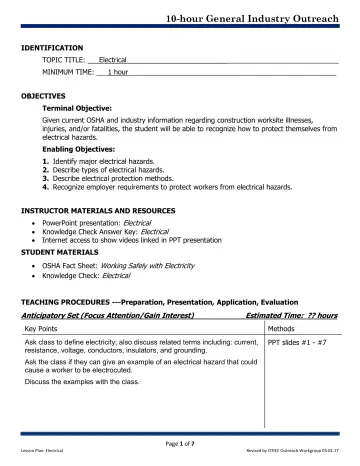
7 slidesElectrical: Lesson Plan (OSHA 10-Hour General Industry Outreach)
Instructor lesson plan (objectives, timing, teaching steps) for the OSHA General Industry electrical outreach deck.
U.S. Department of Labor, OSHA (with the OTIEC Outreach Workgroup)Public domain
pdf
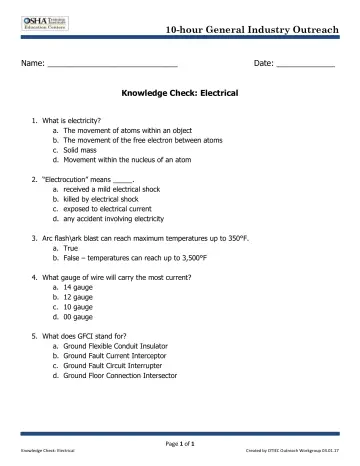
1 slidesElectrical: Knowledge Check (OSHA 10-Hour General Industry Outreach)
Student knowledge-check quiz for the OSHA General Industry electrical outreach deck.
U.S. Department of Labor, OSHA (with the OTIEC Outreach Workgroup)Public domain
pdfes
55 slidesElectricidad (Capacitación de Extensión de 10 horas de OSHA, Industria General)
Spanish edition of OSHA's 10-hour General Industry Outreach deck on electrical (PDF slides; OSHA does not publish an editable Spanish PowerPoint).
U.S. Department of Labor, OSHA (with the OTIEC Outreach Workgroup)Public domain