1 / 15Use ← → to flip
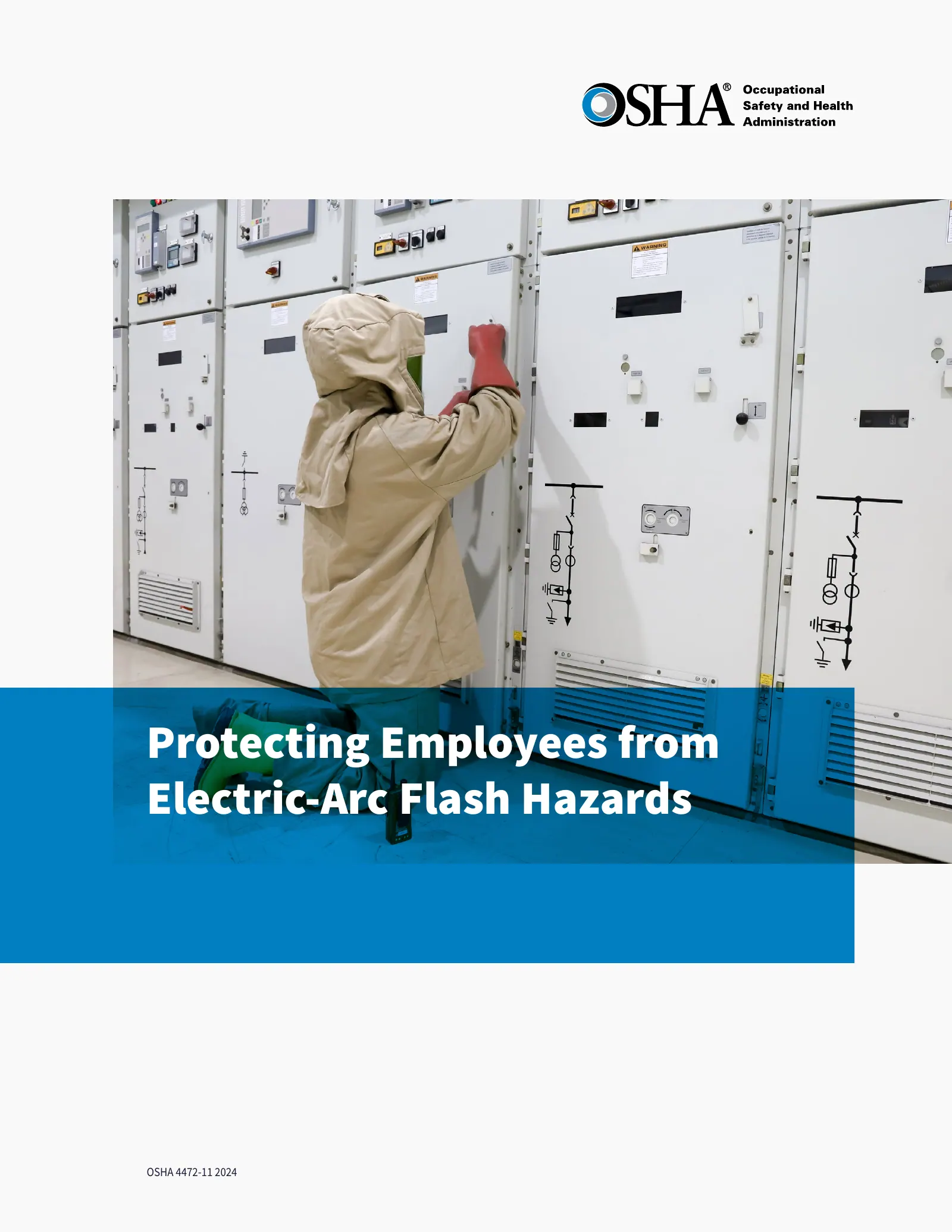
Electrical Safety: Protecting Employees from Electric-Arc Flash Hazards (OSHA 4472)
OSHA booklet, for General Industry classes.
Page text
· 15 pages · by U.S. Department of Labor, OSHA
The words on each page as the author wrote them, read from the file by software so they can be searched. Layout, pictures and tables are not shown here, and long pages are shortened: the pages above and the download are the original.
- Page 1
Protecting Employees from Electric-Arc Flash Hazards
- OSHA 4472-11 2024
- Page 2
- This guidance is not a standard or regulation, and it creates no new legal obligations.
- It contains recommendations as well as descriptions of mandatory safety and health standards. The recommendations are advisory in nature, informational in content, and are intended to assist employers in providing a safe and healthful workplace. The Occupational Safety and Health Act requires employers to comply with safety and health standards and regulations promulgated by OSHA or by a state with an OSHA-approved state plan. In addition, the Act’s General Duty Clause, Section 5(a)(1), requires employers to provide their employees with a workplace free from recognized hazards likely to cause death or serious physical harm.
- Material contained in this publication is in the public domain and may be reproduced, fully or partially, without permission. Source credit is requested but not required.
- This information will be made available to sensory-impaired individuals upon request. Voice phone: (202) 693-1999; teletypewriter (TTY) number: 1-877-889-5627.
- Page 3
Contents
- Introduction … 1
- Addressing Arc Flash Hazards in a Safety and Health Program … 2
- Worker Participation … 3
- Hazard Identification and Assessment … 4
- Limited & Restricted Approach Boundary vs. Arc Flash Boundary … 5
- Difficulties in Determining Arc Flash Incident Energy … 6
- Multiple Calculation Methods … 6
- Working Conditions and Equipment Maintenance … 6
- Hazard Prevention and Control … 7
- Administrative Controls … 7
- Personal Protective Equipment (PPE) … 8
- PPE: Arc-Rated, Rubber Insulated, and Fire-Resistant (FR) Clothing/PPE … 8
- PPE: Arc-Ratings … 8
- Conclusion … 10
- OSHA’s Existing Standards for Working with Electricity … 11
- How OSHA Can Help … 12
- Workers’ Rights … 12
- How to Contact OSHA … 12
- Page 4
Introduction
- Electrical injuries are a serious workplace health and safety issue. This guidance helps employers whose workers interact with live equipment or circuits, and those in power generation, transmission, and distribution to identify, assess, and mitigate arc flash (also known as electric arc) hazards. While arc flash incidents can occur in any setting where employees work with electrical equipment, arc flashes typically involve large electrical panels, motor control centers, electrical switchboards, transformers, disconnect fuses and metal-clad switch gears.
- Research by the Fire Protection Research Foundation, an affiliate of the NFPA, determined that the principal injury events associated with electrical hazards are electric shocks, 1 arc flashes, and arc blasts. 2
- Specific arc flash statistics are difficult to quantify, and multiple sources provide differing information, but they all present alarming data. NFPA estimates, in its 70E Standard for Electrical Safety in the Workplace, that five to ten arc flash explosions occur daily across the US. Similarly, the Industrial Safety and Hygiene News, states that up to ten arc flash incidents occur every day, “totaling more than 3,600 disabling electrical contact injuries each year.” 3
- An electric arc is a type of electrical explosion. The electric arc produces a bright flash, where temperatures can exceed 35,000 °F (19,400 °C), nearly four times
- Electrical worker in protective gear.
- the temperature of the surface of the sun. This energy creates an explosive blast, or arc blast, that produces deafening sound, supersonic concussive forces, and superheated shrapnel.
- Arc flash incidents can ignite clothing, cause structural fires, and produce particles of molten metal, causing severe or even fatal burn injuries. At these high temperatures, most items within 3 feet (0.9 meters), including skin and flammable clothing, will burn, melt, or vaporize. …
- …
- Page 5
Addressing Arc Flash Hazards in a Safety and Health Program
- Before discussing how to identify and mitigate arc flash hazards, two common myths should be addressed. Many workers mistakenly assume that they do not need arc rated or arc flash rated (AR) personal protective equipment (PPE) because either they are not performing energized work. Employees must understand that work on deenergized equipment is not the same as an electrically safe working condition (ESWC). 4 Deenergizing is just one step toward an ESWC, and it does not eliminate electrical hazards. 5
- Additionally, there is a common myth among employees that the justified energized work they are performing is electrically safe. Even when work is considered “justified,”strict safety measures must be implemented and followed to minimize the risks associated with electrical hazards. Justified energized work refers to specific situations where working on or near energized electrical equipment is deemed necessary and “justified” under certain conditions. In some instances, it may not be feasible or practical to deenergize the equipment for maintenance or other tasks (such as interrupting power to a hospital) and de-energization may introduce or create additional hazards.
- OSHA recommends that employers implement a safety and health program. OSHA’s publication, “Recommended Practices for Safety and Health Programs,” www.osha.gov/ safety-management, presents a step-by-step approach to implementing a safety and health program, built around seven core elements that make up a successful program:
- W Management Leadership
- W Worker Participation
- W Hazard Identification and Assessment
- W Hazard Prevention and Control
- W Education and Training
- W Program Evaluation and Improvement
- W Communication and Coordination for Host
- Employers, Contractors, and Staffing Agencies
- This guide shows how management systems can be used to protect workers from arc flash hazards with a focus on worker participation, hazard identification and…
- …
- Page 6
Worker Participation
- To be effective, any safety and health program needs the meaningful participation of workers and their representatives. Workers have much to gain from a successful program, and the most to lose if the program fails. Employers should leverage the firsthand knowledge and experience of their workers who are directly exposed to arc flash risks:
- Worker Participation and Arc Flash Safety
- Encourage Workers to Participate in the Safety and Health Program
- Safety Culture: Create a culture where workers feel comfortable sharing safety concerns and participating in safety programs. Acknowledge and provide positive feedback for workers who raise concerns about arc flash hazards. Managers and supervisors should maintain an environment that invites workers to make safety and health suggestions.
- Encourage Workers to Report Safety and Health
- Concerns
- Reporting Hazards: Establish a system for workers to report potential arc flash hazards without fear of reprisal. Involve workers in finding solutions to any arc flash issues reported.
- Feedback Mechanisms: Regularly review and act on worker feedback to address reported concerns. Ensure workers that reported information will only be used to improve workplace safety.
- Give Workers Access to Safety and Health Information
- Access to Procedures and Guidelines: Ensure workers have up-to-date information on arc flash hazards, safety procedures, required personal protective equipment, and emergency plans.
- Training and Education: Provide access to training materials and sessions on arc flash hazards.
- Involve Workers in All Aspects of the Program
- Collaborate on Procedures: Involve workers in developing and revising safety procedures and procedures for activities involving arc flash hazards. Analyze arc flash hazards in each step of routine and nonroutine jobs, tasks, and processes.
- Customize Training: Design training with worker input to cover relevant arc flash risks and protective measures.
- …
- Page 7
Hazard Identification and Assessment
- Existing regulations require that employers assess the workplace for hazards, including from electric arcs, but do not specify the components of the assessment. The hazard assessment should include: identification of hazards (both electrical and non-electrical); the likelihood of occurrence for each hazard; the severity of harm if the hazard were to occur; and hazard mitigation measures that will reduce the hazard to an acceptable risk.
- To identify and assess potential hazards, employers – in consultation with workers – should review existing information about workplace hazards and periodically conduct an inspection to find additional hazards. Hazards that may lead to arc flashes include:
- W Faulty or malfunctioning electrical equipment,
- W Inadequate installation or maintenance practices,
- Ultimately, arc flashes are less likely to occur when equipment is properly maintained. Having recognized the potential hazards related to arc flashes, employers and workers should assess their likelihood and severity.
- Existing regulations require that employers in the electric power utility industry make an estimate of the “incident heat energy” available at the energized electrical conductor or equipment (29 CFR 1910.269(l)(8)(ii) and
- 29 CFR 1926.960(g)(2)), often referred to as an “arc flash risk assessment.” 6 Incident energy is the amount of heat energy, measured in calories per square centimeter (cal/ cm²), that a worker may be exposed to during an arc flash. This energy can cause burns or other injuries to a worker nearby. The estimate of incident energy will determine:
- W Operating equipment beyond its rated capacity,
- W The distance between the arc flash boundary and the energized source,
- W Unauthorized modifications or alterations to electrical equipment,
- W The incident energy at the working distance, and
- W Lack of proper warning systems, such as warning signs and labels,
- …
- Page 8
Limited & Restricted Approach Boundary vs. Arc Flash Boundary
- Exposed, Energized Electrical Conductor
- NFPA 70E recommends that the closer a worker gets to the electrical hazard the more training and protection they should have. The limited and restricted boundaries are for protecting against electric shock, not against arc flashes:
- W Restricted approach boundary: Inside this boundary is the highest likelihood of electric shock. Under no circumstance should an unqualified worker ever be permitted to cross the restricted boundary. Qualified workers should never enter or take conductive objects within the restricted approach boundary unless they are using appropriate PPE, and the conductive object is insulated.
- W Limited approach boundary: Inside this boundary an electric shock hazard exists. Wherever it is necessary for an unqualified worker to cross the limited approach boundary, the unqualified worker should be supervised by a qualified worker (see 29 CFR 1910.399 or 1926.968) and accompanied while inside the limited approach boundary. However, it is important to note that if the arc flash boundary is within or outside the limited approach boundary, the rules for the arc flash boundary have priority.
- However, the arc flash boundary is specific to arc flash hazards, not electric shock. Additionally, unlike the electric shock boundaries, the arc flash boundary does not follow a set relationship. Specifically, the restricted approach boundary is always inside the limited approach boundary. The arc flash boundary, however, may be inside or outside of either the limited or restricted boundary:
- Limited Approach Boundary
- Restricted Approach Boundary
- Figure 1. The Limited and Restricted Approach
- Boundaries. The Restricted Approach Boundary is ALWAYS inside the Limited Approach Boundary.
- These boundaries serve as the minimum allowable safe limit for a worker, including any conductive tools/ equipment, to approach an energized conductor or circuit part. …
- …
- Page 9
Difficulties in Determining Arc Flash Incident Energy
- Multiple Calculation Methods
- Exposed, Energized Electrical Conductor
- Many organizations and consensus bodies have developed methods to calculate arc flash incident energy levels. 8 These methods vary in applicability, depending on the situation, and the results of the methods may vary dramatically. Employers can more accurately determine the likely incident heat energy to which their workers may be exposed by using multiple methods and utilizing the most reasonable and conservative results.
- Arc Flash Boundary
- Limited Approach Boundary
- Restricted Approach Boundary
- Working Conditions and Equipment
- Maintenance
- If equipment is not properly maintained and kept in good working condition, the calculation of available incident energy may not be accurate. As a result, the approach boundaries may be incorrect, leading to worker exposure to arc flash hazards.
- The amount of incident energy also depends on how fast the faulty component can be isolated from the source of energy. If the protective device isolating the equipment does not operate as intended (e.g., a breaker not opening as quickly as intended), the arc flash energy will be higher than expected during a fault. Employers must inspect and maintain these protective devices in accordance with 29 CFR 1910.334 to ensure they function as designed.
- Additionally, employers should calculate incident energy after each major modification of the electrical system or equipment to account for possible changes in incident energy during an arc flash.
- By identifying and assessing arc flash hazards employers can determine appropriate safeguards to protect their employees.
- Limited Approach
- Boundary
- Restricted Approach
- Boundary
- varies
- Figure 2. Different Arc Flash Boundaries. Unlike the Restricted and Limited Approach Boundaries, the Arc Flash Boundary does not have a set rule for placement. It could be inside or outside the Limited/ Restricted Approach Boundaries.
- …
- Page 10
Hazard Prevention and Control
- The hierarchy of controls ranks safeguards to protect workers from hazards (Figure 3). They are arranged from most to least effective and include: elimination, substitution, engineering controls, administrative controls, and PPE.
- These five levels of the hierarchy can be organized into two groups: preventive and protective controls. Preventive controls – elimination, substitution, and engineering controls – are aimed at eliminating or minimizing hazards at their source to prevent them from occurring in the first place. These controls should be considered first, as they are the most effective in ensuring workplace safety. Protective controls on the other hand – administrative controls and PPE – are measures implemented to minimize the impact of the hazard or reduce workers’ exposure to the hazard. Protective controls are utilized when it is not feasible or practical to eliminate the hazard completely. Employers, in consultation with their workers, should evaluate their safeguards on a regular basis, determine the effectiveness of reducing workers’ exposure, and identify potential improvements.
- Due to the nature of electrical work, many preventive controls will be difficult or impractical to implement (such as redesigning an existing electrical distribution system). As such, employers often rely on protective controls – administrative controls and PPE – to protect their employees.
- The use of administrative controls and PPE require significant and ongoing effort by workers and their supervisors. They are most useful when employers are in the process of implementing other control methods from the hierarchy, when arc flash hazards cannot be reduced to an acceptable level, or to provide an additional layer of protection.
- Administrative Controls
- Administrative controls establish work practices that reduce the duration, frequency, or intensity of exposure to hazards. This may include training, maintenance/ housekeeping, limiting access to…
- …
- Page 11
Personal Protective Equipment (PPE)
- W Providing comprehensive training to personnel on electrical safety and arc flash hazard recognition.
- PPE: Arc-Rated, Rubber Insulated, and Fire-Resistant (FR) Clothing/PPE
- W Ensuring that employees performing the electrical tasks are adequately trained, competent, and certified.
- As discussed above, most arc flash burn injuries occur when the arc ignites flammable clothing and not from the arc itself. Wearing flame-resistant or rubber-insulated PPE does not necessarily provide arc flash protection. Specifically rated PPE, known as arc-rated personal protective equipment (AR PPE), is needed to protect employees from these high temperatures. Employers can stress the importance of wearing the right PPE by using phrases like, “Don’t wear fuel,” to remind workers that proper AR PPE must always be used.
- W Implementing a permit-to-work system that requires authorization and risk assessment before conducting work on or near energized electrical equipment.
- PPE is worn to minimize exposure to hazards. Examples of PPE include shock and arc rated (AR) garments, including clothing, footwear, gloves, safety glasses/face shields, hearing protection, coats, hard hats, and coveralls. When workers use PPE, employers must implement a PPE program according to 29 CFR 1910.132 or 29 CFR 1926.95 & 1926.97. The program must address:
- Additionally, employers should stress the importance of what employees wear under AR PPE, since the arc flash, or the molten metal created, can unpredictably penetrate seams, closures, or flaps and ignite flammable undergarments.
- W Workplace hazards analysis/assessment
- PPE: Arc-Ratings
- W PPE selection and use
- NFPA 70E identifies four categorization levels of AR PPE, where each number represents an increased risk of danger from arc flash events. Category 1 is the lowest level of arc-rated PPE and generally recommends only a single layer of material. …
- …
- Page 12
Arc Flash PPE Category
- Category 1
- Minimum arc rating of 4 cal/cm 2
- Category 2
- Minimum arc rating of 8 cal/cm 2
- Personal Protective Equipment
- Arc-Rated (AR) Clothing
- W Hard hat
- W Hearing protection
- W AR jacket, parka, high-visibility apparel, rainwear, or hard hat liner (AN)
- W Leather footwear (AN)
- W Hard hat
- Category 3
- Minimum arc rating of 25 cal/cm 2
- Protective Equipment
- W Safety glasses or safety goggles
- W Heavy-duty leather gloves, AR gloves, or rubber insulating gloves with leather protectors
- W AR long sleeve shirt
- W Hard hat
- W AR pants
- W AR overall
- W AR flash suit jacket
- W Leather footwear
- W AR flash suit pants
- W AR flash suit hood
- W AR gloves, or rubber insulating gloves with leather protecters
- Category 4
- Minimum arc rating of 40 cal/cm 2
- W Hard hat
- W AR pants
- (AN) – as needed.
- Table 1. NFPA 70E (2021) Arc-Rated PPE Categorization Levels. Credit NFPA
- Page 13
Conclusion
- Some jurisdictions have opted to recognize an additional category of arc-rated PPE. For example, the Canadian Standards Association Workplace Electrical Safety Standard (CSA Z462) has defined a fifth category of arcrated PPE. Category 5 arc-rated PPE is rated to have a minimum arc flash protection of 75 cal/cm 2 (313.8 J/cm 2 ).
- Employers must select appropriate PPE for their workers based on the calculated incident energy, ensuring they are protected from potential arc flash hazards in accordance with 29 CFR 1910.269(l)(8)(v) and 29 CFR
- 1926.960(g)(5).
- Implementing a robust safety and health program can protect workers from arc flash hazards. Safety and health programs foster a proactive approach to “finding and fixing” workplace hazards before they can cause injury or illness. Rather than reacting to an incident, management and workers collaborate to identify and solve issues before they occur. By identifying, assessing, preventing, and controlling the risks associated with arc flash hazards, employers can protect their workers from incidents. Employers should emphasize the distinction between ‘deenergized’ and ‘locked out/tagged out,’ and highlight the consistent use of AR PPE.
- Employers will find that implementing a safety and health program also brings other benefits. Safety and health programs help businesses:
- W Prevent workplace injuries and illnesses,
- W Reduce costs, including significant reductions in workers’ compensation premiums,
- W Engage workers,
- W Enhance their social responsibility goals, and
- W Increase productivity and enhance overall business operations.
- For more information on safety and health programs, please visit: www.osha.gov/safety-management.
- Additionally, employers should share the following arc flash hazards guides specifically tailored to employees:
- W Being Aware of Arc Flash Hazards
- W Electric Work Misconceptions
- W Establishing Boundaries Around Arc Flash Hazards
- W Improve compliance with laws and regulations,
- …
- Page 14
OSHA’s Existing Standards for Working with Electricity
- Broadly, OSHA standards for employees who work with electricity appear in three different sections of the regulations, with a few subdivisions:
- W General Industry, 29 CFR 1910
- Electrical work that involves electric power generation, transmission, and distribution.
- Electrical work that does not involve electric power generation, transmission, and distribution.
- W Construction, 29 CFR 1926
- Electrical work that involves electric power transmission and distribution.
- Electrical work that does not involve electric power transmission and distribution.
- W Maritime Industry, 29 CFR Parts 1915, 1917, and 1918
- Shipyard Employment.
- Marine Terminals.
- Longshoring.
- In both General Industry (29 CFR 1910) and Construction (29 CFR 1926), distinctions are made between the types of electrical work that is being done.
- For electric utility industry work in General Industry, the OSHA electrical regulations are in 29 CFR 1910, Subpart R – Special Industries. Within Subpart R, the regulations are in 29 CFR 1910.269, Electric power, transmission and distribution. For General Industry other than electric utility industry work, the OSHA electrical regulations are in 29 CFR 1910, Subpart S – Electrical,
- 29 CFR 1910.301 through 29 CFR 1910.399.
- For electric utility industry work in Construction, the OSHA electrical regulations are in 29 CFR 1926, Subpart V – Electric Power Transmission and Distribution, 29 CFR 1926.950 through 29 CFR 1926.968 and Appendices A through G. For Construction other than electric utility industry work, the OSHA electrical safety regulations are in 29 CFR 1926, Subpart K – Electrical,
- 29 CFR 1926.400 through 29 CFR 1926.449.
- The employer does not have to be an electric utility for a worker to be covered by 29 CFR 1910.269 or 29 CFR 1926, Subpart V. If the worker is doing utility-type work – that is, their work involves the distribution of electricity throughout a workplace rather than to the use of electricity in the…
- …
- Page 15
How OSHA Can Help
- We have compliance assistance specialists throughout the nation who can provide information to employers and workers about OSHA standards, short educational programs on specific hazards or OSHA rights and responsibilities, and additional compliance assistance resources. Contact your local OSHA office for more information.
- OSHA’s On-Site Consultation Program offers no cost and confidential services to help small and mediumsized businesses find and fix workplace hazards. On-site consultation services are separate from enforcement and do not result in penalties or citations. Visit the nearest Consultation office, or call 1-800-321- OSHA (6742).
- Workers’ Rights
- W Review records of work-related injuries and illnesses.
- W File a complaint asking OSHA to inspect their workplace if they believe there is a serious hazard or that their employer is not following OSHA’s rules. OSHA will keep all identities confidential.
- W Exercise their rights under the law without retaliation, including reporting an injury or raising health and safety concerns with their employer or OSHA. If a worker has been retaliated against for using their rights, they must file a complaint with OSHA as soon as possible, but no later than 30 days.
- For additional information on workers’ rights, visit www.osha.gov/workers.
- Workers have the right to:
- How to Contact OSHA
- W Working conditions that do not pose a risk of serious harm.
- W Receive information and training (in a language and vocabulary the worker understands) about workplace hazards, methods to prevent them and the OSHA standards that apply to their workplace.
- OSHA’s mission is to assure America’s workers have safe and healthful working conditions free from unlawful retaliation. For more information, visit www.osha.gov or call OSHA at 1-800-321-OSHA (6742), TTY 1-877-889-5627.
- OSHA 4472-11 2024
More on Electrical
pptx
55 slidesElectrical (OSHA 10-Hour General Industry Outreach)
OSHA's general industry outreach electrical deck (2017); supplemental slides on shock, GFCIs, cords and lockout.
U.S. Department of Labor, OSHAPublic domain
pdf
7 slidesElectrical: Lesson Plan (OSHA 10-Hour General Industry Outreach)
Instructor lesson plan (objectives, timing, teaching steps) for the OSHA General Industry electrical outreach deck.
U.S. Department of Labor, OSHA (with the OTIEC Outreach Workgroup)Public domain
pdf
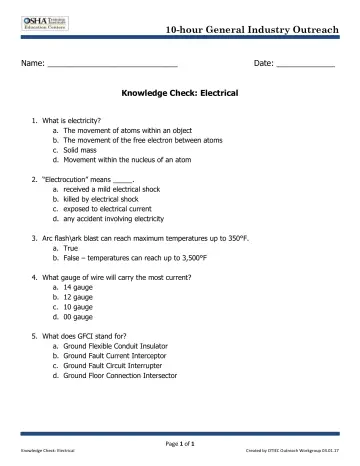
1 slidesElectrical: Knowledge Check (OSHA 10-Hour General Industry Outreach)
Student knowledge-check quiz for the OSHA General Industry electrical outreach deck.
U.S. Department of Labor, OSHA (with the OTIEC Outreach Workgroup)Public domain