1 / 2Use ← → to flip
Electrical Safety: Establishing Boundaries Around Arc Flash Hazards Fact Sheet (OSHA FS-4474)
OSHA fact sheet or bulletin, for General Industry classes.
Page text
· 2 pages · by U.S. Department of Labor, OSHA
The words on each page as the author wrote them, read from the file by software so they can be searched. Layout, pictures and tables are not shown here: the pages above and the download are the original.
- Page 1
Establishing Boundaries Around Arc Flash Hazards
- Arc flash incidents pose significant risks to worker safety. However there are three types of boundaries to consider when approaching energized electrical equipment. It is important to know all approach boundaries and who may cross them and remain safe.
- What is an Arc Flash?
- An electric arc is an electrical explosion that produces a bright flash gas, where temperatures can exceed 35,000 °F (19,400 °C), nearly four times the the heat of the sun’s surface. The energy released in the arc vaporizes the metal conducting the electricity and produces an explosive arc blast with deafening noises, supersonic concussive forces, and super-heated shrapnel.
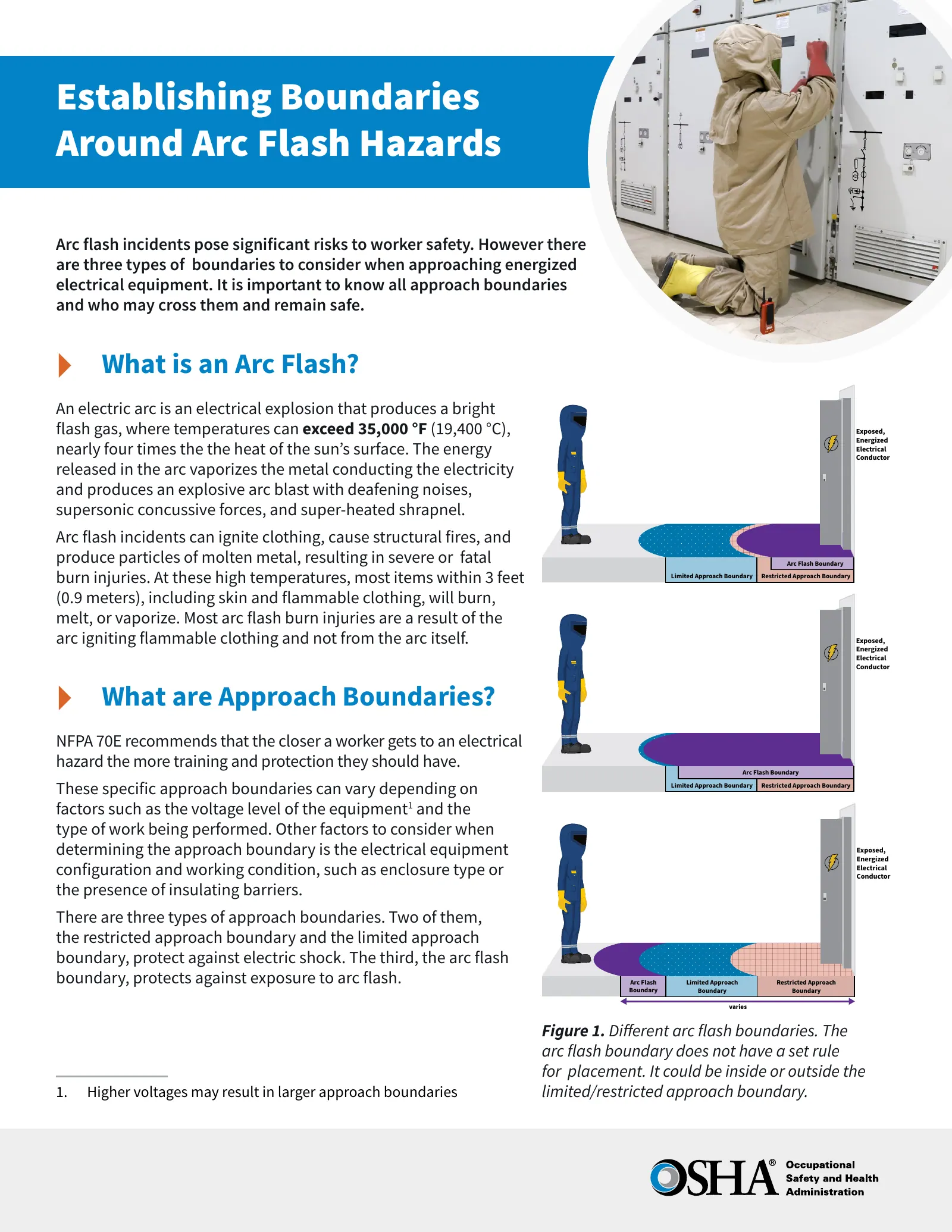
- Exposed, Energized Electrical Conductor
- Arc flash incidents can ignite clothing, cause structural fires, and produce particles of molten metal, resulting in severe or fatal burn injuries. At these high temperatures, most items within 3 feet (0.9 meters), including skin and flammable clothing, will burn, melt, or vaporize. Most arc flash burn injuries are a result of the arc igniting flammable clothing and not from the arc itself.
- Arc Flash Boundary
- Limited Approach Boundary
- Restricted Approach Boundary
- What are Approach Boundaries?
- NFPA 70E recommends that the closer a worker gets to an electrical hazard the more training and protection they should have.
- These specific approach boundaries can vary depending on factors such as the voltage level of the equipment 1 and the type of work being performed. Other factors to consider when determining the approach boundary is the electrical equipment configuration and working condition, such as enclosure type or the presence of insulating barriers.
- There are three types of approach boundaries. Two of them, the restricted approach boundary and the limited approach boundary, protect against electric shock. The third, the arc flash boundary, protects against exposure to arc flash.
- Limited Approach
- Boundary
- Restricted Approach
- Boundary
- varies
- Higher voltages may result in larger approach boundaries
- Figure 1. Different arc flash boundaries. The arc flash boundary does not have a set rule for placement. It could be inside or outside the limited/restricted approach boundary.
- Page 2
Workers’ Rights
- W Restricted approach boundary: Inside this boundary is the highest likelihood of electric shock. Under no circumstance should an unqualified worker ever be permitted to cross the restricted boundary. Qualified workers 2 should never enter or take conductive objects within the restricted approach boundary unless they are using appropriate PPE, and the conductive object is insulated.
- W Limited approach boundary: Inside this boundary an electric shock hazard exists. Wherever it is necessary for an unqualified worker to cross the limited approach boundary, the unqualified worker should be supervised by a qualified worker and accompanied while inside the limited approach boundary. However, it’s important to note that if the arc flash boundary is within or outside the limited approach boundary, the rules for the arc flash boundary have priority (see below).
- W Arc flash boundary: At this boundary a worker without appropriate PPE could receive second degree burns from an arc flash. 3 An unqualified worker may cross the arc flash boundary only if wearing appropriate protective equipment and under the close supervision of a qualified employee.
- The arc flash boundary does not have a direct relationship with the electric shock approach boundaries (see Figure 1). While the restricted approach boundary is always within the limited approach boundary, the arc flash boundary can be either inside (see top and middle of Figure 1) or outside (see bottom of Figure 1) of these boundaries. Whenever there is a likelihood of arc flash incident, use both the arc flash boundary and the limited/restricted approach boundaries to ensure worker safety.
- Workers have the right to:
- W Working conditions that do not pose a risk of serious harm.
- W Receive information and training (in a language and vocabulary the worker understands) about workplace hazards, methods to prevent them, and the OSHA standards that apply to their workplace.
- W Review records of work-related injuries and illnesses.
- W File a complaint asking OSHA to inspect their workplace if they believe there is a serious hazard or that their employer is not following OSHA’s rules. OSHA will keep all identities confidential.
- W Exercise their rights under the law without retaliation, including reporting an injury or raising health and safety concerns with their employer or OSHA. If a worker has been retaliated against for using their rights, they must file a complaint with OSHA as soon as possible, but no later than 30 days.
- For additional information see OSHA’s Worker Rights page, www.osha.gov/workers.
- Contact OSHA
- OSHA’s mission is to assure America’s workers have safe and healthful working conditions free from unlawful retaliation. OSHA carries out its mission by setting and enforcing standards; enforcing anti-retaliation provisions of the OSH Act and other federal whistleblower laws; providing and supporting training, outreach, education, and assistance; and ensuring state OSHA programs are at least as effective as federal OSHA, furthering a national system of worker safety and health protections. For more information, visit www.osha.gov, or call OSHA at 1-800-321-OSHA (6742), TTY 1-877-889-5627.
- According to 29 CFR 1910.399: Qualified person. One who has received training in and has demonstrated skills and knowledge in the construction and operation of electric equipment and installations and the hazards involved.
- According to NFPA 70E the arc flash boundary is the distance from an exposed energized electrical conductor or circuit part where the incident energy equals 1.2 cal/cm 2 (5.02 J/cm 2 ).
- OSHA FS-4474 11/2024
More on Electrical
pptx
55 slidesElectrical (OSHA 10-Hour General Industry Outreach)
OSHA's general industry outreach electrical deck (2017); supplemental slides on shock, GFCIs, cords and lockout.
U.S. Department of Labor, OSHAPublic domain
pdf
7 slidesElectrical: Lesson Plan (OSHA 10-Hour General Industry Outreach)
Instructor lesson plan (objectives, timing, teaching steps) for the OSHA General Industry electrical outreach deck.
U.S. Department of Labor, OSHA (with the OTIEC Outreach Workgroup)Public domain
pdf
1 slidesElectrical: Knowledge Check (OSHA 10-Hour General Industry Outreach)
Student knowledge-check quiz for the OSHA General Industry electrical outreach deck.
U.S. Department of Labor, OSHA (with the OTIEC Outreach Workgroup)Public domain