1 / 71Use ← → to flip
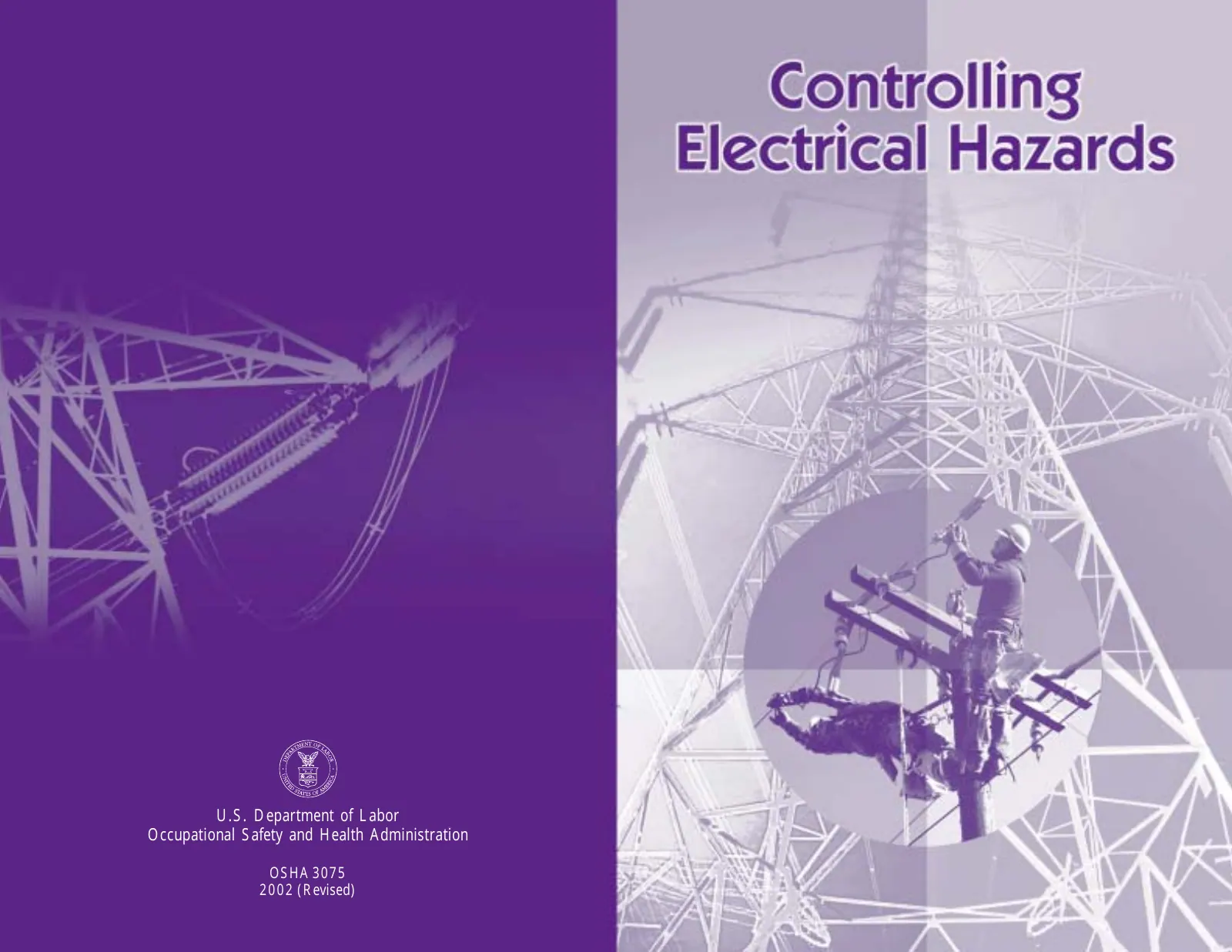
Electrical Hazards: Controlling Electrical Hazards (OSHA 3075)
OSHA booklet on how electricity injures and how to control electrical hazards.
Page text
· 71 pages · by U.S. Department of Labor, OSHA
The words on each page as the author wrote them, read from the file by software so they can be searched. Layout, pictures and tables are not shown here, and long pages are shortened: the pages above and the download are the original.
- Page 1
U.S. Department of Labor
- Occupational Safety and Health Administration
- OSHA 3075
- 2002 (Revised)
- Page 2
U.S. Department of Labor Elaine L. Chao, Secretary
- Occupational Safety and Health Administration
- John L. Henshaw, Assistant Secretary
- OSHA 3075
- 2002 (Revised)
- This booklet provides a generic overview of a standards-related topic. This publication does not alter or determine compliance responsibilities, which are described in the OSHA standards and the Occupational Safety and Health Act. …
- …
- Page 3
Contents
- Introduction … 1
- Why should you be concerned about electrical hazards? … 2
- What OSHA standards address electrical safety? … 3
- How do OSHA’s standards minimize electrical hazards? … 4
- Electricity: The Basics … 5
- What affects the flow of electricity? … 5
- How does water affect the flow of electricity? … 5
- What causes shocks? … 5
- What effect do shocks have on the body? … 6
- What kind of burns can a shock cause? … 8
- …
- Page 4
What are circuit protection devices and how do they work? … 14
- What work practices help protect you against electrical hazards? … 15
- How can you protect yourself against metal parts that become energized? … 15
- How can you prevent an accidental or unexpected equipment startup? … 16
- How can you protect yourself from overhead power lines? … 17
- What protection does personal equipment offer? … 18
- …
- Page 5
How does the Voluntary Protection Program work? … 24
- How does VPP help employers and employees? … 24
- How does OSHA monitor VPP sites? … 25
- Can OSHA inspect an employer who is participating in the VPP? … 25
- How can a partnership with OSHA improve worker safety and health? … 25
- What is OSHA’s Strategic Partnership
- Program (OSPP)? … 26
- What do OSPPs do? … 26
- Are there different kinds of OSPPs? … 26
- …
- Page 6
Introduction
- his booklet provides an overview of basic electrical safety on the job.
- Electricity is essential to modern life, both at home and on the job. Some employees — engineers, electricians, electronic technicians, and power line workers, among them — work with electricity directly. Others, such as office workers and sales people, work with it indirectly. …
- …
- Page 7
Why should you be concerned about electrical hazards?
- Electricity has long been recognized as a serious workplace hazard, exposing employees to electric shock, electrocution, burns, fires, and explosions. In 1999, for example, 278 workers died from electrocutions at work, accounting for almost 5 percent of all on-the-job fatalities that year, according to the Bureau of Labor Statistics. …
- …
- Page 8
What OSHA standards address electrical safety?
- OSHA standards cover many electrical hazards in many different industries. OSHA’s general industry electrical safety standards are published in Title 29 Code of Federal Regulations (CFR), Part 1910.302 through 1910.308 — Design Safety Standards for Electrical Systems, and 1910.331 through 1910.335 — Electrical Safety-Related Work Practices Standards.
- …
- Page 9
How do OSHA’s standards minimize electrical hazards?
- OSHA standards focus on the design and use of electrical equipment and systems. The standards cover only the exposed or operating elements of an electrical installation such as lighting, equipment, motors, machines, appliances, switches, controls, and enclosures, requiring that they be constructed and installed to minimize workplace electrical dangers. …
- …
- Page 10
Electricity: The Basics
- What affects the flow of electricity?
- Electricity flows more easily through some materials than others. Some substances such as metals generally offer very little resistance to the flow of electric current and are called “conductors.” A common but perhaps overlooked conductor is the surface or subsurface of the earth. …
- …
- Page 11
What effect do shocks have on the body?
- electric circuit. This can cause an electrical shock. Shocks occur when a person’s body completes the current path with:
- both wires of an electric circuit;
- one wire of an energized circuit and the ground;
- a metal part that accidentally becomes energized due, for example, to a break in its insulation; or
- another “conductor” that is carrying a current.
- …
- Page 12
Effects of Electric Current in the Human Body
- Current
- Reaction
- Below 1 milliampere
- Generally not perceptible
- 1 milliampere
- Faint tingle
- 5 milliamperes
- Slight shock felt; not painful but disturbing. Average individual can let go. Strong involuntary reactions can lead to other injuries.
- 6–25 milliamperes (women) Painful shock, loss of muscular control*
- 9–30 milliamperes (men)
- …
- Page 13
What kind of burns can a shock cause?
- Burns are the most common shock-related injury.
- An electrical accident can result in an electrical burn, arc burn, thermal contact burn, or a combination of burns.
- Electrical burns are among the most serious burns and require immediate medical attention. They occur when electric current flows through tissues or bone, generating heat that causes tissue damage.
- …
- Page 14
What should you do if someone “freezes” to a live electrical contact?
- The longer the exposure, the greater the risk of serious injury. Longer exposures at even relatively low voltages can be just as dangerous as short exposures at higher voltages. Low voltage does not imply low hazard.
- In addition to muscle contractions that cause “freezing,” electrical shocks also can cause involuntary muscle reactions. …
- …
- Page 15
What is the danger of static electricity?
- Static electricity also can cause a shock, though in a different way and generally not as potentially severe as the type of shock described previously. Static electricity can build up on the surface of an object and, under the right conditions, can discharge to a person, causing a shock.
- The most familiar example of this is when a person reaches for a door knob or other metal…
- …
- Page 16
Protection Against Electrical Hazards
- What is the best way to protect yourself against electrical hazards?
- Most electrical accidents result from one of the following three factors:
- unsafe equipment or installation,
- unsafe environment, or
- unsafe work practices.
- Some ways to prevent these accidents are through the use of insulation, guarding, grounding, electrical protective devices, and safe work practices.
- …
- Page 17
What is guarding and what protection does it offer?
- Before connecting electrical equipment to a power source, it’s a good idea to check the insulation for any exposed wires for possible defects. Insulation covering flexible cords such as extension cords is particularly vulnerable to damage.
- The insulation that covers conductors in non-construction applications is regulated by Subpart S of 29 CFR 1910.302 through…
- …
- Page 18
What is grounding and what protection does it offer?
- “Grounding” a tool or electrical system means intentionally creating a low-resistance path that connects to the earth. This prevents the buildup of voltages that could cause an electrical accident.
- Grounding is normally a secondary protective measure to protect against electric shock. It does not guarantee that you won’t get a shock or be injured or killed by an…
- …
- Page 19
What are circuit protection devices and how do they work?
- Circuit protection devices limit or stop the flow of current automatically in the event of a ground fault, overload, or short circuit in the wiring system. Well-known examples of these devices are fuses, circuit breakers, ground-fault circuit interrupters, and arc-fault circuit interrupters.
- …
- Page 20
What work practices help protect you against electrical hazards?
- Electrical accidents are largely preventable through safe work practices. Examples of these practices include the following:
- deenergizing electric equipment before inspection or repair,
- keeping electric tools properly maintained,
- exercising caution when working near energized lines, and
- using appropriate protective equipment.
- …
- Page 21
How can you prevent an accidental or unexpected equipment startup?
- Another form of protection is to use listed or labeled portable tools and appliances protected by an approved system of double insulation or its equivalent. Where such a system is employed, it must be marked distinctively to indicate that the tool or appliance uses an approved double insulation system.
- …
- Page 22
How can you protect yourself from overhead power lines?
- Before working under or near overhead power lines, ensure that you maintain a safe distance to the lines and, for very high-voltage lines, ground any equipment such as cranes that can become energized. If working on power lines, ensure that the lines have been deenergized and grounded by the owner or operator of the lines. …
- …
- Page 23
What protection does personal equipment offer?
- Employees who work directly with electricity should use the personal protective equipment required for the jobs they perform. This equipment may include rubber insulating gloves, hoods, sleeves, matting, blankets, line hose, and industrial protective helmets designed to reduce electric shock hazard. All help reduce the risk of electrical accidents.
- What role do tools play?
- …
- Page 24
What’s the value of a safety and health program in controlling electrical hazards?
- Every good safety and health program provides measures to control electrical hazards. The measures suggested in this booklet should be helpful in establishing such a program. The responsibility for this program should be delegated to someone with a complete knowledge of electricity, electrical work practices, and the appropriate OSHA…
- …
- Page 25
How Can OSHA Help Me?
- OSHA can provide extensive help through a variety of programs, including assistance about safety and health programs, state plans, workplace consultations, voluntary protection programs, strategic partnerships, training and education, and more.
- How does safety and health program management assistance help employers and employees?
- …
- Page 26
What are state plans?
- State plans are OSHA-approved job safety and health programs operated by individual states or territories instead of Federal OSHA. The Occupational Safety and Health
- Act of 1970 (OSH Act) encourages states to develop and operate their own job safety and health plans and permits state enforcement of OSHA standards if the state has an approved plan. …
- …
- Page 27
Who can get consultation assistance and what does it cost?
- Consultation assistance is available to small employers (with fewer than 250 employees at a fixed site and no more than 500 corporatewide) who want help in establishing and maintaining a safe and healthful workplace.
- Funded largely by OSHA, the service is provided at no cost to the employer. Primarily developed for smaller employers with more hazardous…
- …
- Page 28
Does OSHA provide any incentives for seeking consultation assistance?
- Yes. Under the consultation program, certain exemplary employers may request participation in OSHA’s Safety and Health Achievement Recognition Program (SHARP). Eligibility for participation in SHARP includes, but is not limited to, receiving a full-service, comprehensive consultation visit, correcting all identified hazards, and developing an…
- …
- Page 29
How does the Voluntary Protection Program work?
- There are three levels of VPPs: Star, Merit, and Demonstration. All are designed to do the following:
- recognize employers who have successfully developed and implemented effective and comprehensive safety and health management systems;
- encourage these employers to continuously improve their safety and health management systems;
- …
- Page 30
How does OSHA monitor VPP sites?
- OSHA reviews an employer’s VPP application and conducts a VPP onsite evaluation to verify that the safety and health management systems described are operating effectively at the site. OSHA conducts onsite evaluations on a regular basis, annually for participants at the Demonstration level, every 18 months for Merit, and every 3 to 5 years for Star. …
- …
- Page 31
What is OSHA’s Strategic Partnership Program (OSPP)?
- OSHA Strategic Partnerships are alliances among labor, management, and government to foster improvements in workplace safety and health. These partnerships are voluntary, cooperative relationships between OSHA, employers, employee representatives, and others such as trade unions, trade and professional associations, universities, and other government agencies. …
- …
- Page 32
What are the benefits of participation in the OSPP?
- OSHA is interested in creating new OSPPs at the national, regional, and local levels. OSHA also has found limited partnerships to be valuable. Limited partnerships might address the elimination or control of a specific industry hazard.
- Like VPP, OSPP can mean the following:
- fewer worker fatalities, injuries, and illnesses;
- …
- Page 33
Does OSHA have occupational safety and health training for employers and employees?
- Yes. The OSHA Training Institute in Des Plaines, IL, provides basic and advanced training and education in safety and health for federal and state compliance officers, state consultants, other federal agency personnel, and privatesector employers, employees, and their representatives.
- …
- Page 34
Does OSHA give money to organizations for training and education?
- OSHA awards grants through its Susan Harwood Training Grant Program to nonprofit organizations to provide safety and health training and education to employers and workers in the workplace. The grants focus on programs that will educate workers and employers in small business (fewer than 250 employees), training workers and employers about new OSHA…
- …
- Page 35
Does OSHA have other assistance materials available?
- OSHA has a variety of materials and tools available on its website at www.osha.gov. These include e-Tools such as Expert Advisors and Electronic Compliance Assistance Tools (e-CATs), Technical Links, regulations, directives, publications, videos, and other information for employers and employees. …
- …
- Page 36
OSHA Offices
- OSHA Regional Offices
- Region I
- (CT,* ME, MA, NH, RI, VT*)
- JFK Federal Building, Room E340
- Boston, MA 02203
- (617) 565-9860
- Region II
- (NJ,* NY,* PR,* VI*)
- 201 Varick Street, Room 670
- New York, NY 10014
- (212) 337-2378
- Region III
- (DE, DC, MD,* PA,* VA,* WV) The Curtis Center
- 170 S. Independence Mall West Suite 740 West
- Philadelphia, PA 19106-3309 (215) 861-4900
- Region IV
- …
- Page 37
Region VI
- (AR, LA, NM,* OK, TX)
- 525 Griffin Street, Room 602
- Dallas, TX 75202
- (214) 767-4731 or 4736 x224
- Region VII
- (IA,* KS, MO, NE)
- City Center Square
- 1100 Main Street, Suite 800
- Kansas City, MO 64105
- (816) 426-5861
- Region VIII
- (CO, MT, ND, SD, UT,* WY*)
- 1999 Broadway, Suite 1690
- PO Box 46550
- Denver, CO 80202-5716
- (303) 844-1600
- Region IX
- (American Samoa, AZ,* CA,* HI, NV,* Northern Mariana Islands)
- …
- Page 38
OSHA Area Offices
- Alabama
- U.S. Department of Labor—OSHA Vestavia Village, 2047 Canyon Road Birmingham, AL 35216–1981 (205) 731-1534
- U.S. Department of Labor—OSHA 3737 Government Boulevard, Suite 100 Mobile, AL 36693-4309
- (251) 441-6131
- Alaska
- U.S. Department of Labor—OSHA 301 W. Northern Lights Blvd, Suite 407 Anchorage, AK 99503
- (907) 271-5152
- Arizona
- …
- Page 39
U.S. Department of Labor—OSHA
- 101 El Camino Plaza, Suite 105
- Sacramento, CA 95815
- (916) 566-7471
- Colorado
- U.S. Department of Labor—OSHA 1391 Speer Boulevard, Suite 210 Denver, CO 80204-2552
- (303) 844-5285
- U.S. Department of Labor—OSHA 7935 East Prentice Avenue, Suite 209 Greenwood Village, CO 80111-2714 (303) 843-4500
- Connecticut
- 1057 Broad Street, Fourth Floor
- Bridgeport, CT 06604
- (203) 579-5581
- Federal Building
- …
- Page 40
Florida
- U.S. Department of Labor—OSHA 8040 Peters Road, Building H-100 Fort Lauderdale, FL 33324
- (954) 424-0242
- U.S. Department of Labor—OSHA
- Ribault Building, Suite 227
- 1851 Executive Center Drive
- Jacksonville, FL 32207
- (904) 232-2895
- 5807 Breckenridge Parkway, Suite A Tampa, FL 33610-4249
- (813) 626-1177
- Georgia
- 450 Mall Boulevard, Suite J
- Savannah, GA 31406
- (912) 652-4393
- 2400 Herodian Way, Suite 250
- …
- Page 41
Idaho
- U.S. Department of Labor—OSHA 1150 North Curtis Road, Suite 201 Boise, ID 83706
- (208) 321-2960
- Illinois
- U.S. Department of Labor—OSHA 1600 167th Street, Suite 9
- Calumet City, IL 60409
- (708) 891-3800
- U.S. Department of Labor—OSHA O’hara Plaza
- 701 Lee Street, Suite #950
- Des Plaines, IL 60016
- (847) 803-4800
- U.S. Department of Labor—OSHA 11 Executive Drive, Suite 11
- Fairview Heights, IL 62208
- (618) 632-8612
- …
- Page 42
Iowa
- U.S. Department of Labor—OSHA 210 Walnut Street, Room 815
- Des Moines, IA 50309
- (515) 284-4794
- Kansas
- U.S. Department of Labor—OSHA 217 W. 3rd Street North
- Room #400
- Wichita, KS 67202
- (316) 269-6644
- Kentucky
- U.S. Department of Labor—OSHA John C. Watts Federal Building
- 330 W. Broadway, Room 108
- Frankfort, KY 40601-1922
- (502) 227-7024
- Louisiana
- U.S. Department of Labor—OSHA 9100 Bluebonnet Centre Boulevard Suite 201
- …
- Page 43
Maryland
- U.S. Department of Labor—OSHA 1099 Winterson Road, Suite 140
- Linthicum, MD 21090-2218
- (410) 865-2055/2056
- Massachusetts
- U.S. Department of Labor—OSHA 639 Granite Street, 4th Floor
- Braintree, MA 02184
- (617) 565-6924
- U.S. Department of Labor—OSHA Valley Office Park
- 13 Branch Street
- Methuen, MA 01844
- (617) 565-8110
- U.S. Department of Labor—OSHA 1441 Main Street, Room 550
- Springfield, MA 01103-1493
- (413) 785-0123
- …
- Page 44
Mississippi
- U.S. Department of Labor—OSHA 3780 I-55 North, Suite 210
- Jackson, MS 39211-6323
- (601) 965-4606
- Missouri
- U.S. Department of Labor—OSHA 6200 Connecticut Avenue, Suite 100 Kansas City, MO 64120
- (816) 483-9531
- U.S. Department of Labor—OSHA 911 Washington Avenue, Room 420 St. Louis, MO 63101
- (314) 425-4249
- Montana
- U.S. Department of Labor—OSHA 2900 4th Avenue North, Suite 303 Billings, MT 59101
- (406) 247-7494
- …
- Page 45
New Hampshire
- U.S. Department of Labor—OSHA 279 Pleasant Street, Suite 201
- Concord, NH 03301
- (603) 225-1629
- New Jersey
- U.S. Department of Labor—OSHA 1030 St. Georges Avenue
- Plaza 35, Suite 205
- Avenel, NJ 07001
- (732) 750-3270
- U.S. Department of Labor—OSHA 500 Route 17 South, 2nd Floor
- Hasbrouck Heights, NJ 07604
- (201) 288-1700
- U.S. Department of Labor—OSHA Marlton Executive Park, Building 2 701 Route 73 South, Suite 120…
- …
- Page 46
U.S. Department of Labor—OSHA
- 5360 Genesee Street
- Bowmansville, NY 14026
- (716) 684-3891
- 201 Varick Street, Room #646
- New York, NY 10014
- (212) 337-2636
- 3300 Vickery Road
- North Syracuse, NY 13212
- (315) 451-0808
- 660 White Plains Road, 4th Floor
- Tarrytown, NY 10591-5107
- (914) 524-7510
- U.S. Department of Labor—OSHA 1400 Old Country Road, Room 208 Westbury, NY 11590
- (516) 334-3344
- North Carolina
- …
- Page 47
Ohio
- U.S. Department of Labor—OSHA
- 36 Triangle Park Drive
- Cincinnati, OH 45246
- (513) 841-4132
- Federal Office Building
- 1240 East 9th Street, Room 899
- Cleveland, OH 44199
- (216) 522-3818
- U.S. Department of Labor—OSHA Federal Office Building
- 200 North High Street, Room 620 Columbus, OH 43215
- (614) 469-5582
- 420 Madison Avenue
- Suite 600
- Toledo, OH 43604
- (419) 259-7542
- Oklahoma
- 55 North Robinson, Suite 315
- …
- Page 48
Pennsylvania
- U.S. Department of Labor—OSHA
- 850 North 5th Street
- Allentown, PA 18102
- (610) 776-0592
- U.S. Department of Labor—OSHA 3939 West Ridge Road, Suite B12 Erie, PA 16506-1887
- (814) 833-5758
- Progress Plaza
- 49 North Progress Avenue
- Harrisburg, PA 17109
- (717) 782-3902
- U.S. Custom House, Room 242
- Second and Chestnut Streets
- Philadelphia, PA 19106-2902
- (215) 597-4955
- …
- Page 49
Puerto Rico
- U.S. Department of Labor—OSHA
- Triple SSS Plaza Building
- 1510 F. D. Roosevelt Avenue, Suite 5B Guaynabo, PR 00968
- (787) 277-1560
- Rhode Island
- Federal Office Building
- 380 Westminster Mall, Room 543
- Providence, RI 02903
- (401) 528-4669
- South Carolina
- U.S. Department of Labor—OSHA 1835 Assembly Street, Room 1468 Columbia, SC 29201-2453
- (803) 765-5904
- Tennessee
- …
- Page 50
U.S. Department of Labor—OSHA
- Wilson Plaza
- 606 N. Carancahua, Suite 700
- Corpus Christi, TX 78476
- (361) 888-3420
- 8344 East R.L. Thornton Freeway, Suite 420 Dallas, TX 75228
- (214) 320-2400 (2558)
- 700 E San Antonio St.
- Room C-408
- El Paso, TX 79901
- (915) 534-6251
- North Starr II, Suite 302
- 8713 Airport Freeway
- Fort Worth, TX 76180-7610
- (817) 428-2470 (485-7647)
- 507 N. Sam Houston Parkway, Suite 400 Houston, TX 77060
- …
- Page 51
Utah
- U.S. Depaartment of Labor—OSHA 160 E 300 South
- Heber-Wells Building
- P. O. Box 146650
- Salt Lake City, UT 84114-6650
- (801) 530-6901
- Virginia
- U.S. Department of Labor—OSHA Federal Office Building
- 200 Granby Street, Room 614
- Norfolk, VA 23510
- (757) 441-3820
- Washington
- U.S. Department of Labor—OSHA 505 106th Avenue, NE, Suite 302 Bellevue, WA 98004
- (206) 553-7520
- West Virginia
- …
- Page 52
U.S. Department of Labor—OSHA
- 1310 West Clairmont Avenue
- Eau Claire, WI 54701
- (715) 832-9019
- 4802 E. Broadway
- Madison, WI 53716
- (608) 264-5388
- U.S. Department of Labor—OSHA Henry S. Reuss Building
- 310 W. Wisconsin Ave, Suite 1180 Milwaukee, WI 53203
- (414) 297-3315
- For issues involving federal agencies or private companies working for federal agencies in Arizona, California, Guam, Hawaii, and Nevada, call the numbers…
- …
- Page 53
States and Territories with OSHA- Approved Safety and Health Plans
- Alaska
- Commissioner
- Alaska Department of Labor
- 1111 W. 8th Street, Room 308
- P.O. Box 21149
- Juneau, AK 99802-1149
- (907) 465-2700
- Arizona
- Director
- Industrial Commission of Arizona
- 800 W. Washington
- Phoenix, AZ 85007
- (602) 542-5795
- California
- Director
- California Department of Industrial Relations 455 Golden Gate Avenue, 10th floor
- San Francisco, CA 94102
- …
- Page 54
Indiana
- Commissioner
- Indiana Department of Labor
- State Office Building
- 402 West Washington Street, Room W195 Indianapolis, IN 46204
- (317) 232-2378
- Iowa
- Iowa Division of Labor 1000 E. Grand Avenue Des Moines, IA 50319 (515) 281-3447
- Kentucky
- Secretary
- Kentucky Labor Cabinet
- 1047 U.S. Highway 127 South, Suite 4
- Frankfort, KY 40601
- (502) 564-3070
- Maryland
- …
- Page 55
Minnesota
- Commissioner
- Minnesota Department of Labor and Industry 443 Lafayette Road
- St. Paul, MN 55155
- (651) 284-5010
- Nevada
- Administrator
- Nevada Division of Industrial Relations
- 400 West King Street, Suite 400
- Carson City, NV 89703
- (775) 684-7260
- New Jersey
- New Jersey Department of Labor
- John Fitch Plaza — Labor Building
- Market and Warren Streets
- P.O. Box 110
- Trenton, NJ 08625-0110
- (609) 292-2975
- New Mexico
- Secretary
- …
- Page 56
North Carolina
- Commissioner
- North Carolina Department of Labor
- 4 West Edenton Street
- Raleigh, NC 27601-1092
- (919) 807-2900
- Oregon
- Administrator
- Oregon Department of Consumer and Business Services Occupational Safety and Health Division (OR-OSHA) 350 Winter Street, N.E. Room 430
- Salem, OR 97310-3882
- (503) 378-3272
- Puerto Rico
- Secretary
- Puerto Rico Department of Labor and Human Resources Prudencio Rivera Martinez Building
- …
- Page 57
Utah
- Commissioner
- Labor Commission of Utah
- 160 East 300 South Street, 3rd floor
- P.O. Box 146650
- Salt Lake City, UT 84111
- (801) 530-6901
- Vermont
- Vermont Department of Labor and Industry National Life Building, Drawer 20
- 120 State Street
- Montpelier VT 05620-3401
- (802) 828-2288
- Virgin Islands
- Virgin Islands Department of Labor
- 2203 Church Street
- Christiansted, St. Croix, VI 00820-4660 (340) 773-1990
- Virginia
- …
- Page 58
Wyoming
- Administrator
- Worker’s Safety and Compensation
- Division (WSC)
- Wyoming Department of Employment Herschler Building, 2nd Floor East
- 122 West 25th Street
- Cheyenne, WY 82002
- (307) 777-7786
- Page 59
OSHA Onsite Consultation Offices
- Alabama
- Safety State Program University of Alabama 432 Martha Parham West
- Post Office Box 870388
- Tuscaloosa, AL 35487
- (205) 348-3033
- Alaska
- Consultation Section
- ADOL/AKOSH
- 3301 Eagle Street
- Post Office Box 107022
- Anchorage, AK 99510-7022
- (907) 269-4957
- Arizona
- Consultation and Training
- Division of Occupational Safety & Health Industrial Commission of Arizona
- 800 West Washington
- …
- Page 60
Colorado
- Occupational Safety and Health Section
- Colorado State University
- 133 Environmental Health Building
- Fort Collins, CO 80523
- (970) 491-6151
- Connecticut
- Division of Occupational Safety and Health Connecticut Department of Labor
- 38 Wolcott Hill Road
- Wethersfield, CT 06109
- (860) 566-4550
- Delaware
- Occupational Safety and Health Division of Industrial Affairs Delaware Department of Labor 4425 North Market Street…
- …
- Page 61
Georgia
- Onsite Consultation Program
- Georgia Institute of Technology
- O’Keefe Building, Room 22
- 151 6th Street, N.W.
- Atlanta, GA 30332-0837
- (404) 894-2643
- Guam
- OSHA Onsite Consultation
- Dept. of Labor, Government of Guam
- 107 F Street
- Tiyam, GU 96931
- 9-1-(671) 475-1101
- Hawaii
- Consultation and Training Branch
- Dept of Labor and Industrial Relations
- 830 Punchbowl Street
- Honolulu, HI 96813
- (808) 586-9100
- Idaho
- …
- Page 62
Indiana
- Division of Labor
- Bureau of Safety, Education and Training Room W195
- 402 West Washington
- Indianapolis, IN 46204-2287
- (317) 232-2688
- Iowa
- Iowa Workforce Development Labor Services Bureau of Consultation and Education
- 1000 East Grand Avenue
- Des Moines, IA 50319
- (515) 281-7629
- Kansas
- 21D Consultation Program
- Kansas Department of Human Resources 512 South West 6th Street
- Topeka, KS 66603-3150
- (785) 296-2551
- Kentucky
- …
- Page 63
Maine
- Division of Industrial Safety
- Maine Bureau of Labor Standards
- Workplace Safety and Health Division
- State House Station #45
- Augusta, ME 04333-0045
- (207) 624-6400
- Maryland
- MOSH Consultation Services Attention: Ms. Colleen Ridler 312 Marshall Avenue Rm 600 Laurel, MD 20707
- (410) 880-4970
- Massachusetts
- Division of Occupational Safety and Health Department of Workforce Development 1001 Watertown Street
- …
- Page 64
Mississippi
- Mississippi State University Center for Safety and Health 106 Crosspark Drive, Suite C Pearl, MS 39216
- (601) 939-2047
- Missouri
- Onsite Consultation Program
- Division of Labor Standards
- Department of Labor and Industrial Relations 3315 West Truman Boulevard, Room 205 Post Office Box 449
- Jefferson City, MO 65109
- (573) 751-3403
- Montana
- Department of Labor and Industry
- Bureau of Safety
- Post Office Box 1728
- …
- Page 65
New Hampshire
- Department of Health and Human Services Office of Community & Public Health
- 6 Hazen Drive
- Concord, NH 03301-6527
- (603) 271-2024
- New Jersey
- New Jersey Department of Labor
- Division of Public Safety and Occupational Safety and Health
- 225 E. State Street, 8th Floor West
- P.O. Box 953
- Trenton, NJ 08625-0953
- (609) 292-3923
- New Mexico
- …
- Page 66
North Dakota
- Division of Environmental Engineering
- Room 304
- 1200 Missouri Avenue
- Bismarck, ND 58504
- (701) 328-5188
- Ohio
- On-Site Consultation Program
- Bureau of Occupational Safety and Health LAWS Division / Ohio Department of Commerce 50 W. Broad Street, Suite 2900
- Columbus, OH 43215
- (614) 644-2631
- Oklahoma
- Oklahoma Department of Labor
- OSHA Division
- 4001 North Lincoln Boulevard
- Oklahoma City, OK 73105-5212
- (405) 528-1500
- …
- Page 67
Puerto Rico
- Occupational Safety and Health Office Department of Labor and Human Resources 21st Floor
- 505 Munoz Rivera Avenue
- Hato Rey, PR 00918
- (787) 754-2171
- Rhode Island
- OSHA Consultation Program
- Division of Occupational Health and Radiation Control Rhode Island Department of Health
- 3 Capital Hill, Room 206
- Providence, RI 02908
- (401) 222-2438
- South Carolina
- …
- Page 68
Texas
- Workers’ Health and Safety Division Workers’ Compensation Commission Southfield Building
- 4000 South I H 35
- Austin, TX 78704
- (512) 804-4640
- Utah
- State of Utah Labor Commission
- Workplace Safety and Health
- Consultation Services
- 160 East 300 South
- Salt Lake City, UT 84111
- (801) 530-6901
- Vermont
- Division of Occupational Safety and Health Vermont Department of Labor and Industry National Life Building, Drawer #20…
- …
- Page 69
Washington
- Washington Dept of Labor and Industries Division of Industrial Safety and Health Post Office Box 44643
- Olympia, WA 98504
- (360) 902-5638
- West Virginia
- West Virginia Department of Labor
- Capitol Complex Building #6
- Room 319
- Charleston, WV 25305
- (304) 558-7890
- Wisconsin (Health)
- Wisconsin Department of Health and Family Services Division of Health
- Bureau of Occupational Health
- 1 West Wilson Street, Room B157
- …
- Page 70
U.S. Department of Labor Elaine L. Chao, Secretary
- Occupational Safety and Health Administration
- John L. Henshaw, Assistant Secretary
- OSHA 3075
- 2002 (Revised)
- This booklet provides a generic overview of a standards-related topic. This publication does not alter or determine compliance responsibilities, which are described in the OSHA standards and the Occupational Safety and Health Act. …
- …
- Page 71
U.S. Department of Labor
- Occupational Safety and Health Administration
- OSHA 3075
- 2002 (Revised)
More on Electrical
pptx
55 slidesElectrical (OSHA 10-Hour General Industry Outreach)
OSHA's general industry outreach electrical deck (2017); supplemental slides on shock, GFCIs, cords and lockout.
U.S. Department of Labor, OSHAPublic domain
pdf
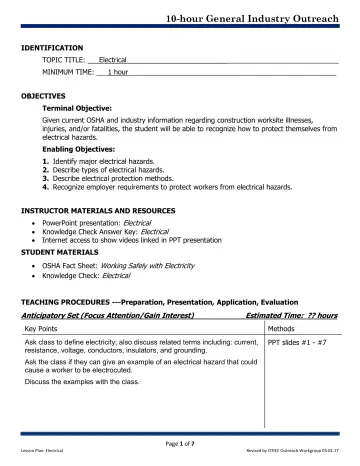
7 slidesElectrical: Lesson Plan (OSHA 10-Hour General Industry Outreach)
Instructor lesson plan (objectives, timing, teaching steps) for the OSHA General Industry electrical outreach deck.
U.S. Department of Labor, OSHA (with the OTIEC Outreach Workgroup)Public domain
pdf
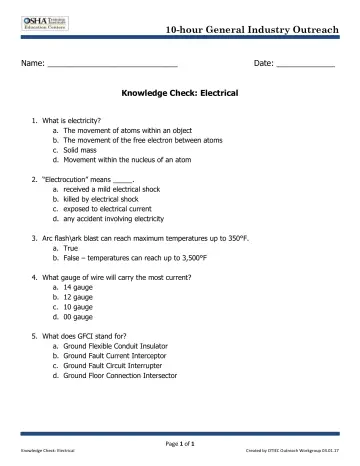
1 slidesElectrical: Knowledge Check (OSHA 10-Hour General Industry Outreach)
Student knowledge-check quiz for the OSHA General Industry electrical outreach deck.
U.S. Department of Labor, OSHA (with the OTIEC Outreach Workgroup)Public domain