1 / 24Use ← → to flip
Hazardous Locations
From a general industry electrical hazards and arc flash course. An archived deck: check it against the current standard before teaching from it.
Slide text
· 24 slides · by Workplace Safety Awareness Council
The words on each slide as the author wrote them, read from the file by software so they can be searched. Layout, pictures and tables are not shown here: the slides above and the download are the original.
- Slide 1
- Hazardous (Classified) Locations
- Slide 2
Introduction
- This material was produced under grant number SH-16615-07-60-F-12 from the Occupational Safety and Health Administration, U.S. Department of Labor. It does not necessarily reflect the views or policies of the U.S. Department of Labor, nor does mention of trade names, commercial products, or organizations imply endorsement by the U.S. Government.
- This material was produced by the Workplace Safety Awareness Council, a 501(c)(3) not-for-profit organization dedicated to safety in the workplace. For further information about the council or upcoming safety related training, please visit our website at www.wpsac.org or call us at (863) 537-4053.
- Slide 3
In the News
- February 8, 2008
- 4 dead in Georgia sugar refinery blast
- PORT WENTWORTH, Ga. – Volatile dust caused an explosion Friday at a sugar refinery that resulted in the death of four employees and injured dozens more. The refinery was severely damaged and firefighters continued to battle the blaze on Friday.
- Slide 4
Hazardous Location Definition
- The National Electrical Code (NEC) defines hazardous locations as those areas
- "where fire or explosion hazards may exist due to flammable gases or vapors, flammable liquids, combustible dust, or ignitable fibers or flyings.“
- NOTE: Hazardous Locations are also described as “Classified Locations”
- Slide 5
Typical Examples
- 1910.307(a)(1)
- Could Include the Following:
- Aircraft hangers
- Service stations
- Storage plants for volatile flammable liquids
- Paint booths
- Health care facilities
- Marinas
- Petroleum processing plants
- Chemical processing plants
- Slide 6
How Hazardous Locations Are Classified
- Slide 7
Class I Locations
- 1910.399 definitions
- Flammable gases or vapors are or may be present in the air in quantities sufficient to produce explosive or ignitable mixtures
- Class I Locations are divided into two
- Divisions
- Slide 8
Class I - Division I
- 1910.399 definitions
- Where gases or vapors exist under normal conditions
- May exist frequently because of repair or maintenance
- Might exist due to faulty equipment or processes
- Slide 9
Class I - Division II
- 1910.399 definitions
- Gases or liquids in closed containers or systems and would escape only with accidental rupture or equipment breakdown
- Ignitable gases or vapors are prevented by positive mechanical ventilation and would become hazardous through failure or abnormal operations of the ventilating equipment
- Area adjacent to Class I Division I and to which ignitable concentrations of gases or vapors might occasionally be communicated
- Slide 10
Class II Locations
- 1910.399 definitions
- Areas that are hazardous because of the presence of combustible dust.
- Class II Locations are divided into two Divisions
- Slide 11
Class II – Division 1
- 1910.399 definitions
- Combustible dust in air under normal conditions in quantities sufficient to produce explosive or ignitable mixtures; or
- Mechanical failure or abnormal operation of equipment releases dust and might provide a source of ignition; or
- Combustible dust of a electrically conductive nature (i.e. magnesium and aluminum dust)
- Slide 12
Class II - Division 2
- 1910.399 definitions
- Combustible dust not normally in high enough quantities to produce explosive or ignitable mixtures
- Dust accumulations will normally be insufficient to interfere with the normal operation of electric equipment or other apparatus
- Accumulation on, in, or near electrical equipment may cause heat build-up and be ignitable by equipment failure
- Slide 13
Class III Locations
- 1910.399 definitions
- Areas that are hazardous because of the presence of easily ignitable fibers or flyings.
- Class III Locations are divided into two Divisions
- Slide 14
Class III – Division 1
- Location in which easily ignitable fibers or materials producing combustible flyings are handled, manufactured, or used.
- Slide 15
Class III – Division 2
- Location in which easily ignitable fibers are stored or handled, other than in the process of manufacture.
- Slide 16
Hazardous Locations: Groups
- A: Acetylene
- B: Hydrogen, etc. C: Ester, etc.
- D: Hydrocarbons. fuels
- E: Metal dusts (conductive & explosive)
- F: Carbon dusts (some are conductive, all are explosive)
- G: Flour, starch, grain, combustible plastic or chemical dust (explosive)
- No specific groups
- Slide 17
Hazardous Location Summary
- Summary of Class I, II, III Hazardous Locations
- Classes
- Groups
- Divisions
- Class I
- Gases, Vapors & Liquids
- A: Acetylene
- B: Hydrogen, etc.
- C: Ester, etc.
- D: Hydrocarbons. fuels
- Normally explosive and hazardous
- Not normally present in an explosive concentration but may accidentally exist.
- Class II Dusts
- E: Metal dusts
- (conductive and explosive)
- F: Carbon dusts
- (some are conductive, all are explosive)
- G: Flour, starch, grain, combustible plastic or chemical dust (explosive)
- Ignitable quantities of dust are or may be in suspension, or conductive dust may be present
- Dust not normally suspended in an ignitable concentration
- (but may accidentally exist). Dust layers are present.
- Class III
- Fibers & Flyings
- Textiles, woodworking etc. (easily ignitable but not usually explosive)
- Handled or used in manufacturing
- Stored or handled in storage (exclusive of manufacturing)
- Slide 18
Professional Engineer
- 1910.307(g)(4)(i)
- Classification of areas and selection of equipment and wiring methods shall be under the supervision of a qualified registered professional engineer
- Slide 19
“Zone Classification System" (Alternative Method)
- NOTE: The alternative Zone Classification System only covers Class I installations.
- Slide 20
Zone Definitions
- 1910.399 definitions
- Zone 0 location is:
- Ignitable flammable gases or vapors are present continuously;
- Ignitable flammable gases or vapors are present for long periods of time.
- Zone 1 location is:
- Ignitable flammable gases or vapors are likely under normal conditions; or
- Ignitable conditions may exist because of repair, maintenance or leakage; or
- Equipment breakdown may cause electric equipment to be a source of ignition;
- A location adjacent to a Class I, Zone 0 location where ignitable concentrations of vapors could be communicated
- Zone 2 location is:
- Ignitable flammable gas or vapor not likely or for short period only; or
- Confined in closed systems or containers but could escape due to accident; or
- Ignitable accumulation prevented by positive ventilation; or
- Area adjacent to Class I Zone I from which ignitable concentrations could be communicated
- Slide 21
Groups (Zone)
- The zone system (0, 1, 2) has three “groups”, designated IIA, IIB, and IIC, with group IIC containing the most volatile gases, and groups IIA and II B containing gases or vapors that are progressively less volatile.
- Substances classified under groups A and B in the division system generally fall under group IIC of the zone system.
- Slide 22
Zone or Division?
- The major differences:
- International versus U.S.
- Allowable protection scheme
- Surface temperature of equipment used
- Both classifications are acceptable to OSHA
- Often dependant on the preference of the Professional Engineer who certifies the location.
- Equipment used in the hazardous location will be specified by the Professional Engineer
- Slide 23
Design Features
- 1910.307(c)(2)(i)
- Equipment shall be approved not only for the class of location, but also for the ignitable or combustible properties of the specific gas, vapor, dust, or fiber that will be present.
- Check Designation:
- For Haz. Loc.
- CL I, GR. B, C, D
- CL II, GR. E, F, G
- CL III
- Slide 24
Design Features
More on Electrical

pptx
55 slidesElectrical (OSHA 10-Hour General Industry Outreach)
OSHA's general industry outreach electrical deck (2017); supplemental slides on shock, GFCIs, cords and lockout.
U.S. Department of Labor, OSHAPublic domain
pdf
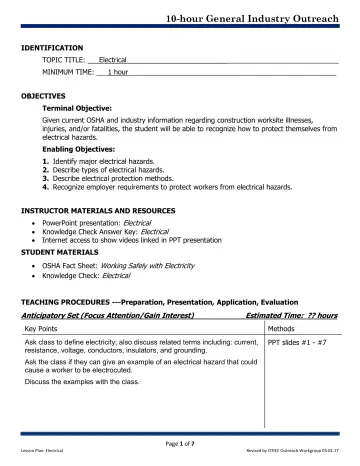
7 slidesElectrical: Lesson Plan (OSHA 10-Hour General Industry Outreach)
Instructor lesson plan (objectives, timing, teaching steps) for the OSHA General Industry electrical outreach deck.
U.S. Department of Labor, OSHA (with the OTIEC Outreach Workgroup)Public domain
pdf
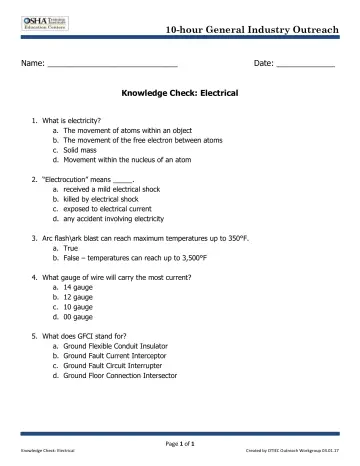
1 slidesElectrical: Knowledge Check (OSHA 10-Hour General Industry Outreach)
Student knowledge-check quiz for the OSHA General Industry electrical outreach deck.
U.S. Department of Labor, OSHA (with the OTIEC Outreach Workgroup)Public domain