1 / 51Use ← → to flip
General Electrical Safety and Hazard Recognition
General electrical safety and hazard recognition from Iowa Lakes Community College.
Slide text
· 51 slides · by Iowa Lakes Community College
The words on each slide as the author wrote them, read from the file by software so they can be searched. Layout, pictures and tables are not shown here: the slides above and the download are the original.
- Slide 1
General Electrical Safety and Hazard Recognition
- Slide 2
Susan Harwood Grant
- This material was produced under Grant SH-31231-SH7 from the Occupational Safety and Health Administration, U.S. Department of Labor. It does not necessarily reflect the views or policies of the U.S. Department of Labor, nor does mention of trade names, commercial products, or organizations imply endorsement by the U.S. Government.
- Slide 3
Employer Responsibilities
- Employers have the responsibility to provide a safe workplace
- Employers have the responsibility to…
- Provide their employees with a workplace that does not have serious hazards and follow all relevant OSHA safety and health standards;
- Inform employees about chemical hazards through training, labels, alarms, color-coded systems, chemical information sheets and other methods;
- Keep accurate records of work-related injuries and illnesses;
- Perform tests in the workplace, such as air sampling, required by some OSHA standards;
- Provide hearing exams or other medical tests required by OSHA standards;
- Post OSHA citations, injury and illness data, and the OSHA poster in the workplace where workers will see them;
- Notify OSHA within 8 hours of a work-place incident in which there is a death; 24 hours when one or more workers are admitted to a hospital, amputations, and losses of an eye; and
- Not discriminate or retaliate against workers for using their rights under the law.
- Slide 4
Employee Rights & Responsibilities
- You have the right to:
- A safe and healthful workplace
- Know about hazardous chemicals
- Information about injuries and illnesses in your workplace
- Complain or request hazard correction from employer
- Slide 5
Employee Rights & Responsibilities
- You have the right to:
- File a confidential complaint with OSHA to have their workplace inspected.
- Receive information and training about hazards, methods to prevent harm, and the OSHA standards that apply to their workplace. The training must be done in a language and vocabulary workers can understand.
- Get copies of their workplace medical records and exposure records.
- Participate in an OSHA inspection and speak in private with the inspector.
- Slide 6
Employee Rights & Responsibilities
- Continued:
- File a complaint with OSHA if they have been retaliated or discriminated against by their employer as the result of requesting an inspection or using any of their other rights under the OSH Act.
- File a complaint if punished or discriminated against for acting as a “whistleblower” under the additional 21 federal statutes for which OSHA has jurisdiction.
- Slide 7
Whistle
- Blower Protection
- Program
- Whistleblower
- Protection
- Program
- Slide 8
Employee Rights and Responsibilities 1.1
- You have the right to:
- A safe and healthful workplace
- Know about hazardous chemicals
- Information about injuries and illnesses in your workplace
- Complain or request hazard correction from employer
- Slide 9
Employee Rights and Responsibilities 1.2
- You have the right to:
- Training
- Access to hazard exposure and medical records
- File a complaint with OSHA
- Participate in an OSHA inspection
- Be free from retaliation for exercising safety and health rights
- Slide 10
Introduction
- General Electrical Safety and Hazard Recognition
- Lesson objectives:
- 1. Understand and describe the dangers of electricity
- 2. Describe and identify different types of electrical hazards
- Slide 11
Electricity - The Dangers
- Takes very little electricity to cause harm.
- Significant risk of causing fires.
- According to the U.S. Bureau of Labor Statistics, there were 156 electrocutions for 2014.
- Courtesy OSHA
- Slide 12
Dangers Of Electricity
- SHOCK
- ARC
- BURNS
- BLAST
- FALLS
- Slide 13
SHOCK 1.1
- Serious injuries and death can be hazards such as arc flash, shocks, b
- Source of graphics: OSHA
- Slide 14
SHOCK 1.2
- Electrical shock is the physical stimulation that occurs when electrical current passes through the body.
- The effect that electric shock has on the body depends on:
- The voltage magnitude
- The magnitude of the current flow
- The body parts through which the current flows
- Duration of contact
- General physical condition of the person being shocked
- Slide 15
Shock and Burns
- Current, not voltage, causes Electric Shock
- mA 0.5 - 3 3+ 10+ 30+ 75+
- 4+ Amps 5+ Amps
- Affect on Person
- Tingling sensation
- May be painful
- Muscle contractions and pain
- Respiratory paralysis
- Ventricular fibrillation
- Heart Paralysis
- Tissue and Organs start to burn
- Source: OSHA
- Slide 16
Arcing
- Electric arcing occurs when a substantial amount of electric current flows through what previously had been air.
- When the conductor vaporizes, the metal vapor can conduct current
- Fault will continue until source is de-energized or conductor is consumed
- Slide 17
Arc Flash
- Factors which affect injuries due to electric arc:
- Distance from arc
- Absorption coefficient of clothing
- Temperature of arc
- Time of exposure
- Length of arc
- Slide 18
Temperature data
- On-Set of 2 nd degree burn (1/10 sec)
- 176 o F
- 3 rd degree (cell death) (1/10 sec)
- 205º F
- Temperature at arc terminals
- 35,000º F
- Temperature of sun’s surface
- 9941º F
- Temperature of burning clothing
- 1400º F
- Slide 19
Burns 1.1
- Most common shock-related injury
- Occurs when you touch electrical wiring or equipment that is improperly used or maintained
- Typically occurs on hands
- Slide 20
Involuntary Muscle Contraction Caused by Shock
- Courtesy OSHA
- Slide 21
Burns 1.2
- Burns suffered in electrical incidents may be one or more of the following three types.
- Electrical burns cause tissue damage, and are the result of heat generated by the flow of electrical current through the body. These are one of the most serious injuries you can receive and require immediate attention.
- Arc or Flash burns are caused by high temperatures near the body produced by an electrical arc or explosion. Attend to them immediately.
- Thermal contact burns occur when skin comes in contact with overheated electric equipment, or when clothing is ignited by an electrical incident.
- Slide 22
Thermal Contact Burns
- Courtesy OSHA
- Slide 23
Electrical Burns
- Courtesy OSHA
- Slide 24
Contact With Ground
- Courtesy OSHA
- Slide 25
Arc or Flash Burns
- Courtesy OSHA
- Slide 26
Electrical Burns Get Worse Before They Get
- Better
- Courtesy OSHA
- Slide 27
A Few Days Later
- Courtesy OSHA
- Slide 28
of Survival, %
- Chance
- Survival Rates from a Burn Injury
- 25% Body Burn
- 50% Body Burn
- 75% Body Burn
- 20-29
- 30-39
- 40-49
- 50-59
- Age Range, Years
- Source: American Burn Association (1991-1993 Study)
- Slide 29
Arc Blast
- Blast comes from the pressure developed by the near-instantaneous heating of the air surrounding the arc and from the expansion of the metal as it is vaporized:
- Throw people from ladders
- Causes deafness
- Knocks down walls
- Burns
- Damage to internal organs
- Slide 30
Falls
- Workers in elevated locations who experience a shock may fall, resulting in serious injury or death
- Courtesy OSHA
- Slide 31
Electrical Hazards 1.1
- Electrical accidents are caused by a combination of three factors:
- Unsafe equipment and/or installation,
- Workplaces made unsafe by the environment, and
- Unsafe work practices.
- Courtesy OSHA
- Slide 32
Electrical Hazards 1.2
- Electrical shocks, fires, or falls result from these hazards:
- Exposed electrical parts
- Overhead power lines
- Inadequate wiring
- Defective insulation
- Improper grounding
- Overloaded circuits
- Wet conditions
- Damaged tools and equipment
- Improper PPE
- Slide 33
Clues that Electrical Hazards Exist
- Tripped circuit breakers or blown fuses
- Warm tools, wires, cords, connections, or junction boxes
- GFCI that shuts off a circuit
- Worn or frayed insulation around wire or connection
- Slide 34
Hazard – Defective Cords & Wires
- Photos represent cords that have been manipulated and used in an unsafe manner other than the manufacture recommend use . Photos courtesy of OSHA.
- Slide 35
Control – Ground Tools & Equipment
- Ground power supply systems, electrical circuits, and electrical equipment
- Frequently inspect electrical systems to insure path to ground is continuous
- Inspect electrical equipment before use
- Don’t remove ground prongs from tools or extension cords
- Ground exposed metal parts of equipment
- Photos courtesy of OSHA
- Slide 36
Power Tool Requirements
- Have a three-wire cord with ground plugged into a grounded receptacle, or
- Be double insulated, or
- Be powered by a low-voltage isolation transformer
- Slide 37
Preventing Electrical Hazards - Tools
- Inspect tools before use
- Use the right tool correctly
- Protect your tools
- Use double insulated tools
- Double Insulated marking
- Courtesy OSHA
- Slide 38
Hazard – Improper Grounding
- Tools plugged into improperly grounded circuits may become energized
- Broken wire or plug on extension cord
- Most frequently violated OSHA standards
- Photos courtesy OSHA
- Slide 39
Control - Assured Equipment Grounding Conductor Program
- Program must cover:
- All cord sets
- Receptacles not part of a building or structure
- Equipment connected by plug and cord
- Program requirements include:
- Specific procedures adopted by the employer
- Competent person to implement the program
- Visual inspection for damage of equipment connected by cord and plug
- Slide 40
Hazard – Overloaded Circuits
- Hazards may result from:
- Too many devices plugged into a circuit, causing heated wires and possibly a fire
- Damaged tools overheating
- Lack of overcurrent protection
- Wire insulation melting, which may cause arcing and a fire in the area where the overload exists, even inside a wall
- Courtesy OSHA
- Slide 41
Control - Electrical Protective Devices
- Automatically opens circuit if excess current from overload or ground-fault is detected – shutting off electricity
- Includes GFCI’s, fuses, and circuit breakers
- Fuses and circuit breakers are overcurrent devices. When too much current:
- Fuses melt
- Circuit breakers trip open
- Courtesy OSHA
- Slide 42
Avoid Wet Conditions 1.1
- If you touch a live wire or other electrical component while standing in even a small puddle of water you’ll get a shock.
- Damaged insulation, equipment, or tools can expose you to live electrical parts.
- Unsafe condition
- Photo of corroded pipe exposing electrical conductors. Photo courtesy of OSHA.
- Slide 43
Avoid Wet Conditions 1.2
- Improperly grounded metal switch plates & ceiling lights are especially hazardous in wet conditions.
- Wet clothing, high humidity, and perspiration increase your chances of being electrocuted.
- Slide 44
What if I work in wet conditions with electricity?
- Avoid working in wet conditions, whenever possible
- Use approved electrical equipment for wet conditions
- Do not stand in wet areas and operate electrical equipment
- How many unsafe acts can you identify?
- Slide 45
Control – Use GFCI (ground-fault circuit interrupter)
- Protects you from shock
- Detects difference in current between the black and white wires
- If ground fault detected, GFCI shuts off electricity in 1/40 th of a second
- Use GFCI’s on all 120-volt, single-phase, 15- and 20-ampere receptacles, or have an assured equipment grounding conductor program.
- Photos courtesy OSHA
- Slide 46
Hazard – Isolate Electrical Parts -
- Cabinets, Boxes & Fittings
- Photos courtesy OSHA
- Slide 47
Preventing Electrical Hazards – Proper
- Wiring and Connectors
- Courtesy Doug Zemler
- Slide 48
Temporary Lighting 1.1
- Protect from contact and damage
- Do not suspend by cords unless designed to do so
- Photos courtesy OSHA
- Slide 49
Temporary Lighting 1.2
- Home made temporary lighting setup.
- Photos courtesy Doug Zemler
- Slide 50
Preventing Electrical Hazards - PPE
- Proper foot protection (not tennis shoes)
- Rubber insulating gloves, hoods, sleeves, matting, and blankets
- Hard hat (insulated - nonconductive)
- Photos courtesy OSHA
- Slide 51
Summarize
- Takes very little electricity to cause harm.
- Current, not voltage, causes electric shock.
- Burns are the most common shock related injury received by people working with electricity.
- Electrical accidents occur from unsafe equipment, unsafe work environment or unsafe work practices.
More on Electrical
pptx
55 slidesElectrical (OSHA 10-Hour General Industry Outreach)
OSHA's general industry outreach electrical deck (2017); supplemental slides on shock, GFCIs, cords and lockout.
U.S. Department of Labor, OSHAPublic domain
pdf
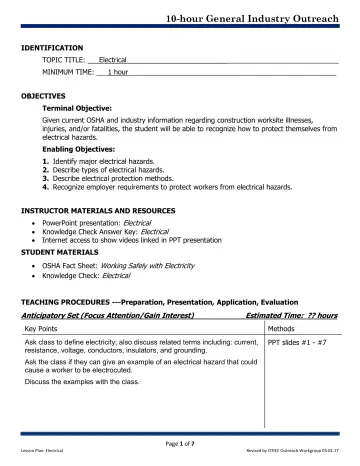
7 slidesElectrical: Lesson Plan (OSHA 10-Hour General Industry Outreach)
Instructor lesson plan (objectives, timing, teaching steps) for the OSHA General Industry electrical outreach deck.
U.S. Department of Labor, OSHA (with the OTIEC Outreach Workgroup)Public domain
pdf
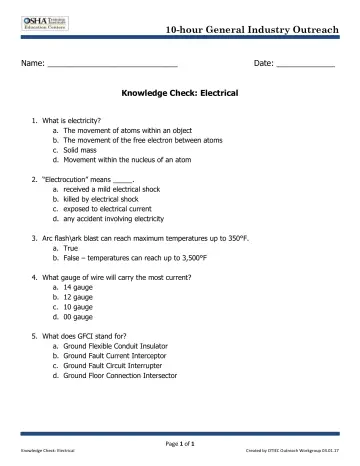
1 slidesElectrical: Knowledge Check (OSHA 10-Hour General Industry Outreach)
Student knowledge-check quiz for the OSHA General Industry electrical outreach deck.
U.S. Department of Labor, OSHA (with the OTIEC Outreach Workgroup)Public domain