1 / 83Use ← → to flip
Electrical Safety: Subpart S
Electrical safety (29 CFR 1910 Subpart S) module from the Georgia Tech poultry and meatpacking course.
Slide text
· 83 slides · by Georgia Tech Research Institute
The words on each slide as the author wrote them, read from the file by software so they can be searched. Layout, pictures and tables are not shown here: the slides above and the download are the original.
- Slide 1
El y t
- Sa
- Slide 2
Disclaimer
- This material was revised under grant number SH-29660-SH6 from the Occupational Safety and Health Administration, U.S. Department of Labor. It does not necessarily reflect the views or policies of the U.S. Department of Labor, nor does mention of trade names, commercial products, or organizations imply endorsement by the U.S. Government.
- The material for this course was produced under grant SH-17809-SH08 from the Occupational Safety and Health Administration, U.S. Department of Labor. Revised December 2016
- Slide 3
- Overview This presentation discusses some of the key issues related to safety for the poultry/meatpacking industry and addresses the following topics:
- General Requirements
- Wiring Protection and Design
- General Use
- Safe Work Practices
- Slide 4
After the completion of this session, the participant Objectives should be able to:
- Recognize key electrical safety components
- Identify select hazards as related to the poultry industry
- List potential methods that can be used to eliminate electrical hazards
- Discuss safe electrical work practices
- Slide 5
Electrical Safety
- There are many rules that apply to electrical safety (installations and work practices) in the workplace, some of those standards included in this presentation are:
- OSHA standards 29 CFR 1910.301-335
- NEC, National Electrical Code-Design of the Systems
- NFPA 70E, Safety Standard for employee workplaces
- Slide 6
Electrical Safety Glossary
- Branch circuit: The circuit conductors between the final over-current device protecting the circuit and the outlets.
- Circuit breaker. A device designed to open/close a circuit.
- Dead front. Without live parts exposed to a person on the operating side.
- Grounded conductor. A system or circuit conductor that is intentionally grounded.
- Grounding conductor. A conductor used to connect equipment or the grounded circuit of a wiring system to a grounding electrode or electrodes.
- Slide 7
Definitions
- (Continued)
- Electrical Safety Glossary
- (continued)
- Ground-fault circuit-interrupter. A device intended for the protection of personnel that functions to de-energize a circuit within an established period of time.
- Live parts. Energized conductive components.
- Over-current. Any current in excess of the rated current of equipment. It may result from overload, short circuit, or ground fault.
- Qualified person. One who has received training in and has demonstrated skills and knowledge in the construction and operation of electric equipment and installations and the hazards involved.
- Slide 8
Hazards of Electricity
- There are several hazards associated with electricity:
- Shock or electrocution from contact with circuits
- Burns associated with electrical contact can be very serious
- Falls can potentially be a secondary hazard
- Arc flash or arc blast (equipment malfunctions)
- Slide 9
Effects on the Body
- Depends on:
- Current and Voltage
- Resistance
- Path through body
- Duration of shock
- More than 3 mA Painful shock – cause indirect accident
- More than 10 mA Muscle contraction – “No Let Go” danger More than 30 mA Lung paralysis, usually temporary
- Slide 10
General Requirements
- The equipment used or permitted has to be approved by a nationally recognized testing laboratory.
- 1910.303(a) Approval
- All electrical conductors and equipment shall be approved.
- UNDERWRITERS LABORATORIES
- LISTED
- Do not use unapproved equipment (especially homemade type devices).
- ENCLOSED SWITCH
- Issue AK 3225
- 1910.303(a)
- NEC Article 110-2
- Slide 11
Approval
- Example: Cord cap with wafer-Not approved
- Example: Extension cord- Listed or approved for use?
- Slide 12
Exam, Installation, and Use
- Employer Obligation:
- All electrical equipment used in the poultry processing/meatpacking industry shall be free from recognized hazards
- Inspect the equipment before you use it
- Slide 13
Examination, Installation and Use
- Safety of electrical equipment shall be determined using the following factors: Suitability of equipment for use (may be evidenced by listing/labeling)
- Mechanical strength/durability-covers in place (no live wiring)
- Wire bending and connection space
- Electrical insulation (fully intact and adequate)
- Heating effects under conditions of use
- Arcing effects
- Classification
- Example of poor Other
- connection space
- Slide 14
Installation and Use
- Plant electrical equipment must be installed and used in accordance with any instructions (e.g.: package inserts)
- Complete wiring installations shall be free of short circuits and grounds other than those permitted (short can damage insulation)
- Equipment intended to interrupt at fault levels shall be adequate for voltage and current at line terminals
- Slide 15
Installation and U se
- All damaged electrical equipment should be immediately reported to management. Note equipment is designed to be mounted, but has been stripped or otherwise damaged.
- Slide 16
Equipment
- Conductors can not be exposed to adverse conditions, unless made for those conditions.
- Note: Cleaning solutions used in sanitation could potentially damage the equipment
- Slide 17
Equipment
- Mechanical Execution:
- Unused openings closed
- Conductors racked to provide ready/safe access
- Internal parts not damaged or contaminated
- No damaged parts that affect operation
- Slide 18
Mounting and Cooling Equipment
- Electrical equipment must firmly mounted
- If atmospheric cooling is required:
- Allow for natural circulation of air No obstruction to ventilation holes
- Do not open panels unless you are qualified Barricades are necessary to keep personnel away from live parts.
- Slide 19
Electrical Connections
- Proper identification and connection of devices (e.g.: soldering lugs)
- Dissimilar metals can not be intermixed in a terminal or splicing connector
- Solder, fluxes, inhibitors, and compounds must be suitable for use and not adversely affect installation, conductors, or equipment
- Slide 20
Terminals
- Connection of conductors in good condition and made with pressure connectors, solder, lugs, or splices to flexible leads
- Terminals for more than one conductor and terminals used to connect aluminum have to be identified
- Slide 21
Markings
- All equipment used in a poultry/meatpacking facility must have marking that describe:
- Name, trademark or information identifying the producer
- Measurements, such as voltage, current, or watts
- Do not use equipment without markings
- Slide 22
Identification of Disconnecting Means (dm) and Circuits
- Each dm in the poultry/meatpacking processing facility must be legibly marked to indicate its purpose
- Unless arranged so the purpose is evident
- Must be capable of being locked (if installed after August 13, 2007)
- A dm is a switch used to disconnect the conductors of a circuit from the source of current
- Slide 23
Identification of Disconnecting
- Means (dm) and Circuits
- The information on the legend has to be as specific as possible
- X Incorrect: Dumper
- Correct: Dumper, BBQ
- Conveyor, Line #3
- Applies to equipment, motors, and circuits
- Slide 24
Note: Disconnect is capable of being locked out
- Lockout tag out
- Tags must
- always be used with locks
- Note: Seal used to close unused opening.
- Slide 25
Access to Electric Equipment
- Maintain access and working space around all electrical equipment, provided & maintained to provide ready and safe operation and maintenance.
- Don’t interfere with the equipment space or work space around the equipment.
- Slide 26
Access to Electric Equipment
- Workspace in front of the equipment must be the greater of the width of equipment or 30”
- Permit 90 degree opening of door
- The depth of the area must be a minimum of 3ft.
- (depends on voltage and materials)
- Two entrance required for equipment rated 1200 amps and 6 ft wide (after 8/13/2007)
- Slide 27
Access to Equipment
- Note: Door will not open the required 90 degrees
- Slide 28
Illumination of the Area
- All indoor electrical service equipment
- In electrical rooms the light may not be automatic
- Always supply ample lighting for the work
- Supplemental lighting may be needed in many cases
- Slide 29
Headroom in the Area
- Slide 30
Guarding of Live Parts Required in all Facilities
- All live components operating at or above 50 volts must be guarded.
- It is a best practice to guard circuits of 50 volts or less, especially in wet environments.
- Slide 31
Guarding Live Parts
- Forms of approved enclosures or other means to guard live parts :
- By location in a room, vault, accessible only to qualified persons
- By permanent, substantial partitions or screens
- By location on a suitable balcony or platform as to exclude unqualified persons
- By elevation of 8 feet or more above the floor or other working surface
- Slide 32
- 1910.304
- Slide 33
Identification of Conductors
- A conductor used as a grounded conductor shall be identifiable and distinguishable from all other conductors.
- Typically white or gray color
- A conductor used as an equipment grounding conductor shall be identifiable and distinguishable from all other conductors
- Typically green, green/yellow, or copper color
- Slide 34
Identification of Conductors
- Identification of ungrounded multi wire branch circuits must identify type and voltage at breaker panel.
- Grounding type receptacles must be installed only on circuits of rated voltage class and current.
- Grounding contacts on receptacles must be effectively grounded.
- Slide 35
Use and identification of grounded and grounding conductors
- No grounded conductor may be attached to any terminal or lead so as to reverse polarity
- A grounding terminal on a receptacle, cord connector, or plug may not be used for purposes other than grounding
- The above points address one potentially dangerous aspect of AC: equipment will operate even though the wires are crossed
- Slide 36
Ground Fault Circuit Interrupters
- Single phase15 and 20 amp,
- 125 volt receptacles in baths and roofs must have GFCI (NEC also states all kitchens and 30+ areas).
- Temporary wiring- Maintenance and repair
- GFCI on all receptacles not part of permanent structure
- Allows for equipment
- grounding conductor program in some cases.
- Note: A GFCI and ground fault protection are not the same. Ground fault protection is designed to protect equipment only.
- Slide 37
Testing GFCI at the Poultry/Meatpacking Facilities
- Included in the manufacturers instructions, which is included with each circuit breaker or receptacle and falls under listing and labeling of equipment.
- The device is to be tested on a monthly basis.
- WHY TEST?
- A study reveals that up to 20% of the Voltage surges such as lightning in equipment does not function.
- The GFCI device may allow current flow even though the device is defective.
- the area, or power company switching can damage a GFCI.
- Always test after the device is tripped.
- Slide 38
Ground Fault Circuit Interrupters Other Than 125 Volt
- Assured Grounding Conductor Program
- Written Plan
- Visual Inspect Daily
- Testing
- Inspection
- Records (current-color coded, logs)
- Only used if there is no GFCI for application
- Slide 39
Branch circuits
- Outlet devices. Outlet devices shall have an ampere rating not less than the load to be served
- Slide 40
Branch Circuits
- Where connected to a branch in excess of 20 amps, the lamp holders shall be heavy duty
- Receptacles
- Receptacle on branch equal to rating of circuit
- Installed wherever flexible cords with plug attachments are used
- Slide 41
Outside Conductors
- Clearance from building openings-Service conductors as open or multiple conductor cable (no jacket) must have 3 feet of clearance
- Conductors can not be installed beneath openings through which materials may be moved (chutes or material handling equipment).
- Slide 42
Disconnecting means
- General. Means shall be provided to disconnect all conductors in a building or other structure from the service-entrance conductors.
- The disconnecting means shall plainly indicate whether it is in the open or closed position and shall be installed at a readily accessible location nearest the point of entrance of the service-entrance conductors. 1000kV
- Slide 43
Services over 600 Volts, Nominal
- Guarded to make them accessible only to qualified persons
- Signs warning of high voltage shall be posted where other than qualified employees might come in contact with live parts
- Danger
- Slide 44
Over Current Protection
- 600 volts or less
- Conductors and equipment shall be protected from overcurrent in accordance with their ability to safely conduct current
- Over current devices shall be readily accessible to each employee or authorized building management personnel.
- The over current devices should not be used to routinely open and close circuits
- 1000kV
- Danger
- Slide 45
Over Current protection
- 600 volts or less
- Arcing or suddenly moving parts – Fuses and circuit breakers shall be so located or shielded
- so
- that employees will not be burned or otherwise injured by their operation and protect the handles or levers to prevent injury
- 1000kV
- Danger
- Slide 46
1910. 304 (e)(1)(vi) Circuit breakers
- Circuit breakers shall clearly indicate whether they are in the open (off) or closed (on) position
- A switch duty circuit breaker should be used if the breaker is used to routinely operate the lights
- Never stand directly in front of the disconnect to operate the equipment
- 1000kV
- Danger
- Slide 47
Grounding
- Systems to be grounded:
- (i) All 3 wire DC systems neutral conductor
- (ii) 2 wire DC systems
- (iii) Some AC circuits of less than 50 volts
- (iv) AC systems of 50-1000 volts
- Slide 48
Grounding
- For AC premises wiring systems the identified conductor shall be grounded
- The path to ground from circuits, equipment, and enclosures shall be permanent and continuous
- (path to ground has to be effective)
- Slide 49
Grounding
- Required to protect employees against:
- Shock
- Safeguard against fire
- Protect equip from damage
- Slide 50
Grounding
- There are two kinds of grounding at food processing facilities:
- 1. Electrical circuit or system grounding
- 2. Electrical equipment grounding
- Slide 51
Electrical System Grounding
- One conductor of the circuit is intentionally grounded to earth
- Protects circuit from lightning, or other high voltage contact
- Stabilizes the voltage in the system so
- “expected voltage levels” are not exceeded under normal conditions
- Slide 52
Grounding
- Metal frames & enclosures of equipment are grounded by a permanent connection or bond.
- The equipment grounding conductor provides a path for dangerous fault current to return to the system ground at the supply source should a fault occur.
- Slide 53
Equipment Grounding
- Generally, all electrical equipment used in a food processing facility has to grounded unless:
- The equipment is double insulation (has to be marked with symbol or statement)
- The equipment is a heated appliance that is permanently installed and isolated
- Slide 54
Grounding Path
- Shall have the capacity to conduct safely any fault current likely to be imposed on it.
- Fault currents may be many times normal currents, and can melt points of poor conductivity
- These high temperatures may be a hazard in themselves, and can destroy the ground-fault path
- Slide 55
- 1910.305
- Wiring methods, components, and equipment for general use
- Slide 56
Wiring in ducts
- No wiring systems of any type shall be installed in ducts used to transport dust, loose stock or flammable vapors
- Slide 57
Temporary Wiring
- All lamps for general illumination shall be guarded by a fixture or lamp holder with a guard
- The sockets must also be grounded
- Slide 58
Conductors Entering Boxes, Cabinets or Fittings
- Conductors can be damaged if they rub against the sharp edges of cabinets, boxes, or fittings
- Cable has to be secured to the box
- Where they enter they must be protected by some type of clamp or rubber grommet
- The device used must close the hole through which the conductor passes as well as provide protection from abrasion
- Slide 59
Conductors Entering Boxes, Cabinets or Fittings
- All pull boxes, junction boxes and fittings must be provided with approved covers
- If covers are metal they must be grounded.
- Each outlet box must have a cover, faceplate or fixture canopy
- Slide 60
Switchboards and panelboards
- Switchboards located in dry areas and accessible to qualified personnel only
- Panelboards shall be mounted in cabinets and have a dead front with no exposed live parts
- Dead front cover
- Slide 61
Cabinets, cutouts boxes, fittings, and panelboards shall be weatherproof
- Enclosures for damp or wet locations
- Switches, circuit breakers, and switchboards shall be in weather proof enclosures
- Must have airspace between Enclosure and mounting
- Surface (after 8/13/2007)
- Slide 62
Requirements for Damp or Wet Locations
- All receptacles in the processing area that are subject to a wet or damp location must be covered
- Electrical equipment should be designed to prevent accumulation of water
- Receptacles in damp areas must have a GFCI
- Slide 63
Around Electrical
- Equipment
- Slide 64
- Protect electronics during sanitation?
- Slide 65
Use of Flexible Cords & Cables
- Flexible cords and shall be approved and suitable for conditions of use and location*
- The OSHA electric standard lists specific situations in which flexible cords may be used
- Slide 66
Use of Flexible Cords & Cables
- Flexible cords and cables shall be used only for: pendants, wiring of fixtures; portable lamps and appliances, portable and mobile signs, elevator cables, cranes/hoists, etc….
- Used as temporary wiring as permitted
- Not installed in raceways
- Slide 67
Use of Flexible Cords and Cables
- Flex cords and cables must never be used as a substitute for premises wiring.
- Cords can not be:
- Run through ceiling
- Be concealed
- Run through doors or windows
- Slide 68
Identification, Splices and Terminations
- Flexible cords shall only be used in continuous lengths, no taps or splices
- Damaged cord improperly repaired
- Slide 69
Splices
- Flexible cords shall be used only in continuous lengths without splice or tap.
- Hard service flexible cords No. 14 or larger may be repaired if spliced so that the splice retains the insulation, sheath properties, and usage characteristics of the cord being spliced.
- Slide 70
Lamps
- All lamps 8 feet or below must have adequate protection
- (guard or cover) to prevent workers from making contact with the bulb and potentially the live parts.
- Slide 71
Safe Electrical Work Practices
- Who should be included in a training program?
- Everyone should receive training to the extent which it involves the job. All employees working around, near, or electrical conductors and equipment.
- Examples of personnel in need of specific electrical safety training: welders, maintenance technicians, and machine operators.
- Slide 72
Training
- Qualified persons: (i.e. those permitted to work on or near exposed energized parts) shall, at a minimum, be trained in and familiar with the following:
- The skills and techniques necessary to distinguish exposed live parts from other parts of electric equipment
- The skills and techniques necessary to determine the nominal voltage of exposed live parts
- The necessary clearance distances specified in the OSHA standard
- 29 CFR1910.333(c)
- Ability to select and safely appropriate test meters
- Ability to perform to identify hazards, assess risk, and provide appropriate safeguards
- Slide 73
De-energize
- All circuits must be placed in a safe electrical work condition
- PPE has to be used in accordance with NFPA 70E until the absence of voltage is verified
- LOTO procedures must be documented
- Slide 74
Electrical Safe Work Practices
- De-energized Parts
- Exceptions to Lockout/tagout:
- Unless the employer can demonstrate that de-energizing introduces increased hazards or is infeasible (not to be confused with convenience).
- Live parts that operate at >50 volts need not be de-energized if there will be no increased exposure to burns or explosions.
- Slide 75
- Equipment still needs lock out tag out
- Slide 76
- Lock out
- Slide 77
Safe Electrical Work Practices
- While any employee is
- exposed to contact with parts or circuits which have been de-energized, the circuits shall be locked out or tagged or both
- If not locked out, treat it as a live circuit
- Slide 78
Illumination
- Adequate illumination must exist
- Employees are not reach
- blindly into the areas that contain live electrical parts
- Slide 79
Safe Electrical Work Practices
- Safety Rules
- Do not use conductive ladders
- Remove all jewelry
- Only qualified persons can remove an electrical interlock
- Portable cord plug connected equipment needs to be inspected before each use
- Only qualified persons can test circuits
- Slide 80
Safe Electrical Work Practices Safety Rules
- As a general rule, always lock out and tag out the circuit.
- Employees working near energized parts in confined spaces must be provided with barriers, protective shields, and insulating materials.
- PPE has to maintained, inspected, and tested.
- Appropriate tools must be used (rated for voltage and insulated).
- Slide 81
Electrical Safe Work Practices Personal Protective Equipment
- Employees working in areas where there are potential electrical hazards shall be provided with, and shall use, electrical protective equipment that is appropriate for the specific parts of the body to be protected and for the work to be performed
- All equipment must be tested
- Slide 82
Electrical Safe Work Practices PPE
- PPE needs to be selected based on the hazards likely to be encountered:
- Non conductive hard hat
- (rated for voltage)
- Voltage rated gloves
- Eye Protection
- Appropriate clothing
- Arc Rated blast suit
- Slide 83
Electrical Safe Work Practices
- Alerting Techniques
- Alerting techniques shall be used to warn and protect employees from hazards which could cause injury:
- Safety signs and tags at point of hazard
- Barricades to limit access to area
- Attendants to warn and protect
More on Electrical
pptx
55 slidesElectrical (OSHA 10-Hour General Industry Outreach)
OSHA's general industry outreach electrical deck (2017); supplemental slides on shock, GFCIs, cords and lockout.
U.S. Department of Labor, OSHAPublic domain
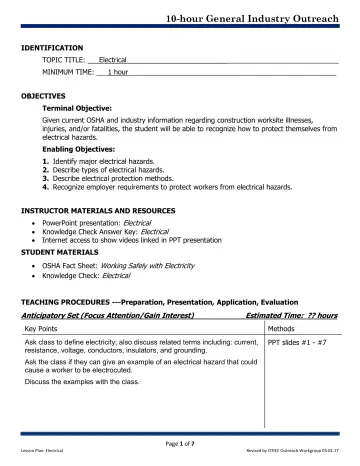
pdf
7 slidesElectrical: Lesson Plan (OSHA 10-Hour General Industry Outreach)
Instructor lesson plan (objectives, timing, teaching steps) for the OSHA General Industry electrical outreach deck.
U.S. Department of Labor, OSHA (with the OTIEC Outreach Workgroup)Public domain
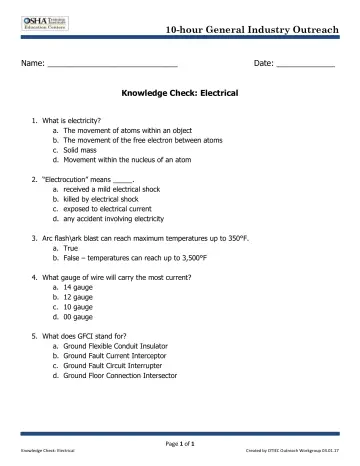
pdf
1 slidesElectrical: Knowledge Check (OSHA 10-Hour General Industry Outreach)
Student knowledge-check quiz for the OSHA General Industry electrical outreach deck.
U.S. Department of Labor, OSHA (with the OTIEC Outreach Workgroup)Public domain