1 / 47Use ← → to flip
Personal Protective Equipment
From a general industry electrical hazards and arc flash course. An archived deck: check it against the current standard before teaching from it.
Slide text
· 42 of 47 slides · by Workplace Safety Awareness Council
The words on each slide as the author wrote them, read from the file by software so they can be searched. Layout, pictures and tables are not shown here: the slides above and the download are the original.
- Slide 1
Personal Protective Equipment
- For Electrical Hazards
- Slide 2
Introduction
- This material was produced under grant number SH-16615-07-60-F-12 from the Occupational Safety and Health Administration, U.S. Department of Labor. It does not necessarily reflect the views or policies of the U.S. Department of Labor, nor does mention of trade names, commercial products, or organizations imply endorsement by the U.S. Government.
- This material was produced by the Workplace Safety Awareness Council, a 501(c)(3) not-for-profit organization dedicated to safety in the workplace. For further information about the council or upcoming safety related training, please visit our website at www.wpsac.org or call us at (863) 537-4053.
- Slide 3
Hierarchy of Control
- 1910 Subpart I Appendix B
- Engineering Solutions:
- Guards
- Barriers
- Design Features
- Administrative Solutions:
- Employee Training
- Standard Operating Procedures
- Hot Work Permit
- Personal Protective Equipment:
- FR Clothing
- Hard Hat
- Safety Glasses
- Remember – PPE is a last line of defense!
- Slide 4
Alerting Techniques
- 1910.335(b)(1)-(3)
- Other examples to protect employees from electrical hazards:
- Safety signs and tags
- Barricades
- Attendants
- Slide 5
PPE Requirements
- 1910.335(a)(1)(i)
- Employers
- Must determine what is needed (JHA)
- Must train employees on proper use
- Must enforce use of PPE
- May be required to pay for the PPE
- Employees must use the PPE!
- Slide 6
Why is FR Needed?
- Most severe burn energies and fatalities are caused by non-flame resistant clothing igniting and continuing to burn
- Flame resistant clothing will self-extinguish, thus limiting the injury
- Body area under non-FR clothing is often burned more severely than exposed skin
- Slide 12
Arc Energy vs Distance
- Energy goes up dramatically as distance from arc drops:
- EXAMPLE: 22,000A, 480V, 6 cycles:
- 24”
- 18”
- 15”
- 12”
- 2.7 cal. 3.2 cal. 7.5 cal. 12.2 cal.
- 10”
- 18 cal.
- How close are you to the arc?
- Slide 13
What PPE Do I Have to Wear
- NFPA uses a three-step process:
- Step 1: Determine the Hazard / Risk Category Classification based on NFPA 70E Table 130.7(C)(9)(a)
- Task
- Hazard / Risk
- V-Rated
- Category
- Gloves
- Panelboards & Switchboards
- >240V and up to 600V
- No
- CB or Fuse Switch Operation
- With covers ON
- With covers OFF
- Work on energized parts, including voltage testing
- V-Rated Tools
- No
- No
- No
- 2*
- Yes
- Yes
- These tables are used for demonstration purposes only.
- Always refer to NFPA 70E for actual requirements
- Slide 14
NFPA Hazard Risk Categories
- Step 2: Select Protective Clothing and PPE based on NFPA 70E Table 130.7(C)(10).
- Personal Protective Clothing
- FR Clothing:
- Hazard / Risk Category Number
- Long-sleeved Shirt
- Pants
- Coverall
- (Note 5) (Note 7)
- Jacket, Parka, Rainwear
- AN
- AN
- (Note 5)
- (Note 9)
- AN
- These tables are used for demonstration purposes only.
- Always refer to NFPA 70E for actual requirements
- AN
- Slide 15
NFPA Hazard Risk Categories
- NFPA 70E Table 130.7(C)(10) – Continued. . .
- Personal Protective Equipment
- FR Protective Equipment:
- Hazard / Risk Category Number
- Hard Hat
- Safety Glasses
- Flash Suit Hood
- Hearing Protection
- (note 8)
- These tables are used for demonstration purposes only.
- Always refer to NFPA 70E for actual requirements
- Slide 16
NFPA Hazard Risk Categories
- Step 3: Identify Minimum ATPV and System based on HRC From Table 130.7(C)(11)
- Hazard Risk
- Category
- Typical Protective Clothing Systems
- Clothing Description
- (number of layers in parenthesis)
- Non Melting Flammable Materials (1)
- Cotton Underwear PLUS FR Shirt and FR Pant or FR Coverall (1-2)
- Cotton Underwear PLUS FR Shirt and FR Pant or FR Coverall (2-3)
- Cotton Underwear PLUS FR Shirt and FR Pant
- PLUS Double Layer Switching Coat and Pants
- (3 or more)
- Minimum
- ATPV
- N/A
- These tables are used for demonstration purposes only.
- Always refer to NFPA 70E for actual requirements
- Slide 17
Arc Thermal Protection Value
- Arc Thermal Protection Value (ATPV) is defined by ASTM F 1959-00 as:
- “the incident energy on a fabric or material that results in sufficient heat transfer through the fabric or material to cause the onset of a second degree burn based on the Stoll Curve”
- Slide 18
The 70E Solution
- Confused by the selection process?
- National trend is single layer HRC 2 daily wear and HRC 4 flash gear
- Don’t let confusion delay your PPE selection!
- Slide 19
What is Flame Resistant Clothing?
- Clothing made from fabrics that self-extinguish
- Fabrics may be natural or synthetic
- Designed to limit (not eliminate) burn injury
- Survival, extent of injury, recovery time and quality of life are all dependent on FRC performance
- Slide 20
Engineered Flame Resistant Fabrics
- Natural fibers
- Synthetic fibers
- Natural / synthetic blends
- NOTE: Flame resistance must be durable to launderings, wear, the environment, etc. for the service life of the garment
- Look for proven products!
- Slide 21
New World of FRC
- FRC used to be perceived as ugly, uncomfortable, expensive, scratchy, hot and not breathable
- Major shift last 3-5 years to lighter, softer more breathable fabrics and to styles virtually identical to “street clothing”
- Examples include Nomex/Rayon blends, Indura UltraSoft®, knits, fleeces, denims.
- Slide 22
Proper Use
- FRC should be appropriate to hazard
- Always the outermost layer
- Worn correctly; zipped, buttoned, etc
- All natural, non-melting undergarments
- Clean, no flammable contaminants
- Repaired correctly and removed from service when needed
- Slide 23
Insulating Gloves: Types
- Insulating gloves come in two “type’s”:
- Type I
- Pro: Greater flexibility and “feel”
- Con: Not ozone-resistant, will crack if exposed to ozone or UV over time.
- Type II
- Pro: Ozone-resistant.
- Con: Not as comfortable to wear (less flexible)
- Slide 24
Insulating Gloves: Class
- FAST FACT: Remember, it’s not the color of the glove that’s important – it’s the color of the tag!
- Slide 25
Glove Markings
- 1910.137(a)(1)(iv)
- Class & Type designations are found on the cuff portion of the glove.
- Slide 26
Protector Gloves
- 1910.137(b)(2)(vii)(A)
- Protector gloves must be worn over insulating gloves, except for Class 0 gloves, under limited-use conditions, where small equipment and parts manipulation necessitate unusually high finger dexterity.
- FAST FACT: Do not use leather protectors alone for protection against electric shock. Serious injury or death could result. Always use proper rubber insulating gloves.
- Slide 27
Glove
- 1910.335(a)(1)(ii)
- 1910.335(a)(1)(ii) Protective equipment shall be maintained in a safe, reliable condition and shall be periodically inspected or tested, as required by 1910.137.
- 1910.335(a)(1)(iii) If the insulating capability of protective equipment may be subject to damage during use, the insulating material shall be protected. (For example, an outer covering of leather is sometimes used for the protection of rubber insulating material.)
- Slide 28
Glove Testing
- 1910.335(a)(1)(ii)
- Protective Equipment Testing Schedule
- Equipment
- When to Test
- Gloves
- Before first issue and every six months after that.*
- Blankets / Sleeves
- Before first issue and every
- 12 months after that.
- Line Hose / Covers
- Upon indication that insulating value is devalued.
- If the protective equipment has been electrically tested, but not issued for use it may not be placed in service unless it has been electrically tested within the previous 12 months.
- Slide 29
Eye Protection
- 1910.335(a)(1)(v)
- Eye protection is required whenever there is danger of injury to the eyes or face from electric arcs or flashes or from flying objects resulting from electrical explosion.
- Remember: If using face shield for arc flash protection be sure to check the Minimum ATPV rating (in cal/cm²)
- Slide 30
Eye Protection Markings
- 1910.133(a)(4) & (b)(1) - (2)
- PPE for eye and face protection purchased after July 5, 1994 shall comply with ANSI Z87.1-1989 or shall be demonstrated by the employer to be equally effective.
- PPE for eye and face purchased before July 5, 1994 shall comply with the ANSI "USA standard for Occupational and Educational Eye and Face Protection," Z87.1-1968 or shall be demonstrated by the employer to be equally effective.
- Eye and face PPE shall be distinctly marked to identify the manufacturer.
- Slide 31
Head Protection
- 1910.335(a)(1)(iv) & 1910.135(b)(1)
- Protective helmets purchased after July 5, 1994 shall comply with ANSI Z89.1-1986
- FAST FACT: ANSI has revised its Z89.1 standard a few times since 1986 and its most current standard is ANSI Z89.1-2003. OSHA however, still references the 1986 standard. As a practical matter if you comply with any of the ANSI Z89.1 standards from 1986 onward, you are compliant with OSHA.
- Slide 32
Helmet Type (Pre-1987)
- ANSI Z89.1-1986 separates protective helmets into two different types and three different classes.
- Type 1 helmets incorporate a full brim (brim fully encircles the dome of the hat)
- Type 2 helmets have no encircling brim, but may include a short bill on the front
- Slide 33
Helmet Class (Pre-1987)
- Regarding electrical performance, ANSI Z89.1-1986 recognizes three classes:
- Class A Helmets reduce the force of impact of falling objects and also reduce the danger of contact with exposed low-voltage electrical conductors. Helmet shells are proof-tested at 2,200 volts of electrical charge.
- Class B Helmets reduce the force of impact of falling objects and also reduce the danger of contact with exposed high-voltage electrical conductors. Helmet shells are proof-tested at 20,000 volts.
- Class C Helmets reduce the force of impact of falling objects, but offer no electrical protection.
- Slide 34
Helmet Type (After 1986)
- ANSI Z89.1-2003 no longer uses Type 1 and Type 2 to describe the brim characteristics of a protective helmet. The new Type designation is as follows:
- Type I helmets offer protection from blows to the top of the head
- Type II helmets offer protection from blows to both the top and sides of the head
- Slide 35
Helmet Class (After 1986)
- Class G (General) Helmets -This is equivalent to the old Class A. Class G helmets are proof tested at 2,200 volts.
- Class E (Electrical) Helmets - This is equivalent to the old Class B. Class E helmets are proof tested at 20,000 volts.
- Class C (Conductive) Helmets - This class provides no electrical insulation; the class designation did not change from the old standard.
- Slide 36
ANSI Markings
- The following information must be marked inside the helmet
- Manufacturer's name
- The “ANSI Z89.1-1997" designation
- Class designation (G, E or C)
- Date of manufacture
- Slide 37
Protective Footwear
- 1910.136(a)
- Employees must use protective footwear when
- falling or rolling objects,
- objects piercing the sole,
- employee's feet are exposed to electrical hazards.
- Slide 38
ANSI Markings – Footwear
- 1910.136(b)(1)-(2)
- Protective footwear purchased after July 5, 1994 shall comply with ANSI Z41-1991
- Protective footwear purchased before July 5, 1994 shall comply with the ANSI Z41.1-1967
- Slide 39
ANSI Markings – Footwear
- 1910.136(b)(1)
- Indicates ANSI standard met
- PT indicates “protective toe” portion of standard
- Indicates Male or Female Impact resistance Compression resistance
- (Cd) conductive properties (EH) electrical hazard
- (Mt) metatarsal resistance rating,
- (PR) puncture resistance (SD) static dissipative properties .
- Slide 40
EH Footwear
- Electrical shock resistant (EH) footwear is manufactured with non-conductive electrical shock resistant soles and heals.
- It must be capable of withstanding the application of 14,000 volts at 60 hertz for one minute with no current flow or leakage current in excess of 3.0 milliamperes, under dry conditions.
- Slide 41
ASTM Designations
- After March 2005
- On March 2005, ANSI Z41 was replaced by two new American Society of Testing Material (ASTM) International Standards. The new ASTM standards are:
- F2412-05 Standard Test Methods for Foot Protection
- F2413-05 Standard Specification for Performance Requirements for Foot Protection.
- Slide 42
ASTM Designations
- After March 2005
- ASTM F2413-05 M I/75/C/75/Mt75 PR
- CS
- Indicates ASTM standard met
- Indicates Male or Female
- Impact resistance
- Compression resistance
- (Mt) metatarsal resistance rating
- ( Cd) conductive properties
- (CS) chain saw cut resistance (DI)dielectric insulation
- (EH) electrical hazard
- (PR) puncture resistance
- (SD) static dissipative properties
- Slide 43
Insulating Blankets
- 1910.137(a) - 1910.137(a)(1)(ii)(G)
- Insulating blankets, matting, covers, line hose, gloves, and sleeves made of rubber shall meet the following requirements:
- Manufacture and marking
- Blankets, gloves, and sleeves shall be produced by a seamless process.
- Each item shall be marked with its classification (i.e. Class 0 – Class 4)
- REMEMBER: Non-ozone-resistant will be marked “Type I”
- Ozone-resistant will be marked “Type II”
- Slide 44
Employee Owned PPE
- 1910.132(b)
- If an employee provides their own protective equipment, the employer shall be responsible to assure its adequacy, including proper maintenance, and sanitation of such equipment.
- Slide 45
Insulated Tools
- 1910.335(a)(2)(i)
- When working near exposed conductors the employee must use insulated tools or handling equipment
- Slide 46
Employee Training
- 1910.132(f)(1) – (1)(v)
- When PPE is required, the employer must cover the following areas:
- When PPE is necessary;
- What PPE is necessary;
- How to properly don and doff PPE
- How to adjust and wear PPE;
- The limitations of the PPE; and,
- The proper care, maintenance, useful life and disposal of the
- PPE.
- Slide 47
Training Documentation
- 1910.132(f)(4)
- The employer must issue a written “training certificate” which must include:
- the name of each employee trained,
- the date(s) of training, and
- Identity of the subject covered
More on Electrical
pptx
55 slidesElectrical (OSHA 10-Hour General Industry Outreach)
OSHA's general industry outreach electrical deck (2017); supplemental slides on shock, GFCIs, cords and lockout.
U.S. Department of Labor, OSHAPublic domain
pdf
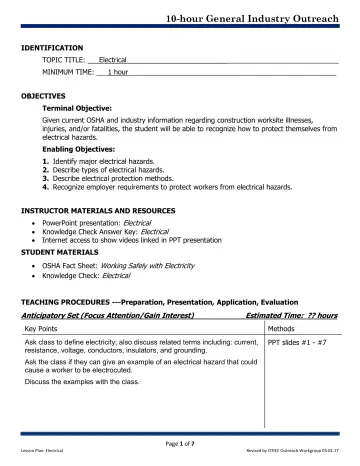
7 slidesElectrical: Lesson Plan (OSHA 10-Hour General Industry Outreach)
Instructor lesson plan (objectives, timing, teaching steps) for the OSHA General Industry electrical outreach deck.
U.S. Department of Labor, OSHA (with the OTIEC Outreach Workgroup)Public domain
pdf
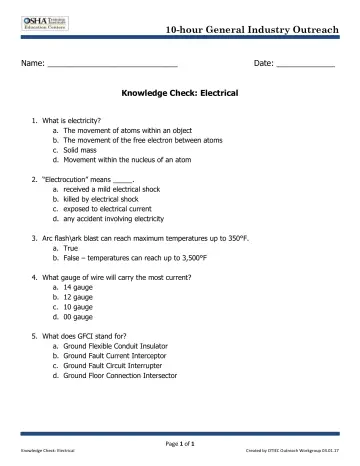
1 slidesElectrical: Knowledge Check (OSHA 10-Hour General Industry Outreach)
Student knowledge-check quiz for the OSHA General Industry electrical outreach deck.
U.S. Department of Labor, OSHA (with the OTIEC Outreach Workgroup)Public domain