Skip to content
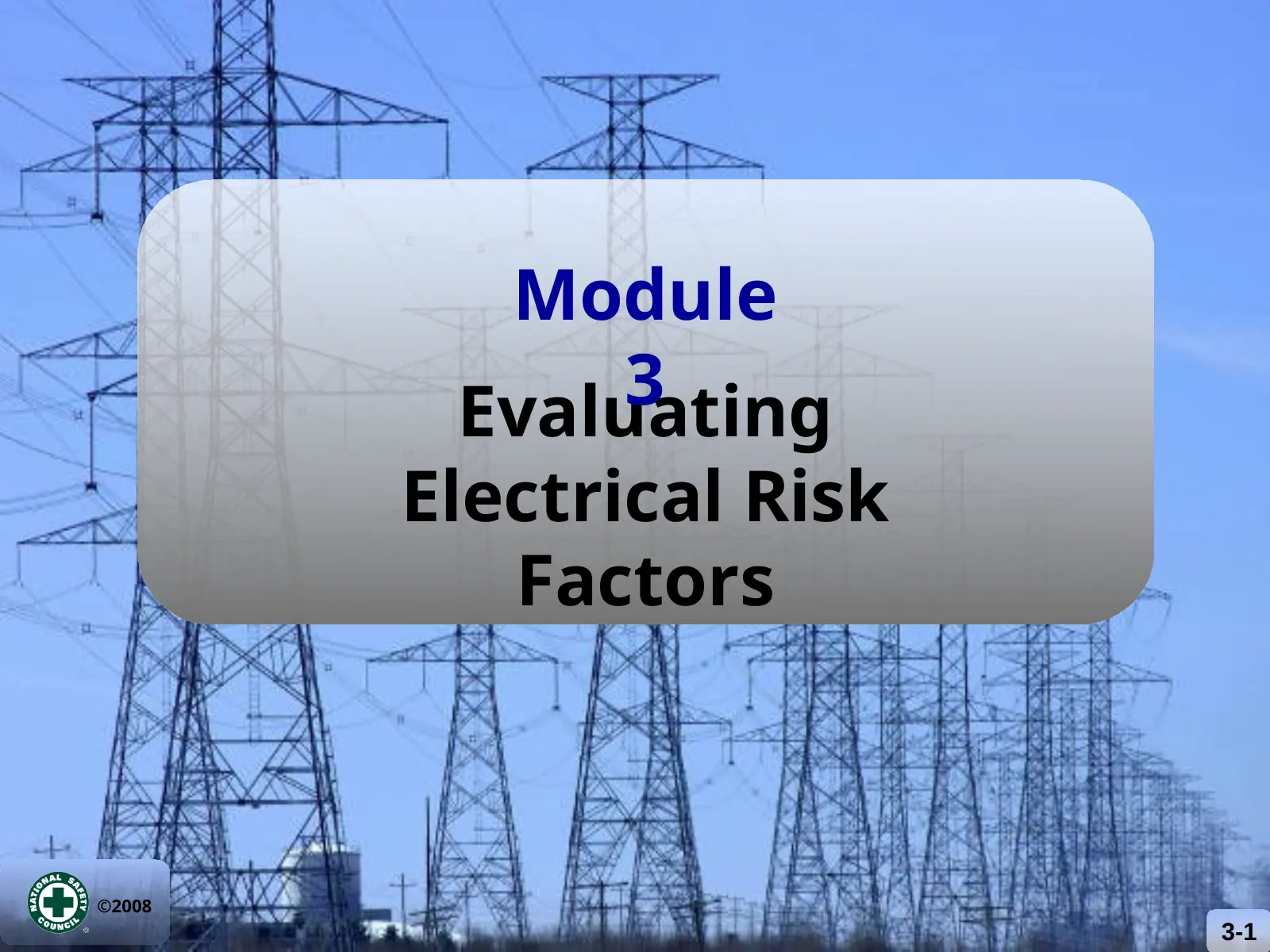
Module 3: Evaluating Electrical Risk Factors, slide 1: Module
1 / 19

Module 3: Evaluating Electrical Risk Factors

One module of a small-business course on preventing electrical injuries. An archived deck: check it against the current standard before teaching from it.

Slide text

· 19 slides · by National Safety Council

The words on each slide as the author wrote them, read from the file by software so they can be searched. Layout, pictures and tables are not shown here: the slides above and the download are the original.

  1. Slide 1

    Module

    • 3
    • Evaluating
    • Electrical Risk
    • Factors
  2. Slide 2

    Recogni ze

    • Evaluate
    • Control
  3. Slide 3

    Module Objectives

    • Recognize the purpose and various methods for evaluating arc flash. Identify arc flash approach boundaries and their meaning.
    • List the steps for conducting a task analysis.
  4. Slide 4

    Module Objectives

    • Recognize how to conduct a fall hazard evaluation.
    • Given a case study, analyze the hazards and recommend improvements.
  5. Slide 5

    Desired Outputs for Analyses

    • 1. To determine flash protection boundaries
    • 2. To determine incident energy
    • 3. To determine the hazard/risk category for PPE selection
  6. Slide 6

    Methods for Evaluating Arc

    • Flash
    • NFPA 70E Equations and Tables
    • ftw
    • ram
    • IE
    • 15
    • Dc = [2.65 X MVAbf X
    • t]1/2
    • Electrical System
    • Analysis
  7. Slide 7

    Limits of Approach

    • Prohibited Approach
    • Boundary
    • Restricted Approach
    • Boundary
    • Exposed Energized
    • Part
    • Flash Protection Boundary
    • Limited Approach
    • Boundary
    • Note that the outer boundary is for flash protection. All other boundaries are for shock protection.
  8. Slide 8

    Flash Protection Zone

    • Outer zone of flash protection
    • Employees in this zone must wear flash protective equipment
  9. Slide 9

    Limited Approach Zone

    • Only qualified people can enter this zone.
    • Must wear flash protective equipment
    • Unqualified workers prohibited
  10. Slide 10

    Restricted Approach Zone

    • A person in this zone is in restricted space Qualified people only Approved written plan required
    • PPE required
    • Must keep as much of body out of restricted zone as possible
    • No body part may cross prohibited line
  11. Slide 11

    Prohibited Approach Zone

    • Being in this zone is the same as being in contact with the live part
    • Qualified people only Must have specified training
    • Approved written plan and risk hazard analysis
    • PPE for working on live 3-11
  12. Slide 12

    Using the NFPA Tables

    • Panelboards rated 240v
    • and below Hazard/Risk
    • Task
    • V-Rated
    • V-Rated
    • Category
    • Gloves
    • Circuit
    • breaker
    • (CB)
    • or
    • Tools
    • fused switch operation
    • with covers on
    • N on energized parts,
    • Work
    • including voltage testing
    • Remove or install circuit breakers or fused switches 1
    • When you use this table, ALL corresponding notes must be taken into consideration.
  13. Slide 13

    Using the NFPA Tables

    • 600v Class Motor Control
    • Task Centers
    • Hazard/Risk
    • V-Rated
    • V-Rated
    • Category
    • Gloves
    • Work
    • on energized
    • parts,
    • Tools
    • including voltage testing
    • 2*
    • Y or removal of
    • Insertion
    • individual starter “buckets” from the motor control center
    • Application
    • of safety
    • grounds, after voltage test
    • *A double-layer switching hood and hearing protection are required for this task in addition to other
    • Category
    • 2 requirements.
    • Note:
    • When you
    • use this table, ALL
    • corresponding notes must be taken into consideration.
  14. Slide 14

    Steps for Task Analysis

    • 1. Involve everyone who will work on the job/project.
    • 2. Identify every step that must be taken to complete the job/project.
    • 3. For each step, identify the electrical procedures that will be performed.
  15. Slide 15

    Steps for Task Analysis

    • 4. Obtain or create drawings and other documents pertaining to the electrical system(s) that will be involved.
    • 5. Identify the hazards associated with the job/project.
  16. Slide 16

    Steps for Task Analysis

    • 6. Agree on safety procedures that everyone will follow.
    • 7. Determine the proper tools that need to be used for the job/project.
    • 8. Determine the PPE that must be used for the job/project.
  17. Slide 17

    Fall Hazards

    • Why is it important to consider falls when evaluating electrical safety?
  18. Slide 18

    Case Study

    • What hazards were present in this situation?
    • What did the management and employees do wrong?
    • How could an incident like this have been prevented?
  19. Slide 19

    Planning for Your Small

    • Action
    • Potential
    • Overcoming the
    • Business
    • Barriers
    • Barriers

More on Electrical

Esc