1 / 3Use ← → to flip
Cranes and Derricks in Construction: Wire Rope Inspection (OSHA 3635)
OSHA Subpart CC fact sheet on wire rope inspection.
Page text
· 3 pages · by U.S. Department of Labor, OSHA
The words on each page as the author wrote them, read from the file by software so they can be searched. Layout, pictures and tables are not shown here: the pages above and the download are the original.
- Page 1
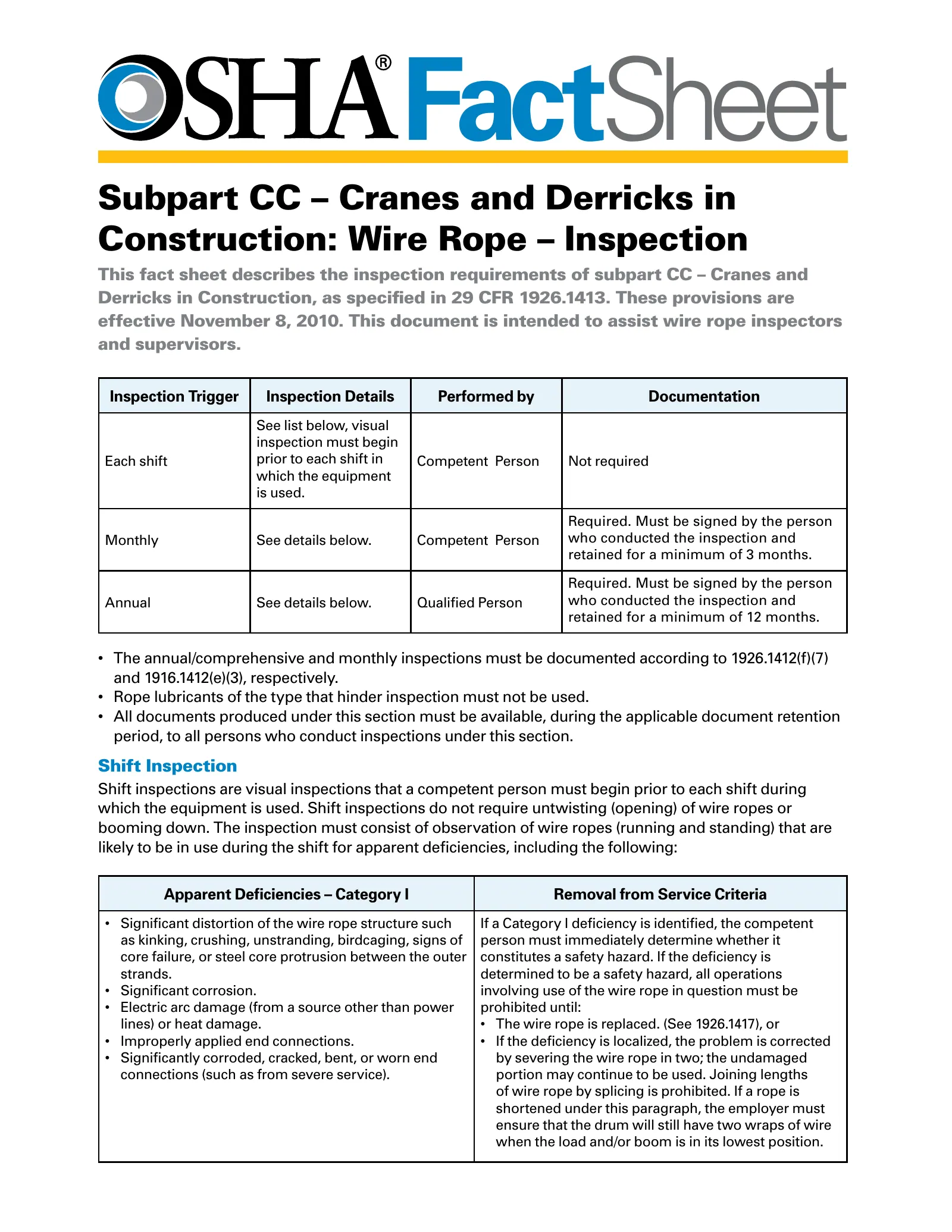
FactSheet
- Subpart CC – Cranes and Derricks in Construction: Wire Rope – Inspection
- This fact sheet describes the inspection requirements of subpart CC – Cranes and Derricks in Construction, as specified in 29 CFR 1926.1413. These provisions are effective November 8, 2010. This document is intended to assist wire rope inspectors and supervisors.
- Inspection Trigger
- Inspection Details
- Performed by
- Documentation
- Each shift
- See list below, visual inspection must begin prior to each shift in which the equipment is used.
- Competent Person
- Not required
- Monthly
- See details below.
- Required. Must be signed by the person who conducted the inspection and retained for a minimum of 3 months.
- Annual
- Qualified Person
- Required. Must be signed by the person who conducted the inspection and retained for a minimum of 12 months.
- The annual/comprehensive and monthly inspections must be documented according to 1926.1412(f)(7) and 1916.1412(e)(3), respectively.
- Rope lubricants of the type that hinder inspection must not be used.
- All documents produced under this section must be available, during the applicable document retention period, to all persons who conduct inspections under this section.
- Shift Inspection
- Shift inspections are visual inspections that a competent person must begin prior to each shift during which the equipment is used. Shift inspections do not require untwisting (opening) of wire ropes or booming down. The inspection must consist of observation of wire ropes (running and standing) that are likely to be in use during the shift for apparent deficiencies, including the following:
- Apparent Deficiencies – Category I
- Removal from Service Criteria
- Significant distortion of the wire rope structure such as kinking, crushing, unstranding, birdcaging, signs of core failure, or steel core protrusion between the outer strands.
- Significant corrosion.
- Electric arc damage (from a source other than power lines) or heat damage.
- Improperly applied end connections.
- Significantly corroded, cracked, bent, or worn end connections (such as from severe service).
- If a Category I deficiency is identified, the competent person must immediately determine whether it constitutes a safety hazard. If the deficiency is determined to be a safety hazard, all operations involving use of the wire rope in question must be prohibited until:
- The wire rope is replaced. (See 1926.1417), or
- If the deficiency is localized, the problem is corrected by severing the wire rope in two; the undamaged portion may continue to be used. Joining lengths of wire rope by splicing is prohibited. If a rope is shortened under this paragraph, the employer must ensure that the drum will still have two wraps of wire when the load and/or boom is in its lowest position.
- Page 2
Apparent Deficiencies – Category II
- Removal from Service Criteria
- Visible broken wires:
- ° In running wire ropes: six randomly distributed broken wires in one rope lay or three broken wires
- in one strand in one rope lay, where a rope lay is the length along the rope in which one strand makes a complete revolution around the rope.
- ° In rotation-resistant ropes: two randomly
- distributed broken wires in six rope diameters or four randomly distributed broken wires in 30 rope diameters.
- ° In pendants or standing wire ropes: more than two broken wires in one rope lay located in rope beyond
- end connections and/or more than one broken wire in a rope lay located at an end connection.
- A diameter reduction of more than 5% from nominal diameter.
- If a Category II deficiency is identified, operations involving use of the wire rope in question must be prohibited until:
- Employer complies with the wire rope manufacturer’s established criterion for removal from service, or with a different criterion that the wire rope manufacturer has approved in writing for that specific wire rope. (See 1926.1417).
- The wire rope is replaced. (See 1926.1417), or
- If the deficiency is localized, the problem is corrected by severing the wire rope in two; the undamaged portion may continue to be used. Joining lengths of wire rope by splicing is prohibited. If a rope is shortened under this paragraph, the employer must ensure that the drum will still have two wraps of wire when the load and/or boom is in its lowest position.
- Apparent Deficiencies – Category III
- In rotation-resistant wire rope, core protrusion or other distortion indicating core failure.
- Prior electrical contact with a power line.
- A broken strand.
- If a Category III deficiency is identified, operations involving use of the wire rope in question must be prohibited until:
- If the deficiency (other than power line contact) is localized, the problem is corrected by severing the wire rope in two; the undamaged portion may continue to be used. Joining lengths of wire rope by splicing is prohibited. Repair of wire rope that contacted an energized power line is also prohibited. If a rope is shortened under this paragraph, the employer must ensure that the drum will still have two wraps of wire when the load and/or boom is in its lowest position.
- Where a wire rope is required to be removed from service under this section, either the equipment (as a whole), or the hoist with that wire rope must be tagged-out, in accord with 1926.1417(f)(1), until the wire rope is repaired or replaced.
- Critical Review Items
- Particular attention must be given to all of the following:
- Rotation-resistant wire rope in use.
- Wire rope being used for boom hoists and luffing hoists, particularly at reverse bends.
- Wire rope at flange points, crossover points, and repetitive pickup points on drums.
- Wire rope at or near terminal ends.
- Wire rope in contact with saddles, equalizer sheaves or other sheaves where rope travel is limited.
- Monthly Inspection
- Each month an inspection must be conducted as stated under “Shift Inspection” above.
- In addition to the criteria for shift inspection, monthly inspections require that:
- The inspection must include any deficiencies that the qualified person who conducts the annual inspection determines under 1926.1413(c)(3)(ii) must be monitored.
- Wire ropes on equipment must not be used until an inspection under this paragraph demonstrates that no corrective action under 1926.1413(a)(4) is required.
- The inspection must be documented according to 1926.1412(e)(3) (monthly inspection documentation).
- Page 3
Annual/Comprehensive Inspection
- At least every 12 months, wire ropes in use on equipment must be inspected by a qualified person as stated under “Shift Inspection” above.
- In addition to the criteria for shift inspection, annual inspections require that –
- The inspection must be complete and thorough, covering the surface of the entire length of the wire ropes, with particular attention given to all of the following:
- ° Critical review items from 1926.1413(a)(3)–(see “Critical Review Items” above).
- ° Those sections that are normally hidden during shift and monthly inspections.
- ° Wire rope subject to reverse bends.
- ° Wire rope passing over sheaves.
- Exception
- In the event an annual inspection under 1926.1413(c)(2) is not feasible due to existing set-up and configuration of the equipment (such as where an assist crane is needed) or due to site conditions (such as a dense urban setting), such inspections must be conducted as soon as it becomes feasible, but no longer than an additional 6 months for running ropes and, for standing ropes, at the time of disassembly.
- If a deficiency is determined to constitute a safety hazard, operations involving use of the wire rope in question must be prohibited until:
- ° The wire rope is replaced (see 1926.1417), or
- ° If the deficiency is localized, the problem is corrected by severing the wire rope in two; the undamaged portion may continue to be used. Joining wire rope by splicing is prohibited. If a rope is shortened under this paragraph, the employer must ensure that the drum will still have two wraps of wire when the load and/or boom is in its lowest position.
- If a deficiency is identified and the qualified person determines that, though not presently a safety hazard, the deficiency needs to be monitored, the employer must ensure that the deficiency is checked in the monthly inspections.
- Additionally
- The inspection must be documented according to 1926.1412(f)(7).
- Rope lubricants of the type that hinder inspection must not be used.
- All documents produced under this section must be available, during the applicable document retention period, to all persons who conduct inspections under this section.
- This is one in a series of informational fact sheets highlighting OSHA programs, policies or standards. It does not impose any new compliance requirements. For a comprehensive list of compliance requirements of OSHA standards or regulations, refer to Title 29 of the Code of Federal Regulations. This information will be made available to sensory-impaired individuals upon request. The voice phone is (202) 693-1999; teletypewriter (TTY) number: (877) 889-5627.
- DOC FS-3635
- 01/2013
More on Cranes
pptx
32 slidesCranes, Derricks, Hoists, Elevators, and Conveyors (OSHA 10-Hour Construction Outreach)
OSHA's own 10-hour Construction Outreach deck on crane hazards: power lines, load charts, rigging, signal persons and inspections (2015 edition).
U.S. Department of Labor, OSHA (with the OTIEC Outreach Workgroup)ArchivedPublic domain
pdf
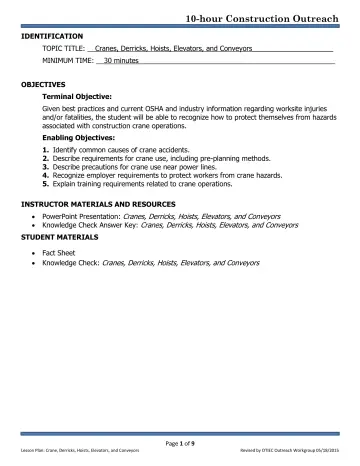
9 slidesCranes, Derricks, Hoists, Elevators, and Conveyors: Lesson Plan (OSHA 10-Hour Construction Outreach)
Instructor lesson plan with objectives, timing and teaching procedures for the OSHA cranes, derricks, hoists, elevators, and conveyors outreach deck.
U.S. Department of Labor, OSHA (with the OTIEC Outreach Workgroup)ArchivedPublic domain
pdf
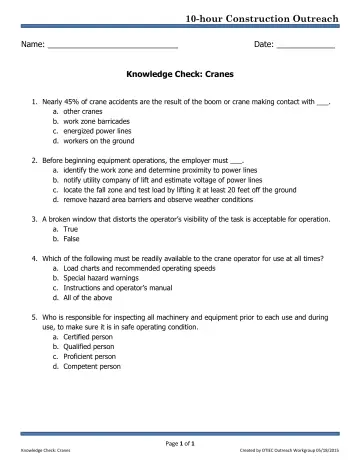
1 slidesCranes, Derricks, Hoists, Elevators, and Conveyors: Knowledge Check (OSHA 10-Hour Construction Outreach)
Student knowledge-check quiz that accompanies the OSHA cranes, derricks, hoists, elevators, and conveyors outreach deck.
U.S. Department of Labor, OSHA (with the OTIEC Outreach Workgroup)ArchivedPublic domain