Rigging Fundamentals
Mobile crane rigging fundamentals (hoists, slings, hitches, rigging inspection) from Hennepin Technical College, built for small construction companies (2009).
Slide text
· 150 slides · by Hennepin Technical College
The words on each slide as the author wrote them, read from the file by software so they can be searched. Layout, pictures and tables are not shown here: the slides above and the download are the original.
- Slide 1
- Moving large, heavy loads is crucial to today's manufacturing and construction industries.
- Much technology has been developed for these operations, including careful training and extensive workplace precautions.
- There are significant safety issues to be considered, both for the operators of the diverse "lifting" devices, and for workers in proximity to them.
- Slide 2
RIGGING FUNDAMENTALS
- PRESENTED BY:
- HENNEPIN TECHNICAL COLLEGE
- IN PARTNERSHIP WITH FEDERAL OSHA
- SUSAN HARWOOD GRANT
- This material was produced under Grant # SH-19496-09-60-F-27 from the OSHA, U.S. Dept of Labor. It does not necessarily reflect the views or policies of the U.S. Dept of Labor, nor does mentioning of trade names, commercial products, or organizations imply endorsement by the U.S. Government.
- Slide 3
Course Introduction
- Instructor(s)
- Classroom
- Restrooms
- Emergency Exits
- Breaks
- Introduction to TurningPoint
- Slide 4
TurningPoint
- Slide 5
2. E J W
- 25%
- 25%
- 25%
- 25%
- 3. I B B
- 4. C E X
- Slide 6
Rigging Fundamentals
- Slide 7
Rigging Fundamentals
- WHY ARE WE HERE?
- Slide 8
Why Are We Here?
- Crane and Rigging Accidents
- An annual average of 22 construction workers were killed in crane-related incidents from 1992 to 2006, according to The Center for Construction Research and Training.
- OSHA regulations and standards
- Because we care about you, your co-workers, and your families.
- Everyone is entitled to go home from work, EVERY DAY!
- Slide 9
Occupational Safety and Health Administration (OSHA)
- Code of Federal Regulations (29 CFR):
- General Duty Clause:
- (a) Each employer
- (1) shall furnish to each of his employees employment and a place of employment which are free from recognized hazards that are causing or are likely to cause death or serious physical harm to his employees;
- (2) shall comply with occupational safety and health standards promulgated under this Act.
- Slide 10
Occupational Safety and Health Administration (OSHA)
- Code of Federal Regulations (29 CFR):
- General Duty Clause:
- (b) Each employee shall comply with occupational safety and health standards and all rules, regulations, and orders issued pursuant to this Act which are applicable to his own actions and conduct.
- Slide 11
29 CFR Occupational Safety and Health Regulations (OSHA Standards)
- 1910; Occupational Safety and Health Standards
- 1926; Safety and Health
- Regulations for Construction
- Subpart N: Materials Handling and Storage
- Subpart N: Cranes, Derricks, Hoists, Elevators, and Conveyors
- 1910.179 - Overhead and gantry cranes.
- 1910.180 - Crawler locomotive and truck cranes.
- 1910.184 - Slings.
- 1926.251 - Rigging equipment for material handling.
- 1926.550 - Cranes and derricks.
- Slide 12
American Society of Mechanical Engineers (ASME)
- Standards
- B30.9: Slings
- B30.10:
- Hooks
- B30.16:
- Overhead Hoist Underhung
- B30.20:
- Below the Hook Lifters
- B30.21:
- Lever Hoist
- B30.26:
- Rigging Hardware
- Slide 13
Rigging Fundamentals
- DEFINITION OF TERMS
- Slide 14
Overhead lifting refers to an object raised more than six feet above the ground.
- 50%
- 50%
- True
- 2. False
- se
- Fa
- Tr
- ue
- Slide 15
Overhead Lifting
- “Process of lifting that
- would elevate a freely
- suspended load to such a
- position that dropping a
- load would present a
- possibility of bodily injury or property damage.”
- Slide 16
Working Load Limit (W.L.L.)
- The MAXIMUM load that shall be applied in direct tension to undamaged straight length of a sling or hoisting equipment
- Slide 17
The Working Load Limit [WLL] is ___ of the rigging equipment.
- 33%
- 33%
- 33%
- Less than the breaking strength
- 2. Equal to the breaking strength
- 3. Greater than the breaking strength
- t..
- ha
- Gr
- ea
- te
- al
- Eq
- Le ss
- th
- th
- th
- b.
- Slide 18
Design Factor
- A ratio of the breaking strength to the working load limit
- Example: If a chain sling has a breaking strength of 28,400# and a W.L.L. of 7,100#; it would have a design factor of 4:1
- Slide 19
Design Factor
- Component
- Minimum
- Nylon rope sling
- 5:1
- Polyester rope sling
- 5:1
- Polypropylene rope sling
- 5:1
- Alloy steel chain sling
- 4:1
- Wire rope sling
- 5:1
- Metal mesh sling
- 5:1
- Synthetic web sling
- 5:1
- Synthetic round sling
- 5:1
- Slide 20
Elongation
- The ability of a piece of load bearing material to permanently increase in length before it fails or breaks
- Expressed as a percentage of increase over its original length
- Slide 21
Reach
- The distance measured from the top of the master link to the bowl of the load hook.
- Slide 22
Sling Hitches
- Vertical
- Slide 23
Sling Hitches
- Vertical
- Choker
- Slide 24
Sling Hitches
- Vertical
- Choker
- Basket
- Slide 25
Who Are These People?
- Designated person
- Competent person
- Qualified person
- Slide 26
OSHA Says…
- The term "designated" personnel means selected or assigned by the employer or the employer's representative as being qualified to perform specific duties.
- Slide 27
OSHA Says…
- Competent Person
- Qualified Person
- 29 CFR 1926.32(f) states: "Competent person" means one who is capable of identifying existing and predictable hazards in the surroundings or working conditions, which are unsanitary, hazardous, or dangerous to employees, and who has authorization to take prompt corrective measures to eliminate them.
- 29 CFR 1926.32(l) states: "Qualified" means one who, by possession of a recognized degree, certificate, or professional standing, or who by extensive knowledge, training and experience, has successfully demonstrated his ability to solve or resolve problems relating to the subject matter, the work, or the project.
- Slide 28
Unattended
- A condition in which the operator of a hoist is NOT at, or within 26 feet of, the operating control devices.
- OSHA 1910.179(n)(3)(x).
- Slide 29
“HOIST”
- hoist (hoist) v. hoist·ed, hoist·ing, hoists
- 1. To raise or haul up with or as if with the help of a mechanical apparatus.
- 2. To raise to one's mouth in order to drink: hoist a few beers.
- Slide 30
Regardless of The Load You Hoist…
- Slide 31
…Or What You Hoist It With…
- Slide 32
- …The Objective is to Hoist It Safely.
- HOISTSAF
- Slide 33
HOISTSAFE
- Slide 34
HOISTSAFE
- How
- H heavy is the load?
- Slide 35
Determining Load Weight
- Actual or calculated weight of object or materials being lifted
- Include weight of rigging equipment and hardware
- How HEAVY is the load?
- Slide 36
Determining Load Weight
- Actual weight obtained from engineering data, shipping papers, catalogs.
- Calculated weight based on common materials.
- Volume of object
- Weight of material
- Reduced for air (voids)
- How HEAVY is the load?
- Slide 37
Determining Load Weight
- Slide 38
Worksheet Problem #1
- 25%
- 25%
- 25%
- 25%
- 800#
- 2. 2,400#
- 3. 4,800#
- 4. 12,800#
- ,8
- 4,
- 0#
- 2,
- 0#
- 0#
- Slide 39
Worksheet Problem #1
- 4’ x 4’ x 16’ = 256 cubic feet
- Wood weighs 50 pounds per cubic foot
- 256 c.f. x 50#/c.f. = 12,800#
- Slide 40
Worksheet Problem #2
- 25%
- 25%
- 25%
- 25%
- 1,415#
- 2. 3,150#
- 3. 9,900#
- 4. 39,565#
- ,5
- 9,
- 0#
- 3,
- 0#
- 1,
- 5#
- Slide 41
Worksheet Problem #2
- Outside Diameter
- 150.72 Cu. Ft.
- Inside Diameter
- 84.78 Cu. Ft.
- Total Volume
- 65.94 Cu. Ft.
- 66 cubic feet of concrete
- 150 pounds per cubic foot
- 66 x 150
- TOTAL WEIGHT
- 9,900 pounds
- Slide 42
Worksheet Problem #3
- 25%
- 25%
- 25%
- 25%
- 120#
- 2. 140#
- 3. 240#
- 4. 480#
- 0#
- 0#
- 0#
- 0#
- Slide 43
Worksheet Problem #3
- 4’ x 3’ = 12 square feet
- ½” steel plate = 20 lbs/sq. ft.
- 12 s.f. x 20 lbs/sq. ft. = 240#
- Slide 44
Determining Load Weight
- Known
- Estimated
- Data plate
- Engineering specifications
- Shipping papers
- “Tribal Knowledge”
- Volume of object
- Density of materials
- Adjusted for voids (air)
- How HEAVY is the load?
- Slide 45
HOISTSAFE
- How
- What are the
- H heavy is the load?
- O operating limitations of the crane and rigging?
- Slide 46
HOISTSAFE
- CRANE OPERATING CAPACITY
- What are the OPERATING LIMITATIONS of the crane and rigging?
- Slide 47
Crane Operating Capacity
- Manufacturer's operating notes supplied with the machine contain important information concerning load handling capacities of cranes.
- Mistakes in calculating capacity can cause accidents.
- Several factors to be considered when calculating a cranes load capacity, including the following:
- What are the OPERATING LIMITATIONS of the crane and rigging?
- Slide 48
Crane Operating Capacity
- Load Radius: the horizontal distance between the center of the crane rotation to center of the load.
- Boom length: including the jib, swing away extension or any other attachments that may increase length of the boom.
- Quadrant of operation: the area of operation that the lift is being made in; note different quadrants usually have lower lifting capacities.
- What are the OPERATING LIMITATIONS of the crane and rigging?
- Slide 49
Crane Operating Capacity
- Boom angle: the angle formed between the horizontal plane of rotation and center line of the boom.
- Weight of any attachments: jib, lattice extension or auxiliary boom point.
- Weight of handling devices: ball, block, and/or any necessary rigging.
- What are the OPERATING LIMITATIONS of the crane and rigging?
- Slide 50
BOOM LENGTH 35’
- LOAD
- RADIUS
- (FT)
- BOOM LENGTH 50’
- BOOM LENGTH 65’
- OVER FRONT (LBS)
- BOOM ANGLE
- 360° (LBS)
- 66.7
- 110,000
- 110,000
- 73.9 60,100 60,100
- 63.1
- 96,700
- 93,700
- 71.5 60,100 60,100
- 57.5
- 75,200
- 73,100
- 69.7 60,100 60,100
- 73.2 58,800
- 58,800
- 47.1
- 53,600
- 52,300
- 61.5 54,900 53,600
- 68.5 52,200
- 52,200
- 34.5
- 40,700
- 39,700
- 54.8 42,000 41,100
- 63.7 42,700
- 41,700
- 14.8
- 31,900
- 31,200
- 47.4 33,400 32,700
- 58.6 34,100
- 33,400
- 39.0 27,300 26,700
- 53.3 28,000
- 27,400
- 28.8 22,000 21,000
- 47.6 22,700
- 21,700
- 12.4 17,400 16,500
- 41.3 18,300
- 17,400
- 34.1 14,900
- 14,200
- 25.2 12,300
- 11,700
- 10.9 10,100
- 9,600
- BOOM ANGLE
- 360° (LBS)
- BOOM ANGLE
- 360° (LBS)
- LOAD
- RADIUS (FT)
- Slide 51
HOISTSAFE
- SLING CAPACITY
- What are the OPERATING LIMITATIONS of the crane and rigging?
- Slide 52
Sling Capacity
- Load bearing material
- Alloy chain
- Wire rope
- Synthetic
- Metal mesh
- Upper and Lower End Attachments
- What are the OPERATING LIMITATIONS of the crane and rigging?
- Slide 53
HOISTSAFE
- ALLOY CHAIN SLINGS
- What are the OPERATING LIMITATIONS of the crane and rigging?
- Slide 54
Alloy Chain Slings
- Advantages
- Flexible
- Impact resistant
- Easy to inspect
- Can be used at relatively high temperatures
- Completely repairable
- Minimum elongation
- Corrosion resistant
- Durable
- Disadvantages
- Heavy
- Moderate initial cost
- What are the OPERATING LIMITATIONS of the crane and rigging?
- Slide 55
NACM WELDED STEEL CHAIN SPECIFICATIONS
- Grade 30 Proof Coil Chain
- General purpose, carbon steel chain. Used in a wide range of applications.
- Not to be used in overhead lifting.
- What are the OPERATING LIMITATIONS of the crane and rigging?
- Slide 56
NACM WELDED STEEL CHAIN SPECIFICATIONS
- Grade 43 High Test Chain
- A carbon steel chain widely used in industry, construction, agricultural and lumbering operations.
- Not to be used in overhead lifting.
- What are the OPERATING LIMITATIONS of the crane and rigging?
- Slide 57
NACM WELDED STEEL CHAIN SPECIFICATIONS
- Grade 70 Transport Chain
- A high quality, high strength carbon steel chain used for load securing.
- Not to be used in overhead lifting.
- What are the OPERATING LIMITATIONS of the crane and rigging?
- Slide 58
NACM WELDED STEEL CHAIN SPECIFICATIONS
- Grade 80 Alloy Chain
- Premium quality, high strength alloy chain, heat treated, used in a variety of sling and tie down applications.
- For overhead lifting applications, only Alloy Chain should be used.
- What are the OPERATING LIMITATIONS of the crane and rigging?
- Slide 59
NACM WELDED STEEL CHAIN SPECIFICATIONS
- Grade 100 Alloy Chain
- Premium quality, highest strength alloy chain, heat treated, used in a variety of sling and tie down applications.
- For overhead lifting applications, only Alloy Chain should be used.
- What are the OPERATING LIMITATIONS of the crane and rigging?
- Slide 60
Elongation
- Elongation shall not be less than:
- 20% for Grades 80 and 100;
- 15% for Grades 30, 43, 70, and Stainless;
- 10% for Machine, Coil, and Passing Link chain.
- What are the OPERATING LIMITATIONS of the crane and rigging?
- Slide 61
Working Load Limit
- Working Load Limit (lbs)
- Proof Coil Size Grade 30
- 1,300
- High Test Grade 43
- Transport Grade 70
- 2,600
- 3,150
- Alloy
- Grade 80
- Alloy
- Alloy
- Grade 100 Grade 120
- 3,500
- 4,300
- 5,200
- 1,900
- 3,900
- 4,700
- 4,500
- 5,700
- 2,650
- 5,400
- 6,600
- 7,100
- 8,800
- 10,600
- 4,500
- 9,200
- 11,300
- 12,000
- 15,000
- 17,900
- 6,900
- 13,000
- 15,800
- 18,100
- 22,600
- 28,300
- 34,200
- 47,700
- 1-1/4
- 72,300
- Slide 62
Ambient Conditions
- High temperatures can significantly reduce the W.L.L. of slings.
- Extreme temperatures can cause permanent damage.
- Foundries
- Arc welding
- What are the OPERATING LIMITATIONS of the crane and rigging?
- Slide 63
Reduction of Working Load Limit
- Chains should not be used outside of the -40°F to 400°F (-40 °C to 204 °C) temperature range without consulting the chain manufacturer.
- The specific working load limit reductions for Grade 80 and Grade 100 chains used at and after exposure to elevated temperatures have been established and are shown in Table XII.
- What are the OPERATING LIMITATIONS of the crane and rigging?
- Slide 64
Reduction Of Working Load Limit
- Temperature
- Grade Of Chain
- Grade 80
- Grade 100
- °F
- °C
- While At Temperature
- After
- Exposure
- After
- Exposure
- <400
- <204
- None
- None
- None
- None
- 10%
- None
- 15%
- None
- 15%
- None
- 25%
- 5%
- 20%
- 5%
- 30%
- 15%
- 30%
- 10%
- 40%
- 20%
- 40%
- 15%
- 50%
- 25%
- 50%
- 20%
- 60%
- 30%
- 1,000
- 60%
- 25%
- 70%
- 35%
- >1,000
- >538
- OSHA 1910.184 requires all slings exposed to temperatures over 1000° F to be removed from service
- Slide 65
HOISTSAFE
- WIRE ROPE SLINGS
- What are the OPERATING LIMITATIONS of the crane and rigging?
- Slide 66
Wire Rope Slings
- Advantages
- Low initial cost
- Lighter weight than alloy chain
- Disadvantages
- Low strength to weight ratio
- Difficult to inspect
- Easily kinked
- Internal corrosion
- Not repairable
- What are the OPERATING LIMITATIONS of the crane and rigging?
- Slide 67
Wire Rope Slings
- Mechanical Splice Slings – Single Part Body – IPS – 6 x 19 IWRC
- RATED CAPACITY (lbs.)
- Basket Hitch – Sling Angle
- Size (in.)
- Vertical
- Choker
- 90°
- 60°
- 45°
- 1,120
- 2,200
- 1,940
- 1,580
- 2,400
- 1,840
- 4,800
- 4,200
- 3,400
- 4,400
- 3,200
- 8,800
- 7,600
- 6,200
- 6,800
- 5,000
- 13,600
- 11,800
- 9,600
- 9,800
- 7,200
- 19,600
- 17,000
- 13,800
- 13,200
- 9,600
- 26,000
- 22,000
- 18,600
- 17,000
- 12,600
- 34,000
- 30,000
- 24,000
- 1 – 1 / 8
- 20,000
- 15,800
- 40,000
- 34,000
- 28,000
- D/d ratio is 20 or greater
- Slide 68
Wire Rope Slings
- What are the OPERATING LIMITATIONS of the crane and rigging?
- Slide 69
HOISTSAFE
- METAL MESH SLINGS
- What are the OPERATING LIMITATIONS of the crane and rigging?
- Slide 70
Metal Mesh Slings
- Advantages
- Flexibility
- Wide bearing surface
- Resists abrasion and cutting
- Resists corrosion
- Disadvantages
- Subject to crushing
- Any broken wire is cause for removal from service
- What are the OPERATING LIMITATIONS of the crane and rigging?
- Slide 71
HOISTSAFE
- SYNTHETIC SLINGS
- What are the OPERATING LIMITATIONS of the crane and rigging?
- Slide 72
Synthetic Slings
- Advantages
- Light weight
- Easy to rig
- Low initial cost
- Reduced load damage
- Disadvantages
- Low heat resistance
- 194° F.
- Subject to cuts and abrasion
- Subject to chemicals and UV
- Cannot be repaired
- What are the OPERATING LIMITATIONS of the crane and rigging?
- Slide 73
Synthetic Clings
- Flat / Tubular Slings
- Round Slings
- What are the OPERATING LIMITATIONS of the crane and rigging?
- Slide 74
Polyester Round Slings
- Rated Capacity (Lbs.)
- Width (In.)
- Vertical
- Choker
- Purple
- 3,000
- 2,400
- 6,000
- Black
- 4,500
- 3,600
- 9,000
- Green
- 6,000
- 4,800
- 12,000
- Yellow
- 9,000
- 7,200
- 18,000
- Gray
- 12,000
- 9,600
- 24,000
- Red
- 14,000
- 11,200
- 28,000
- Brown
- 17,000
- 13,600
- 34,000
- Blue
- 22,000
- 17,600
- 44,000
- 26,000
- 20,800
- 52,000
- 32,000
- 25,600
- 64,000
- 50,000
- 40,000
- 100,000
- 60,000
- 48,000
- 120,000
- Color
- Orange
- Basket
- Slide 75
Number of Attachment Points
- Double leg slings share the load equally*
- Triple leg slings have 50% more capacity than double leg slings.
- Quad leg slings rely on the fourth leg for stability only, not additional lift capacity.
- What are the OPERATING LIMITATIONS of the crane and rigging?
- Slide 76
Operating Limitations
- Crane Capacity Charts
- Mobile Crane
- Boom angle
- Boom extension
- Overhead Crane
- Static versus Dynamic loads
- Slings and Hardware
- Vertical capacity
- Basket capacity
- Choker capacity
- Bridle capacity
- What are the OPERATING LIMITATIONS of the crane and rigging?
- Slide 77
HOISTSAFE
- How
- What are the
- When was the last
- H heavy is the load?
- O operating limitations of the crane and rigging?
- inspection performed?
- Slide 78
HOISTSAFE
- SLING INSPECTION
- When was the last INSPECTION performed?
- Slide 79
Every sling inspection must be documented.
- 50%
- 50%
- True
- 2. False
- se
- Fa
- Tr
- ue
- Slide 80
OSHA 1910.184 ASME B30.9
- Reasons
- Ensure safe equipment
- Gain knowledge and experience:
- Record Keeping
- Most recent report
- Test certificates
- Nature of lifts being made
- Sling usage
- Operator competence
- Inspections
- Daily / Periodic before use (NO records)
- Minimum annual with records
- Frequently, as warranted
- When was the last INSPECTION performed?
- Slide 81
Periodic inspection of slings should be performed by a competent person.
- 50%
- 50%
- True
- 2. False
- se
- Fa
- Tr
- ue
- Slide 82
Daily / Period Inspection
- A thorough periodic inspection of slings shall be performed by a competent person designated by the employer and shall include a thorough inspection for:
- Wear
- Deformation
- Elongation
- Sharp traverse nicks and gouges in chain
- Cuts
- Corrosion
- Heat damage
- Hardware
- Latches for proper seating, operation and distortion
- Hooks for wear and distortion
- When was the last INSPECTION performed?
- Slide 83
HOISTSAFE
- How
- What are the
- When was the last
- How will
- H heavy is the load?
- O operating limitations of the crane and rigging?
- inspection performed?
- S sling angles affect lifting capacity?
- Slide 84
Sling Angle
- Slide 85
A 24-can case of beer weighs…
- 25%
- 25%
- 25%
- 25%
- 10 pounds
- 2. 15 pounds
- 3. 20 pounds
- 4. 25 pounds
- po un ds
- po un ds
- po un ds
- po un ds
- Slide 86
Beer Facts
- One can of beer weighs 13.1 ounces
- 13.1 oz. x 24 cans =
- 314.4 oz.
- The cardboard box weighs 7 ounces
- 314.4 + 7 = 321.4 oz.
- 321.4 oz. ÷ 16 oz. per pound
- 20 pounds
- Slide 87
How much does it weigh?
- How will SLING ANGLES affect lifting capacity?
- Slide 88
How heavy does it feel?
- How will SLING ANGLES affect lifting capacity?
- Slide 89
Sling Angle Factor
- SLING ANGLE CHART
- Angle from Horizontal
- [A]
- S.A.F. [L ÷ H]
- 90° 60° 45° 30°
- 1.000 1.155 1.415 2.000
- Slide 90
Sling Angle Factor
- Slide 91
Worksheet Problem #4
- 25%
- 7#
- 25%
- 2,
- 6#
- 25%
- 2,
- 8#
- 25%
- 1,
- 0#
- 1,700#
- 2. 2,268#
- 3. 2,266#
- 4. 567#
- Slide 92
Worksheet Problem #4
- How many legs will actually carry the load?
- Three
- Slide 93
Worksheet Problem #4
- What is the share of the load?
- 1,133.3333333333#
- Slide 94
Worksheet Problem #4
- What is the load factor?
- 3’ ÷ 1.5’ = 2.0
- Slide 95
Worksheet Problem #4
- What is the tension in each sling leg?
- 2.0 x 1,133# = 2,266#
- 2.0 x 1,134# = 2,268#
- Slide 96
Worksheet Problem #5
- 25%
- 6,
- 0#
- 25%
- 5,
- 8#
- 25%
- 5,
- 6#
- 25%
- 1,
- 6#
- 1,746#
- 2. 5,856#
- 3. 5,888#
- 4. 6,400#
- Slide 97
Worksheet Problem #5
- What is the share of the load?
- 6,400# ÷ 2 = 3,200#
- Slide 98
Worksheet Problem #5
- What is the load factor?
- 5.5 ÷ 3 =
- 1.83333333333333
- 1.83
- 1.84
- 2.00
- Slide 99
Worksheet Problem #5
- What is the tension in each sling leg?
- 3,200# x 1.833333333 = 5,866.6666666667#
- 5,856#
- 5,888#
- 6,400#
- Slide 100
Worksheet Problem #5
- What other factors might affect sling capacity?
- Wet environment for synthetic slings
- Dynamic loading as object enters and leaves water
- Slide 101
Grade 80 Alloy Chain Slings
- Single
- Chain Trade Size
- Chain Size
- 9/32”
- 3,500
- 3/8”
- 7,100
- ½”
- 12,000
- 5/8”
- 18,100
- ¾”
- 28,300
- 7/8”
- 34,200
- 1”
- 1.000
- 47,700
- 1-1/4”
- 1.250
- 72,300
- Working Load Limit (lbs)
- How will SLING ANGLES affect lifting capacity?
- Slide 102
Grade 80 Alloy Chain Slings
- Double
- 90°
- 60°
- 45°
- 30°
- Chain Trade Size
- Chain Size
- 9/32”
- 7,000
- 6,100
- 4,900
- 3,500
- 3/8”
- 14,200
- 12,300
- 10,000
- 7,100
- ½”
- 24,000
- 20,800
- 17,000
- 12,000
- 5/8”
- 36,200
- 31,300
- 25,600
- 18,100
- ¾”
- 56,600
- 49,000
- 40,000
- 28,300
- 7/8”
- 68,400
- 59,200
- 48,400
- 34,200
- 1”
- 1.000
- 95,400
- 82,600
- 67,400
- 47,700
- 1-1/4”
- 1.250
- 144,600
- 125,200
- 102,200
- 72,300
- Working Load Limit (lbs)
- How will SLING ANGLES affect lifting capacity?
- Slide 103
Grade 80 Alloy Chain Slings
- T & Q
- 90°
- 60°
- 45°
- 30°
- Chain Trade Size
- Chain Size
- 9/32”
- 10,500
- 9,100
- 7,400
- 5,200
- 3/8”
- 21,300
- 18,400
- 15,100
- 10,600
- ½”
- 36,000
- 31,200
- 25,500
- 18,000
- 5/8”
- 54,300
- 47,000
- 38,400
- 27,100
- ¾”
- 84,900
- 73,500
- 60,000
- 42,200
- 7/8”
- 102,600
- 88,900
- 72,500
- 51,300
- 1”
- 1.000
- 143,100
- 123,900
- 101,200
- 71,500
- 1-1/4”
- 1.250
- 216,900
- 187,800
- 153,400
- 108,400
- Working Load Limit (lbs)
- How will SLING ANGLES affect lifting capacity?
- Slide 104
Wire Rope Slings
- Mechanical Splice Slings – Single Part Body – IPS – 6 x 19 IWRC
- RATED CAPACITY (lbs.)
- Basket Hitch – Sling Angle
- Size (in.)
- Vertical
- Choker
- 90°
- 60°
- 45°
- 1,120
- 2,200
- 1,940
- 1,580
- 2,400
- 1,840
- 4,800
- 4,200
- 3,400
- 4,400
- 3,200
- 8,800
- 7,600
- 6,200
- 6,800
- 5,000
- 13,600
- 11,800
- 9,600
- 9,800
- 7,200
- 19,600
- 17,000
- 13,800
- 13,200
- 9,600
- 26,000
- 22,000
- 18,600
- 17,000
- 12,600
- 34,000
- 30,000
- 24,000
- 1 – 1 / 8
- 20,000
- 15,800
- 40,000
- 34,000
- 28,000
- D/d ratio is 20 or greater How will SLING ANGLES affect lifting capacity?
- Slide 105
Sling Angle – Unequal Legs
- Slide 106
Sling Angle – Unequal Legs
- S2 = 8’
- S1 = 5’
- H = 4’
- D1 = 3’
- D2 = 7’
- L = 1,000#
- How will SLING ANGLES affect lifting capacity?
- Slide 107
Sling 1
- Tension = Load x D2 x S1/(H(D1 + D2))
- Tension = 1,000 x 7 x 5/(4(3+7))
- Tension = 1,000 x 7 x 5/40
- Tension = 1,000 x 7 x 0.125
- Tension = 875#
- Slide 108
Sling 2
- Tension = Load x D1 x S2/(H(D1 + D2))
- Tension = 1,000 x 3 x 8/(4(3+7))
- Tension = 1,000 x 3 x 8/40
- Tension = 1,000 x 3 x 0.2
- Tension = 600#
- Slide 109
Sling Angle – Unequal Legs
- S1 = 875#
- S2 = 600#
- L = 1,000#
- How will SLING ANGLES affect lifting capacity?
- Slide 110
Sling Angle – Spreader Beam
- Distributes load evenly without excessive sling angles
- Requires greater headroom clearance
- How will SLING ANGLES affect lifting capacity?
- Slide 111
Vertical Basket Hitch
- Two times the single leg capacity
- Legs must be vertical to within 5 degrees
- D/d must be greater than 20/1
- How will SLING ANGLES affect lifting capacity?
- Slide 112
Double Wrap Basket Hitch
- Excellent load control for loose materials and good grip on smooth surfaces.
- Twice the single leg capacity.
- Sling wrap must be lay side by side
- Do not overlap at bottom of load
- Adjust sling as slack is taken up
- How will SLING ANGLES affect lifting capacity?
- Slide 113
Choker Hitch
- 75-80% OF SINGLE LEG CAPACITY
- ANGLE OF CHOKE MUST BE GREATER THAN 120 DEGREES
- How will SLING ANGLES affect lifting capacity?
- Slide 114
Double Wrap Choker Hitches
- EXCELLENT LOAD CONTROL FOR LOOSE MATERIALS AND GRIP ON SMOOTH SURFACES
- 75-80% OF SINGLE LEG CAPACITY
- ANGLE OF CHOKE MUST BE GREATER THAN 120 DEGREES
- SLING WRAP MUST LAY SIDE BY SIDE
- DO NOT OVERLAP AT BOTTOM OF LOAD
- How will SLING ANGLES affect lifting capacity?
- Slide 115
Sling Angles – Edge Protection
- When edges are sharp or abrasive
- Sling damage may occur
- When sling angle become shallow.
- Lateral loading may crush object being lifted.
- How will SLING ANGLES affect lifting capacity?
- Slide 116
Sling Angles
- Sling tension
- Loads tend to hang vertically
- Forcing load points away from vertical requires force
- Reaction to the force increases sling tension
- Crush Force
- The result of forcing load points away from vertical
- Cribbing
- Protects the sling from being damaged
- Protects the load from being crushed
- How will SLING ANGLES affect lifting capacity?
- Slide 117
HOISTSAFE
- How
- What are the
- When was the last
- How will
- Have you performed a
- H heavy is the load?
- O operating limitations of the crane and rigging?
- inspection performed?
- S sling angles affect lifting capacity?
- T test lift to check stability?
- Slide 118
HOISTSAFE
- LOAD STABILITY
- Have you performed a TEST LIFT to verify stability?
- Slide 119
Load Stability
- Capture the Center-of- Gravity
- When suspended an object will always center itself under the lift point
- Center the lift above the center of gravity, not the physical center of the object
- Calculating the C.G.
- Have you performed a TEST LIFT to verify stability?
- Slide 120
Center of Gravity
- Have you performed a TEST LIFT to verify stability?
- Slide 121
Center of Gravity
- Have you performed a TEST LIFT to verify stability?
- Slide 122
HOISTSAFE
- How
- What are the
- When was the last
- How will
- H heavy is the load?
- O operating limitations of the crane and rigging?
- inspection performed?
- S sling angles affect lifting capacity?
- Have you performed a
- T test lift to check stability?
- Move the load with
- S smooth and steady actions
- Slide 123
HOISTSAFE
- SAFE HOIST AND CRANE OPERATIONS
- Move the load with SMOOTH AND STEADY actions.
- Slide 124
Safe Hoist and Crane Operations
- General
- Make certain that multiple-part lines are not twisted around each other.
- Be sure that hoist rope or chain is properly seated in sheaves or pocketwheels.
- Make certain that the load will not contact any obstructions.
- Avoid swinging the load or load hook while traveling.
- Avoid sudden acceleration and deceleration of the load.
- Move the load with SMOOTH AND STEADY actions.
- Slide 125
Safe Hoist and Crane Operations
- General
- Avoid severe contact between the trolley and trolley stops on the tracks, and between a crane and crane stops on railways.
- When winds become dangerous high during an outdoor job, discontinue use of the equipment and anchor it as recommended.
- Move the load with SMOOTH AND STEADY actions.
- Slide 126
Safe Hoist and Crane Operations
- General
- If power is interrupted during operation of a crane or hoist, place all controls in the “OFF” position.
- If more than one hoist or crane must be used to lift or move a load, ONE person should be assigned responsibility for the operation.
- Move the load with SMOOTH AND STEADY actions.
- Slide 127
Safe Hoist and Crane Operations
- Special Heavy Lifts
- Lifts in excess of the rated capacity
- Each heavy lift must be analyzed and authorized by a qualified person
- ONLY applies to the specific lift
- Does NOT authorize any heavy lifts in everyday operations
- Move the load with SMOOTH AND STEADY actions.
- Slide 128
Safe Hoist and Crane Operations
- Pulling a Load
- Use of hoists and cranes for pulling a load is NOT recommended.
- If necessary use a pulley (snatch) block to re-direct force to the load.
- Avoid ‘side pull’ on the hoist.
- Use second hoist anchored to a structural member to achieve load pulls
- Consult supervisor before any load pulling operations
- Move the load with SMOOTH AND STEADY actions.
- Slide 129
Safe Hoist and Crane Operations
- Turning a Load
- Visualize the load and its center of gravity
- Visualize sling positions while turning
- Determine if blocks or supports will be required
- Determine how load will be controlled
- Tagline
- Two-hook turn
- Move the load with SMOOTH AND STEADY actions.
- Slide 130
Safe Hoist and Crane Operations
- Smooth, steady application of lifting force
- Allows hoist and rigging to adjust to change
- Minimizes spin
- Reduces wear on wire and synthetic rope
- NO shock loading
- Especially with wire rope slings
- Move the load with SMOOTH AND STEADY actions.
- Slide 131
HOISTSAFE
- STANDARD
- HAND SIGNALS
- Move the load with SMOOTH AND STEADY actions.
- Slide 132
Standard Hand Signals
- Move the load with SMOOTH AND STEADY actions.
- Slide 133
HOISTSAFE
- How
- What are the
- When was the last
- How will
- H heavy is the load?
- O operating limitations of the crane and rigging?
- inspection performed?
- S sling angles affect lifting capacity?
- Have you performed a
- T test lift to check stability?
- Move the load with
- S smooth and steady actions
- Is the
- A area clear of personnel and obstructions?
- Slide 134
Area Clear
- Personnel
- Barriers and warning signs
- May distract crane operator
- Security personnel
- Vehicles and equipment
- Block visibility
- Is the AREA CLEAR of personnel and obstructions?
- Slide 135
HOISTSAFE
- How
- What are the
- When was the last
- How will
- H heavy is the load?
- O operating limitations of the crane and rigging?
- inspection performed?
- S sling angles affect lifting capacity?
- Have you performed a
- T test lift to check stability?
- Move the load with
- S smooth and steady actions
- Is the
- Can the load be
- A area clear of personnel and obstructions?
- F Flown and landed safely?
- Slide 136
Flying the Load
- Is there a clear, unobstructed path from lift point to landing?
- Do NOT fly the load over people.
- Maintain clearance from objects such as buildings, vehicles and utilities.
- Can the load be FLOWN AND LANDED safely?
- Slide 137
Flying the Load
- Can the load be FLOWN AND LANDED safely?
- Slide 138
Flying the Load
- Utility lines
- Clearly identified
- Shielding
- Maintain minimum clearances
- Voltage
- Distance from Power Lines
- ≤ 50kV
- 10 feet
- 200 kV
- 15 feet
- 350 kV
- 20 feet
- 500 kV
- 25 feet
- 650 kV
- 30 feet
- 800 kV
- 35 feet
- Construction Safety Council
- Can the load be FLOWN AND LANDED safely?
- Slide 139
Flying the Load
- Swing and Travel
- Use smooth, steady motions to fly the load.
- Keep the load under control.
- Avoid dynamic loading or load shifting.
- Can the load be FLOWN AND LANDED safely?
- Slide 140
Landing the Load
- Plan where the load will be landed before lifting.
- Consider the weight, type, and shape of load.
- Land the load on a firm, flat surface.
- Can the load be FLOWN AND LANDED safely?
- Slide 141
Landing the Load
- Land load on blocks / cribbing to allow removal of slings.
- NEVER land a load directly on the slings.
- Chock cylindrical loads to prevent rolling.
- Slowly relieve tension on hoist and rigging.
- Can the load be FLOWN AND LANDED safely?
- Slide 142
HOISTSAFE
- How
- What are the
- When was the last
- How will
- H heavy is the load?
- O operating limitations of the crane and rigging?
- inspection performed?
- S sling angles affect lifting capacity?
- Have you performed a
- T test lift to check stability?
- Move the load with
- S smooth and steady actions
- Is the
- Can the load be
- How will the
- A area clear of personnel and obstructions?
- F flown and landed safely?
- E environment affect the safety of the lift?
- Slide 143
Environmental Considerations
- Weather
- Terrain
- Chemical Conditions and Exposure
- How will the ENVIRONMENT affect the safety of the lift?
- Slide 144
Tag lines are only required when winds exceed 20 mph
- 50%
- 50%
- True
- 2. False
- se
- Fa
- Tr
- ue
- Slide 145
Weather
- Wind
- Tag lines shall be used unless their use creates an unsafe condition [OSHA 1926.550(g)(6) (iii)]
- How will the ENVIRONMENT affect the safety of the lift?
- Slide 146
Rigging is affected at temperatures…
- 25%
- 25%
- 25%
- 25%
- Below -40° F
- 2. Below 32° F
- 3. Above 190° F
- 4. Above 400° F
- 0°
- ve
- Ab
- Ab
- ve
- 0°
- ° F
- Be
- lo w
- Be
- lo w
- 0°
- Slide 147
Weather
- Wind
- Temperature
- Chain and wire rope affected below -40° F
- Synthetic affected above 190° F
- Wire rope affected above 300° F
- Chain affected above
- 400° F
- How will the ENVIRONMENT affect the safety of the lift?
- Slide 148
Weather
- Wind
- Temperature
- Precipitation
- How will the ENVIRONMENT affect the safety of the lift?
- Slide 149
Weather
- Wind
- Temperature
- Precipitation
- Visibility
- How will the ENVIRONMENT affect the safety of the lift?
- Slide 150
Terrain
- Level
- Dry
- Stable
- Wet / Mud
- Frozen
- How will the ENVIRONMENT affect the safety of the lift?
More on Cranes

Cranes, Derricks, Hoists, Elevators, and Conveyors (OSHA 10-Hour Construction Outreach)
OSHA's own 10-hour Construction Outreach deck on crane hazards: power lines, load charts, rigging, signal persons and inspections (2015 edition).
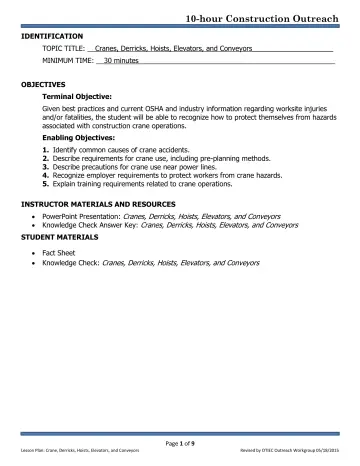
Cranes, Derricks, Hoists, Elevators, and Conveyors: Lesson Plan (OSHA 10-Hour Construction Outreach)
Instructor lesson plan with objectives, timing and teaching procedures for the OSHA cranes, derricks, hoists, elevators, and conveyors outreach deck.
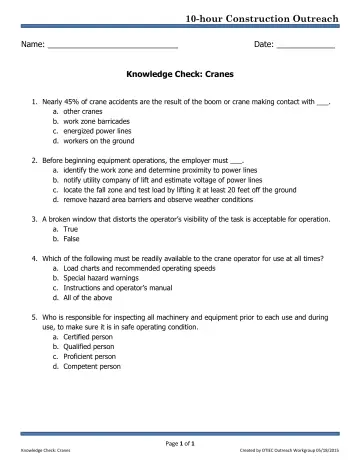
Cranes, Derricks, Hoists, Elevators, and Conveyors: Knowledge Check (OSHA 10-Hour Construction Outreach)
Student knowledge-check quiz that accompanies the OSHA cranes, derricks, hoists, elevators, and conveyors outreach deck.