1 / 3Use ← → to flip
Confined Space Fire: Fatal Facts (OSHA 4278)
Fatal Facts case study of a confined space fire, with prevention steps.
Page text
· 3 pages · by U.S. Department of Labor, OSHA
The words on each page as the author wrote them, read from the file by software so they can be searched. Layout, pictures and tables are not shown here: the pages above and the download are the original.
- Page 1
FATALFacts
- 19
- No. 19 – 2023
- Confined Space Fire
- U.S. Department of Labor
- Occupational Safety and Health Administration www.osha.gov • (800) 321-OSHA (6742)
- BRIEF DESCRIPTION OF INCIDENT †
- LIKELY CAUSES
- Two contract workers died of smoke inhalation and multiple blunt-force injuries during maintenance work on the inner walls of a connected pair of pulp bleaching towers at a paper mill.
- The pulp mill issued the confined space entry permits to the contractor crews. However, the contractors did not realize, nor identify, the electric heat gun as an ignition source and did not complete a hot work permit 3 ; nor were cold work options 4 considered to address long resin hardening times. OSHA prohibits the use of this resin 5 near an ignition source. 6 OSHA also considers the FRP to be combustible. 7
- Two different contract crews were hired to work on the towers. 1 The first crew, or “upflow” crew, was installing new fiber reinforced plastic (FRP), while the second crew, or “downflow” crew, was sandblasting to prepare for new FRP installation. The upflow crew used a flammable resin 2 , like glue, to install sheets of combustible FRP. After a few FRP layers were mounted, the upflow crew noticed that the resin was not hardening fast enough, because of cold weather. One upflow crew worker decided to use an electric heat gun to warm the resin. The heat gun fell into the resin bucket, igniting the resin on contact.
- The upflow crew
- noticed the flames and evacuated the tower. One member of that crew
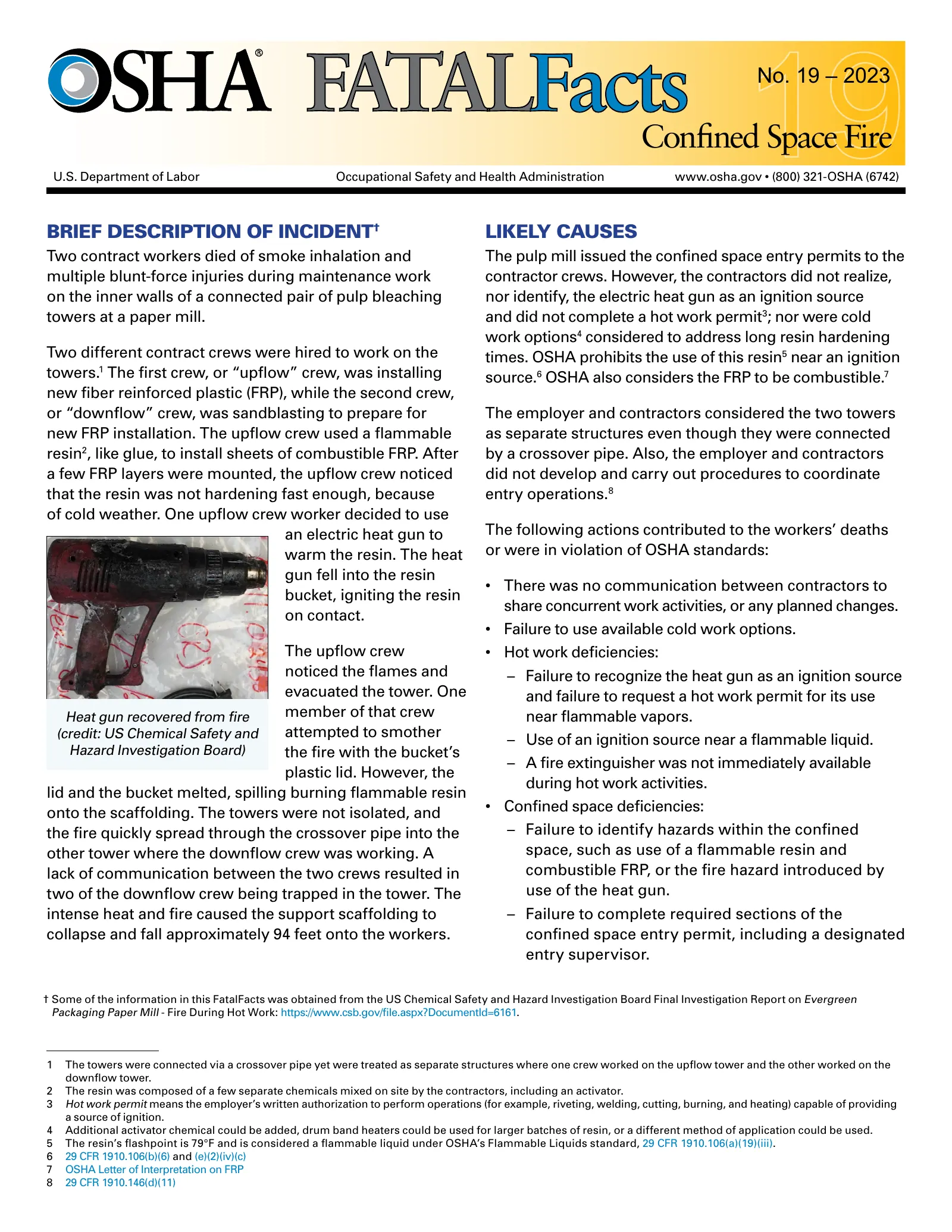
- Heat gun recovered from fire attempted to smother
- (credit: US Chemical Safety and
- Hazard Investigation Board) the fire with the bucket’s plastic lid. However, the lid and the bucket melted, spilling burning flammable resin onto the scaffolding. The towers were not isolated, and the fire quickly spread through the crossover pipe into the other tower where the downflow crew was working. A lack of communication between the two crews resulted in two of the downflow crew being trapped in the tower. The intense heat and fire caused the support scaffolding to collapse and fall approximately 94 feet onto the workers.
- The employer and contractors considered the two towers as separate structures even though they were connected by a crossover pipe. Also, the employer and contractors did not develop and carry out procedures to coordinate entry operations. 8
- The following actions contributed to the workers’ deaths or were in violation of OSHA standards:
- There was no communication between contractors to share concurrent work activities, or any planned changes.
- Failure to use available cold work options.
- Hot work deficiencies:
- Failure to recognize the heat gun as an ignition source and failure to request a hot work permit for its use near flammable vapors.
- Use of an ignition source near a flammable liquid.
- A fire extinguisher was not immediately available during hot work activities.
- Confined space deficiencies:
- Failure to identify hazards within the confined space, such as use of a flammable resin and combustible FRP, or the fire hazard introduced by use of the heat gun.
- Failure to complete required sections of the confined space entry permit, including a designated entry supervisor.
- † Some of the information in this FatalFacts was obtained from the US Chemical Safety and Hazard Investigation Board Final Investigation Report on Evergreen Packaging Paper Mill - Fire During Hot Work: https://www.csb.gov/file.aspx?DocumentId=6161.
- 2 3
- 4 5 6 7 8
- The towers were connected via a crossover pipe yet were treated as separate structures where one crew worked on the upflow tower and the other worked on the downflow tower.
- The resin was composed of a few separate chemicals mixed on site by the contractors, including an activator.
- Hot work permit means the employer’s written authorization to perform operations (for example, riveting, welding, cutting, burning, and heating) capable of providing a source of ignition.
- Additional activator chemical could be added, drum band heaters could be used for larger batches of resin, or a different method of application could be used.
- The resin’s flashpoint is 79°F and is considered a flammable liquid under OSHA’s Flammable Liquids standard, 29 CFR 1910.106(a)(19)(iii).
- 29 CFR 1910.106(b)(6) and (e)(2)(iv)(c)
- OSHA Letter of Interpretation on FRP
- 29 CFR 1910.146(d)(11)
- Page 2
INCIDENT PREVENTION
- Rescue personnel could not respond in a timely manner.
- No continuous forced air ventilation while work was being performed in the confined space.
- Failure to recognize the pair of towers as interconnected and communicate/coordinate concurrent operations between different crews.
- Employers should implement and train employees on the hierarchy of controls. 9 With this knowledge, employers and workers can identify options to control hazards in the workplace. When working in a confined space, employers should try to remove the hazard altogether 10 or replace it with something less dangerous. 11 For example, if the work can be done outside of the confined space, that is the best option. If the work must be done inside the confined space, the employer should use non-flammable materials and ignition-proof tools/equipment.
- Whenever workers are assigned duties in a permitrequired confined space (PRCS), employers must ensure that all hazards are identified, and entry permits are issued before starting work. 12 Paragraph (b) of OSHA’s
- PRCS standard states a PRCS has one or more of the following characteristics:
- 1. Contains or has the potential to contain a hazardous atmosphere. 13
- 2. Contains material that has the potential for engulfing an entrant.
- 3. Has an internal configuration such that an entrant could be trapped or asphyxiated by inwardly converging walls or by a downward-sloping floor tapering to a smaller cross-section.
- 4. Contains any other recognized serious safety or health hazard.
- Employers with workers who enter one or more PRCS must develop and implement a program for safe entry operations 14 with the following requirements:
- Identify hazards present in the space and new hazards, including hazards introduced by the work being performed 15 ; evaluate the need to perform hot work and obtain a hot work permit 16 ; and identify any other information necessary to ensure worker safety 17 as part of PRCS evaluation.
- Terminate a confined space entry when a hazard or condition not previously stated on the permit, is introduced in or near the space. 18
- Designate an entry supervisor and an attendant, whose duties include monitoring entrants; maintaining contact; and order evacuation and summon emergency services when it is determined unsafe. 19
- Develop and implement procedures to coordinate operations and maintenance when employees of more than one employer are working simultaneously as authorized entrants in a PRCS, so that employees of one employer do not endanger the employees of any other employer. 20
- Identify rescue and emergency services that can be summoned in the event of an emergency. 21
- ADDITIONAL RESOURCES
- The following CSB report provides a detailed incident report: Evergreen Packaging Paper Mill - Fire During Hot Work
- The following resources provide additional information on how to protect workers in PRCS and from flammable liquids:
- OSHA Safety and Health Topics Pages
- Confined Spaces
- Welding, Cutting, and Brazing (Hot Work)
- OSHA Confined Spaces Fact Sheet
- OSHA Confined Spaces Guidance Booklet
- OSHA Confined Spaces Quick Card
- OSHA Confined Spaces Advisor eTool
- OSHA Standard on Permit Required Confined Spaces 29 CFR 1910.146
- OSHA Standard on Hot Work 29 CFR 1910.252 Welding, Cutting, and Brazing
- 9 OSHA Safety Management Identifying Hazard Control Options: The Hierarchy of Controls
- 10 Known as “Elimination” under the Hierarchy of Controls.
- 11 Known as “Substitution” under the Hierarchy of Controls.
- 12 29 CFR 1910.146(f)
- 13 Hazardous atmosphere means an atmosphere that may expose employees to the risk of death, incapacitation, impairment of ability to self-rescue (that is, escape unaided from a permit space), injury, or acute illness from one of multiple causes, including flammable gas, vapor, or mist more than 10 percent of its lower explosive limit.
- 14 29 CFR 1910.146(c)(4), (c)(8), (d), and (g)
- 15 29 CFR 1910.146(d)(2), (d)(3)(vi), and (e)(5)(ii)
- 16 29 CFR 1910.146(f)(15)
- 17 29 CFR 1910.146(f)(14)
- 18 29 CFR 1910.146(e)(5)
- 19 29 CFR 1910.146(i) and (j)
- 20 29 CFR 1910.146(c)(8), (c)(9), (d)(11)
- 21 29 CFR 1910.146(f)(11), (d)(9), and (k)
- Page 3
YOU HAVE A VOICE IN THE WORKPLACE MORE INFORMATION
- The Occupational Safety and Health Act of 1970 (OSH Act) assures workers the right to a safe workplace and the right to speak up about hazards without fear of retaliation (see OSHA’s Worker Rights page). Workers also have the right to file a complaint with OSHA if they believe that there are violations of OSHA standards or serious workplace hazards. In addition, if workers are retaliated against for exercising their rights under the OSH Act, they may file a whistleblower complaint with OSHA within 30 days of the alleged retaliation.
- OSHA standards and regulations: www.osha.gov/law-regs
- HOW OSHA CAN HELP
- For questions or to get information or advice, to report an emergency, fatality, hospitalization, amputation, or loss of an eye, or to file a confidential complaint, contact your nearest OSHA office, visit www.osha.gov or call our toll-free number at 1-800-321-OSHA (6742), TTY 1-877- 889-5627. It’s confidential.
- OSHA publications: www.osha.gov/publications
- OSHA-approved state plans: www.osha.gov/stateplans
- OSHA’s free On-Site Consultation services: www.osha.gov/consultation
- Training resources: www.osha.gov/training
- Help for Employers: www.osha.gov/employers
- Note: The described case was selected to increase awareness of the risk discussed and prevent similar fatalities. The incident prevention recommendations do not necessarily reflect the outcome of any legal aspects of this case. OSHA encourages your company or organization to duplicate and share this information.
- This Fatal Facts is not an OSHA standard or regulation and it creates no new legal obligations. The recommendations contained herein are advisory in nature and are intended to assist employers in providing safe and healthful workplaces. The Occupational Safety and Health Act of 1970 (OSH Act) requires employers to comply with safety and health standards promulgated by OSHA or by an OSHA-approved state plan. The requirements of OSHA approved state plans can be reviewed by selecting the state’s website at: www.osha.gov/stateplans. The OSH Act’s General Duty Clause, Section 5(a)(1), requires employers to provide employees with a workplace free from recognized hazards likely to cause death or serious physical harm.
- For assistance, contact us. We can help. It’s confidential.
- DSG FF-4278 08/2023
More on Confined Spaces

pptx
47 slidesConfined Space Training
Confined space awareness deck from the Sustainable Workplace Alliance: permit spaces, atmospheric hazards, roles and rescue.
The Sustainable Workplace AllianceOSHA Harwood grant

pptxes
47 slidesCapacitación en espacios confinados
Spanish edition of the Sustainable Workplace Alliance confined space deck.
The Sustainable Workplace AllianceOSHA Harwood grant
pptx
64 slidesConfined Spaces PPE
Respirators, retrieval systems and other PPE for confined space entry.
Western Iowa Technical Community CollegeOSHA Harwood grant