1 / 2Use ← → to flip
Enclosed Tank Cleaning: Fatal Facts (OSHA 4490)
OSHA fact sheet or bulletin, for General Industry classes.
Page text
· 2 pages · by U.S. Department of Labor, OSHA
The words on each page as the author wrote them, read from the file by software so they can be searched. Layout, pictures and tables are not shown here: the pages above and the download are the original.
- Page 1
FatalFacts
- ISSUE NO. 21-2025
- U.S. DEPARTMENT OF LABOR
- OCCUPATIONAL SAFETY AND HEALTH ADMINISTRATION
- OSHA.GOV • 1-800-321-OSHA (6742)
- Enclosed Tank Cleaning
- DESCRIPTION OF INCIDENT
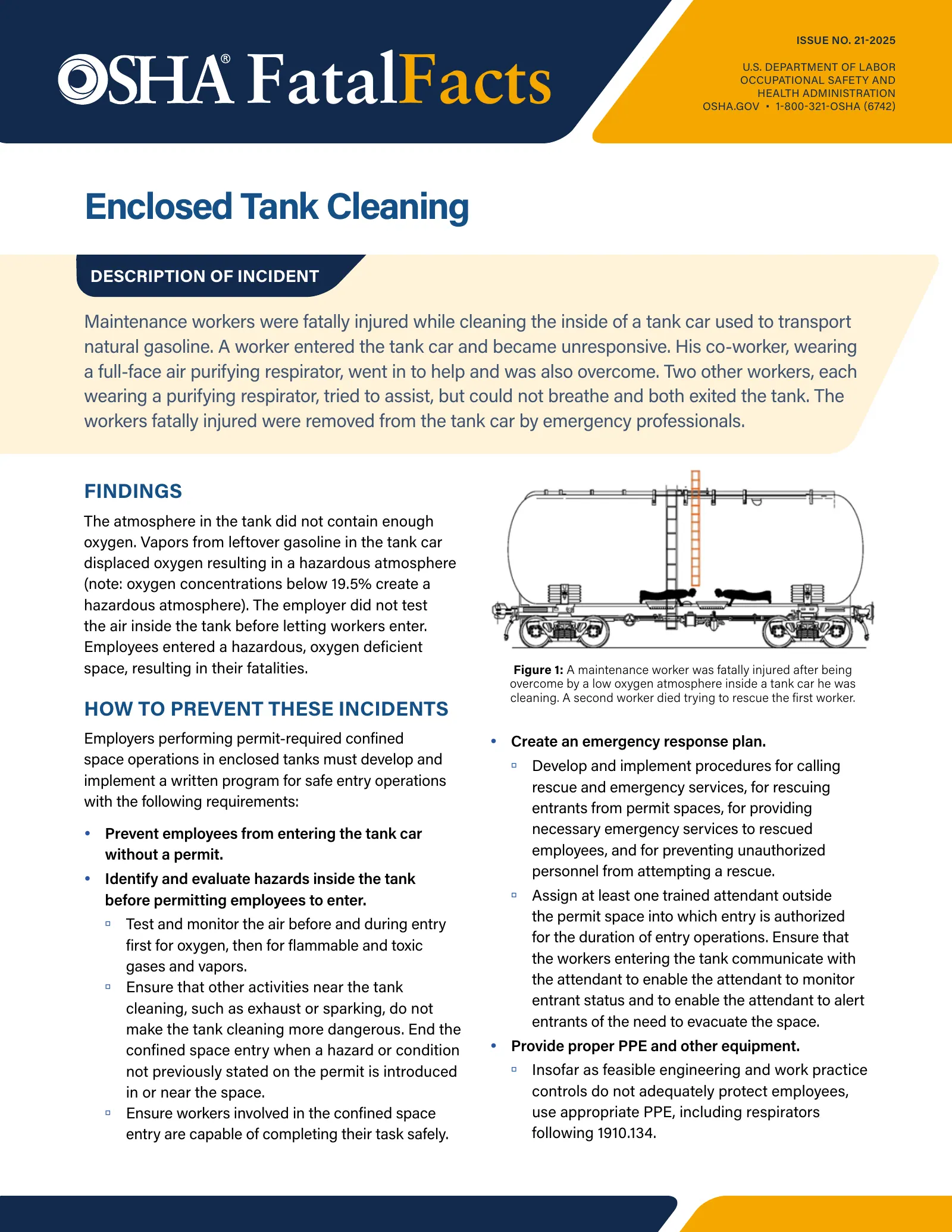
- Maintenance workers were fatally injured while cleaning the inside of a tank car used to transport natural gasoline. A worker entered the tank car and became unresponsive. His co-worker, wearing a full-face air purifying respirator, went in to help and was also overcome. Two other workers, each wearing a purifying respirator, tried to assist, but could not breathe and both exited the tank. The workers fatally injured were removed from the tank car by emergency professionals.
- FINDINGS
- The atmosphere in the tank did not contain enough oxygen. Vapors from leftover gasoline in the tank car displaced oxygen resulting in a hazardous atmosphere (note: oxygen concentrations below 19.5% create a hazardous atmosphere). The employer did not test the air inside the tank before letting workers enter. Employees entered a hazardous, oxygen deficient space, resulting in their fatalities.
- HOW TO PREVENT THESE INCIDENTS
- Employers performing permit-required confined space operations in enclosed tanks must develop and implement a written program for safe entry operations with the following requirements:
- y Prevent employees from entering the tank car without a permit.
- y Identify and evaluate hazards inside the tank before permitting employees to enter.
- à Test and monitor the air before and during entry first for oxygen, then for flammable and toxic gases and vapors.
- à Ensure that other activities near the tank cleaning, such as exhaust or sparking, do not make the tank cleaning more dangerous. End the confined space entry when a hazard or condition not previously stated on the permit is introduced in or near the space.
- à Ensure workers involved in the confined space entry are capable of completing their task safely.
- Figure 1: A maintenance worker was fatally injured after being overcome by a low oxygen atmosphere inside a tank car he was cleaning. A second worker died trying to rescue the first worker.
- y Create an emergency response plan.
- à Develop and implement procedures for calling rescue and emergency services, for rescuing entrants from permit spaces, for providing necessary emergency services to rescued employees, and for preventing unauthorized personnel from attempting a rescue.
- à Assign at least one trained attendant outside the permit space into which entry is authorized for the duration of entry operations. Ensure that the workers entering the tank communicate with the attendant to enable the attendant to monitor entrant status and to enable the attendant to alert entrants of the need to evacuate the space.
- y Provide proper PPE and other equipment.
- à Insofar as feasible engineering and work practice controls do not adequately protect employees, use appropriate PPE, including respirators following 1910.134.
- Page 2
ADDITIONAL RESOURCES
- à Provide workers with personal air monitoring equipment and appropriate training.
- y Provide proper training for workers, attendants, entry supervisors, and employees providing first aid.
- à Ensure that the employees have the understanding, knowledge, and skills necessary to safely perform their duties. Emergency responders must be trained in CPR and first aid.
- à Ensure each worker involved in the permit‑required confined space entry understands the established permit entry and emergency procedures.
- à Ensure workers involved in observation and potential rescue operations are attentive, informed, and capable of completing their assignment.
- Emergency responders should understand their duties and have necessary training.
- à Ensure workers are trained in the operation of atmospheric monitoring equipment, the use of PPE, and all other necessary equipment.
- y Review entry procedures when there is reason to believe that the current program may not protect employees, and correct deficiencies.
- y OSHA’s Safety and Health Topics: Confined Spaces y 29 CFR 1910.146 Permit-required confined spaces y 29 CFR 1910.134 Personal Protective Equipment y 1926 Subpart AA - Confined Spaces in Construction y Refer to the consensus standard on permit-required confined space: American National Standard ANSI/ ASSE Z117.1: Safety Requirements for Entering Confined Spaces
- KNOW YOUR RIGHTS
- Workers have the right to:
- y Safe working conditions. Training and information about workplace hazards, how to prevent them, and the OSHA standards that apply to their workplace.
- y Review records of work-related injuries and illnesses.
- y File a complaint with OSHA if they believe their workplace is unsafe or their employer is not following OSHA’s rules.
- y Report an injury or speak up about health and safety concerns without retaliation. If a worker has been retaliated against, they must file a complaint with OSHA as soon as possible, but no later than 30 days.
- For additional information, see osha.gov/workers.
- OSHA Standards and Regulations: osha.gov/laws-regs
- OSHA Publications: osha.gov/publications
- OSHA-Approved State Plans: osha.gov/stateplans
- No Cost On-Site Consultation Services: osha.gov/consultation
- Training Resources: osha.gov/training
- Compliance Assistance Services: osha.gov/employers
- Note: The described case was selected as an example of improper work practices that likely contributed to a workplace fatality. The incident prevention recommendations do not necessarily reflect the outcome of any legal aspects of this case. OSHA encourages your company or organization to duplicate and share this information.
- This Fatal Facts is not an OSHA standard or regulation, and it creates no new legal obligations. The recommendations contained herein are advisory in nature and are intended to assist employers in providing safe and healthful workplaces. The Occupational Safety and Health Act of 1970 (OSH Act) requires employers to comply with safety and health standards promulgated by OSHA or by an OSHA-approved state plan. The requirements of OSHA-approved state plans can be reviewed by selecting the state’s website at: osha.gov/stateplans. The OSH Act’s General Duty Clause, Section 5(a)(1), requires employers to provide employees with a workplace free from recognized hazards likely to cause death or serious physical harm.
- DTSEM FF-4490 09/2025
More on Confined Spaces
pptx
47 slidesConfined Space Training
Confined space awareness deck from the Sustainable Workplace Alliance: permit spaces, atmospheric hazards, roles and rescue.
The Sustainable Workplace AllianceOSHA Harwood grant
pptxes
47 slidesCapacitación en espacios confinados
Spanish edition of the Sustainable Workplace Alliance confined space deck.
The Sustainable Workplace AllianceOSHA Harwood grant
pptx
64 slidesConfined Spaces PPE
Respirators, retrieval systems and other PPE for confined space entry.
Western Iowa Technical Community CollegeOSHA Harwood grant