1 / 57Use ← → to flip
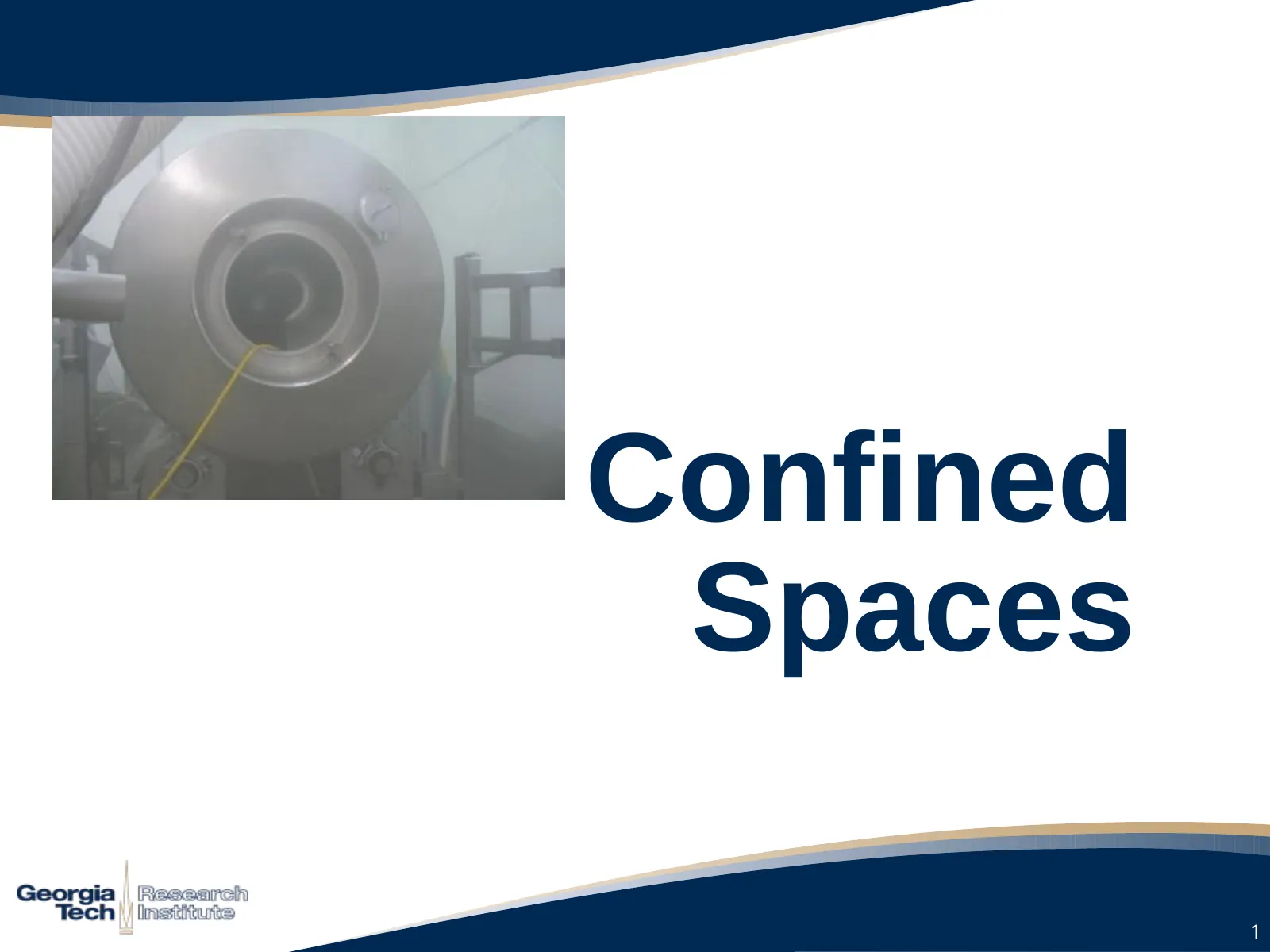
Confined Space
Permit-required confined spaces in poultry and meatpacking plants.
Slide text
· 57 slides · by Georgia Tech Research Institute
The words on each slide as the author wrote them, read from the file by software so they can be searched. Layout, pictures and tables are not shown here: the slides above and the download are the original.
- Slide 1
Confined
- Spaces
- Slide 2
Disclaimer
- This material was produced under grant number SH-29660-SH6 from the Occupational Safety and Health Administration, U.S. Department of Labor. It does not necessarily reflect the views or policies of the U.S. Department of Labor, nor does mention of trade names, commercial products, or organizations imply endorsement by the U.S. Government.
- Slide 3
What kind of Confined Spaces Do You
- Have At Your Facility?
- Slide 4
Standard
- Permit-Required Confined Spaces
- 29 CFR 1910.146
- Slide 5
Confined Space
- Confined space is space that:
- Is large enough & so configured that employee can bodily enter & perform assigned work
- Has limited or restricted means for entry or exit (i.e. tanks, vessels, silos, pits, vaults or hoppers)
- Is not designed for continuous employee occupancy
- Slide 6
Permit-Required Confined Space
- Permit-Required Confined Space is confined space that has one or more of following characteristics:
- Contains or has potential to contain hazardous atmosphere
- Contains material that has potential for engulfing entrant
- Slide 7
Permit-Required Confined Space
- Has internal configuration such that entrant could be trapped or asphyxiated by inwardly converging walls or by floor which slopes downward & tapers to smaller cross-section
- Contains any other serious safety or health hazard
- Slide 8
Examples
- Slide 9
29 CFR 1910.146 Permit-Required Confined Spaces
- Scope & application
- Definitions
- General requirements (to include dev. of written plan)
- Permit system
- Entry permit
- Training
- Duties of authorized entrants
- Duties of attendants
- Duties of entry supervisors
- Rescue & emergency services
- Employee participation
- Slide 10
Appendices
- Appendix A - Permit-Required Confined Space Decision Flow Chart
- Appendix B - Procedures for Atmospheric Testing
- Appendix C - Examples of Permit-Required Confined Space Programs
- Appendix D - Confined Space Pre-Entry Check List
- Appendix E - Sewer System Entry
- Appendix F - Rescue Team or Rescue Service Evaluation Criteria
- Slide 11
Confined Space Crew
- Slide 12
Definitions
- Attendant
- Individual stationed outside one or more permit spaces who monitors authorized entrants & performs all attendant’s duties assigned in employer’s permit space program
- Slide 13
Duties of Attendants
- Knows hazards that may be faced during entry
- Aware of possible behavioral effects of hazard exposure in authorized entrants
- Continuously maintains accurate count of authorized entrants
- Remains outside permit space during entry operations until relieved by another attendant
- Slide 14
Duties of Attendants
- Communicates with authorized entrants
- Monitors activities inside & outside space
- Summons rescue & other emergency services
- Performs non-entry rescues as specified by employer's rescue procedure
- Performs no duties that might interfere with primary duty to monitor & protect authorized entrants
- Slide 15
Confined Space Attendant
- Slide 16
Definitions
- Authorized entrant
- Employee authorized by employer to enter permit space
- Slide 17
Duties of Authorized Entrants
- Know hazards that may be faced during entry, including information on mode, signs or symptoms & consequences of exposure
- Properly use equipment as required by paragraph (d)(4)
- Communicate with attendant as necessary to enable attendant to monitor entrant status & enable attendant to alert entrants of need to evacuate space as required by paragraph (i)(6)
- Slide 18
Duties of Authorized Entrants
- Alert attendant whenever:
- Entrant recognizes any warning sign or symptom of exposure to dangerous situation
- Entrant detects prohibited condition
- Exit from permit space as quickly as possible whenever:
- Slide 19
Duties of Authorized Entrants
- Exit from permit space…
- Order to evacuate is given by attendant or entry supervisor
- Entrant recognizes any warning sign or symptom of exposure to a dangerous situation
- Entrant detects prohibited condition
- Evacuation alarm activated
- Slide 20
Confined Space Entrant
- Slide 21
Definitions
- Engulfment
- Surrounding & effective capture of person by liquid or finely divided (flowable) solid substance that can be aspirated to cause death by filling or plugging respiratory system
- Can exert enough force on body to cause death by strangulation, constriction or crushing
- Slide 22
Definitions
- Entry
- Action by which person passes through opening into permit-required confined space
- Entry includes ensuing work activities in space and is considered to have occurred as soon as any part of entrant’s body breaks plane of opening into space
- Slide 23
Confined Space Entrant
- Slide 24
Confined Space Entrant
- Slide 25
Definitions
- Entry Supervisor
- Person (such as employer, foreman or crew chief) responsible for determining if acceptable entry conditions are present at permit space where entry is planned, for authorizing entry & overseeing entry operations & for terminating entry
- Note: entry supervisor may serve as attendant or authorized entrant, as long as that person is trained & equipped as required for each role filled
- Duties of entry supervisor may be passed from one individual to another during entry operations
- Slide 26
Duties of Entry Supervisor
- Knows hazards that may be faced during entry, including information on mode, signs or symptoms & consequences of exposure
- Verifies, by checking that appropriate entries have been made on permit, all tests specified by permit have been conducted & all procedures & equipment specified by permit are in place before endorsing permit & allowing entry to begin
- Terminates entry & cancels permit as required by paragraph (e)(5)
- Slide 27
Duties of Entry Supervisor
- Verifies that rescue services are available & means for summoning are operable
- Removes unauthorized individuals who enter or attempt to enter permit space during entry operations
- Determines, whenever responsibility for permit space entry operation is transferred & at intervals dictated by hazards & operations performed within space, that entry operations remain consistent with terms of entry permit & acceptable entry conditions are maintained
- Slide 28
Definitions
- Hazardous atmosphere
- Atmosphere that may expose employees to risk of death, incapacitation, impairment of ability to self-rescue (i.e. unaided escape from permit space), injury or acute illness from one or more following causes:
- Flammable gas, vapor or mist in excess of 10% of Lower Flammable Limit (LFL)
- Slide 29
Definitions
- Hazardous atmosphere
- Airborne combustible dust at concentration that meets or exceeds LFL
- Note: concentration may be approximated as condition in which dust obscures vision at distance of 5 ft or less
- Atmospheric oxygen concentration <19.5% or >23.5%
- Slide 30
Definitions
- Hazardous atmosphere
- Atmospheric concentration of any substance for which dose or PEL could result in employee exposure in excess of dose or PEL
- Note: atmospheric concentration of any substance not capable of causing death, incapacitation, impairment of ability to self-rescue, injury or acute illness due to health effects is not covered
- Slide 31
Definitions
- Hazardous atmosphere
- Any other atmospheric condition that is IDLH
- Note: for air contaminants which OSHA has no dose or PEL, other sources of information, such as MSDSs that comply with 29 CFR 1910.1200, published information & internal documents can provide guidance in establishing acceptable atmospheric conditions
- Slide 32
Definitions
- Immediately Dangerous to Life and Health (IDLH)
- Condition that poses immediate or delayed threat to life or cause irreversible adverse health effects or interfere with individual’s ability to escape unaided from permit space
- Slide 33
Definitions
- Isolation
- Process by which permit space is removed from service & completely protected against release of energy & material into space by such means as: blanking or blinding; misaligning or removing sections of lines, pipes or ducts; double block & bleed system; lockout or tagout of all sources of energy; or blocking or disconnecting all mechanical linkages
- Slide 34
Valve Lockout Clamshell
- Slide 35
Definitions
- Line breaking
- Intentional opening of pipe, line or duct that is or has been carrying flammable, corrosive or toxic material, inert gas or any fluid at volume, pressure or temperature capable of causing injury
- Slide 36
Definitions
- Rescue service
- Personnel designated to rescue employees from permit spaces
- Note: rescue personnel may be industry emergency personnel, outside rescue service or combination of teams
- Slide 37
Rescue & Emergency Services
- Rescue and emergency services
- Employer who designates rescue & emergency services, pursuant to paragraph (d)(9) shall:
- Evaluate prospective rescuer's ability to respond to rescue summons in timely manner, considering hazard(s) identified
- Slide 38
Confined space rescue
- Slide 39
Definitions
- Retrieval system
- Equipment (including retrieval line, chest or full-body harness, wristlets, if appropriate, & lifting device or anchor) used for non-entry rescue of persons from permit spaces
- Slide 40
Confined Space Retrieval System
- Slide 41
Definitions
- Testing
- Process by which hazards that may confront entrants are identified & evaluated
- Testing includes specifying tests to be performed in permit space
- Note: testing enables employers to devise & implement adequate control measures for protection of authorized entrants & determine if acceptable entry conditions are present immediately prior to & during entry
- Slide 42
Testing Protocol
- Before employee enters space, internal atmosphere shall be tested, with calibrated direct-reading instrument, for following conditions in order given
- Oxygen content
- Flammable gases & vapors
- Potential toxic air contaminants
- Slide 43
Monitoring Confined Space
- Slide 44
Other Hazards
- Unstable or dangerous work surfaces
- Falling objects
- Insects or animals
- Biological
- Slide 45
Mechanical Hazards Agitator Blades
- Slide 46
Mechanical Hazards Agitator B lades
- Slide 47
Mechanical Hazards Agitator Blades
- Slide 48
Snakes in Confined Space
- Slide 49
PRCS Signage
- Slide 50
Confined Space Sign
- Slide 51
Confined Space Sign
- Slide 52
Manhole Cover With No Sign
- Slide 53
Pit Entry With No Sign
- Slide 54
Confined Space Entry Supervisor
- Slide 55
PRCS Written Plan Outline
- Introduction - company policy
- Definitions
- Equipment for entry & rescue
- Evaluation of confined spaces
- Identification of confined
- Permits spaces
- Notification and warning
- Authorized entrants
- Hazard identification
- Authorized attendants
- Slide 56
PRCS Written Plan Outline
- Entry supervisors
- Entry procedures
- Communications procedures
- Rescue procedures
- Closure procedures
- Coordination of work with contractors
- Program review and update (required annually)
- Training requirements and documentation
- Slide 57
Entry Permits
- Permit space to be entered
- Purpose of entry
- Acceptable entry conditions
- Date & authorized duration of permit
- Results of initial & periodic atmospheric monitoring
- Authorized entrants
- Rescue & emergency services
- Authorized attendants
- Communications procedures
- Name & signature of entry supervisor
- Equipment required for entry & rescue operations
- Hazards of permit space to be entered
- Other necessary information & other required permits
- Isolation of hazard control measures
More on Confined Spaces

pptx
47 slidesConfined Space Training
Confined space awareness deck from the Sustainable Workplace Alliance: permit spaces, atmospheric hazards, roles and rescue.
The Sustainable Workplace AllianceOSHA Harwood grant
pptxes
47 slidesCapacitación en espacios confinados
Spanish edition of the Sustainable Workplace Alliance confined space deck.
The Sustainable Workplace AllianceOSHA Harwood grant
pptx
64 slidesConfined Spaces PPE
Respirators, retrieval systems and other PPE for confined space entry.
Western Iowa Technical Community CollegeOSHA Harwood grant