1 / 141Use ← → to flip
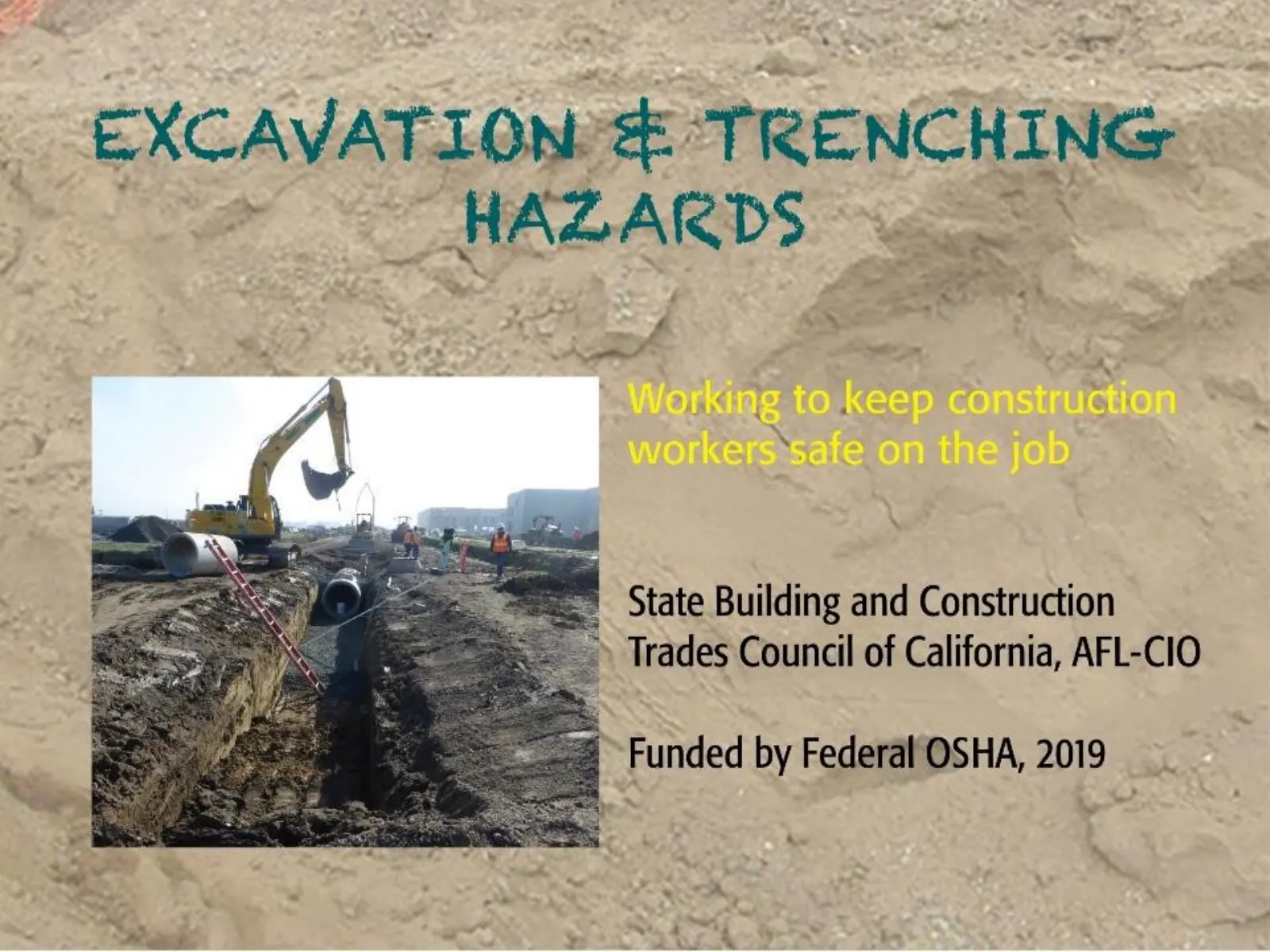
Excavation Hazards
Trench and excavation cave-in hazards (the most common caught-in/between scenario) from the State Building and Construction Trades Council; also suits the Excavations elective.
Slide text
· 141 slides · by State Building and Construction Trade Council
The words on each slide as the author wrote them, read from the file by software so they can be searched. Layout, pictures and tables are not shown here: the slides above and the download are the original.
- Slide 1
Title Slide
- Slide 2
Training Developed By:
- State Building and Construction Trades Council of CA, AFL-CIO
- Funded by:
- This material was produced under grant SH-05030-SH8 from the Occupational Safety and Health Administration, U.S. Department of Labor. It does not necessarily reflect the views or policies of the U.S. Department of Labor, nor does mention of trade names, commercial products, or organizations imply endorsement by the U.S. Government.
- Slide 3
Use of material and duplication
- Material may be used for non-commercial, instructional, educational purposes ONLY with proper accreditation to SBCTC
- Fees may not be charged for this material
- Every effort has been made to ensure information is current and accurate, the SBCTC does not assume any liability for errors or omissions
- Slide 4
Acknowledgements
- We gratefully thank the following organizations for:
- Providing technical assistance with developing this training:
- Federal OSHA
- Cal/OSHA
- CA Department of Public Health
- Elaine Nazima El-Askari, MPH, Consultant
- UC Berkeley Labor Occupational Health Program (LOHP)
- Sharing: photos, video, training material
- CA Dept. of Industrial Relations—Commission on Health and Safety and Workers’
- Compensation (WOSHTEP program)
- Center for Construction Research and Training (CPWR)
- Elcosh Images
- McGuire and Hester
- Oregon OSHA
- OSHA Training Institute Education Center—Chabot-Las Positas College
- Rudy Schroeder, Safety Consultant
- Swinerton Builders
- Existing photos and material developed by these previous OSHA grantees was incorporated into this training:
- Construction Advancement Foundation of Northwest Indiana, Inc.
- Maryland Fire and Rescue Institute
- University of Texas at Arlington
- Slide 5
Which one is an excavation?
- Slide 6
OSHA’s definition of excavation
- “Any man-made cut, cavity, trench, or depression in the Earth’s surface formed by earth removal”
- Slide 7
Examples
- Slide 8
What construction projects?
- Slide 9
Is a trench different from an excavation?
- All trenches are excavations;
- not all excavations are trenches.
- Slide 10
Also considered a trench
- Slide 11
Excavations are dangerous
- Known to be among most hazardous construction operations
- Slide 12
Buried Alive: Joe’s Story
- http://utilitycontractoronline.com/buried-alive-joes-story/
- "Buried alive. Alone. Screaming you know no one can hear. You wonder if the rescuers can get to you in time. You can’t move a muscle— not even your fingers. It is tough for you to breathe. And breathing is getting more difficult with each shallow breath because the dirt is crushing you.…
- Slide 13
Buried Alive: Joe’s Story
- …You have been doing this type of work for years and odds were that it would never happen to you. You may be asking yourself why you didn’t listen to the safety manager who told you never to go into an unprotected trench. And now as the last few minutes of your life pass you by, you think about your wife and kids, your parents and close friends and how much you would like to tell them you love them. But it is too late."
- Slide 14
Construction fatalities
- Slide 15
Excavation and trenching fatalities
- Rate for these fatalities is 112% higher than rate for general construction
- Construction averages 2 trench fatalities every month
- 80% of all U.S. trench/excavation fatalities from 2011-16 were in private construction industry
- Slide 16
Trench fatalities 2011-16
- Slide 17
Trench fatality facts 2011-14
- Water/sewer work, site preparation
- Majority contractors with <50 employees; largest % <10 employees
- Most victims between 25-54 years old
- 75% Hispanic workers, over 1/3 foreign born
- Construction laborers, plumbers & pipelayers, supervisors
- Residential sites and road construction
- Slide 18
Excavation accidents are preventable
- It’s the law!
- OSHA 29CFR 1926 Subpart P
- Blue indicates State Plan states
- Slide 19
Goal of today’s training… you will be able to:
- Understand excavation risk factors
- Identify excavation/trenching hazards
- Recognize employer requirements
- Understand role of “Competent Person”
- Describe protective systems and controls
- Apply best practices for excavation safety
- Understand rescue challenges
- Slide 20
PART 1:
- RISKS AND HAZARDS
- Slide 21
Every excavation is different
- Buzz Group: What are the variables?
- Slide 22
Fixed or changeable?
- Surrounding Environment
- Natural
- Topography
- Existing
- Infrastructure
- Soil Type
- Slide 23
Most common hazards
- Slide 24
Trench cave-ins = greatest risk
- Quickly bury workers
- More likely fatal
- Most in trenches
- 5-15’ deep
- Workers are trapped
- Slide 25
Cave-ins happen suddenly
- Access Oregon OSHA video clip on YouTube: https://www.youtube.com/watch?v
- =0wmcD3aM8X4
- Slide 26
Myth: “I can get out of the way”
- Only in Hollywood will this work!
- Slide 27
Think you can run?
- If a trench collapses, why not just run out of the way?
- Soil falls too fast.
- Guess how fast it falls from a height of: 2 feet
- Slide 28
From two feet …
- It takes only 0.35 seconds for soil to fall two feet.
- Human reaction time is about 0.50 seconds.
- There’s no time to escape.
- What about 4 feet?
- Slide 29
From four feet …
- It takes only 0.50 seconds for soil to fall four feet.
- Human reaction time is about 0.50 seconds.
- There’s no time to escape.
- What about 6 feet?
- Slide 30
From six feet …
- There’s no time to escape!
- It takes only 0.61 seconds for soil to fall six feet.
- Human reaction time is about 0.50 seconds.
- It would take a worker another 0.11 seconds to reach the ladder.
- Slide 31
Myth: “I can dig myself out”
- The trench has collapsed. A little bit of soil can’t weigh that much, right? Maybe you could dig out?
- Wrong! Assume you’re buried three feet deep. A cubic yard of soil is pressing on you.
- How much do you think a cubic yard weighs?
- Slide 32
How much does soil weigh?
- Cubic foot of soil = 100-120 lbs
- Cubic yard of soil = 2,700-3,000 lbs
- What does a cubic yard look like?
- Slide 33
Up to two tons!
- One cubic yard of wet excavated clay weighs 3078 lbs.
- One cubic yard of wet sand and gravel weighs 3375 lbs.
- One cubic yard of sandstone weighs 3915 lbs.
- tons!
- That’s almost two
- Slide 34
That’s equivalent to a vehicle
- 2,605-3,035 lbs (1 yd 3 )
- 4,798-5,372 lbs (1.75 yd 3 )
- 3,922-4,441 lbs (1.5 yd 3 )
- Slide 35
How does a cave-in affect your body?
- Impact of crushing force:
- Cuts/abrasions
- Broken bones
- Stretched/broken ligaments
- Internal bleeding
- Lacerated/punctured organs
- Immediate cell damage
- Weight of soil:
- Lack of oxygen
- “Crush Syndrome”
- Traumatic asphyxia
- Slide 36
Recognize clues of soil stress
- Near Excav ation
- In Trenc h
- Botto m of Trenc h
- Ground settlement
- Cracking in sidewalls or slopes
- Changes/bulges in wall slope
- Falling flakes, pebbles, soil clumps
- Water seepage
- Walls or bottom of trench softening
- Slide 37
Ways an open trench can fail
- Slide 38
More failures
- Downward pressure of adjoining soil causes bulge at bottom of trench
- Upward water flow into bottom of cut. Soil can become like “quick sand”
- Slide 39
Common trench hazards
- Spoil Pile Slide
- Shear Wall Collapse
- Lip Slide
- Belly Slough
- Slide 40
Spoil pile slide
- Slide 41
Shear wall collapse
- Slide 42
Lip slide
- Slide 43
Belly slough
- Slide 44
See any clues here?
- Slide 45
What’s happening here?
- Slide 46
Is this a safe excavation?
- Slide 47
Cave-in hazards are real—Review
- Excavations are naturally unstable
- Conditions can change quickly
- Trench cave-ins result in more fatalities
- Cave-ins happen suddenly, without warning
- You cannot run away or dig yourself out
- Force & weight of collapsing soil causes serious injury/death
- NEVER enter a trench unless you are sure it is safe!
- Slide 48
Other excavation hazards
- UNSTABLE
- FALLS
- CAVE-INS
- UTILITY LINES
- FALLING LOADS
- STRUCTURES
- TRAFFIC
- FALLING OBJECTS
- BAD AIR
- VALLEY FEVER
- WATER
- Slide 49
Underground utilities— what are the hazards?
- Gas, Electric, Water, Sewer, Communications
- Can’t see them
- May be anywhere under construction site
- Slide 50
What is the risk?
- Without proper planning, workers are at risk for:
- Electrocution
- Fire
- Explosions
- Gases
- Toxic Substances
- Drowning
- Cave-in
- Excavation equipment contacting/damaging utility lines
- Handheld power equipment (concrete breakers/pneumatic drills)
- Hand digging with sharp tools (shovels/picks/pry bars) close to underground utilities
- Slide 51
Gas line fatal blast—Nov 2004
- Slide 52
Overhead power line dangers?
- High voltage—high current
- Not insulated
- Out of sight line— people don’t look up
- Current can arc
- Controlled by utility company, not job site
- Slide 53
Hazardous atmospheres
- Can expect in excavations >4 ft deep
- Limited exits and air circulation
- Buildup of gases, fumes, vapors and mists Oxygen-deficient atmosphere
- Poisoning, asphyxiation and death
- Slide 54
What are potential sources of “Bad Air?”
- Some Examples:
- Hydrogen sulfide
- Carbon dioxide
- Methane
- Carbon monoxide
- Excavating near landfills
- Leaking gas lines/storage tanks
- Contaminated soil
- Sewers
- Gas powered tools
- Generators
- Vehicles
- Slide 55
Water in the excavation
- Slide 56
Dangers of water
- Fills surface cracks
- Softens soil
- Weakens/undermines excavation walls
- Can lead to cave-ins
- Difficult to get out
- Drowning
- Electrocution risk
- SOURCES:
- Heavy rain
- Broken pipe
- Ground water
- NEVER work in trenches where water has accumulated!
- Slide 57
Falling loads
- During loading/unloading Rigging failures
- Shifting loads
- Slide 58
Falling objects
- Loose rock or soil Tools Materials Equipment
- Slide 59
Fall hazards around excavations?
- Excavations >6’ deep
- Edges not clearly visible
- Unguarded walkways
- Pier holes, wells, pits, shafts
- Unprotected remote excavations
- Portable ladders
- Slide 60
Destabilized structures
- Buildings
- Walls
- Sidewalks
- Pavement
- Slide 61
Exposure to vehicular traffic
- Slide 62
Exposure to Valley fever
- What is it?
- An infection caused by inhaling spores of a
- fungus in the soil
- Just a few (<10) spores can cause disease
- Scientific name of fungus: Coccidioides
- Illness also known as “coccidioidomycosis” or “cocci”
- Slide 63
Region where fungus is found
- Slide 64
California Valley fever cases
- Slide 65
How people get valley fever
- Workers disturbing soil in areas where Valley fever is common are at highest risk
- Fungus lives 2–12” below surface
- Becomes airborne
- Slide 66
What are Valley fever symptoms?
- Flu-like (Cough, fever, muscle aches, headache)
- Fatigue
- Difficulty breathing
- Rash on upper trunk, arms, or legs
- Joint pain in knees or ankles
- Symptoms can last weeks or months Can be fatal without treatment
- Slide 67
Who is exposed here?
- Slide 68
Hazards Review Quiz—True or False
- T • Cave-ins happen without warning.
- T • Dangerous gases can build-up in trenches.
- F • Adding water strengthens the soil.
- F • All excavations are trenches.
- T • Valley fever is caused by fungus in the soil.
- F • If soil begins to cave-in, you can run to safety. F • A cubic yard of soil weighs about 1,000 lbs.
- T • Excavations can have all Focus Four hazards.
- Slide 69
Case Studies—Small Group Activity
- Slide 70
PART 2:
- HAZARD CONTROLS and PROTECTIVE SYSTEMS
- Slide 71
Who controls hazards?
- Who is legally responsible for providing a safe and healthful workplace?
- The Employer
- Employers must follow requirements of the OSHA Excavation standard (or State Plan standards)
- Employers may be cited, fined and prosecuted for non-compliance
- 7 1
- Slide 72
The OSHA Excavation Standard
- “29 CFR 1926 Subpart P”
- Applies to all open excavations
- Requires employers to protect workers from all of the following:
- Cave-ins
- Exposure to vehicle traffic and falling loads
- Hazardous atmospheres and water accumulation
- Loose rock, soil or other falling objects
- Falls from edges of excavation and walkways
- 7 2
- Slide 73
Employers must:
- Designate a Competent Person
- Locate underground utilities
- Locate/remove/stabilize surface encumbrances
- Assure warning systems for mobile equipment
- Provide safe access, including trench ingress/egress
- Provide worker training
- 7 3
- Slide 74
What does “competent person” mean?
- Capable of identifying and predicting hazardous conditions AND authorized by employer to take prompt corrective action.
- “The First Line of Defense from Cave-ins”
- Employer decides who is qualified
- Foreman, superintendent or other employee
- 7 4
- Slide 75
Excavation competent person must:
- Understand overlapping OSHA standards
- Anticipate potential risks
- Clearly communicate with workers
- Recognize and eliminate hazards
- Monitor employees at excavation site
- Authorize when to stop work
- Correct hazards and determine when it’s safe to return to work
- 7 5
- Slide 76
What are competent person tasks?
- Ongoing site/equipment inspections
- Analyze and classify soil types
- Determine required protective systems
- Assure correct installation of protective systems
- Design structural ramps
- Test for hazardous atmospheres
- Monitor water removal equipment
- KNOW WHO YOUR COMPETENT PERSON IS!
- 7 6
- Slide 77
Trench safety: Inspect—Test—Protect
- 7 7
- Slide 78
How can cave-ins be prevented?
- Different approaches:
- Excavate soil back to safe angle
- Install system to support trench walls
- Competent Person chooses based on:
- Soil type and water content
- Excavation depth and width
- Nature of work
- Nearby activities that increase risk
- Excavations >20’ deep require a system designed by registered professional engineer
- 7 8
- Slide 79
Soil classification is critical
- Dirt is dirt, right?
- NO!
- Variables that affect soil stability: Strength
- Plasticity Cohesiveness
- EVERY EXCAVATION IS DIFFERENT!
- Slide 80
Soil types
- Slide 81
Soil testing by competent person
- Visual Tests
- Observe site
- Examine soil samples
- Tension cracks/fissures
- Soil fragments falling
- Water seeping
- Manual Tests—Determine
- Plasticity
- Dry strength
- Compressive strength
- Slide 82
Types of protective systems
- Slide 83
Sloping
- Removes unstable soil back to a safe angle to prevent cave-ins
- “Safe angle” varies with soil type; specified by OSHA
- The less stable the soil, the more gradual the slope
- Slide 84
Slope angles by soil type
- RED FLAGS!
- Your safety is at risk if:
- No designated competent person
- Slope angles are too steep for soil type
- Conditions change and are not reassessed
- Slide 85
More examples
- Slide 86
Another option = benching
- Cannot be used with Type C soils
- Benching follows the slope line
- Slide 87
Combo of benching and sloping
- Slide 88
Shoring systems
- Designed to support sides of trench to prevent cave-ins
- Timber or metal
- Custom-tailored to trench
- Fit narrow spaces & around utilities
- Soil arching stabilizes trench walls
- Requires technical knowledge
- Slide 89
Timber shoring
- Slide 90
Hydraulic shoring
- Prefabricated of aluminum or steel
- Installed from outside trench
- Adapt to various depths/widths
- Vertical shore may be installed by one worker
- Vertical shore type
- Horizontal wale type w/sheeting
- Slide 91
Hydraulic shoring in use
- Protecting workers from cave-ins
- Soil arching at work
- Slide 92
Shoring must meet OSHA standard
- Follow dimensions and spacing specified by OSHA
- Designed for specific soil type, depth, width and length of trench
- Follow OSHA standard charts
- --OR--
- Tabulated Data approved by registered professional engineer
- Slide 93
Other shoring examples
- Slide 94
Shielding (trench boxes)
- Prefabricated structure that protects workers if cave-in happens
- Designed by registered professional engineer
- Does not support trench, acts like “bomb shelter”
- Workers must stay in confines of trench box to be protected!
- Slide 95
Proper use of shields
- Follow manufacturer’s specifications—load cannot exceed capacity
- Top of shield must extend to top of trench
- Cut trench no more than 2’ below bottom of shield
- Backfill around box to prevent lateral shifts
- May be used in combo with sloping
- Slide 96
Shielding examples
- Shield protected from cave-in
- Slide 97
Safely entering and leaving a trench
- Must be a stairway, ladder, or ramp in excavations 4’ or deeper
- It must be within 25’ of the workers
- Ladder should extend 3’ above the top of the trench
- Slide 98
Remember the other hazards?
- UNSTABLE
- FALLS
- CAVE-INS
- UTILITY LINES
- FALLING LOADS
- STRUCTURES
- TRAFFIC
- FALLING OBJECTS
- BAD AIR
- VALLEY FEVER
- WATER
- Slide 99
Underground utilities
- What must you do before you dig?
- Survey and mark area
- Be aware of pipeline markers
- Call 811 at least 2 working days prior to starting work
- Wait required time, give utilities 2 full working days to locate/mark
- Call private utility locator if necessary to ID private lines
- Maintain utility locator marks and respect them when digging
- Underground Service Alert (USA)
- Slide 100
Dig with care—hand digging
- Hand dig within 24 inches of each side of marked lines
- Use rounded or blunt-edged fiberglass handled shovel
- See the line with your own eyes
- Don’t use sharp tools or pry against a utility line
- Slide 101
Overhead power lines What are best practices?
- Inspect for power lines, poles, support wires before work begins
- Assume ALL lines are energized
- Mark safe boundary, post warning signs at ground level, use portable safety barriers
- Keep workers and equipment at least 10 feet away from lines
- Use dedicated spotter for heavy equipment
- Don’t guide a load and be spotter at same time
- Know what to do if equipment contacts power line
- Slide 102
Hazardous Atmospheres
- Before workers enter excavations >4 feet deep where bad air or oxygen deficiency (<19.5%) could be expected:
- Competent person must test air
- Provide proper respiratory protection or ventilation
- Conduct testing as often as necessary
- Emergency rescue equipment must be readily available
- Slide 103
Water accumulation
- NEVER work in an excavation with standing water, or if water is accumulating
- Precautions must be taken to protect you such as:
- Special support or shield systems
- Water removal equipment
- Monitored by competent person
- Slide 104
Exposure to falling loads
- Workers are not permitted to stand or work underneath loads handled by digging or lifting equipment
- Stand away from vehicle being loaded or unloaded to avoid being struck by spillage or falling materials
- Operators may remain in cab of vehicle being loaded/unloaded if equipped to provide adequate protection for the operator
- Slide 105
Protection from falling objects
- Keep spoils, tools/equipment at least 2 feet from excavation edge
- Use retaining devices to prevent material/equipment from falling/rolling into excavation
- Use warning system (barricades, hand/mechanical signals, stop logs) for mobile equipment near edge
- Protect from loose rock/soil falling from excavation face (scaling, barricades, retaining devices)
- Wear proper PPE
- Slide 106
Fall protection—Excavation Standard
- Walkways must have guard rails if 6 feet or more above lower levels
- Physical barrier protection at all remotely located excavations
- Wells, pits, shafts must be barricaded or covered
- Backfill upon completion of operations
- Slide 107
Stabilize adjacent structures
- Where stability is endangered by excavation operations
- Employers must:
- Not undermine sidewalks, pavement or structures unless support systems are used to protect employees
- Provide shoring, bracing or underpinning
- Slide 108
Exposure to vehicle traffic
- Employees must wear warning vests or other suitable garments marked or made with reflectorized or highly visible material
- Require a designated, trained flag person along with signs, signals, and barricades when necessary
- Slide 109
Protection from Valley fever
- Plan ahead—know where fungus is found
- Limit dust generation—wet soil before and while digging
- Cover spoils piles with tarps
- Stay upwind of digging
- Protect equipment operators with enclosed cabs with HEPA air filtration
- Use respiratory protection
- Provide training on Valley Fever hazards
- Slide 110
Excavation rescue
- Show a news clip showing a trench rescue
- Slide 111
Danger to first responders & victims
- Excavation rescue operations are dangerous and might:
- Cause additional cave-ins
- Create more soil pressure on buried victim
- Injure the victim more severely
- NEVER RUSH IN TO A COLLAPSED
- TRENCH—YOU MAY BECOME A VICTIM TOO!
- Slide 112
Will it be rescue or recovery?
- Chaotic, unstable, dangerous situation
- Requires technical rescue team
- Must stabilize trench before team can enter
- May take several hours to free victim
- High profile, lots of media attention
- Slide 113
Have an emergency action plan
- Outline steps for every possible excavation emergency
- Include contact info for fire, police, OSHA
- Have emergency equipment available on-site
- Define responsibilities of workers on-site before/after rescue team arrives
- Practice the plan—train to be ready for fast implementation
- Slide 114
At the scene
- Slide 115
- 11 5
- PART 3:
- Practice What You
- Learned
- Slide 116
What’s Wrong Here?
- Slide 117
Photo
- Slide 118
What’s wrong with these pictures?
- Identify the hazards in the next slides and ask yourself:
- Would you allow your kids or other loved ones into any of the following situations?
- Slide 119
What’s wrong?
- Slide 120
1. What’s wrong?
- Slide 121
- 2. What’s wrong?
- Slide 122
3. What’s wrong?
- Slide 123
4. What’s wrong?
- Slide 124
- 5. What’s wrong?
- Slide 125
- 6. What’s wrong?
- Slide 126
7. What’s wrong?
- Slide 127
8. What’s wrong?
- Slide 128
9. What’s wrong?
- Slide 129
10. What’s wrong?
- Slide 130
11. What’s wrong?
- Slide 131
- 12. What’s wrong?
- Slide 132
13. What’s wrong?
- Slide 133
14. What’s wrong?
- Slide 134
15. What’s wrong?
- Slide 135
16. What’s wrong?
- Slide 136
17. What’s wrong?
- Slide 137
What’s wrong?
- Slide 138
Safety best practices for workers
- Slide 139
Best practices for employers
- Slide 140
Be aware/be safe
- Excavation accidents are preventable!
- Name three important things you learned from this training…
- Slide 141
Final questions?
- Post-tests
- Evaluations
More on Caught-In/Between
ppt
20 slidesFocus Four: Caught-In or -Between Hazard Recognition
OSHA's official Construction Focus Four slide deck on caught-in or -between hazards: trench cave-ins, unguarded machinery, equipment rollovers and pinch points.
U.S. Department of Labor, OSHAPublic domain
ppt
10 slidesFocus Four: Caught-In or -Between Accident Prevention Workshop
Companion workshop deck for the caught-in/between module with accident scenarios for group discussion.
U.S. Department of Labor, OSHAPublic domain
pdf
58 slidesFocus Four: Caught-In or -Between Instructor Guide
OSHA instructor guide/lesson plan for the Focus Four caught-in or -between module.
U.S. Department of Labor, OSHAPublic domain