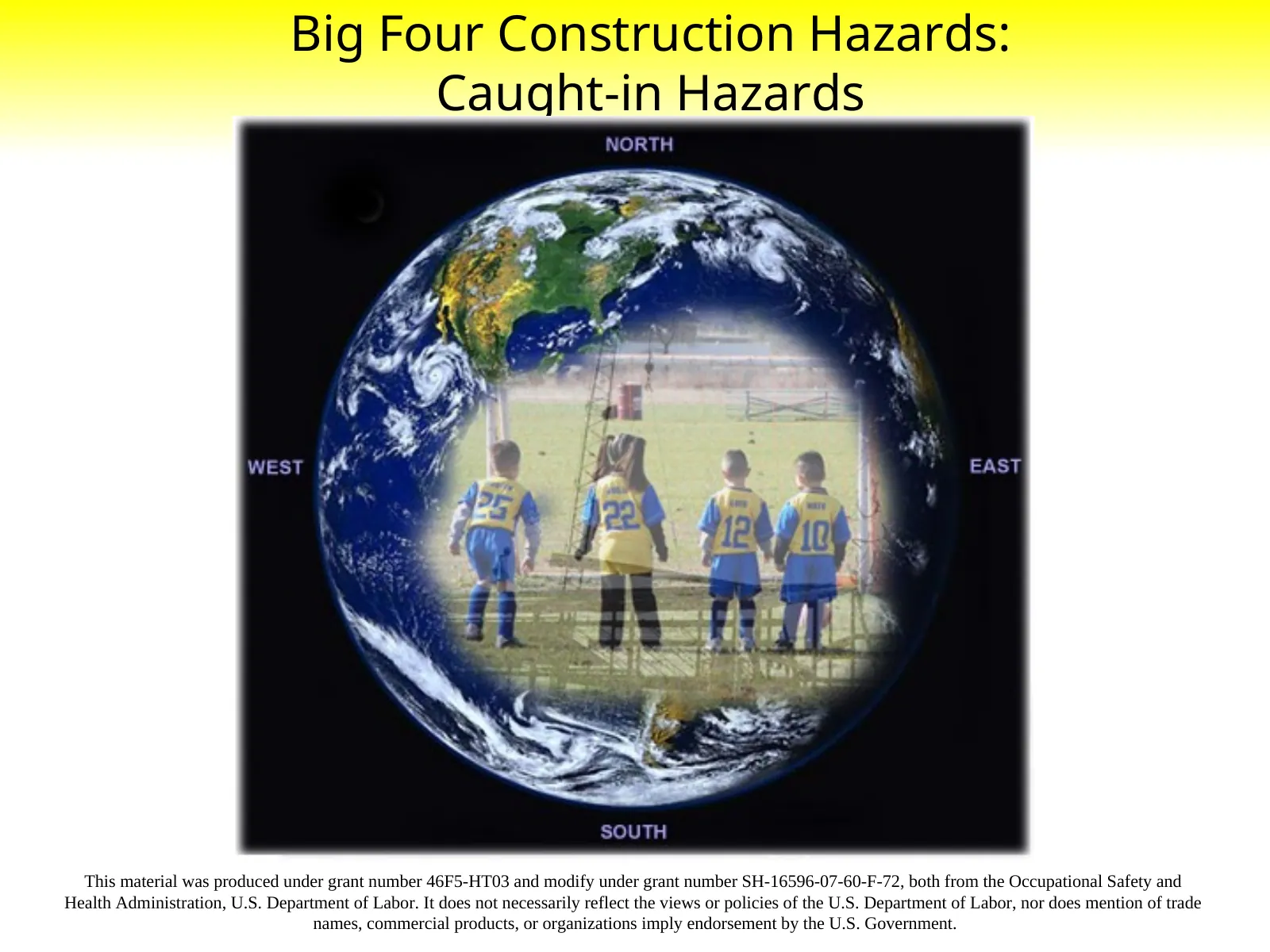
1 / 41Use ← → to flip
Caught-In Hazards
Focus Four caught-in/between hazards deck from the University of Puerto Rico Medical Sciences Campus (2007).
Slide text
· 41 slides · by University of Puerto Rico, Medical Sciences Campus
The words on each slide as the author wrote them, read from the file by software so they can be searched. Layout, pictures and tables are not shown here: the slides above and the download are the original.
- Slide 1
Big Four Construction Hazards:
- Caught-in Hazards
- This material was produced under grant number 46F5-HT03 and modify under grant number SH-16596-07-60-F-72, both from the Occupational Safety and Health Administration, U.S. Department of Labor. It does not necessarily reflect the views or policies of the U.S. Department of Labor, nor does mention of trade names, commercial products, or organizations imply endorsement by the U.S. Government.
- Slide 2
Sponsor
- United States Department of Labor
- Occupational Safety and Health Administration
- OSHA
- Susan Harwood Grant #SH-16596-07-60-F-72
- Slide 3
Working Team
- UNIVERSITY OF PUERTO RICO MEDICAL SCIENCES CAMPUS
- Graduate School of Public Health, Dep. of Environmental Health
- Sergio Caporali, Ph.D., CSP – Principal Investigator
- Lida Orta-Anés, Ph.D., Field Trainer
- Marcilyn Colón Colón, MSc., Training Coordinator
- Harlyn Rivera, Administrative Assistant
- Slide 4
Working Team
- CONTRACTORS
- Circe E. Niezen, ME, MBA, Training Evaluator, PUPR
- Mark Fullen, Ph.D. Candidate, Field Trainer and Curriculum Developer, WVU
- Carmen Vázquez, RN, Field Trainer
- Migdalia Ruiz, MS, Field Trainer
- Carlos Ortiz, Ph.D., Online Training Administrator, UPR-CPRS-OIRE
- Eliel Melón Ramos – Online Training Adm. Assistant, UPR-CPRS-OIRE
- Slide 5
Introduction
- The following presentations have been developed in both Spanish and English for the construction industry. These presentations focus on the Big Four Construction Hazards – falls, electrical, caught-in and struck-by.
- All training materials will cover the four hazards seen regularly on construction sites and will focus on the methods for the recognition and the prevention of these common hazards.
- Slide 6
Caught-in Hazards Overview
- A. Hazard Recognition
- 1. Cranes and Heavy Equipment
- 2. Tools and Equipment
- 3. Materials Handling
- 4. Trenches and Excavations
- B Accident Prevention
- 1. Guarding Moving Equipment/Parts
- 2. Barricades
- 3. Proper Materials Handling
- 4. Shielding/Trench Boxes
- Slide 7
Caught-in Hazards
- Caught-in hazards are one of the four most deadly hazards found at construction sites.
- This program will help you recognize common caught-in hazards.
- Safe
- The symbol will tell you if the situation in the picture is either safe or not safe.
- Not safe
- Slide 8
Caught-in Statistics
- Each year, workers die from ‘caught-in’ accidents. During the year 2006:
- Total deaths from ‘caught-in’ cases: 388
- Caught-in deaths in construction: 95
- Approximately 8% of deaths in construction are from ‘caught-in’ accidents.
- Approximately 7% of all occupational deaths are from ‘caught-in’ accidents.
- Slide 9
Hazard Recognition
- Caught-in hazards occur when a worker is caught inside of or in between different objects.
- Slide 10
Cranes and Heavy Equipment
- Caught-in hazards are often created when working around heavy equipment.
- Slide 11
Cranes and Heavy Equipment
- Never place yourself between a piece of heavy equipment and an immovable object.
- Slide 12
Cranes and Heavy Equipment
- Never work in the swing radius of rotating equipment.
- Slide 13
Cranes and Heavy Equipment
- Always work at a safe distance from equipment.
- Slide 14
Tools and Equipment
- Caught-in hazards exist when workers remove or disable guards on tools or equipments.
- Slide 15
Tools and Equipment
- Never place your hands or body near moving parts.
- Slide 16
Tools and Equipment
- Gloves, long sleeve shirts, jewelry, or loose fitting clothing can be hazardous if caught in moving parts.
- Slide 17
Tools and Equipment
- Never use equipment that is missing guards or other protective devices.
- Slide 18
Materials Handling
- Use caution when handling materials.
- Slide 19
Materials Handling
- Be careful when stacking and storing materials.
- Slide 20
Materials Handling
- Do not place yourself between materials and an immovable structure.
- Slide 21
Trenches & Excavations
- Workers inside of an excavation must be protected from a cave-in.
- Slide 22
Trenches & Excavations
- Workers are exposed to a potential cave-in when there are unprotected sides.
- Slide 23
Trenches & Excavations
- Workers could be caught-in between the sides of an excavation and pipes or other objects inside the excavation.
- Slide 24
Trenches & Excavations
- Never work inside an excavation where water is accumulating.
- Slide 25
Accident Prevention
- A willing, positive attitude towards safety will help make a safer work environment.
- Slide 26
Accident Prevention
- Plan your work and look for potential hazards.
- Each task will have different hazards.
- Slide 27
Guarding Moving Equipment/Parts
- Always use equipment with all of the guards properly adjusted and in position.
- Slide 28
Guarding Moving Equipment/Parts
- Always use equipment with rotating or moving parts that are properly guarded.
- Slide 29
Guarding Moving Equipment/Parts
- Always use tools or equipments that are properly guarded.
- Slide 30
Guarding Moving Equipment/Parts
- Some equipments may need to be guarded by distance.
- Slide 31
Barricades
- When working near equipments, such as cranes, use a barricade to identify the unsafe area.
- Slide 32
Barricades
- Barricades must be maintained.
- Slide 33
Proper Materials Handling
- Properly handle and guide materials that are being flown overhead.
- Slide 34
Proper Materials Handling
- Be safe when moving materials.
- Slide 35
Protective Systems
- Before performing any excavation work, all employees must be trained.
- When excavation work is taking place, a competent person must be present.
- Anytime an excavation’s depth is greater than 5 feet and less than 20 feet, a competent person must select the protective system to put in place.
- Excavations over 20 feet require the design of a protective system by a licensed professional engineer.
- Slide 36
Shielding/Trench Boxes
- Benching and sloping prevents the sides of a trench from collapsing onto workers inside the trench.
- Anytime an excavation is greater than 5 feet in depth, protective systems must be in place.
- Bench
- Slide 37
Shielding/Trench Boxes
- A safe way to enter and exit excavations must be provided any time there is a trench.
- Slide 38
Shielding/Trench Boxes
- Regardless of the type of protection used, a safe way to enter the trench is required.
- Slide 39
Disclaimer/Usage Notes
- Photos shown in this presentation may depict situations that are not in compliance with applicable OSHA requirements.
- It is not the intent of the content developers to provide compliance-based training in this presentation, the intent is more to address hazard awareness in the construction industry, and to recognize the overlapping hazards present in many construction workplaces.
- It should NOT be assumed that the suggestions, comments, or recommendations contained herein constitute a thorough review of the applicable standards, nor should discussion of “issues” or “concerns” be construed as a prioritization of hazards or possible controls. Where opinions (“best practices”) have been expressed, it is important to remember that safety issues in general and construction jobsites specifically will require a great deal of site - or hazard-specificity - a “one size fits all” approach is not recommended, nor will it likely be very effective.
- It is assumed that individuals using this presentation, or content, to augment their training programs will be “qualified” to do so, and that said presenters will be otherwise prepared to answer questions, solve problems, and discuss issues with their audiences.
- Slide 40
Disclaimer/Usage Notes
- No representation is made as to the thoroughness of the presentation, nor to the exact methods of recommendation to be taken. It is understood that site conditions vary constantly, and that the developers of this content cannot be held responsible for safety problems they did not address or could not anticipate, nor those which have been discussed herein or during physical presentation. It is the responsibility of each employer contractor and their employees to comply with all pertinent rules and regulations in the jurisdiction in which they work. Copies of all OSHA regulations are available from your local OSHA office. This presentation is intended to discuss Federal Regulations only – your individual State requirements may be more stringent.
- As a presenter, you should be prepared to discuss all of the potential issues/concerns, or problems inherent in those photos particularly.
- Slide 41
Big Four
- Construction Hazards:
- Caught-in Hazards
- This concludes the Caught-in Hazards Module
- “The End”
More on Caught-In/Between
ppt
20 slidesFocus Four: Caught-In or -Between Hazard Recognition
OSHA's official Construction Focus Four slide deck on caught-in or -between hazards: trench cave-ins, unguarded machinery, equipment rollovers and pinch points.
U.S. Department of Labor, OSHAPublic domain
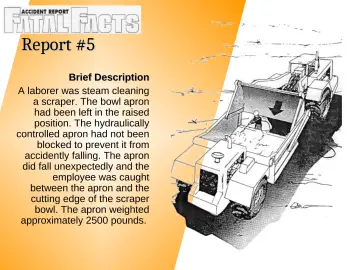
ppt
10 slidesFocus Four: Caught-In or -Between Accident Prevention Workshop
Companion workshop deck for the caught-in/between module with accident scenarios for group discussion.
U.S. Department of Labor, OSHAPublic domain
pdf
58 slidesFocus Four: Caught-In or -Between Instructor Guide
OSHA instructor guide/lesson plan for the Focus Four caught-in or -between module.
U.S. Department of Labor, OSHAPublic domain