OSHA fact sheet or bulletin, for General Industry classes.
Page text
· 2 pages · by U.S. Department of Labor, OSHA
The words on each page as the author wrote them, read from the file by software so they can be searched. Layout, pictures and tables are not shown here: the pages above and the download are the original.
- Page 1
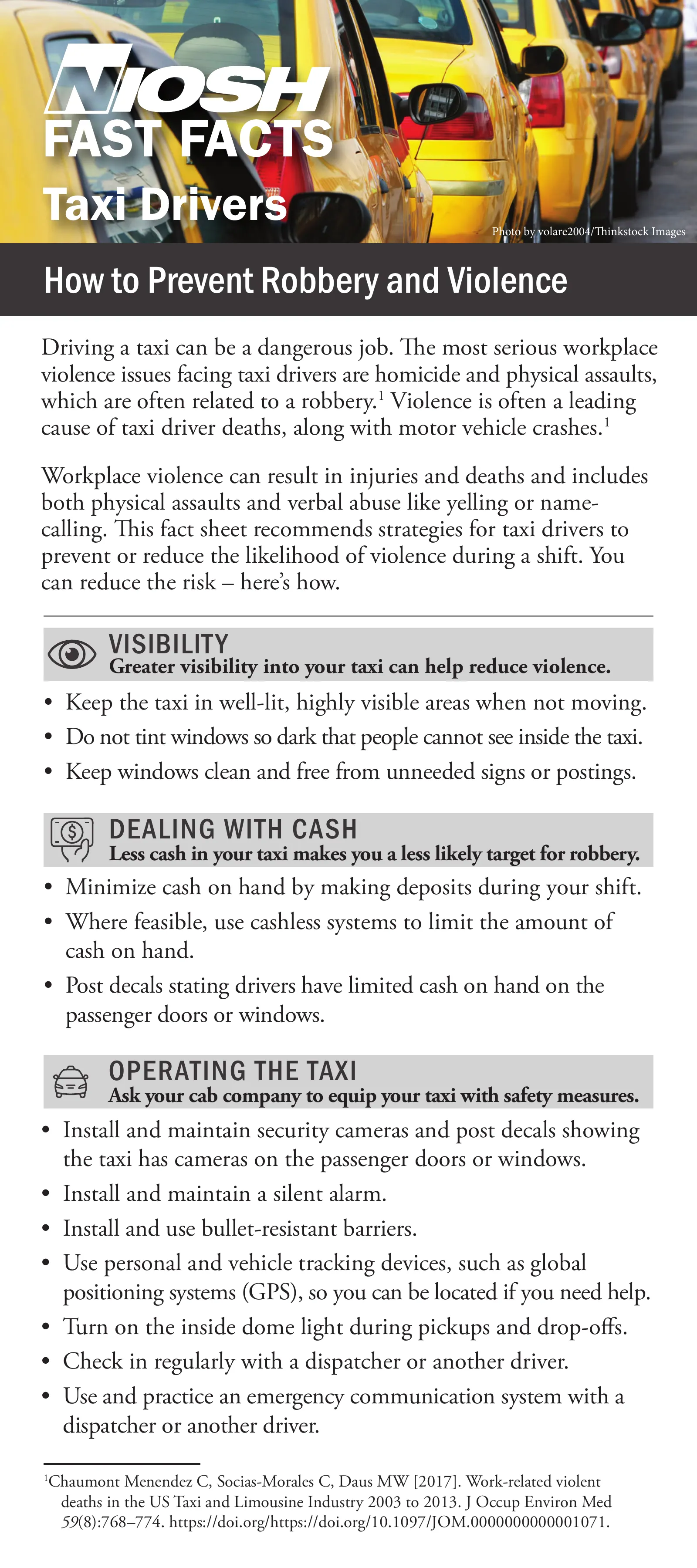
How to Prevent Robbery and Violence
- Photo by volare2004/Thinkstock Images
- Driving a taxi can be a dangerous job. The most serious workplace violence issues facing taxi drivers are homicide and physical assaults, which are often related to a robbery. 1 Violence is often a leading cause of taxi driver deaths, along with motor vehicle crashes. 1
- Workplace violence can result in injuries and deaths and includes both physical assaults and verbal abuse like yelling or namecalling. This fact sheet recommends strategies for taxi drivers to prevent or reduce the likelihood of violence during a shift. You can reduce the risk – here’s how.
- VISIBILIT Y
- Greater visibility into your taxi can help reduce violence.
- Keep the taxi in well-lit, highly visible areas when not moving.
- Do not tint windows so dark that people cannot see inside the taxi.
- Keep windows clean and free from unneeded signs or postings.
- DEALING WITH CASH
- Less cash in your taxi makes you a less likely target for robbery.
- Minimize cash on hand by making deposits during your shift.
- Where feasible, use cashless systems to limit the amount of cash on hand.
- Post decals stating drivers have limited cash on hand on the passenger doors or windows.
- OPERATING THE TAXI
- Ask your cab company to equip your taxi with safety measures.
- Install and maintain security cameras and post decals showing the taxi has cameras on the passenger doors or windows.
- Install and maintain a silent alarm.
- Install and use bullet-resistant barriers.
- Use personal and vehicle tracking devices, such as global positioning systems (GPS), so you can be located if you need help.
- Turn on the inside dome light during pickups and drop-offs.
- Check in regularly with a dispatcher or another driver.
- Use and practice an emergency communication system with a dispatcher or another driver.
- Chaumont Menendez C, Socias-Morales C, Daus MW [2017]. Work-related violent deaths in the US Taxi and Limousine Industry 2003 to 2013. J Occup Environ Med 59(8):768–774. https://doi.org/https://doi.org/10.1097/JOM.0000000000001071.
- Page 2
DEALING WITH CUSTOMERS
- Photo by Aidon/Getty Images
- Prepare for possible unsafe situations with customers.
- Do not chase after fare evaders.
- Ask your cab company to provide safety training on how to recognize, avoid, or calm potentially violent situations.
- Do not resist a robbery. Let robbers take your money.
- Do not accept passengers who cannot provide a destination.
- Notify a dispatcher or another driver immediately when picking up a passenger.
- Notify a dispatcher or another driver immediately if passengers change destinations once they are in the taxi.
- Notify a dispatcher or another driver if driving to certain areas feels potentially unsafe.
- GET INFORMATION
- Find NIOSH products and get answers to workplace safety and health questions: 1-800-CDC-INFO (1-800-232-4636) | TTY: 1-888-232-6348
- CDC INFO: www.cdc.gov/info | www.cdc.gov/niosh
- Monthly NIOSH eNews: cdc.gov/niosh/eNews
- Find compliance assistance resources, OSHA standards, or file a confidential workplace safety and health complaint:
- 1-800-321-OSHA (6742) | TTY: 1-877-889-5627 | www.osha.gov
- Twice-monthly OSHA eNewsletter: osha.gov/quicktakes
- SUGGESTED CITATION
- NIOSH/OSHA [2019]. NIOSH fast facts: taxi drivers—how to prevent robbery and violence. By Chaumont Menendez C, Dalsey E. Morgantown, WV: U.S. Department of Health and Human Services, Centers for Disease Control and Prevention, National Institute for Occupational Safety and Health, DHHS (NIOSH) Publication 2020-100, https://doi.org/10.26616/NIOSHPUB2020100revised112019. Washington, DC: U.S. Department of Labor, Occupational Safety and Health Administration, DOL (OSHA) Publication No. 3976, https://www.osha.gov/Publications/OSHA3976.pdf.
- DOI: https://doi.org/10.26616/NIOSHPUB2020100revised112019
- DHHS (NIOSH) Publication No. 2020-100 (revised 11/2019) DOL (OSHA) Publication No. 3976
- November 2019