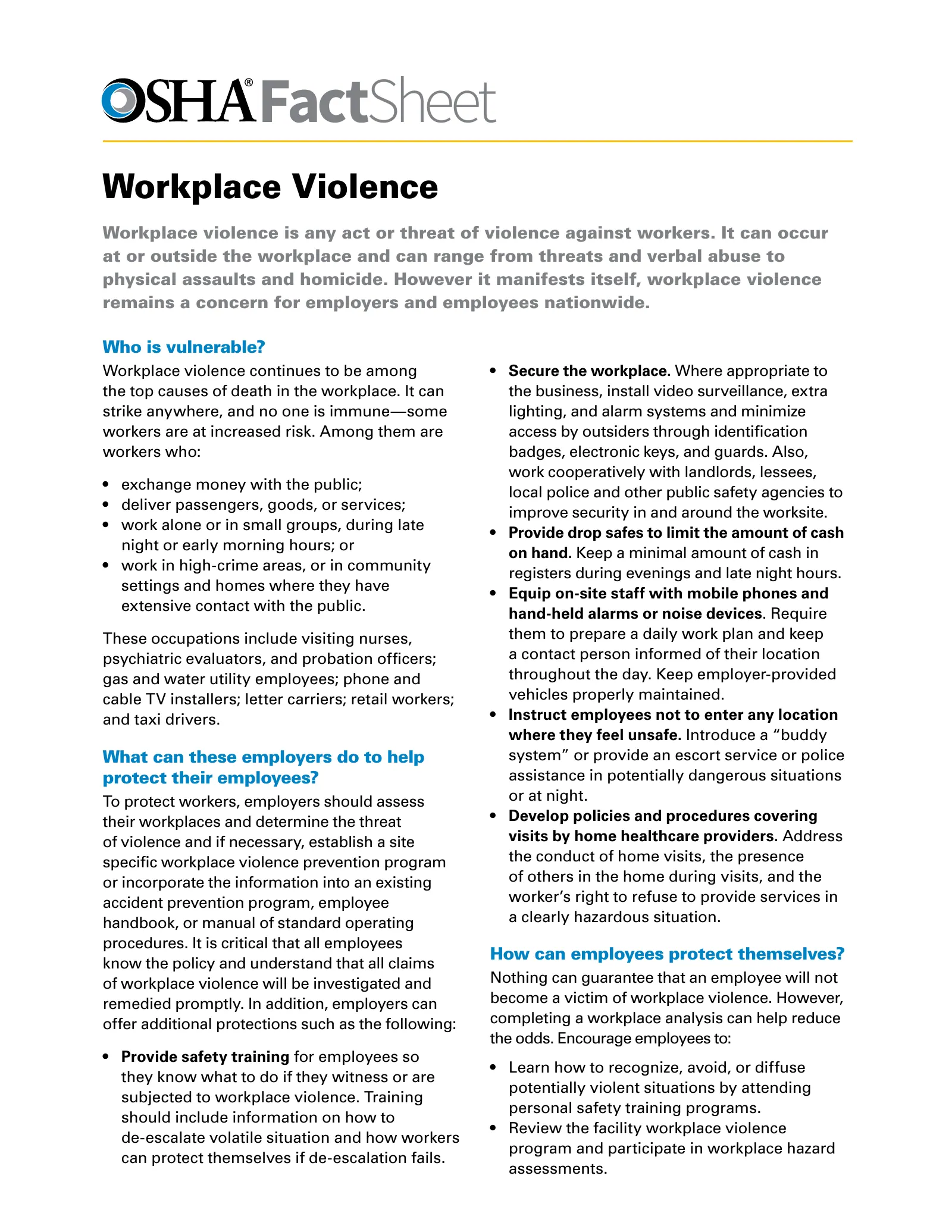
1 / 2Use ← → to flip
Workplace Violence Fact Sheet (OSHA FS-3509)
OSHA fact sheet or bulletin, for General Industry classes.
Page text
· 2 pages · by U.S. Department of Labor, OSHA
The words on each page as the author wrote them, read from the file by software so they can be searched. Layout, pictures and tables are not shown here: the pages above and the download are the original.
- Page 1
FactSheet
- Workplace Violence
- Workplace violence is any act or threat of violence against workers. It can occur at or outside the workplace and can range from threats and verbal abuse to physical assaults and homicide. However it manifests itself, workplace violence remains a concern for employers and employees nationwide.
- Who is vulnerable?
- Workplace violence continues to be among the top causes of death in the workplace. It can strike anywhere, and no one is immune—some workers are at increased risk. Among them are workers who:
- exchange money with the public;
- deliver passengers, goods, or services;
- work alone or in small groups, during late night or early morning hours; or
- work in high-crime areas, or in community settings and homes where they have extensive contact with the public.
- These occupations include visiting nurses, psychiatric evaluators, and probation officers; gas and water utility employees; phone and cable TV installers; letter carriers; retail workers; and taxi drivers.
- What can these employers do to help protect their employees?
- To protect workers, employers should assess their workplaces and determine the threat of violence and if necessary, establish a site specific workplace violence prevention program or incorporate the information into an existing accident prevention program, employee handbook, or manual of standard operating procedures. It is critical that all employees know the policy and understand that all claims of workplace violence will be investigated and remedied promptly. In addition, employers can offer additional protections such as the following:
- Provide safety training for employees so they know what to do if they witness or are subjected to workplace violence. Training should include information on how to de‑escalate volatile situation and how workers can protect themselves if de-escalation fails.
- Secure the workplace. Where appropriate to the business, install video surveillance, extra lighting, and alarm systems and minimize access by outsiders through identification badges, electronic keys, and guards. Also, work cooperatively with landlords, lessees, local police and other public safety agencies to improve security in and around the worksite.
- Provide drop safes to limit the amount of cash on hand. Keep a minimal amount of cash in registers during evenings and late night hours.
- Equip on-site staff with mobile phones and hand-held alarms or noise devices. Require them to prepare a daily work plan and keep a contact person informed of their location throughout the day. Keep employer-provided vehicles properly maintained.
- Instruct employees not to enter any location where they feel unsafe. Introduce a “buddy system” or provide an escort service or police assistance in potentially dangerous situations or at night.
- Develop policies and procedures covering visits by home healthcare providers. Address the conduct of home visits, the presence of others in the home during visits, and the worker’s right to refuse to provide services in a clearly hazardous situation.
- How can employees protect themselves?
- Nothing can guarantee that an employee will not become a victim of workplace violence. However, completing a workplace analysis can help reduce the odds. Encourage employees to:
- Learn how to recognize, avoid, or diffuse potentially violent situations by attending personal safety training programs.
- Review the facility workplace violence program and participate in workplace hazard assessments.
- Page 2
- Alert supervisors to any concerns about safety or security and report all incidents immediately in writing.
- Avoid traveling alone into unfamiliar locations or situations whenever possible.
- Carry only minimal money and required identification into community settings.
- Inform an employer of disputes or problems before escalation.
- What should employers do following a workplace violence incident?
- Encourage employees to report and log all incidents and threats of workplace violence.
- Provide prompt medical evaluation and treatment after the incident, including trauma informed care.
- Report violent incidents to the local police promptly.
- Inform victims of their legal right to prosecute perpetrators.
- Discuss the circumstances of the incident with staff members. Encourage employees to share information about ways to avoid similar situations in the future.
- Offer stress debriefing sessions and posttraumatic counseling services to help workers recover from a violent incident.
- Investigate all violent incidents and threats, monitor trends in violent incidents by type or circumstance, and institute corrective actions.
- Review the violence prevention program to determine if changes are needed.
- Discuss changes in the program during regular employee meetings.
- For more information
- OSHA has several resources that address this topic. Visit OSHA’s Workplace Violence Safety and Health Topics webpage and Publications webpage.
- Workers’ rights
- Workers have the right to:
- Working conditions that do not pose a risk of serious harm.
- Receive information and training (in a language and vocabulary the worker understands) about workplace hazards, methods to prevent them, and the OSHA standards that apply to their workplace.
- Review records of work-related injuries and illnesses.
- File a complaint asking OSHA to inspect their workplace if they believe there is a serious hazard or that their employer is not following OSHA’s rules. OSHA will keep all identities confidential.
- Exercise their rights under the law without retaliation, including reporting an injury or raising health and safety concerns with their employer or OSHA. If a worker has been retaliated against for using their rights, they must file a complaint with OSHA as soon as possible, but no later than 30 days.
- For additional information on workers’ rights, visit www.osha.gov/workers.
- How to contact OSHA
- OSHA’s mission is to assure America’s workers have safe and healthful working conditions free from unlawful retaliation. For more information, visit www.osha.gov or call OSHA at 1-800-321- OSHA (6742), TTY 1-877-889-5627.
- This is one in a series of informational fact sheets highlighting OSHA programs, policies or standards. It does not impose any new compliance requirements. For a comprehensive list of compliance requirements of OSHA standards or regulations, refer to Title 29 of the Code of Federal Regulations. This information will be made available to sensory-impaired individuals upon request. The voice phone is (202) 693-1999; teletypewriter (TTY) number: (877) 889-5627.
- DEP FS-3509 10/2024
More on Workplace Violence
pdfes
2 slidesWorkplace Violence Fact Sheet (OSHA FS-3524) (en español)
OSHA fact sheet or bulletin, in Spanish, for General Industry classes.
U.S. Department of Labor, OSHAPublic domain
pdf
60 slidesWorkplace Violence: Guidelines for Preventing Workplace Violence for Healthcare and Social Service Workers (OSHA 3148)
OSHA booklet, for General Industry classes.
U.S. Department of Labor, OSHAPublic domain
link
Workplace Violence: Recommendations for Workplace Violence Prevention Programs in Late-Night Retail Establishments (OSHA 3153)
OSHA booklet, for General Industry classes.
U.S. Department of Labor, OSHAExternal link