1 / 12Use ← → to flip
Responding to Workplace Violence: Train-the-Trainer Module 5: Roles and Roleplaying
Trainer manual chapter for the Responding to Workplace Violence course.
Page text
· 12 pages · by Summa Health
The words on each page as the author wrote them, read from the file by software so they can be searched. Layout, pictures and tables are not shown here: the pages above and the download are the original.
- Page 1
Responding to Workplace Violence in Healthcare: Train-the-trainer
- Module 5: Roles and Roleplaying
- I.
- Objectives
- Instructors will explore the simulation roles and learn the intricacies of course roleplaying.
- II.
- Introduction
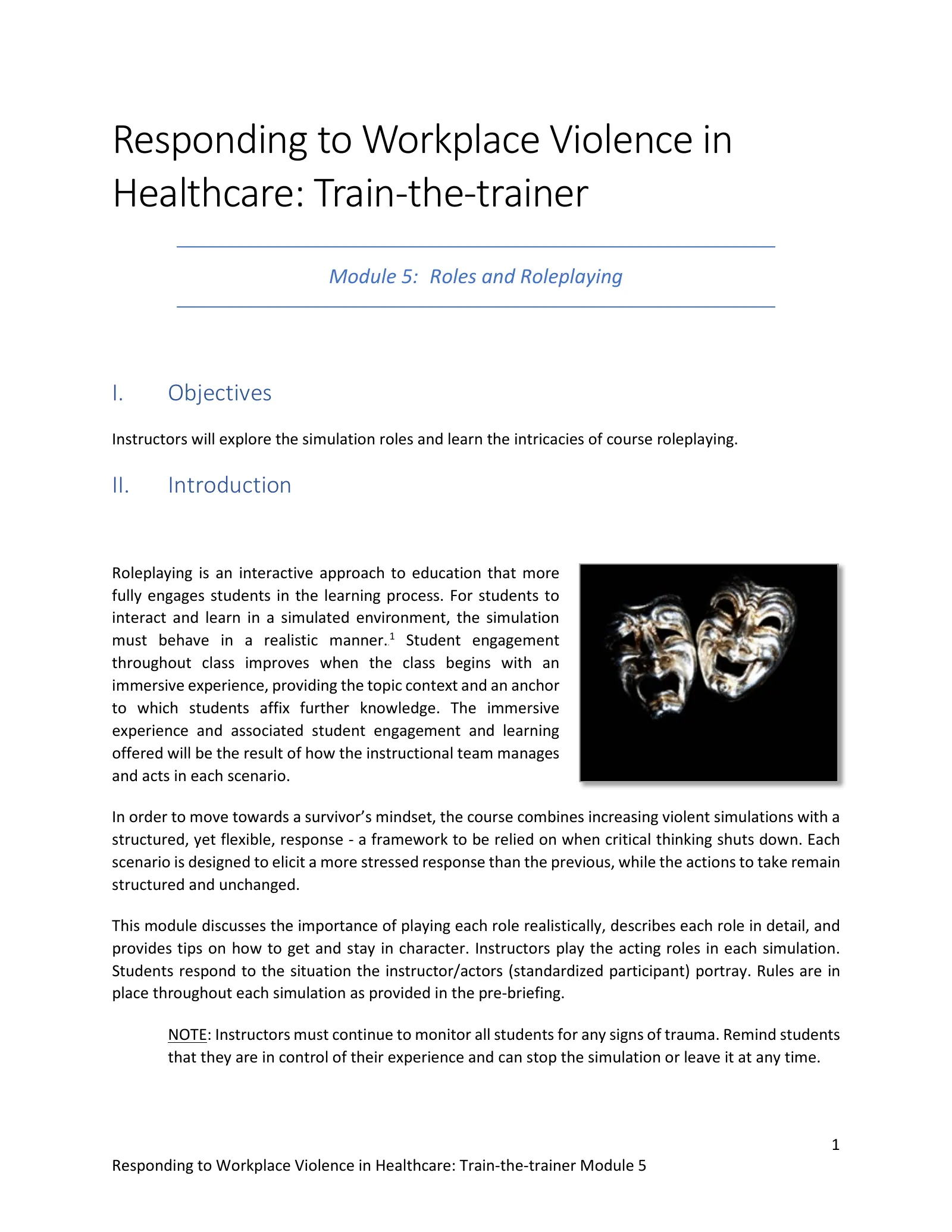
- Roleplaying is an interactive approach to education that more fully engages students in the learning process. For students to interact and learn in a simulated environment, the simulation must behave in a realistic manner. 1 Student engagement throughout class improves when the class begins with an immersive experience, providing the topic context and an anchor to which students affix further knowledge. The immersive experience and associated student engagement and learning offered will be the result of how the instructional team manages and acts in each scenario.
- 0F
- In order to move towards a survivor’s mindset, the course combines increasing violent simulations with a structured, yet flexible, response - a framework to be relied on when critical thinking shuts down. Each scenario is designed to elicit a more stressed response than the previous, while the actions to take remain structured and unchanged.
- This module discusses the importance of playing each role realistically, describes each role in detail, and provides tips on how to get and stay in character. Instructors play the acting roles in each simulation. Students respond to the situation the instructor/actors (standardized participant) portray. Rules are in place throughout each simulation as provided in the pre-briefing.
- NOTE: Instructors must continue to monitor all students for any signs of trauma. Remind students that they are in control of their experience and can stop the simulation or leave it at any time.
- Page 2
III. Roleplaying
- We do not rise to the level of our expectations.
- We fall to the level of our training.
- Archilochus
- Figure 1: Archilochus
- Greek poet, 650 BC
- Lourve Museum, Paris, France
- Realistic simulations make the course effective. Simulation quality is directly linked to a realistic performance. Low quality simulations will not create stress leading to rapid heart rate, slower critical thinking skills, and the freeze or inaction response frequently associated with poor action or inaction. Having a physical stress response is necessary for students to benefit by then evaluating and responding with appropriate actions. Survivor training needs this stress response to be more effective.
- Students have the opportunity to take action using the options presented in class with each new simulation. In this way, you are working to condition students to evaluate a rapidly escalating dangerous situation and respond using the options learned. Needless to say, instruction must remain professional. Going beyond the scope of what is presented in this course as far as scenarios and realism is not in keeping with the course and is not advised nor is it necessary.
- A.
- The Roles
- The roles (standardized participants) are played by instructors include the violent person (aggressor) who is either a family member of a patient or a patient, and a unit or department manager. Students play the roles of other patients, staff, and visitors, and are the ones to react to the situation escalated by the violent person and the manager.
- (A Standardized Participant is a simulation term used to describe a person who has been trained to portray the roles of patients, family members or professionals during simulation.)
- Page 3
Violent Visitor
- Simulations at-a-glance:
- Initial Simulation involves a visitor who is angry after learning of their spouse’s death. This visitor is actively looking for the doctor they blame and become very aggressive and threatening. The visitor is armed.
- The Huddle involves a former co-worker who seeks the manager who fired them and holds the students hostage.
- Scenario #1 involves a patient who becomes aggressive and uses a piece of medical equipment as a weapon.
- Scenario #2 involves a visitor who learned their spouse has a terminal illness. The visitor is clearly angry, leaves the area, and returns with a weapon.
- Scenario #3 involves a visitor who is angry after learning of their spouse’s death. This visitor is actively looking for the doctor they blame and become very aggressive and threatening. The visitor is armed. (Mimics the Initial Simulation).
- Simulation Roles:
- Aggressor
- Violent Patient
- Violent Former Co-worker
- Manager
- Operator
- Responding Officer
- Page 4
- NOTE: The importance of realistic simulations cannot be understated. Everyone knows this is not really a dangerous situation and that the gun is fake. It is your job as the instructor to elicit stress, alarm, fear, and anxiety in your students. Students know they are in control and have been given instructions on how to control the simulation if it becomes too intense. Knowing that your students are prepared for this simulated violent scene, feel free to make the most of your acting skills.
- YOU MUST STAY IN CHARACTER THROUGHOUT THE SIMULATION!
- ANY BREAK IN YOUR PERSONA WILL COMPROMISE STUDENT EXPERIENCE.
- EVEN THE SLIGHTEST SNICKER WILL RESULT IN LOSS OF STUDENT ENGAGEMENT.
- YOU MUST PRACTICE STAYING IN CHARACTER.
- B.
- The Aggressor
- The Aggressor is part of all simulations. Each simulation has its specific storyline, or scenario, and the role of the aggressor varies. There is a common thread throughout the different aggressor roles and the following information applies to all.
- Getting into and staying in character: The Aggressor
- Getting into and staying in character can be difficult for those without acting or drama experience. In this section we discuss strategies for achieving a credible aggressor persona. Click the link below to watch the video.
- Click here to access Video 10- Roleplaying: Getting into Character
- Tips on getting in and staying in character
- In order to get into and stay in character, consider the following tips:
- Take on the mindset of the character you are playing.
- Abandon all concerns you may have about what other people think about you outside of the action.
- Step away from others to focus your mind on the impending action.
- Envision someone you have experienced being aggressive or a television or movie character.
- Be ready to be violent - Yell, pound, and intimidate - Create fear and anxiety.
- Take this seriously because this part of the training is serious.
- Do not break character during the simulation.
- Consider some lozenges or hot tea before and afterwards to soothe your throat.
- Page 5
- Putting on a convincing performance takes practice. Rehearse outside of the course, both alone and with the other instructors. Help each other improve acting skills with constructive and beneficial comments and suggestions.
- NOTE: Ensure your practicing time does not result in a 9-1-1 call. Be sure to warn anyone who may be in earshot.
- C.
- The Manager
- The Manager is part of all simulations. The Manager role is placed in each scenario to help keep the aggressor escalated. This allows the crisis situation to continue and provides students the time to practice Accepting, making the call, Barricading, or Leaving. It is important to share that the instructor is acting as a “bad” or “dangerous” manager and not following facility protocol or demonstrating effective de-escalation techniques. While instructors will not point out the purpose of this poor behavior, they should tell the students during pre-briefing that the manager will purposefully act inappropriately and is not modeling good behavior. Do not do what they do.
- The aggressor, a visitor, enters the scene after learning of their spouse’s death. They are very angry, blame the doctor, and are currently looking for them. When you are presenting this scenario, be sure to use a doctor’s name that is not present, employed at your facility, or known in the area.
- The purpose of the “bad” or “dangerous” manager:
- Demonstrate how actions can escalate a situation, and
- Keep the aggressor escalated and violent longer in order to give students time to react and carry out their actions.
- Acting the role of a manager includes getting and staying “in the aggressor’s face”, invading their personal space.
- D.
- Violent Visitor and Manager: A Demonstration
- To further explore the scenarios with the aggressor and manager roles, the following video sequence illustrates an example and provides explanation of the details important to these roles. Click the link below to watch the video.
- Click here to access Video 11- The Dangerous Manager, Part 1
- The manager remains close to the aggressor, asks repeated questions, and raises their voice to overpower that of the aggressor. Generally, the manager gets in the face of the aggressor and successfully escalates the situation.
- Page 6
- The manager shoves the aggressor at the same point in each scenario each time. This action allows instructors to time student responses post-shove and also serves to escalate the aggressor to the next level. The shove is intended to mark the start of extreme behavior from the aggressor, volume increase, rage level skyrockets and a weapon appears within seconds.
- As the aggressor further escalates their anger by raising their voice even louder and angrier, student heart rates should increase, and critical thinking skills begin to diminish. The aggressor’s extreme behavior is expected to result in a change in the student’s mindset or to “flipping the switch” from “helping” to “get to safety”. Calls for help should have been made by now if not before.
- As the scene progresses, you begin to see students take action to protect themselves and others. Click the link below to watch the video.
- Click here to access Video 12- The Dangerous Manager, Part 2
- Interaction between the two actors/instructors continue as they play off each other. Neither back down. The aggressor acts increasingly violent, pounding and yelling, to raise student heart rates even more. Eventually, the aggressor draws a gun and points it at the manager.
- Never underestimate the importance of yelling and pounding. Throwing in physical threats with the demand to “get the doctor” works well to raise heart rates. Many students can relate to being threatened while at work in the healthcare setting. Students know this is a simulation, but most will experience some autonomic nervous system response.
- Drawing a weapon and threatening the manager is an effective tool in raising heart rates and releasing adrenaline.
- NOTE: Continue to monitor students for signs of trauma.
- NOTE: The ONLY touching of others during simulation is between the actor/instructors. Students are never to touch each other or the actor/instructors. The only touch is when the bad manager shoves the chest of the aggressor as described above. Physical contact is too intense and is avoided for the safety of both actors and students.
- NOTE: The simulation should include overhead paging that mimics the announcements that would occur in your facility in the event of a violent situation. Codes announced (e.g., Code Violet or Code Silver) should be consistent with your facility, and the “information” announced should be based only on what the student callers reported.
- Page 7
- At this point, the simulation is generally terminated by either a responding officer arriving or simply concluded by the instructors dropping out of character and saying “all clear” or some other indication the simulation is concluded. If no calls are made by students, there should be no law enforcement officer responding.
- In this demonstration, students made calls and reported the armed aggressor. Click the link below to watch the video.
- Click here to access Video 13- The Dangerous Manager, Part 3
- The Operator received calls reporting a Code Silver. An overhead page announcing “Code Silver – There is a dangerous situation in the Sim Lab – Avoid this area” is made (although the page is very muffled in the video). An officer responds with weapon drawn because the calls provided details of the aggressor and weapon. If the caller does not include the presence of a weapon, the response will be different. Your Responding Officer will respond appropriately based on the information provided by the caller and your facility’s policies and procedures.
- E.
- Violent Patient and Manager: A Demonstration
- Scenario #2 involves a patient who becomes violent. The patient is in pain and needs more medication, but it is not time yet. Provide your patient actor a plastic bed pan or other unbreakable item to throw at the manager. IV pole can be located nearby and wielded by the patient, pounded against the bed or other surface to increase intensity, and then carefully swung to demonstrate this too can be a weapon. The scene also includes the Manager to escalate the patient actor to become more aggressive.
- As with any roleplay, you will need to provide convincing lines. When working with people you know, this can be challenging. Making eye contact with other students, especially someone you know, can cause you to break character. Practice your role outside class and ensure that you can deliver a convincing performance without smirking or giggling.
- A patient can become violent for many reasons. While this scenario example is one where a patient is in pain and requests more medication, any unmet patient need could be used in this scenario.
- Consider the following when portraying a patient whose needs are not, or perceived as not, being met:
- Get into the mindset of a patient who is suffering.
- Consider your condition and how an unmet need would make you angry.
- Make eye contact only with other instructors, or no one at all.
- Ramp up your demands as the staff fails to manage your concerns to your satisfaction.
- Page 8
- This actor is placed discreetly in one of the patient rooms, without the knowledge of the other students. Students are expecting the same aggressor seen in previous simulations. Whenever possible, avoid placing co-workers who know the violent patient actor in the same patient room for this simulation.
- To further explore this scenario, the following video illustrates an example. The idea for this scenario came from an actual attack that occurred at St. John’s Hospital in Maplewood, Minnesota, on November 6, 2014 (video available online). 2 Click the link below to watch the scenario created for this course.
- 1F
- Click here to access Video 14- The Violent Patient
- Violent patients are common in the healthcare setting and this scenario helps in preparing to effectively manage a violent patient.
- F.
- The Violent Former Co-worker
- The Violent Former Co-worker role plays in The Huddle: 2-minute timer. This role was described in detail in a previous module during the discussion of early monitoring for signs of trauma. In general, acting as an aggressor, no matter the specific role, utilizes the same preparation to get into and stay in character.
- Review the following video from The Huddle presented earlier in this course keeping in mind the additional instruction since provided on roles, roleplaying and simulations:
- Click here to access Video 05- The Huddle – Class Example
- Page 9
- Think about what a disgruntled former co-worker who believes they were wrongly fired may say or do. How will they pay their bills and provide for their family? The immense stress a firing can have on a person can lead to the type of violent behavior depicted in the video as evidenced by actual situations across the country. Use this information to develop a script for your Huddle.
- NOTE: The aggressor (actor) must select a name for this activity of a person that is not present in class. Check the course roster ahead of time and confirm by asking the class if there is anyone present with that name prior to beginning the activity.
- G.
- The Operator
- Calling for assistance is a crucial part of responding to workplace violence. If no call is made, help will not arrive. General hesitation to call for emergency services is not unusual. Often times people assume someone else will or has called, or they are not sure what to say if they were to make the call. It is important to encourage students to make these calls. Repeated calls to the operator are an important part of taking that action in a real-life emergency.
- DO NOT HESITATE – MAKE THE CALL
- Your simulation should provide some way for students to make a call, within the simulation area only, to an operator (actor) to report the situation and request assistance. If possible, locate your operator in a room adjacent or nearby. The operator fields the calls, dispatches police response in accordance with the information provided by the students and provides the simulated overhead page per facility procedure. Early scenarios often include the operator gently prompting students for details. Prompting may include questions like, “is there anything else?” or “so, you are reporting a Code Violet?” The operator should refrain from asking specific leading questions. As the simulations progress, the operator should need to use less and less prompting as the students become more accustomed to providing the necessary details and aggressor description including presence of a weapon. While the examples provided include 1-way glass between the operator and simulation, this is not necessary.
- Page 10
- Students should be taught to follow the emergency calling procedures for their facility. Make the call for emergency services as quickly as is safe to do so. Depending on your location, that may be a call directly to 9-1-1 or some other emergency number to report the situation and request assistance. Be sure to provide additional instructions if they need to dial a number for an outside line (e.g., 8-9-1-1). You will customize the student course PowerPoint slide to include specific information regarding your facility and its policies and procedures.
- To further explore this scenario, the following video introduces you to the operator role, discusses management of student calls, and how the communication system is set up. Click the link below to watch the video.
- Click here to access Video 15- The Telephone Operator
- NOTE: Be sure to provide the necessary notifications prior to the day and time of your simulations to warn offices or departments located in the vicinity of the simulation area you are running simulations and they can expect to hear yelling, pounding, screaming, “gun, gun, gun”, etc. Alerting those around you to the simulations, avoids real calls to 9-1-1 or local emergency services and actual response from local police. This would be a very DANEROUS SITUATION FOR ALL INVOLVED.
- NOTE: Ensure that student cell phones are not accessible during the simulation, so students will not accidentally make a real phone call to emergency services. Cell phones should be placed on silence and left in the classroom area.
- In the following brief video, you see the view from the control room, the wall and overhead camera views, and the student in the simulation area making the call. Our operator provides overhead pages that mimics our facility page language. Be sure to use language used at your facility. Click the link below to watch the video.
- Click here to access Video 16- Call and Response – Class Example
- The Operator plays an important role in each simulation. In addition to fielding student calls and managing the overhead announcements, they are responsible for deciding what information is provided to the responding officer and when that responder should arrive.
- Page 11
- H.
- The Responding Officer
- Security departments will vary depending on the facility. A large hospital may have its own police force on site with a response time of a few minutes. A rural outpatient facility may rely solely on local law enforcement with a several minutes or longer response time. You will customize your Responding Officer to mimic that of your facility.
- The responding officer is located in the control room and, after a brief delay designed to mimic the time it would take for on-site police or security to arrive, they arrive at the simulation area responding based on the information provided by the student calls. Of course, the responding officer is not going to be standing next to the operator in real life. However, during the simulation, the responding officer is in the control room listening to the calls. After confirming with the operator, the information provided and waiting for the operator’s signal, the officer proceeds with a response to the simulation area as they would, based on the information provided.
- Page 12
Next up . . .
- It is important to pay attention to exactly what the caller reports. You must respond accordingly. If the caller reports someone with a gun, then respond how your law enforcement agency would in that situation. If no weapon is reported, report as you would for a typical violent person situation. If a gun is present and the Responding Officer arrives without that knowledge, the officer’s response will be very different. Students are often upset when the responding officer does not arrive with gun drawn – and seeing this play out in simulations really helps students understand the need for, and remember to provide, as much detail as possible - and to call with updates as the situation changes.
- As the simulations proceed through the course, student calls improve in the timeliness and number of calls, as well as the description of the aggressor and situation – including location and movement.
- IV.
- Next up: Simulations and Debriefings
- Module 6 presents a detail look at how to manage and present each simulation as well as each debriefing session.
- This material was produced under grant number SH-05150-SH9 awarded to Summa Health from the Occupational Safety and Health Administration, U.S. Department of Labor. It does not necessarily reflect the views or policies of the U.S. Department of Labor, nor does mention of trade names, commercial products, or organizations imply endorsement by the U.S. Government.
- Choi, Wayne, et al. “Engagement and Learning in Simulation: Recommendations of the Simnovate Engaged Learning Domain Group.” BMJ Simulation & Technology Enhanced Learning, BMJ Specialist Journals, 1 Mar. 2017, stel.bmj.com/content/3/Suppl_1/S23.
- https://minnesota.cbslocal.com/2014/11/06/video-shows-man-attacking-nurses-with-metal-pole/
- (Also available at https://www.youtube.com/watch?v=jTbvVbkUaPM)
More on Workplace Violence
pdf
2 slidesWorkplace Violence Fact Sheet (OSHA FS-3509)
OSHA fact sheet or bulletin, for General Industry classes.
U.S. Department of Labor, OSHAPublic domain
pdfes
2 slidesWorkplace Violence Fact Sheet (OSHA FS-3524) (en español)
OSHA fact sheet or bulletin, in Spanish, for General Industry classes.
U.S. Department of Labor, OSHAPublic domain
pdf
60 slidesWorkplace Violence: Guidelines for Preventing Workplace Violence for Healthcare and Social Service Workers (OSHA 3148)
OSHA booklet, for General Industry classes.
U.S. Department of Labor, OSHAPublic domain