1 / 12Use ← → to flip
Responding to Workplace Violence: Train-the-Trainer Module 3: Trauma-Informed
Trainer manual chapter for the Responding to Workplace Violence course.
Page text
· 12 pages · by Summa Health
The words on each page as the author wrote them, read from the file by software so they can be searched. Layout, pictures and tables are not shown here: the pages above and the download are the original.
- Page 1
Responding to Workplace Violence in Healthcare: Train-the-trainer
- Module 3: Trauma-Informed Approach
- I.
- Objectives
- To learn how the topics of this course, and associated realistic, violent simulations can and will cause stress and anxiety in students. Instructors learn how to identify signs of trauma and how to work with students who exhibit such signs. In addition, mitigation strategies in place to minimize or alleviate trauma are discussed in detail.
- II.
- Introduction
- The simulated violent scenarios used in this course are purposefully designed to elicit stress in the students. Stress at a mild or even moderate level can be beneficial. Stress can also affect our critical thinking skills. During stressful or extremely stressful situations, critical thinking skills tend to be slower, or even non-existent, and concentration is diminished, causing inaction or a failure to react.
- Trauma
- Training to respond to violence includes being able to think critically and take appropriate action quickly in stressful situations. So, part of training includes practicing evaluation, decision making, and action while under stress. The simulation of violence can, and hopefully does, create a stress response in the student. With this heightened stress, students then work through evaluating a situation and taking appropriate actions.
- As the course progresses, the scenarios become more violent, producing higher levels of stress in students. The violent simulations presented are close to home as they are specifically focused on the student’s daily workplace. This training could be traumatic to any student but may be particularly traumatic to students who have previously experienced other traumatic events, even if the events experienced were not similar to the scenarios presented in training. Needless to say, instruction must remain professional. Going beyond the scope of what is presented in this course as far as scenarios and realism is not in keeping with the course and is not advised nor is it necessary.
- Page 2
- Trauma is a person’s emotional response to a distressing experience. 1 Students vary in their personal previous experiences with traumatic events and in their ability to manage stressors. This course does not delve into trauma per se but does promote instructor awareness of the potential for trauma and integrates mitigation strategies designed to protect students from trauma.
- 0F
- It is critical to the safety of all students that instructors observe and take action if the elicited “stress” becomes “distress”, such as fear or anxiety. All instructors will take on this role as an ongoing part of instructing. However, there should be an instructor tasked at any given time to observe student behavior and take action in the event signs of trauma are detected.
- Signs of trauma related stress, fear, or anxiety include, but are not limited to:
- Increased heart rate and blood pressure
- Rapid shallow breathing
- Tightened or tense muscles
- Dilated pupils
- Pale or flushed skin
- Uncontrolled shaking or trembling
- Tearful or crying
- Wrapping arms around torso
- (swaddling)
- Clasping hands tightly in front
- (protective)
- Not making eye contact or bowed head
- Rocking, tapping, pacing
- Picking at fingernails, wringing hands
- Anger
- Laughter (hysteric)
- Instructors must use their professional judgement regarding when and how to respond to a student exhibiting signs of trauma.
- Below are examples of facial expressions and certain body language of someone exhibiting signs of stress. Keep in mind the full list above as many are not readily depicted in photos.
- Mild: Continue to observe.
- Examples:
- Page 3
- Moderate: Find a time to call student to the side and discuss. Ask if they need anything. Ask if they are able to continue or if they would like to observe from an area outside the “in play” zone.
- Examples:
- Severe: Remove student from activity to a safe space without delay. Ask what they need. Ask if they would like to continue and consider observing from an area outside the “in play” zone. Refer student to your facility’s Employee Assistance Program (EAP) if available, or their healthcare provider.
- Examples:
- Pay attention to students’ facial expressions and body language. If you notice any of the above signs, or just perceive that something is not right, go check with the student. Take care to not call out the behavior or otherwise alert other students unnecessarily. Consider this a confidential conversation. Ensure all instructors are aware of the situation and to avoid any aggressive act towards that student. Evaluating and responding to these signs is discussed later in the next section.
- Page 4
Self-assess
- In order to minimize or eliminate the potential for this training to cause trauma or to re-traumatize, the following mitigation strategies are an integral part of teaching this class:
- Trauma screening and self-selecting out of training
- Pre-arranged course accommodations
- Observation of student behavior and intervention
- III.
- Trauma Mitigation Strategies
- A.
- Mitigation Strategy #1: Trauma Screening and Self-selecting Out of Training
- All participants are self-screened using the same Trauma Screening Tool 2 you used prior to this course. Screening helps assure those with personal trauma experience, which makes them more sensitive or vulnerable, have the opportunity to consider not participating. Successful trauma screening should be “. . . accurate at detecting both current PTSD and the risk for future PTSD and that they should work well with different traumas, with different periods of time elapsed post trauma and with varying prevalence of PTSD.” 3
- 1F
- 2F
- This screening tool was designed to help identify an existing post-traumatic stress disorder and is for use with survivors of all types of traumatic stress. The screening tool provided here is a validated psychiatric tool and was reviewed by a staff psychologist at Summa Health 4 and has been deemed a valid instrument for this purpose. Participants self-review the screening results. All students should be encouraged to consider their participation in regard to how it may affect them. Any student answering “Yes” to 5 or more of the questions may want to opt out of the class.
- 3F
- NOTE: Screening tools are used to determine possible areas of concern but are not intended as a substitution for professional screening or related treatment. Please encourage employees to seek advice from a qualified healthcare provider with any questions or concerns.
- B.
- Mitigation Strategy #2: Pre-arranged Accommodations
- Instructors are encouraged to make accommodations that will allow each student to participate to the extent to which they are comfortable without taking away from the experience of the rest of the class.
- Students should be made aware that they can discuss the training and their individual level of comfort or concern with the instructors ahead of time. Encourage students to contact the instructors ahead of time to discuss the course, student concerns, and available accommodations if needed.
- Accommodate
- Page 5
Accommodation examples
- Lecture
- Classroom accommodations provided to the student may be helpful to lessen the fear and anxiety this course can evoke. Some students benefit from minor adjustments that allow them to attend class more comfortably.
- Accommodations include:
- Sitting in the back of the room
- Observing simulations from outside the “in-play” zone (The Huddle mini simulation)
- Leaving and returning as needed
- Simulations
- Simulation accommodations related to the violent scenarios may be appropriate to provide the student the level of comfort they need to attend class more comfortably.
- Arrange to be assigned scenario roles that put the student in a less active role (e.g., as a patient in bed) rather than a caregiver or staff role (e.g., as a receptionist or medical staff).
- Arrange to be assigned that role in an area that is farther away from the violent actions that instructors know will be occurring (e.g., a patient in bed in the room situated farther from the action).
- Arrange to observe from a side area rather than being a part of the simulation (e.g., standing in an area outside the “in-play” zone).
- Arrange to observe from the control room (if available) where the student is completely separated from the action but able to observe at their comfort level.
- Provide some, but limited, details to just that student regarding the scenario – not so much as to take away from the real-life situation, but enough to give student a small “heads up” as to what types of things could occur (e.g. “someone comes in and is very angry, yells and threatens, and it’s really loud”, or “this scenario includes someone yelling and they have a weapon”).
- Frequently, students who request initial accommodations end up feeling more comfortable as they see the class lecture and simulations play out. You may see students decide to participate more fully once they experience the care and professionalism your instructional team demonstrates. As well, you may find students request accommodations after the class has started. Ensure all students hear throughout the class that accommodations are available to anyone at any time.
- Page 6
- Example: Red arrows indicate the “out of play” or “safe zone” in the simulation area.
- C.
- Mitigation Strategy #3: Observation of Student Behavior and Intervention
- Students who, after completing and evaluating the trauma screening, decide to participate in training are still at risk of adverse reactions to both the classroom lecture and simulated violent scenarios. As an instructor, you have the important task of monitoring each student throughout the course for signs of trauma and then taking action to protect each student. If a student exhibits any behaviors associated with trauma, discreetly pull them to the side to discuss. Take care to not alert other students as to your concerns to protect their privacy. Let the student know you are concerned for their wellbeing and inquire as to whether they feel comfortable continuing or if they need to observe from an area outside the action.
- Ensure all instructors are aware of your concerns so all will be alert and observant regarding the student.
- There are three ways in which a student could let you know they are experiencing trauma. Intervention is necessary in each of the following instances.
- Calling a “Time Out” or “Stop”
- Students are empowered and in control of the scenario’s “brakes”. Prior to each simulation, instructions are provided. This is called “pre-briefing”. Pre-briefing includes information on where the “safe” or “outside” areas are. Students are also told that, at any time they feel uncomfortable and need the scenario to stop immediately, they may stop the simulation by calling “Time Out!” or “Stop!”.
- If a student stops the scenario in this manner, the scenario may start again once the student has been separated from the class and is under the supervision of another instructor. The student may decide to rejoin or to observe from a distance.
- Page 7
Leaving the simulation area
- Students are empowered to leave the simulation area at any time. If a student leaves the scenario in this manner, the scenario can continue without interruption. Another instructor should be available to attend to the student’s needs with little delay. The student may decide to rejoin or to observe from a distance.
- Always speak to the student privately to discuss their needs and make necessary accommodations. If the participant is traumatized, refer them to Employee Assistance, or the appropriate department at your facility, for further assistance.
- Example: A battered women who starts to cry or is trembling when a man is yelling and threatening. This student may need to be referred to Employee Assistance or a counselor.
- Exhibiting signs of trauma
- Often times students do not want others to know they are fearful or experiencing anxiety. It is important for instructors to notice any signs being exhibited and to speak to the student. These signs may become apparent early in class, however, keep in mind that fear or anxiety can be experienced at any time.
- The goal of the course is to teach participants to get and be safe, not to induce trauma. As instructors, you will not know the trauma history of the participants and what may trigger a traumatic response. Never assume that students who are coping well during class will continue to do so. Observation of students for signs of trauma, and addressing appropriately, is a task that will continue throughout the course.
- a)
- Observing students
- To improve your understanding of how to observe for signs of trauma and how to address it, presented here is an activity occurring early in the course. To put this activity into the student course context, after the course is introduced, the instructor discusses the types of emergencies that require some sort of action for safety. This is part of the PowerPoint student lecture.
- We discuss the types of “drills” we learned as children and how these drills are still widely used today. Consider the types of drills where, in an emergency, we have been taught to take action for safety. Our response will vary depending on the emergency. We are taught to hide in a sturdy area during a tornado and to evacuate during a fire. Today’s lockdown drills generally include both hiding and evacuating. Being told to do something in the event of an emergency does not always equate to actually taking that action. Inaction is also addressed early in the course.
- Page 8
- Huddling together is a common response to the fear an armed aggressor may induce. Huddling together is what some students at Virginia Tech did while they waited for help to arrive. Many students were killed when the active shooter found them. In this presentation of “The Huddle”, you will learn how to identify signs of trauma and how to respond. The Huddle is the second violent simulation students are exposed to in class.
- Example: During “The Huddle” one instructor is observing from the back while the actor plays an aggressor who has taken hostages.
- b)
- The Huddle: Lecture’s mini simulation
- In this activity, we expose students to an armed aggressor in a darkened room. The students are told in advance which instructor will be acting and that they will come in acting very threatening. They will be aggressive and frightening. They are told the experience is designed to raise their heartrate and get some adrenaline pumping – to cause a physical and emotional response. As always, students are also told they may step to the side or leave the room, if needed, and that instructors are available to assist.
- As an egg timer ticks, students huddle together as an instructor acts out the role of a disgruntled coworker who was fired and is looking for the supervisor who fired them. While the aggressor (actor) holds hostages (students), another instructor is watching for signs of trauma.
- NOTE: The aggressor (actor) must select a name for this activity of a person that is not present in class. Check the course roster ahead of time and confirm by asking the class if there is anyone present with that name prior to beginning the activity.
- Page 9
- During the simulation, the aggressor and the observing instructor will make eye contact and provide subtle communication as to whether any student appears to be experiencing trauma. Both instructors will be watching, but the actor needs assistance as they are also working to be realistic and very threatening.
- Example: As one instructor acts the aggressor role, another instructor observes students for signs of trauma.
- Pay attention to the students’ body language as you watch the following staged video. See if you notice any that are showing signs of trauma. During an actual course, the room is darkened, however in this demonstration, the lights were left on to allow you to better visualize what is happening.
- Click here to access Video 02- Huddle Observation Instruction, Part 1
- As you saw in the simulation, all of the participants are crowded together in a huddle. The aggressor is intimidating the participants, waving a gun at them, and yelling. At the same time, another instructor is circulating the room looking at each of the participants for signs of trauma. This observing instructor works to blend into the background and not distract from the actor.
- When the instructor notices a student exhibiting signs of trauma, they will subtly communicate with the aggressor to let them know who to avoid. Depending on the severity, the instructor may decide to pull them to the side during the activity, or to speak with them after the activity.
- Here is an example of quietly removing a student from the simulation:
- Click here to access Video 03- Huddle Observation Instruction, Part 2
- The student on the far right is in tears and shaking. An instructor quietly approaches from the side, moves them away from the action, and speaks to them privately. This is to both preserve their privacy and to permit the simulation to continue. It is important to protect students from a traumatic experience while not impeding other student’s experiences unless necessary.
- Page 10
Examples of inquiring into a student’s wellbeing depending on the situation:
- “Are you okay?”
- “Can I help you?”
- “Are you able to continue?”
- “Do you want to observe from the side?”
- “Do you need to leave the course?”
- “I am going to ask that you follow up with a counselor.”
- If needed, students can be referred for follow-up specialize care.
- Deciding on continued participation is the student’s choice, however, in extreme situations, you must use your professional judgement as to allowing a student to continue. A student may be embarrassed and not want to leave the class. Instructors have a responsibility to take care of the students. Whether the student should be pulled from a simulation or spoken to afterwards (but before the next simulation) is a judgement you will have to make as an instructor.
- Here is some guidance on how you might decide on the timing of approaching students. This is not intended as a full or complete list but to provide insight.
- Pull student out during simulation if you see these types of indicators:
- Crying
- Trembling
- Speak to the student after the simulation if you see these types of indicators: Not making eye contact
- Example: Instructor approaches student privately and they leave the area without stopping the simulation.
- Page 11
- Did you notice any other students who you may have either pulled from the simulation or spoken to afterwards? You likely noticed the student to the far left who was shaking and hiding protectively behind another student. This student would also be pulled from the simulation. You may have also noticed the student in the center who was showing a protective behavior by wrapping their sweater around their torso. This student would be one to speak to after the simulation regarding their comfort level with continuing. Please watch the video again if you did not notice these student behaviors.
- Students who chose to continue participating, either actively or from the side, still require monitoring and care must be taken during all upcoming simulations. In addition, students who have not previously exhibited signs of trauma must still be monitored as earlier comfort levels may change as the simulations become more intense.
- After The Huddle, instructors discuss privately any students who shown signs of trauma. To ensure all instructors are aware of student needs, it is important to discuss throughout the course student needs and to adjust participation level to meet such needs (See Accommodations above).
- Click here to access Video 04- Huddle Observation Instruction, Part 3
- The instructors huddle privately to discuss what was observed. Specifically, the instructors who play roles in later simulations are instructed to not direct yelling at these students and to not point the gun at them. Suggested student accommodations can also be made and then discussed with the student. It is important for instructors to remember these changes and to provide reminders throughout the course.
- View this video captured during an actual course:
- Click here to access Video 05- Huddle – Class Example
- With overhead lights turned off, this two-minute in-lecture mini simulation provides an early opportunity to focus on student behaviors.
- NOTE: Be sure to review the attendee log and select a name to seek that is not the same name of anyone in attendance.
- After The Huddle, a short debriefing activity includes a discussion on how long the timer went. Students frequently think it was longer than two minutes. Additionally, the aggressor could have shot every one of the students had they just huddled in the corner. Even if someone had called 9-1-1, the standard response time is over 5-7 minutes, and can be longer. There was plenty of time to shoot them all.
- Page 12
Next up . . .
- The need to care for these students is great and must be managed quickly. Seek out the proper care of licensed professional if necessary. Be comfortable having a conversation with the participant and pulling them to the side to ensure their safety and wellbeing.
- IV.
- Next Up: Instructing the Student Course
- Module 4 presents and discusses the student course itself.
- This material was produced under grant number SH-05150-SH9 awarded to Summa Health from the Occupational Safety and Health Administration, U.S. Department of Labor. It does not necessarily reflect the views or policies of the U.S. Department of Labor, nor does mention of trade names, commercial products, or organizations imply endorsement by the U.S. Government.
- “Trauma.” Psychology Today, Sussex Publishers, www.psychologytoday.com/us/basics/trauma.
- Modified from tool published by Brewin, Chris R., et al. “Brief Screening Instrument for Post-Traumatic Stress Disorder: The British Journal of Psychiatry.” Cambridge Core, Cambridge University Press, 2 Jan. 2018, www.cambridge.org/core/journals/the-british-journal-of-psychiatry/article/brief-screening-instrument-forposttraumatic-stress-disorder/8FE873195DE100DD13A3F4370E5BB266.
- Ibid. 160-161.
- Summa Health, www.summahealth.org/.
More on Workplace Violence
pdf
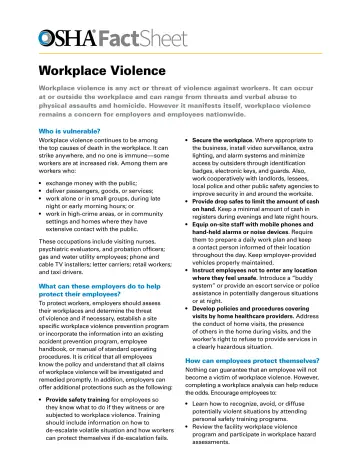
2 slidesWorkplace Violence Fact Sheet (OSHA FS-3509)
OSHA fact sheet or bulletin, for General Industry classes.
U.S. Department of Labor, OSHAPublic domain
pdfes
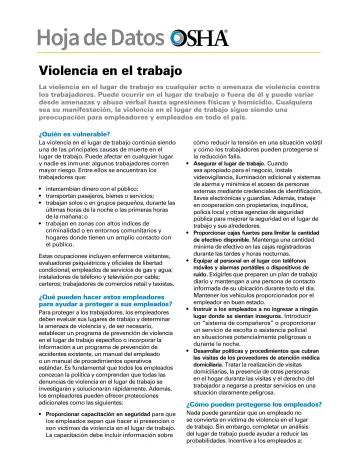
2 slidesWorkplace Violence Fact Sheet (OSHA FS-3524) (en español)
OSHA fact sheet or bulletin, in Spanish, for General Industry classes.
U.S. Department of Labor, OSHAPublic domain
pdf
60 slidesWorkplace Violence: Guidelines for Preventing Workplace Violence for Healthcare and Social Service Workers (OSHA 3148)
OSHA booklet, for General Industry classes.
U.S. Department of Labor, OSHAPublic domain