1 / 9Use ← → to flip
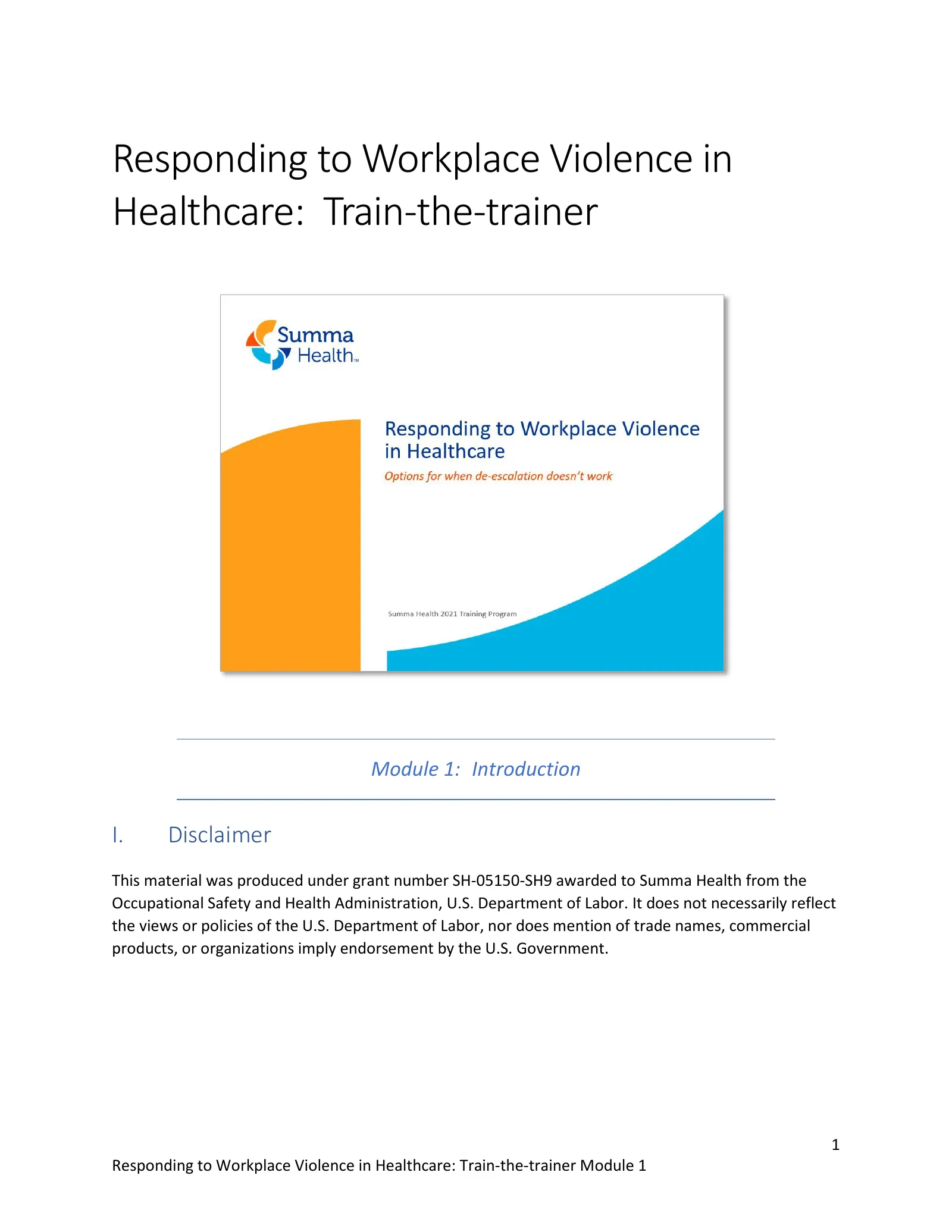
Responding to Workplace Violence: Train-the-Trainer Module 1: Introduction
Trainer manual chapter for the Responding to Workplace Violence course.
Page text
· 9 pages · by Summa Health
The words on each page as the author wrote them, read from the file by software so they can be searched. Layout, pictures and tables are not shown here: the pages above and the download are the original.
- Page 1
Responding to Workplace Violence in Healthcare: Train-the-trainer
- Module 1: Introduction
- I.
- Disclaimer
- This material was produced under grant number SH-05150-SH9 awarded to Summa Health from the Occupational Safety and Health Administration, U.S. Department of Labor. It does not necessarily reflect the views or policies of the U.S. Department of Labor, nor does mention of trade names, commercial products, or organizations imply endorsement by the U.S. Government.
- Page 2
Screening
- II.
- Getting Started: Screening and Pre-test
- Welcome to the Instructor Course for Responding to Workplace Violence in Healthcare. Before getting started, please review the following information, and complete the screening and pre-test provided.
- NOTE: This course includes discussions of violence and contains violent imagery and actions. Participants may experience stress, anxiety, or other effects, due to the nature of this course and its contents. Everyone taking this course is required to complete a self-screening to help them determine the appropriate level of course participation. The course has the potential to be traumatic regardless of personal history.
- A.
- Trauma Screening
- Complete the Trauma Screening Tool 1 , review your results, and consider whether to continue in the course. Click on the link below to access the Trauma Screening Self-assessment.
- 0F
- Click here to access Document 01- RWVH Trauma Screening
- B.
- Pre-test
- Prior to engaging in this course, complete the Pre-test. At the end of the course, you will take a post-test. You will be able to compare how your knowledge and understanding have progressed after completion of the course. Click on the link below to access the Train-the-trainer Pre-test.
- Click here to access Document 02- RWVH Trainer Pre-test
- III.
- Welcome
- Welcome to the Instructor Course for Responding to Workplace Violence in Healthcare. This course is an advanced instructional opportunity for healthcare facilities ready to provide a proven method to better prepare their employees to react when faced with violent situations when deescalation is not working. Workplace violence in healthcare has risen steadily in the past decade and is an important public health concern.
- Welcome
- According to the Occupational Safety and Health Administration (OSHA), half of all workplace assaults happen to health care workers. 2 Providing employees with training to help them evaluate and respond to violent situations is crucial to the health and safety of healthcare clients, including patients and visitors, as well as employees themselves. Employees generally experience the initial encounter with an aggressor;
- 1F
- Page 3
- therefore, it is the employees that are best able to take early and critical actions for the safety of everyone involved.
- The Responding to Workplace Violence in Healthcare: Student Course provided through this training is research based, tested, and evaluated in a hospital setting. 3 For the statisticians in class, results of the course demonstrated an 86% growth rate in participants’ reaction to violent situations during simulations. P-values from single factor ANOVA, indicated statistically significant difference at less than 0.01. An adjusted R2 explained that the high variance was accounted for by the pre- and post-tests; there was only 15.49% pre and 7.7% post of the variance not accounted for by the variables. Participants’ pre and post self-evaluations demonstrate statistically significant difference in perceptions of comfort (p=<0.01) to respond effectively and safely in hostile aggressor situations.
- 2F
- A.
- Purpose
- The purpose of this instructor course is to provide specific techniques and guidance in the training of employees to respond to workplace violence in a healthcare setting. The focus is on options where deescalation techniques are ineffective, up to and including an active shooter situation. You will be provided with information and resources to both assist and guide you in providing a comprehensive, simulation based, workplace violence training program at your facility.
- Education and practice through simulated workplace violence scenarios provide employees the opportunity to develop a survivor mindset and empowers them to respond effectively to threats and mitigate harm. While this course is designed for use in healthcare, the principles, organization, and techniques are applicable to training employees in any industry.
- B.
- Course Goal and Objective
- Goal
- To help minimize or prevent injuries or deaths from violent acts through more effective employee response to workplace violence incidents by using improved instructor training and simulation-based instruction.
- Objective
- Instructors will be able to lead students through this simulation-based workplace violence response course, using a trauma-sensitive approach, as defined, and provided for in the course guidelines.
- C.
- Scope of Course
- Responding to Workplace Violence in Healthcare: Instructor Course, is an online course providing comprehensive training materials for successful implementation of the student course at your healthcare facility.
- Page 4
- The instructor course includes how to provide classroom training of employees in options for responding to violent situations when de-escalation is not effective, as well as topics such as: the impact of fear on our ability to respond, implications of our intuition and instincts, and how to effectively describe a person and situation when making a call for help. Simulation-based scenario instruction includes guidance in leader and actor roles, simulation debriefing, and simulation management. Basic hands-on defense tactics instruction, including videos, are also provided for both instructor training and in-class use. Guidance in classroom and simulation area set up are included.
- The student course includes classroom learning, hands-on simulated-violence scenarios, and hands-on defense techniques. Classroom learning is focused on how to maintain critical thinking skills in stressful situations and overcome fear-related inaction. Students gain insights into the survivor’s mindset and are offered methods for developing a framework of response to violent actions. Students work to prepare mentally and emotionally for unexpected acts of aggression or violence, including active shooters. Students are taught that they have permission to break the rules of ordinary behavior, take control, and protect themselves and others in violent situations. “Breaking the rules” could include throwing a fire extinguisher or using medical equipment as a defensive weapon, for example.
- D.
- IV.
- Instructor Course Module Progression
- Module 1: Introduction
- Module 2: Classroom Design
- Module 3: Trauma-Informed Approach
- Module 4: Instructing the Student Course
- Module 5: Roles and Roleplaying
- Module 6: Simulations and Debriefings
- Module 7: Tools of Engagement
- Module 8: Review
- The Educational Model: Simulation-based
- A.
- Why simulation-based education?
- Training employees to respond to workplace violence has progressed over the past decade. Initially, workers were provided information on how to respond. This was followed by modeling and possibly walking through the steps of how one could respond. Today, we offer a simulation-based instruction using realistic scenarios. This allows students to experience the stressful and violent situation, complete the decision-making process of what actions can be taken – and to then take those actions in real-time.
- Simulation-based education is a proven training technique widely known for its effectiveness in training in a variety of professions. Airlines, police, fire, military, emergency medical services, and surgeons are
- Page 5
- among many industries or professions using simulation to train for the required quick assessment and action in providing safety and saving lives. It is particularly effective due to the repetition, cognitive interactivity, repetitive practice, range of difficulty levels, and learner feedback. 4
- 3F
- Survival training works by helping overcome cognitive processing issues associated with the rapid onset of life-threatening danger. Without survival training, most people would suffer confusion, impaired reasoning, and slow evaluation, or worse - counterproductive actions that increase danger, including inaction. Freezing can happen when your cognitive processing evaluates the danger as something you can neither fight nor flight (run) from – so they experience paralysis. 5, 6
- 4F
- 5F
- Simulations replace real-life experiences with tailored experiences designed to promote thought and action development by replicating a situation while keeping participants safe and protecting others from the risk involved with decision-making. 7 Greater realism enhances engagement and learning.
- 6F
- Responding to workplace violence is frequently a team effort and training as a team improves both the individual’s and collective’s learning experience and enhances future actions taken in a real-life violent situation. In our student course, structured and tailored scenarios are provided in realistic settings that further enhance the learning experience. Scenarios use equipment and areas similar to where they work every day.
- B.
- Debriefing
- A crucial part of simulation education is the debriefing which follows the simulation. Debriefing is the instructor-led conversation examining the simulation and actions taken. Debriefing is an opportunity to reflect on what has occurred, how students react and the implications of those actions.
- Debriefing should occur immediately after each scenario and is designed to bring about a fuller reflection on the experience and integrate each student’s individual learning and understanding. This results in improved confidence in their ability to respond. Debriefing is the most important aspect of the simulation experience. Reflection on the experience leads to discussion of actions that did not occur and how that could or would have changed the outcome. Reflection helps to bring together a student’s existing knowledge with that of this new experience
- V.
- Offering the Student Course
- A.
- Importance of Instructor Selection
- This course is designed to be implemented by multiple trained and dedicated instructors working together to both instruct and take on actor roles in the scenarios. It is recommended to include instructors with leadership roles within your facility as this provides credibility to the instruction and course.
- The minimum number of instructors for each class is three (3) in order to fulfill critical roles during the simulations, however four (4) is
- Page 6
- preferred as this additional person would play the Responding Officer. The most important consideration for selecting potential trainers is passion for the topic and some schedule flexibility to allow for availability to teach and engage in the program.
- Having a variety of areas from which you recruit instructors helps develop an understanding among both your instructors and your employees. The different areas, while working towards the same facility goal, often vary in experiences and speak different professional languages. For example, your interdisciplinary team could include representatives from hospital security, nursing supervision, emergency preparedness and safety, and simulation education. This combination has proven very successful; however, it is not required for a successful course.
- Our facility has two primary instructors from the Protective Services/Police Department who complete the lecture and hands-on self-defense instructional portions of the course as well as acting in our simulations. We have two nursing directors consistently involved in the simulation portion of the training. Additional instructors are from Nursing, Simulation Education, and Safety/Emergency Preparedness. These instructors fill acting roles during simulations, monitor student stress reactions, and provide needed support for the simulation activities.
- B.
- Instructor Course Target Audience
- In General, potential instructors include individuals with a passion to prepare employees for workplace violence situations when de-escalation is not effective. The credibility associated with law enforcement professionals and other leaders as instructors should be considered.
- Areas to consider drawing instructors from include:
- Protective Services & Law Enforcement
- Nursing Directors/managers/supervisors
- Safety and Emergency Preparedness
- Behavioral Health/Counseling professionals
- Employee Education or Development
- Simulation Education professionals
- Exempt persons with a passion for safety or to train/educate employees
- C.
- Instructor Course Prerequisites
- There are no prerequisites for becoming an instructor of this course. However, experience in areas related to this instruction is certainly beneficial.
- Consider instructors having background experience in the following areas:
- Non-violent crisis intervention
- Teaching other workplace violence response, including active shooter preparedness Behavioral health, including having the ability to assess student anxiety and stress Conducting simulations or drills, and debriefing
- Page 7
VI. Instructional Methods
- D.
- Student Course Target Audience
- Everyone.
- All employees. Employees in leadership positions such as team leaders, area supervisors, or similar, are frequently looked to for guidance in emergency situations. However, not all emergency situations permit the time to look to leaders for guidance. Consider setting a goal of how many employees you would like to train and work towards that goal. All employees would benefit from this training.
- E.
- Student Course Prerequisites
- This course is designed to provide additional training for healthcare workers beyond training in deescalation techniques for non-violent crisis interventions. While formal de-escalation training is not a prerequisite, it may enhance the learning experience.
- This training approaches instruction through multiple senses including visual, verbal, auditory, and tactile (physical). Experiential learning through escalating simulated scenarios teaches students strategies for maintaining critical thinking under stress and overcoming fear-related inaction response to violent situations. Our instructional approach includes techniques addressing all seven learning styles: visual, auditory, verbal, physical, logical, social, and solitary.
- A.
- Curriculum Use
- NOTE: This training is to be used only as described and requires:
- Full knowledge and consent of all students related to the time and nature of the training
- Adherence to all precautions provided within the curriculum
- The student course was strategically designed with lecture, simulation and debriefing purposefully ordered for effectiveness and safety. This should not be altered. Needless to say, instruction must remain professional. Going beyond the scope of what is presented in this course as far as scenarios and realism is not in keeping with the course and is not advised nor is it necessary.
- Page 8
- Customization of course where indicated is permitted to provide instruction specific to your facility. See instructor course guidance provided for this customization. Any other changes or modifications to this course, or the course embedded for use in student instruction, are not recommended. Seek professional guidance prior to making any changes to the courses as provided. Goals and objectives are not to be modified or altered without professional guidance. Discussion of current events can enhance training, but prior consideration should be completed before using such events to consider applicability, sensitivity, and impact on the students.
- B.
- Advisory Regarding the Student Course
- Training in how to respond to violence is an important yet potentially harmful experience. This curriculum is designed for use with adults who consent to the contents and activities. Within course parameters, students are provided prior warnings regarding topics and events that are designed to, and likely will, invoke stress, fear, and anxiety associated with violent situations. Students must be instructed ahead of time the various options, available to them during and after the course, designed to empower and protect each student’s physical and mental health.
- Always inform the students of what to expect as provided in this instructor course’s parameters. Always allow students to decide whether to attend the course and their level of participation in the course.
- C.
- Violent Imagery and Discussion of Violence: A trauma-informed approach
- This course includes discussion of violence as well as violent imagery. Effects on students will vary. Students will have varying life experiences, most or all of which you, as the instructor, know nothing about. While the risk to students who are sensitive to these topics cannot be removed, the risks can be mitigated through a trauma-informed approach.
- It is important that all students are fully aware of what the course entails, however providing specific details of each scenario is withheld from students. Simulation education requires a certain level of non-disclosure in order to make the simulations, and student responses, more realistic. This non-disclosure can be modified as needed for individual students without calling attention to the student or depriving other students of a fuller experience.
- In the student course, students may self-select out and not participate after completing the screening tool. Or students may decide to participate but wish to minimize their exposure to certain situations. Several accommodations are provided and available to students who decide to participate.
- The following video is a dramatization of what might happen if an active shooter entered a lobby area and is an example of what students will view and discuss during the course. All videos are available in both low- and high-resolution depending on presentation requirements. The links provide access to both.
- Click here to access Video 01: SIMULATION Hospital Lobby Active Shooter
- Page 9
VII. Credits
- Responding to Workplace Violence in Healthcare instructor and student courses were developed by Summa Health, Akron, Ohio, and are a collaboration between Summa Health’s departments of nursing, emergency preparedness and protective services. Instructor Course curriculum was developed with assistance from Summa Health’s offices of Research Administration and Innovation. Videography and photography were produced by Tomsick Media, Mentor, Ohio, and Summa Health’s Media Services and Virtual Care Simulation Lab. For more information, contact Protective Services/Police Department at Summa Health.
- VIII. Next up: Classroom Design
- Module 2 discusses how to set up a classroom and simulation area. Guidance is provided on creating an effecting learning environment with what your facility has available.
- This material was produced under grant number SH-05150-SH9 awarded to Summa Health from the Occupational Safety and Health Administration, U.S. Department of Labor. It does not necessarily reflect the views or policies of the U.S. Department of Labor, nor does mention of trade names, commercial products, or organizations imply endorsement by the U.S. Government.
- Modified from tool published by Brewin, Chris R., et al. “Brief Screening Instrument for Post-Traumatic Stress Disorder: The British Journal of Psychiatry.” Cambridge Core, Cambridge University Press, 2 Jan. 2018, www.cambridge.org/core/journals/the-british-journal-of-psychiatry/article/brief-screening-instrument-forposttraumatic-stress-disorder/8FE873195DE100DD13A3F4370E5BB266.
- U.S. Department of Labor, Occupational Safety and Health Administration. Guidelines for Preventing Workplace Violence for Healthcare and Social Service Workers, Washington, DC; 2016. OSHA 3148-06R 2016. Viewed at https://www.osha.gov/Publications/osha3148.pdf
- Brown RG, Anderson S, Brunt B, Enos T, Blough K, Kropp D. Workplace Violence Training Using Simulation. Am J Nurs. 2018 Oct;118(10):56-68. doi: 10.1097/01.NAJ.0000546382.12045.54. PMID: 30260888.
- Lateef, Fatimah, “Simulation-based learning: Just like the real thing”; Journal of Emergencies, Trauma, and Shock; 3:4 Oct – Dec 2010.
- Seltzer, Leon F. “Trauma and the Freeze Response: Good, Bad, or Both?” Psychology Today, Sussex Publishers, 8 July 2015, www.psychologytoday.com/us/blog/evolution-the-self/201507/trauma-and-the-freeze-responsegood-bad-or-both.
- Leach J. Why people 'freeze' in an emergency: temporal and cognitive constraints on survival responses. Aviat Space Environ Med. 2004 Jun;75(6):539-42. PMID: 15198281.
More on Workplace Violence
pdf
2 slidesWorkplace Violence Fact Sheet (OSHA FS-3509)
OSHA fact sheet or bulletin, for General Industry classes.
U.S. Department of Labor, OSHAPublic domain
pdfes
2 slidesWorkplace Violence Fact Sheet (OSHA FS-3524) (en español)
OSHA fact sheet or bulletin, in Spanish, for General Industry classes.
U.S. Department of Labor, OSHAPublic domain
pdf
60 slidesWorkplace Violence: Guidelines for Preventing Workplace Violence for Healthcare and Social Service Workers (OSHA 3148)
OSHA booklet, for General Industry classes.
U.S. Department of Labor, OSHAPublic domain