1 / 92Use ← → to flip
Responding to Workplace Violence: Student Course
Student course on recognizing, de-escalating and responding to violence against health care workers. This is the version with links in place of embedded video.
Slide text
· 92 slides · by Summa Health
The words on each slide as the author wrote them, read from the file by software so they can be searched. Layout, pictures and tables are not shown here: the slides above and the download are the original.
- Slide 1
Responding to Workplace Violence in Healthcare
- Options for when de-escalation doesn’t work
- Summa Health 2021 Training Program
- Slide 2
Authorship and Disclaimer
- Authorship
- This course was developed by Summa Health in Akron, Ohio, and is a collaboration between Summa Health’s departments of nursing, emergency preparedness and protective services. For more information, contact Protective Services/Police Department at Summa Health.
- Disclaimer
- This material was produced under grant number SH-05150-SH9 from the Occupational Safety and Health Administration, U.S. Department of Labor. It does not necessarily reflect the views or policies of the U.S. Department of Labor, nor does mention of trade names, commercial products, or organizations imply endorsement by the U.S. Government.
- Slide 3
Introduction
- Introduction and Warnings
- Instructors
- How we got here
- Warnings
- Violent sounds and images in simulations
- Not a substitute for N.V.C.I.
- (Non-Violent Crisis Intervention training)
- No guarantee of survival or safety when concepts are applied in real life
- Slide 4
Initial Simulation
- Slide 5
Objectives
- Objectives
- To increase confidence in your reactions to violence by building a response framework
- To move away from a victim mindset . . .
- . . . and toward a Survivor mindset
- Slide 6
Mindset Sliding Scale
- Slide 7
What is Workplace Violence?
- Definition
- Occupational Safety and Health
- Administration (OSHA) defines workplace violence as:
- Any act or threat of physical violence, both verbal and nonverbal, harassment, intimidation, or other threatening disruptive behavior that occurs at the work site.
- Slide 8
In the healthcare environment, these acts and threats include incidents such as:
- Incident Examples
- Combative patients
- Violent terminations
- Domestic disputes
- Homicidal or suicidal acts
- Patient or family dissatisfaction, wrongful death
- Chemically induced behavior (Narcan, intoxication)
- Slide 9
Statistics….
- Statistics
- According to the Online Journal of Issues in
- Nursing (OJIN), nurses are ranked number one of employees in all industries experiencing workplace violence.
- The Centers for Disease Control and Prevention
- (CDC) states that nursing is the highest safety risk occupation.
- Slide 10
More Statistics . . .
- More Statistics
- According to OSHA, there are approximately 25,000 workplace violence assaults per year, 70-74% of which are against healthcare workers.
- Due to under-reporting of assaults, these statistic is said to be low.
- How many of you have been kicked, bitten, hit, had pudding thrown at you, grabbed, etc.?
- Slide 11
Will it happen here?
- Simulation Video: Lobby
- Click and Select Video #01 SIMULATION Hospital Lobby Active Shooter
- Slide 12
What would you do?
- Question
- With your patients?
- Visitors?
- Children?
- Slide 13
Past “crisis” training typically included:
- Drills Historically
- Tornado Drills
- Fire Drills
- Nuclear Air Raid Drills
- Slide 14
The Huddle Activity
- Click to begin timer
- Slide 15
The Huddle
- The Huddle Example Video
- Click and Select Video #02 Huddle Observation Instruction Part 1
- Slide 16
Response Statistics
- The average police response times to an active aggressor incident is 5 - 20 minutes in the United States
- The average duration of incident with an active Shooter is 3 - 4 minutes
- Slide 17
Ask Yourself
- What options did we choose?
- What happened to our critical thinking?
- Slide 18
A.B.L.E.
- Accept that it’s really happening, you cannot react until you accept the circumstance.
- Barricade yourself and others in, so that the aggressor stays out.
- Leave the area. Get as far away as possible.
- Engage the aggressor, if you must, fight back.
- Slide 19
What do we do?
- Crisis Starts
- BOOM
- When a balloon pops . . .
- When someone slams a book on the desk . . .
- When someone nearly hits you when changing lanes . . .
- When a patient or visitor yells at or threatens you . . .
- Slide 20
Accept It
- BOOM
- Initial Choices
- Don’t Accept
- Slide 21
= What does this mean?
- Don’t Accept
- Why we freeze
- Why do people freeze?
- No framework for the event
- No similar life experience or training
- Physical capabilities or limitations
- Emotional capabilities or limitations
- Slide 22
Gift of Intuition
- Intuition
- Gut feeling
- Mother’s intuition
- Hair stands up on the back of your neck
- Déjà vu
- Slide 23
Gut Feelings
- Always trust your gut . . .
- It knows what your head hasn’t yet figured out.
- Slide 24
Human vs. Animal
- Trust your gut
- High stakes predictions - we make them every day
- Animals:
- Always listen to “intuition” and . . .
- run from danger
- fight back when threatened or cornered
- enact a self-defense mechanism
- Humans:
- Are the only species that ignore their intuition warning them of “DANGER”
- Slide 25
BOOM
- Accept It
- Accept It
- Don’t Accept
- Freeze
- (NOT AN OPTION)
- Slide 26
Our options:
- Options
- A.B.L.E.
- Slide 27
A = Accept what is happening
- A - Accept
- quickly -
- Slide 28
A ccept It
- It’s real
- It’s happening
- It’s real
- This may take seconds or minutes.
- Some events gradually build,
- . . . while some events have “no-warning”
- You won’t be able to REACT until you Accept the situation.
- Slide 29
A ccept It
- React
- BOOM
- Don’t Accept
- React
- (help yourself, help others)
- (NOT AN
- OPTION )
- Slide 30
It’s your right!
- Take control of your choices to be safe.
- Take control of your choices to survive.
- You have a responsibility to your family, friends, patients, and co-workers to survive!
- You have the right to survive!
- Slide 31
Activate Emergency Response
- Activate a call for help by:
- Dialing
- Your in-house emergency number
- (Remember to dial for an outside line if needed)
- Vocera or other personal communication device
- (If available)
- Using the Code Violet button on your phone
- 9-1-1 or local emergency number
- Place dialing instructions at each phone
- Slide 32
Program our emergency number into your cellular
- Save the number
- This number should appear first in your contacts.
- Slide 33
Be attentive
- Describe this…
- Slide 34
What to report:
- What to notice
- Number of aggressors
- Aggressor's description
- Type of weapon(s)
- Last known location
- Direction of travel
- Slide 35
Let’s watch this scenario … .
- Simulation Video: Patient Room
- Would you do anything differently?
- Click and Select Video #09 SIMULATION Patient Room Active Shooter
- Slide 36
A ccept It
- React by barricading
- BOOM
- Don’t Accept
- B arricade
- React
- (help yourself, help others)
- (NOT AN
- OPTION )
- Slide 37
B = Barricade - create a barrier
- B - Barricade
- between you and the aggressor
- Slide 38
Where can you barricade yourself?
- Barricade options - levels
- Facility
- Wing/Division
- Department/Suite
- Office
- Restroom/Closet
- Slide 39
Barricade options - items
- How does your door operate?
- What could you use?
- Slide 40
What is available?
- Barricade options - examples
- Beds/Desks
- Beds
- Belt
- IV Tubing
- Nightstands
- Restraint Belts
- Slide 41
Hospital Lockdown Policy:
- Lockdown Policy
- The objective of lockdown is to control entry into the hospital while maintaining safety and service.
- Partial lockdown: Protective Services will limit access into selected areas of the hospital by controlling entry points.
- Full facility lockdown: Protective Services will limit access into all entry points.
- Slide 42
Know your exits
- Know your EXITS and how to avoid the dangerous areas
- Slide 43
A ccept It
- React by leaving
- BOOM
- Don’t Accept
- L eave
- B arricade
- React
- (help yourself, help others)
- (NOT AN
- OPTION )
- Slide 44
L = Leave - put as much distance as
- L - Leave
- possible between you and the aggressor
- Slide 45
Ambulatory Patients
- Help patients leave
- Leave is an option (RUN)
- Leave through a predetermined evacuation route
- Leave belongings behind
- Know where your exits lead
- Have a meet up location
- Slide 46
Barricade with patients
- Non-Ambulatory Patients
- Removing the patient may not be an option
- Barricade or “defend” in place
- Turn off lights
- Silence cell phones
- Block windows
- Position behind cover
- Treat injured if trained
- Await directions
- Slide 47
Upon exiting the building:
- When you do leave
- Do not expect police to initially help you
- Officers are trained to neutralize the threat
- Rescue operations will arrive next
- Do not have anything in your hands
- Officers may point their gun at you
- Raise your open hands so officers can see your empty hands
- Treat the injured if you are trained
- Slide 48
What to expect
- Expect that you:
- May have weapons pointed at you May be searched
- May be handcuffed
- May be told to lay on the ground
- Slide 49
Break (10 minutes)
- Break time
- Next up:
- Simulations…
- Slide 50
Simulation rules begin
- Simulation Rules
- Do not touch the actors
- Do not throw anything
- The Safe-Zone:
- Outside of the room, and any other designated area
- Slide 51
Begin simulations
- Slide 52
Simulation review
- Slide 53
- The last resort
- Finally, as a last resort,
- and sometimes the only option . . .
- Slide 54
A ccept It
- React by engaging
- BOOM
- Don’t Accept
- L eave
- B arricade
- React
- (help yourself, help others)
- (Not an
- option )
- E ngage
- Slide 55
E - Engage
- E = Engage - physically confront
- aggressor as a last resort
- Slide 56
E ngage
- You are strong
- Tools to engage
- You are strong, but you may not know it yet
- You have an inner voice that is STRONG and directive
- You have permission to “not be nice” to survive
- You must believe that you are strong and will survive
- Slide 57
Tools to Engage (Continued)
- Be powerful
- Feel your balance
- Learn to be a tactical breather
- Always stand in a balanced fighting stance Power comes from the hips
- Practice falling and getting up
- Invest in your fitness
- Slide 58
Strikes
- Engage: Hammer Fist
- Hammer fist
- Kick with balance
- Always strike the midline of the body
- The goal is to always get away
- Slide 59
How to use the Hammer Fist
- Slide 60
Hammer Fist Strike
- Hammer Fist Video
- Instructional Video
- Click and Select Video #20 Tools to Engage Strikes Hammer Fist
- Slide 61
How to use the Hammer Fist.
- Slide 62
Wrist Grab
- Engage: Snake & Vine
- Snake and the vine Never pull someone toward you
- Slide 63
How to use the Snake & Vine
- Slide 64
Wrist Grab Defense
- Snake & Vine Video
- Instructional Video
- Click and Select Video #21 Tools to Engage Wrist Grab Snake and the Vine
- Slide 65
How to use the Snake & Vine review
- Slide 66
Hair Pull / Grab
- Engage: Be a Ballerina
- Be a Ballerina
- It’s all about the angles
- Slide 67
How to Be a Ballerina
- Slide 68
Hair Pull/Grab Defense
- Be a Ballerina Video
- Instructional Video
- Click and Select Video #22 Tools to Engage Hair Pull Be a Ballerina
- Slide 69
How to Be a Ballerina review
- Slide 70
Front Choke Hold
- Engage: Major League Pitcher
- Major League pitcher Power from the hips
- Slide 71
How to be a ML Pitcher
- Slide 72
Front Choke Defense
- Major League Pitcher Video
- Instructional Video
- Click and Select Video #23 Tools to Engage Front Choke Major League Pitcher
- Slide 73
How to be a ML Pitcher review
- Slide 74
Grab from Behind
- Engage: Squash the Bug
- Squash the bug Groin strikes
- Slide 75
How to Squash the Bug
- Slide 76
Grab from Behind Defense
- Squash the Bug Video
- Instructional Video
- Click and Select Video #24 Tools to Engage Rear Choke Squash the Bug
- Slide 77
How to Squash the Bug review
- Slide 78
Just how good are the shooters?
- Hit rates
- Let’s see . . .
- What is a trained officer’s hit rate?
- Slide 79
Distraction . . . What Causes a Reaction?
- How to distract a shooter
- Click and Select Video #26 Distraction What Causes a Reaction
- Slide 80
Distraction and aim
- Just how good are the shooters?
- Slide 81
What Could You Use As A Distraction?
- What can you throw?
- Soda Cans
- Food Trays
- Laptop
- IV Pole
- Charts
- Lunch Bags
- Phone
- Stapler
- Book Bags
- Keyboard
- Slide 82
Authority
- Authority granted
- Authority must be given to employees
- Employees must give themselves authority
- Slide 83
Engage: The Swarm
- Very simple and effective tactic: The Swarm
- The goal is to control 3 points:
- Arms
- Legs
- Head
- Slide 84
The Swarm Demonstration
- The Swarm Video Demo
- Click and Select Video #25 SIMULATION Swarm Maneuver Demo
- Slide 85
How to Swarm
- Slide 86
The Swarm
- The Swarm Video
- Instructional Video
- Click and Select Video #27 Tools to Engage Weapon Swarm Maneuver
- Slide 87
How to Swarm review
- Slide 88
Hostage:
- Hostage Situations
- If you are taken hostage:
- Be patient
- Be alert and follow instructions
- Do not speak unless spoken to
- Avoid arguments or appearing hostile
- Conserve your energy
- Be observant
- Slide 89
A ccept It
- A.B.L.E. Recap
- BOOM
- Don’t Accept
- L eave
- B arricade
- React
- (help yourself & help others)
- (Not an option )
- E ngage
- Slide 90
Review of Objectives
- Review Objectives
- To increase confidence in your reactions to a crisis by building a framework of options
- Accept that its happening and take action.
- Options for fire drills and tornados do not fit options for violent people
- Barricade . . . Leave . . . Engage
- To move away from a Victim Mindset . . .
- . . . and toward a Survival Mindset
- React to your intuition - that gut feeling
- You have a right and duty to survive
- Slide 91
Confirming Statement
- When confronted with violence, I will NOT FREEZE.
- I will take action, and I will survive.
- Slide 92
Questions and Feedback
More on Workplace Violence
pdf
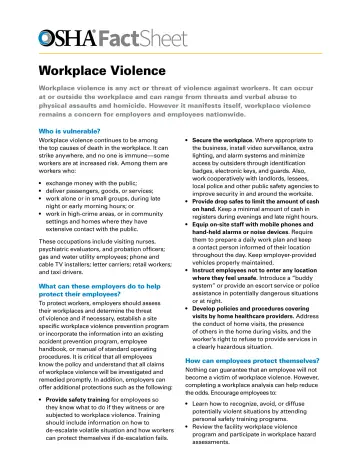
2 slidesWorkplace Violence Fact Sheet (OSHA FS-3509)
OSHA fact sheet or bulletin, for General Industry classes.
U.S. Department of Labor, OSHAPublic domain
pdfes
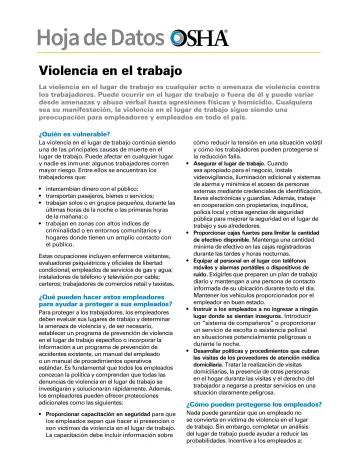
2 slidesWorkplace Violence Fact Sheet (OSHA FS-3524) (en español)
OSHA fact sheet or bulletin, in Spanish, for General Industry classes.
U.S. Department of Labor, OSHAPublic domain
pdf
60 slidesWorkplace Violence: Guidelines for Preventing Workplace Violence for Healthcare and Social Service Workers (OSHA 3148)
OSHA booklet, for General Industry classes.
U.S. Department of Labor, OSHAPublic domain