1 / 47Use ← → to flip
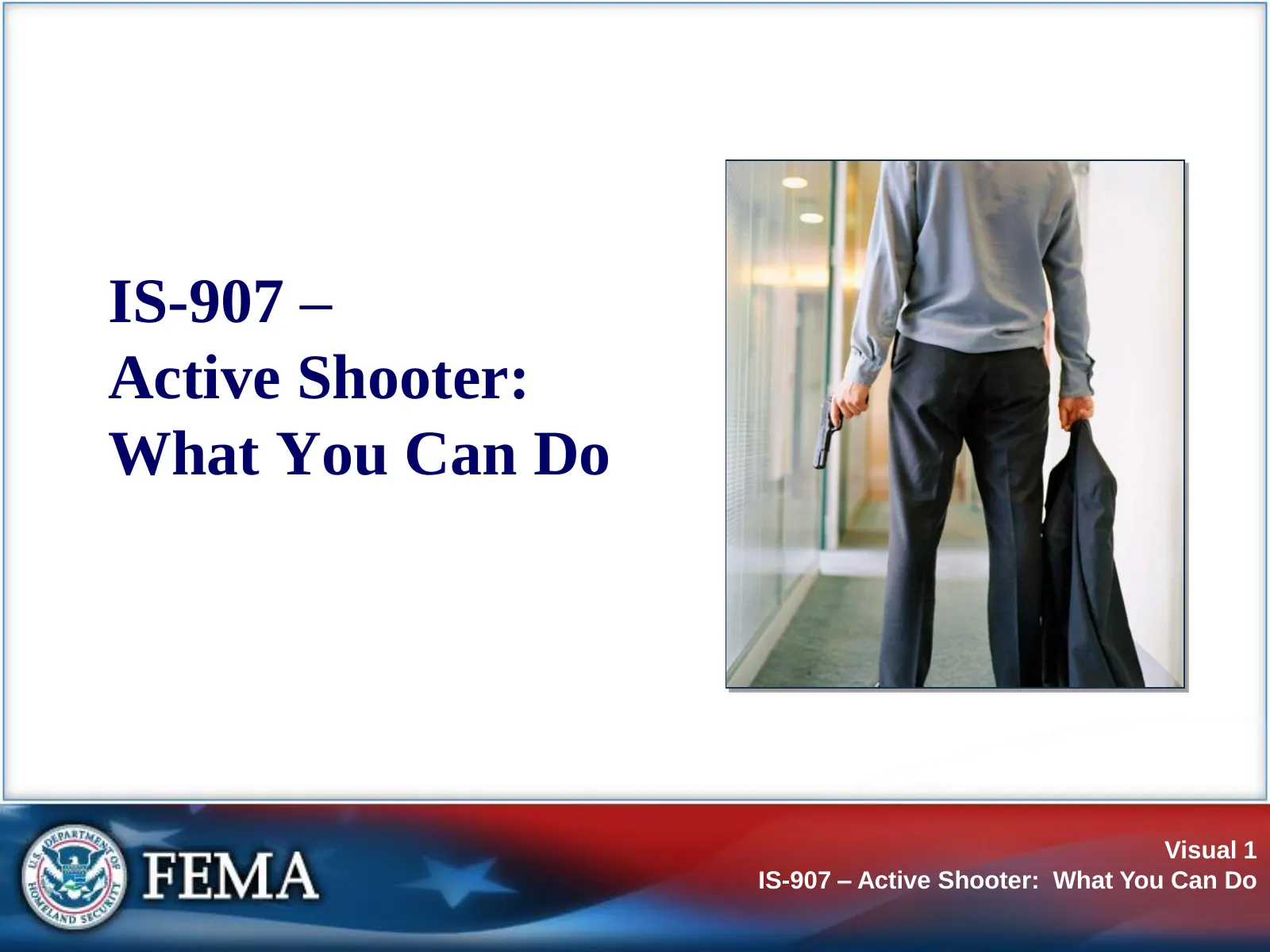
Active Shooter: What You Can Do (FEMA IS-907) Course Visuals
The slides of the FEMA active shooter course, as a PDF.
Slide text
· 47 slides · by U.S. Department of Homeland Security / FEMA Emergency Management Institute
The words on each slide as the author wrote them, read from the file by software so they can be searched. Layout, pictures and tables are not shown here: the slides above and the download are the original.
- Slide 1
IS-907 –
- Active Shooter:
- What You Can Do
- Slide 2
Course Administration
- Sign-in sheet
- Course evaluation forms
- Site logistics
- Emergency procedures
- Breaks
- Restrooms
- Cell phones
- Slide 3
“911, what is the nature of your emergency?”
- DISPATCHER:
- CALLER:
- “There’s somebody with a gun in the main entrance to the mall and I don’t . . .”
- Active shooter situations are unpredictable and evolve quickly.
- Are you prepared?
- Slide 4
Course Objectives
- Describe actions to take when confronted with:
- An active shooter.
- Law enforcement officers who are responding to the situation.
- Recognize potential workplace violence indicators.
- Describe actions to take to prevent and prepare for potential active shooter incidents.
- Describe how to manage the consequences of an active shooter incident.
- Slide 5
Active Shooter Incidents
- Where we:
- Shop
- Exercise free speech
- Learn
- Work
- Slide 6
About Active Shooter Incidents
- More frequent.
- Anger, revenge, ideology, untreated mental illness.
- Slide 7
Active Shooter Situations
- Unpredictable.
- Evolve quickly.
- Continue until stopped by law enforcement, suicide, or intervention.
- Slide 8
Active Shooter Booklet
- Guidance for:
- Individuals
- Managers
- Employees
- Slide 9
Course Topics
- Slide 10
Discussion: Response
- Slide 11
How To Respond
- Run
- Hide
- Fight
- Slide 12
Run (1 of 2)
- Have an escape route and plan in mind.
- Leave your belongings behind.
- Help others escape, if possible.
- Evacuate regardless of others.
- Warn/prevent individuals from entering.
- Slide 13
Run (2 of 2)
- Do not attempt to move wounded people.
- Keep your hands visible.
- Follow police instructions.
- Call 911 when safe.
- Slide 14
Hide
- Your hiding spot should:
- Be out of the active shooter’s view.
- Provide protection if shots are fired.
- Not restrict options for movement.
- Slide 15
Keeping Yourself Safe While Hiding
- If the shooter is nearby:
- Lock the door.
- Hide behind large item (e.g., cabinet, desk).
- Silence cell phone/pager.
- Remain quiet.
- Slide 16
Important Information
- Provide law enforcement or 911 operators with:
- Location of shooter.
- Number of shooters.
- Physical description of shooters.
- Number and types of weapons.
- Number of potential victims.
- Slide 17
Fight
- As an absolute last resort:
- Act as aggressively as possible.
- Throw items and use improvised weapons.
- Work together to incapacitate the shooter.
- Commit to your actions.
- Slide 18
Discussion: Reaction of Managers
- Slide 19
Activity: What Would You Do?
- Instructions: Working as a team:
- 1. Look around the room. Consider what you would do in an active shooter situation and whether it would be better to run or hide.
- 2. Come up with a list of actions you would take to protect yourself and those around you.
- 3. Record the list on chart paper.
- 4. Select a spokesperson and be prepared to present the list in 5 minutes.
- Slide 20
Discussion: When Law Enforcement Arrives
- Slide 21
Law Enforcement’s Role
- Immediate purpose:
- Stop the active shooter.
- Proceed to area where last shots heard.
- First priority is to eliminate the threat.
- Slide 22
Additional Officers and Rescue Teams
- Teams may:
- Wear bulletproof vests, helmets, and other equipment.
- Be armed with rifles, shotguns, and/or handguns.
- Use pepper spray.
- Shout commands.
- Push individuals to the ground for their safety.
- Slide 23
Reacting to Law Enforcement
- Remain calm.
- Put down any items.
- Raise hands and spread fingers.
- Avoid quick movements.
- Avoid pointing, screaming, or yelling.
- Proceed in direction from which officers are entering.
- Slide 24
Safe Location
- Area controlled by law enforcement until:
- The situation is under control.
- All witnesses are identified and questioned.
- Slide 25
Course Topics
- Respond
- Prepare
- Follow Up
- Slide 26
Discussion: Preparation
- Slide 27
How To Prepare
- Develop an Emergency Action Plan.
- Conduct training.
- Recognize indicators of potential workplace violence.
- Slide 28
Developing an Emergency Action Plan
- Get input from:
- Human resources department.
- Training department.
- Facility owners/operators.
- Property manager.
- Local law enforcement and emergency responders.
- Slide 29
Components of an Effective Plan
- A preferred method for reporting different types of emergencies
- An evacuation policy and procedure
- Emergency escape procedures and route assignments
- Contact information for individuals to be contacted under the Emergency Action Plan
- Information concerning local area hospitals
- An emergency notification system to alert various parties of an emergency
- Slide 30
Conducting Training
- Employee training should include:
- Identifying the sound of gunfire.
- Reacting quickly.
- Calling 911.
- Reacting when law enforcement arrives.
- Adopting a survival mindset during a crisis.
- Slide 31
Meet Everyone’s Needs
- Ensure that plans assess and provide for functional needs:
- Hearing or sight
- Mobility
- Limited or no English proficiency
- Slide 32
Facility Manager Responsibilities (1 of 2)
- Institute access controls.
- Distribute critical items.
- Assemble crisis kits.
- Activate the emergency notification system.
- Ensure two evacuation routes.
- Coordinate with the facility’s security department.
- Slide 33
Facility Manager Responsibilities (2 of 2)
- Post evacuation routes.
- Place removable floor plans near entrances and exits.
- Include law enforcement and first responders in training.
- Encourage active shooter training.
- Foster a respectful workplace.
- Be aware of workplace violence indicators.
- Slide 34
Recognizing Indicators of Violence
- Slide 35
Workplace Violence Indicators
- May be current or former employee.
- May display characteristics of potentially violent behavior.
- Slide 36
Human Resources Responsibilities
- Conduct effective background checks.
- Create system for reporting violent behavior.
- Make counseling available.
- Develop plan dealing with an active shooter situation.
- Slide 37
Activity: Indicators of Workplace Violence
- Instructions: Working as a team:
- 1. Create a list of 10 indicators of potentially violent behavior.
- 2. Record the list on chart paper.
- 3. Select a spokesperson and be prepared to present your list in 5 minutes.
- Slide 38
Activity: Self-Assessment
- Instructions: Working individually:
- 1. Take 5 minutes to complete the self-assessment in your Student Manual.
- 2. Jot down action steps you can take for areas needing improvement.
- 3. Remember, this is a self-assessment, so be honest!
- Slide 39
Course Topics
- Respond
- Prepare
- Follow Up
- Slide 40
How To Follow Up
- Important to:
- Manage consequences
- Capture lessons learned Results:
- Promotes well-being of those involved
- Facilitates preparedness for future emergencies
- Slide 41
Managing the Consequences
- Determine who is missing or injured.
- Determine a method for notifying families.
- Assess psychological state of individuals.
- Identify and fill critical personnel or operational gaps.
- Slide 42
Lessons Learned
- Document response activities.
- Identify successes and failures.
- Provide analysis of existing plan effectiveness.
- Describe plans for improvements.
- Slide 43
Activity: Post-Event Actions
- Instructions: Working as a team:
- 1. Review the scenario in your Student Manual.
- 2. Write a list of post-event actions you should take that day and in the coming weeks.
- 3. Select a spokesperson and be prepared to present your list in 5 minutes.
- Slide 44
Workplace Violence Resources
- Resources include:
- Active Shooter
- Booklet
- Pocket Guide
- Poster
- Slide 45
Course Summary
- Run, Hide, Fight.
- Call 911 when it is safe to do so!
- Always take note of the two nearest exits.
- Be aware of your environment and possible dangers.
- Slide 46
Final Exam
- Instructions:
- 1. Take a few moments to review the Student
- Manual and identify any questions.
- 2. Ensure all questions are answered.
- 3. When taking the test . . .
- Read each item carefully.
- Check your work and enter the answers online.
- Slide 47
Feedback
- Please complete the course evaluation form.
- Your comments are important!
More on Workplace Violence
pdf
2 slidesWorkplace Violence Fact Sheet (OSHA FS-3509)
OSHA fact sheet or bulletin, for General Industry classes.
U.S. Department of Labor, OSHAPublic domain
pdfes
2 slidesWorkplace Violence Fact Sheet (OSHA FS-3524) (en español)
OSHA fact sheet or bulletin, in Spanish, for General Industry classes.
U.S. Department of Labor, OSHAPublic domain
pdf
60 slidesWorkplace Violence: Guidelines for Preventing Workplace Violence for Healthcare and Social Service Workers (OSHA 3148)
OSHA booklet, for General Industry classes.
U.S. Department of Labor, OSHAPublic domain