1 / 4Use ← → to flip
Working Safely with Mobile Ladder Stands (OSHA SHIB 09-27-2019)
OSHA fact sheet or bulletin, for General Industry classes.
Page text
· 4 pages · by U.S. Department of Labor, OSHA
The words on each page as the author wrote them, read from the file by software so they can be searched. Layout, pictures and tables are not shown here: the pages above and the download are the original.
- Page 1
Working Safely with Mobile Ladder Stands and Mobile Ladder Stand Platforms
- Safety and Health Information Bulletin
- SHIB 09-27-2019
- Introduction
- Mobile ladder stands and platforms (i.e., mobile ladder stands) are used in businesses with warehouses, material storage facilities, merchandise distribution centers, and in home improvement stores.
- Manufacturing and production facilities are more likely to customize mobile ladder stand design for specific work activities. Each year, preventable injuries and fatalities occur while using mobile ladder stands, usually when not operated in accordance with the manufacturers’ instructions and industry safety standards. Safe mobile ladder stand design, training, and inspections, as part of an overall workplace safety and health program, will prevent mobile stand ladder incidents.
- Mobile Ladder Stand Design
- Mobile ladder stands are designed to provide a safe, elevated
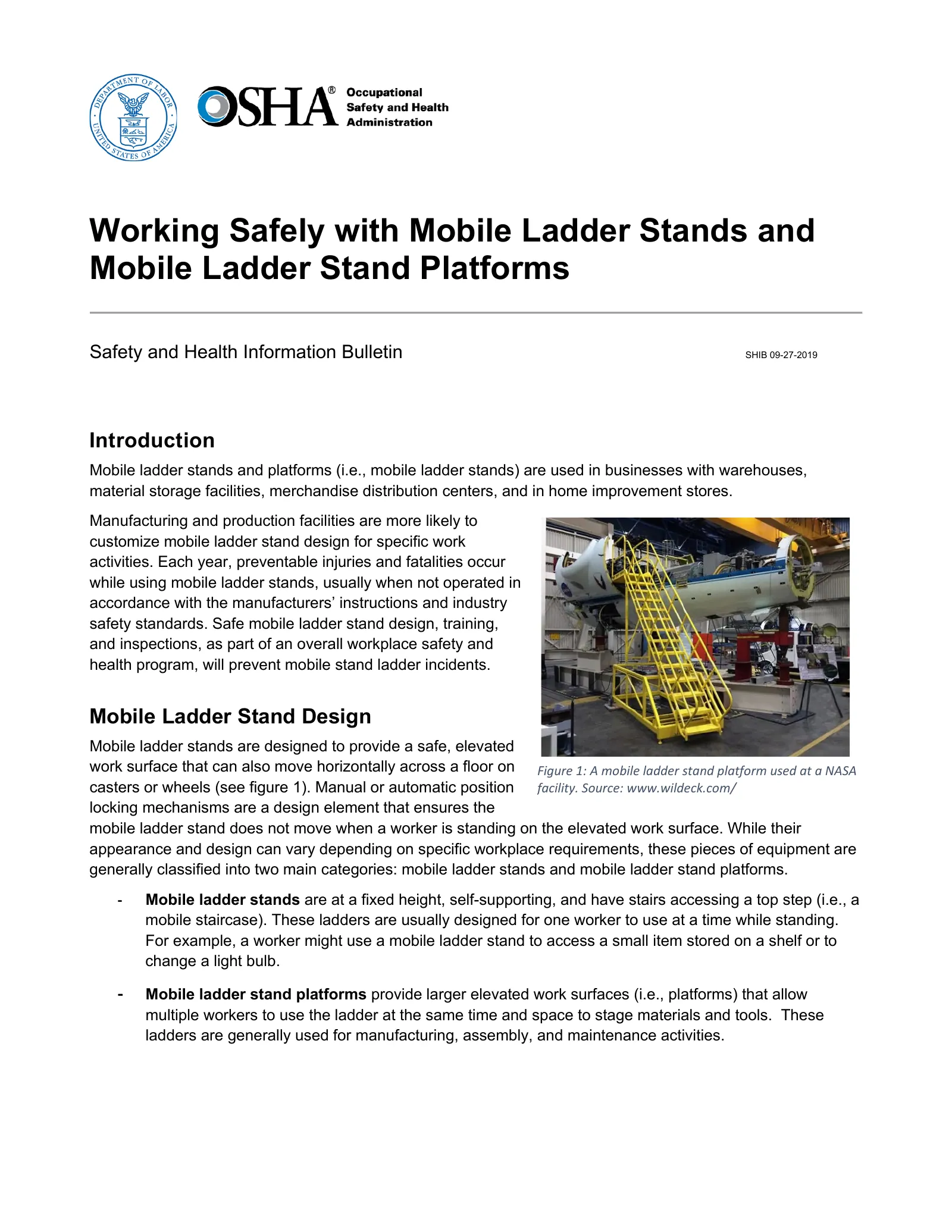
- work surface that can also move horizontally across a floor on Figure 1: A mobile ladder stand platform used at a NASA casters or wheels (see figure 1). Manual or automatic position facility. Source: www.wildeck.com/locking mechanisms are a design element that ensures the mobile ladder stand does not move when a worker is standing on the elevated work surface. While their appearance and design can vary depending on specific workplace requirements, these pieces of equipment are generally classified into two main categories: mobile ladder stands and mobile ladder stand platforms.
- Mobile ladder stands are at a fixed height, self-supporting, and have stairs accessing a top step (i.e., a mobile staircase). These ladders are usually designed for one worker to use at a time while standing. For example, a worker might use a mobile ladder stand to access a small item stored on a shelf or to change a light bulb.
- Mobile ladder stand platforms provide larger elevated work surfaces (i.e., platforms) that allow multiple workers to use the ladder at the same time and space to stage materials and tools. These ladders are generally used for manufacturing, assembly, and maintenance activities.
- Page 2
Training
- Preventing injuries and fatalities when using mobile ladders stands starts with choosing the right mobile ladder stand for the activity. The following are considerations to make when choosing an appropriate mobile ladder stand for the work task:
- Preventing overreach of the rail during the work activity.
- Align the platform size, height, and mobility of the ladder with the task duration, complexity, and/or mobility needs.
- Calculate and compare the maximum intended load (e.g., worker, tools, and materials) to the mobile ladder stand’s designed capabilities.
- A mobile ladder stand’s main structural components and use must meet specific requirements in 29 CFR 1910.23(e): Mobile ladder stands and mobile ladder stand platforms and the applicable general requirements for ladders in 29 CFR 1910.23(b).
- For additional information on mobile stands and platforms, employers should reference appropriate industry standards such as ANSI A14.7.
- Before using a mobile ladder stand, employers must train each worker in the proper care, inspection, storage, and use of mobile ladder stands, which may include:
- Position locking mechanisms (i.e., weight activated vs manual). Stair step, platform, handrail, and guardrail use.
- Structural component and design requirements.
- Employers must retrain workers when they have reason to believe workers do not have the understanding and/or skill required to safely continue to use mobile ladder stands. Some situations requiring employers to retrain workers include, but are not limited to, when the worker:
- Performs the job or uses equipment in an unsafe manner;
- Receives an evaluation or information that the worker is not performing the job safely or the employer receives such information; or
- Is involved in an incident or near-miss.
- These training requirements can be found in 29 CFR 1910.30: Training requirements.
- An on-line safety training video offered by the American Ladder Institute for Mobile Ladder Stand and Platform Safety is available at: www.americanladderinstitute.org/page/LSTVideos.
- Using Mobile Ladder Stands and Platforms
- Mobile ladder stand use includes two different functions; moving the mobile ladder stand from position to position, and as an immobilized elevated work surface. Never move the mobile ladder stand or platform while a worker is on it. (29 CFR 1910.23(e)(1)(viii))
- When moving mobile ladder stands:
- Ensure the mobile ladder stand is unoccupied.
- Disengage locking mechanisms and verify the casters or wheels can move freely.
- Maintain awareness to avoid hitting objects, other elevated structures, and workers in the area.
- Page 3
Inspecting Mobile Ladder Stands and Platforms
- When working on mobile ladder stands:
- Position the mobile ladder stand on a smooth, flat surface.
- Engage the locking mechanisms to prevent the mobile ladder stand from moving before stepping onto it. Ensure that steps and platforms of mobile ladder stands and platforms are slip resistant. (29 CFR 1910.23(e)(ii))
- Keep steps and platforms clean, dry, and free of spills and debris. (29 CFR 1910.22(a)(3))
- Ensure mobile ladder stands are only used for the purposes for which they were designed (29 CFR 1910.23(b)(8)):
- Do not use additional ladders or other objects to increase the working height.
- Do not overreach from the top step or platform.
- Do not stand on handrails, mid-rails, or toeboards, if so equipped, to gain additional height.
- Keep both feet firmly on a step or platform.
- When using mobile ladder stands around electrical lines, additional precautions should be taken to prevent electrical shock. For information on hazardous energy sources, see https://www.osha.gov/powerlines.
- Mobile ladder stand inspections, conducted by a competent person following the manufacturer’s instructions, will identify structural defects before use. These inspections should be documented and each mobile ladder stand should display a sticker, placard, tag, or log with inspection dates. In addition to following the manufacturer’s recommended schedule, inspections of ladders must be conducted before they are used, for each work shift. (29 CFR 1910.23(b)(9))
- Per 29 CFR 1910.23(b)(10), if structural defects are found:
- Immediately tag “Dangerous: Do Not Use.”
- Remove the mobile ladder stand from service until it is repaired, or replace it.
- Mobile Ladder Stands and Platforms in the Workplace Safety and Health Program
- Workplace safety and health programs should incorporate mobile ladder stands, when applicable, to clearly communicate policies for safe use. Specifically, safety and health programs should include:
- Where there mobile ladders stands are located in the workplace.
- How to access the manufacturers’ instructions.
- Clarify roles and responsibilities mobile ladder stand use, inspection, training, and maintenance. Procedures for using each mobile ladder stand in specific worksite areas.
- Inspection expectations.
- Training program expectations.
- Resources
- 29 CFR 1910.23: Ladders
- ANSI A14.7: American National Standard for Mobile Ladder Stands and Mobile Ladder Stand Platforms
- 29 CFR 1910.30: Training Requirements
- 29 CFR 1910.145: Specifications for accident prevention signs and tags
- 29 CFR 1910 Subpart I, Personal protective equipment
- OSHA Recommended Practices for Safety and Health Programs
- Page 4
Additional Information
- OSHA provides compliance assistance through a variety of programs. OSHA’s On-Site Consultation Program offers no-cost and confidential occupational safety and health services to small and medium-sized businesses in all 50 states, the District of Columbia, and several U.S. territories, with priority given to high-hazard worksites. Consultants from local agencies or universities work with employers to identify workplace hazards and how to fix them, provide advice for compliance with OSHA standards, train and educate, and assist in establishing and improving safety and health programs. On-Site Consultation services are separate from OSHA enforcement efforts and do not result in penalties or citations. However, employers must agree to correct any serious and imminent danger hazards identified in a timely manner. To locate the OSHA On-Site Consultation Program nearest you, call 1-800-321-OSHA (6742) or visit www.osha.gov/consultation.
- Workers' Rights
- Workers have the right to:
- Working conditions that do not pose a risk of serious harm.
- Receive information and training (in a language and vocabulary the worker understands) about workplace hazards, methods to prevent them, and the OSHA standards that apply to their workplace.
- Review records of work-related injuries and illnesses.
- File a complaint asking OSHA to inspect their workplace if they believe there is a serious hazard or that their employer is not following OSHA's rules. OSHA will keep all identities confidential.
- Exercise their rights under the law without retaliation, including reporting an injury or raising health and safety concerns with their employer or OSHA. If a worker has been retaliated against for using their rights, they must file a complaint with OSHA as soon as possible, but no later than 30 days.
- Exercise their rights under the Consumer Product Safety Improvement Act (CPSIA) without retaliation, including reporting a potentially unsafe or defective product to their employer, the federal government (i.e., the Consumer Product Safety Commission (CPSC)), or a state attorney general. A worker must file a CPSIA whistleblower complaint with OSHA no later than 180 days after an alleged violation occurs.
- For additional information, see OSHA's Workers’ page.
- Contact OSHA
- For more information, visit www.osha.gov or call OSHA at 1-800-321-OSHA (6742), TTY 1-877-889-5627.
- This Safety and Health Information Bulletin is not a standard or regulation, and it creates no new legal obligations. The Bulletin is advisory in nature, informational in content, and is intended to assist employers in providing a safe and healthful workplace. Pursuant to the Occupational Safety and Health Act (OSH Act), employers must comply with hazard-specific safety and health standards and regulations promulgated by OSHA or by a state with an OSHA-approved State Plan. In addition, pursuant to Section 5(a)(1), the General Duty Clause of the Act, employers must provide their employees with a workplace free from recognized hazards likely to cause death or serious physical harm. Employers can be cited for violating the General Duty Clause if there is a recognized hazard and they do not take reasonable steps to prevent or abate the hazard. However, failure to implement any recommendations in this Safety and Health Information Bulletin is not, in itself, a violation of the General Duty Clause. Citations can only be based on standards, regulations, and the General Duty Clause.
- There are 28 OSHA-approved occupational safety and health State Plans. State Plans are required to have standards and enforcement programs that are at least as effective as federal OSHA’s and may have different or more stringent standards. More information about State Plans is available at: http://www.osha.gov/stateplans.
More on Walking-Working Surfaces
pptx
66 slidesWalking and Working Surfaces (OSHA 10-Hour General Industry Outreach)
OSHA's own 10-hour General Industry Outreach deck on walking and working surfaces (v. 03-01-17), editable PowerPoint with trainer notes.
U.S. Department of Labor, OSHA (with the OTIEC Outreach Workgroup)Public domain
pdf
11 slidesWalking and Working Surfaces: Lesson Plan (OSHA 10-Hour General Industry Outreach)
Instructor lesson plan (objectives, timing, teaching steps) for the OSHA General Industry walking and working surfaces outreach deck.
U.S. Department of Labor, OSHA (with the OTIEC Outreach Workgroup)Public domain
pdf
2 slidesWalking and Working Surfaces: Knowledge Check (OSHA 10-Hour General Industry Outreach)
Student knowledge-check quiz for the OSHA General Industry walking and working surfaces outreach deck.
U.S. Department of Labor, OSHA (with the OTIEC Outreach Workgroup)Public domain