1 / 11Use ← → to flip
Walking and Working Surfaces: Lesson Plan (OSHA 10-Hour General Industry Outreach)
Instructor lesson plan (objectives, timing, teaching steps) for the OSHA General Industry walking and working surfaces outreach deck.
Page text
· 11 pages · by U.S. Department of Labor, OSHA (with the OTIEC Outreach Workgroup)
The words on each page as the author wrote them, read from the file by software so they can be searched. Layout, pictures and tables are not shown here: the pages above and the download are the original.
- Page 1
IDENTIFICATION
- TOPIC TITLE: Walking and Working Surfaces, including Fall Protection___
- MINIMUM TIME: 60 minutes___
- OBJECTIVES
- Terminal Objective:
- Given the various walking/working surface types, the students will be able to protect themselves from walking/working hazards including fall hazards.
- Enabling Objectives:
- 1. Identify hazards in the workplace associated with walking and working surfaces.
- 2. Identify best practices for eliminating or controlling hazards associated with walking and working surfaces in the workplace.
- 3. Identify best practices for eliminating or controlling fall hazards in the workplace.
- INSTRUCTOR MATERIALS AND RESOURCES
- PowerPoint Presentation: Walking and Working Surfaces, including Fall Protection Knowledge Check Answer Key: Walking and Working Surfaces, including Fall Protection
- STUDENT MATERIALS
- OSHA Fact Sheet: OSHA’s Final Rule to Update, Align, and Provide Greater Flexibility in its
- General Industry Walking-Working Surfaces and Fall Protection Standards
- OSHA Fact Sheet: Aerial Lifts
- OSHA Guidance: Stairways and Ladders: A Guide to OSHA Rules
- Knowledge Check: Walking and Working Surfaces, including Fall Protection
- Page 2
TEACHING PROCEDURES ---Preparation, Presentation, Application, Evaluation
- Anticipatory Set (Focus Attention/Gain Interest)
- Estimated Time: ?? hours
- Key Points
- Methods
- From NIOSH In-hose FACE Report 2009-01
- Case Study
- Summary
- On January 22, 2009, a 33-year-old Hispanic worker was injured after a fall from an 8-foot step ladder. A bucket partially filled with a cleaning solution was tied with a rag to the top of the ladder. The victim was cleaning windows when he fell onto a tiled floor and hit his head. At approximately 1:08 p.m., a tile foreman on the site called 911 and stayed with the conscious victim. The victim became unresponsive and at 1:14 p.m., Emergency Medical Services (EMS) arrived on the scene. When emergency medical personnel arrived, the victim was unconscious and having seizures. EMS transported the victim to a local hospital. The following morning the worker died from his injuries. Key contributing factors identified in this investigation include: work at an elevation, the improper use of a step ladder and insufficient worker training.
- Slips, trips, and falls constitute the majority of general industry accidents. They cause 15% of all accidental deaths, and are second only to motor vehicles as a cause of fatalities. The OSHA standards for walking/working surfaces apply to all permanent places of employment, except where only domestic, mining, or agricultural work is performed.
- Slide #2
- Slide #3
- Terminal Objective:
- Given the various walking/working surface types, the student will be able to protect themselves from walking/working hazards including fall hazards.
- Enabling Objectives:
- 1. Identify hazards in the workplace associated with walking and working surfaces
- Slide #4
- 2. Identify best practices for eliminating or controlling hazards associated with walking and working surfaces in the workplace
- 3. Identify best practices for eliminating or controlling fall hazards in the workplace
- Page 3
Presentation (Instruction)___
- Key Points
- I.
- Estimated Time: ?? hours
- Methods
- Types of Hazards and Controls
- A. Slip Hazards
- Slide #5
- 1. Types of hazards
- a. Grease, oil, water, ice, snow, liquid spills, or polished floors
- b. Improper footwear
- 2. Controlling Slip Hazards
- a. Work surfaces should be kept clean, dry, and appropriate means to assure slip-resistance.
- Slide #6
- b. Type of shoe-sole should match the job task to reduce possible slips
- c. Wet operations should be properly drained
- d. Spilled materials should be cleaned-up immediately
- e. Ice and snow removal should be frequent and regular
- B. Trip Hazards
- Slides #7 - #8
- a. Poor housekeeping
- b. Loose flooring, carpeting, or uneven surfaces
- c. Cords, hoses, open draws, or other protruding items
- 2. Controlling Trip Hazards
- a. Aisles and passageways should be well lit, clean and marked
- Slide #9
- b. Storage of material and equipment should not interfere with walkways
- c. Scrap, debris, and waste should be removed often
- Page 4
- d. Cords, hoses and other work-related trip hazards should be kept out of the work zone as much a practical
- C. Fall hazards associated with working on elevated surfaces or surfaces with lower-level hazards
- Slide #10
- 1. Examples
- a. Elevated surfaces – top of tanks, towers, machines, platforms, and other elevated surfaces; access top surfaces that are 4 feet or greater above the lower level – these less routine situations require equal protection
- Slides #11- #13
- b. Lower-level hazards – open pits, tanks, vats, ditches
- 2. Controlling fall hazards
- a. The best way to address fall hazards is to engineer out the need to access elevated surfaces whenever possible. For example, moving a tank gauge to ground level.
- b. Often guardrails, whether temporary or permanent, can be installed.
- c. The last line of defense would be to use a personal fall arrest system (PFAS).
- d. Platforms or runways next to dangerous operations require standard railings regardless of height.
- Slides #14- #15
- D. Controlling structural collapse due to lack of structural integrity or overloading walking/working surfaces –
- 1. Employers must ensure walking working surfaces are structurally sound.
- 2. Surfaces must be able to support the intended or potential load, whether it be people, equipment, or stored materials.
- 3. Load rating limits must be marked on plates and conspicuously posted.
- Slide #16 - #17
- II. Fall Hazards in the Workplace
- Page 5
- A. Conditions leading to incidents involving falls from ladders, scaffolds, scissor lifts, stairways, floor openings, or other elevated surface
- 1. Improper ladder selection, condition, or use
- 2. Improper scaffold selection, condition, or use
- 3. Improper stairway design, condition, or use
- 4. Unprotected or poorly protected floor and wall openings, open –sided platforms, or runways
- Slide #18 - #24
- 5. Fall hazards associated with other elevated surfaces
- B. Controlling Fall Hazards
- 1. Portable Ladders – proper selection, condition and use are crucial for controlling portable ladder-related hazards.
- a. Select, used and maintained according to the manufacturer. No damaged or missing components.
- b. Read and follow all labels/markings on the ladder.
- c. Always inspect the ladder prior to using it. If the ladder is damaged, it must be removed from service and tagged until repaired or discarded.
- d. Do not exceed the maximum load rating of a ladder. Be aware of the ladder’s load rating and of the weight it is supporting, including the weight of any tools or equipment.
- e. Do not use a self-supporting ladder (e.g., step ladder) as a single ladder or in a partially closed position.
- f. Do not use the top step/rung of a ladder as a step/rung unless it was designed for that purpose.
- g. Use a ladder only on a stable and level surface, unless it has been secured (top or bottom) to prevent displacement.
- h. Do not place a ladder on boxes, barrels or other unstable bases to obtain additional height.
- i. Do not move or shift a ladder while a person or equipment is on the ladder.
- j. A ladder placed in any location where it can be displaced by other work activities must be secured to prevent displacement or a barricade must be erected to keep traffic away from the ladder.
- k. Always maintain a 3-point (two hands and a foot, or two feet and a hand) contact on the ladder
- Page 6
- when climbing. Keep your body near the middle of the step and always face the ladder while climbing
- l. Only use ladders and appropriate accessories (ladder levelers, jacks or hooks) for their designed purposes.
- m. Ladders must be free of any slippery material on the rungs, steps or feet.
- n. An extension or straight ladder used to access an elevated surface must extend at least 3 feet above the point of support
- o. Do not stand on the three top rungs of a straight, single or extension ladder.
- p. The proper angle for setting up a straight or extension ladder is to place its base a quarter of the working length of the ladder from the wall or other vertical surface
- Slide #25
- 2. Fixed Ladders – proper design, construction, condition and use are crucial for controlling fixed ladder-related hazards.
- a. If the total length of the climb on a fixed ladder equals/exceeds 24 feet, the ladder must be
- i. Equipped with a PFAS or ladder safety system
- (if installed on/after 12/19/18;
- ii. Equipped with a PFAS, ladder safety system, cage, or well (if installed before 12/19/18;
- iii. Replace cages and wells with ladder safety or PFAS during replacement on all fixed ladders over 24 feet; final deadline 12/18/2036.
- b. For heights exceeding 20 feet, a landing platform, with guardrails, must be provided for each 20 feet of height or fraction thereof.
- c. Ladder safety devices allow climbing ladders exceeding 20 feet without platforms when used on such structures as chimneys, tanks, and towers.
- d. The same safe climbing practices also apply to fixed ladders.
- e. Fixed ladders must also be inspected and maintained in safe condition.
- Slides #26 - #36
- 3. Scaffolds – proper selection, condition and use are crucial for controlling scaffold-related hazards.
- a. Scaffolds must be selected, erected, used and maintained according to the manufacturer. No missing components or partial assembly.
- Page 7
- b. Damage scaffolds or components must be replaced before use.
- c. The footing or anchorage for scaffolding must be sound and capable of supporting the load.
- d. Supported scaffolds must be erected plumb and level.
- e. Unstable make-shift items such as barrels, boxes, blocks must not be used to support scaffold planks.
- f. Scaffolds must be capable of supporting at least four times the intended load.
- g. Scaffolds must be fully planked with scaffold grade planking or platforms.
- h. A safe means of access such as a ladder must be provided.
- i. Guard rails, mid-rails, and toe boards must be installed on all open sides of platforms more than 10 feet above grade.
- j. Mesh must be installed between the toe board and top-rail if tools of materials are higher than the toe board or workers must work or pass under the scaffolding
- k. Mobile scaffolds cannot be moved while workers are on them.
- l. All wheel casters on mobile scaffolds must be locked while accessing work platform and during work activities.
- m. Stationary scaffolds with a height to width ratio greater than 4:1 must be restrained from tipping. Mobile scaffolds must never exceed the 4:1 ratio
- 4. Scissor Lifts – over a one-year period, OSHA investigated ten preventable fatalities and more than 20 preventable injuries resulting from a variety of incidents involving scissor lifts. Although scissor lifts present hazards similar to scaffolding when extended and stationary, using scissor lifts safely depends on considering equipment capabilities, limitations and safe practices.
- Slides #37 - #39
- Slides #40 - #46
- 5. Stairs – proper design, construction, condition and use are crucial for controlling stairway-related hazards.
- Every flight of stairs with four or more risers must have standard stair railings on all open sides or standard handrails if stairs are enclosed (preferably on the right side descending).
- Page 8
f. All stairs should be inspected on a regular basis for Slides #47 - #50
- a. Fixed industrial stairs (stairs around tanks, machinery, equipment, platforms, pits etc.) must be strong enough to carry five times the anticipated live load with a minimum of 1,000 lbs.
- b. Fixed industrial stairs must be at least 22 inches wide
- c. Fixed industrial stairs must be installed at angles between 30-50 degrees.
- d. Fixed industrials stairs must have at least 7 feet of vertical clearance above any tread
- e. All stairs require proper lighting for safe use
- condition and housekeeping-related hazards
- g. Items should never be placed, left, or stored on stairs
- 6. Floor and Wall Openings, open-sided platforms, or runways – Floor openings, floor holes, wall openings and open-sided platforms or runways are hazardous situations. Properly protecting floor and wall openings and elevated platforms is crucial in eliminating fall hazards
- a. Floor openings, such as those needed for stairways must protected
- b. Standard railings must be present on all sides of the opening except at the stairway entrance.
- c. A standard railing is 42 inches high (+/- 3”) and made up of a top rail, mid rail, vertical posts, and toe boards to prevent struck-by hazards to those using the stairs
- d. Floor openings may be guarded by covers instead.
- When routine travel over the opening is necessary, often a cover is used, such as a trap-door.
- e. When the floor opening cover is opened, either a temporary guardrail must be in place or the opening must be constantly attended by someone until closed.
- f. Every open-sided platform or wall opening that is
- 4 ft. or move above the next level must be protected by a standard railing
- g. Platforms or runways next to dangerous operations
- Slides #51 - #53
- require standard railings regardless of height.
- III.
- Employer Requirements
- Page 9
- A. Comply with all applicable OSHA standards related to walking and working surfaces, including:
- 1. OSHA Requirements
- 2. Employer Responsibilities
- Application (How students apply what they learn) __
- Key Points
- Estimated Time: ?? hours
- Methods
- Show pictures of walking and working surfaces. Have students identify any unsafe actions or conditions and discuss related best practices.
- Evaluation/Summary
- Slides #54 - #59
- Estimated Time: 1 hour
- Key Points
- Methods
- Knowledge Check: Walking and working surfaces including fall protection
- Slides #60 - #66
- References
- OSHA Standard
- 1910 Subpart D - Walking-Working Surfaces
- 1910.21 - Scope and definitions.
- 1910.22 - General requirements.
- 1910.23 - Ladders.
- 1910.24 - Step bolts and manhole steps.
- 1910.25 - Stairways.
- 1910.26 - Dockboards.
- 1910.27 - Scaffolds and rope descent systems.
- 1910.28 - Duty to have fall protection and falling object protection.
- 1910.29 - Fall protection systems and falling object protection-criteria and practices.
- 1910.30 - Training requirements.
- OSHA Publications
- Page 10
- Compatibility of Personal Fall Protection System Components (2003, September 22) (English: HTML PDF*)
- Fall From a Telecommunications Tower: Fatal Facts (OSHA 3710 - 2014) (English: PDF*)
- Fall Prevention: Training Guide - A Lesson Plan for Employers (OSHA 3666 - 2014) (English: EPUB** MOBI** PDF*);
- (OSHA 3727 - 2014) (Spanish: EPUB** MOBI** PDF*)
- Fall Protection in General Industry QuickCard TM
- (OSHA 3257 - 2010) (English: HTML PDF*); (OSHA 3257 - 2010) (Spanish: HTML PDF*)
- Falls- Preventing Falls Fact Sheet
- (English: HTML PDF*); (OSHA FS 3604 - 2012) (Portuguese: PDF*)
- Ladder Safety QuickCard™
- (OSHA 3246 - 2005) (English: HTML PDF*)
- Ladder Safety: Falling Off Ladders Can Kill: Use Them Safely (OSHA 3625 - 2015) (English: EPUB** MOBI** PDF*)
- (OSHA 3625 - 2015) (Spanish: EPUB** MOBI** PDF*)
- Scaffolding: Narrow Frame Scaffolds Fact Sheet (OSHA 3722 - 2014) (English: HTML PDF*)
- Snow Removal: Falls and Other Hazards to Workers Removing Snow from Rooftops and Other Elevated Surfaces
- (OSHA 3513 - 2012) (English: HTML PDF*)
- Stairways and Ladders
- (OSHA 3124 - 2003) (English: HTML PDF*)
- Working Safely with Scissor Lifts (OSHA HA-3842 2016) https://www.osha.gov/Publications/OSHA3842.pdf
- OSHA References/Resources
- Page 11
- Walking and Working Surfaces , OSHA Safety and Health Topics (n.d.),
- Falls , OSHA Construction eTool (2014),
- Scaffolding , OSHA eTool (2002), https://www.osha.gov/SLTC/etools/scaffolding/index.html
- Work Surface Hazard Results in Slip and Fall, OSHA video (2005), https://www.osha.gov/video/shipyard_accidents/05_fall_drowning.html https://www.osha.gov/SLTC/walkingworkingsurfaces/hazards.html https://www.osha.gov/SLTC/etools/construction/falls/mainpage.html
More on Walking-Working Surfaces
pptx
66 slidesWalking and Working Surfaces (OSHA 10-Hour General Industry Outreach)
OSHA's own 10-hour General Industry Outreach deck on walking and working surfaces (v. 03-01-17), editable PowerPoint with trainer notes.
U.S. Department of Labor, OSHA (with the OTIEC Outreach Workgroup)Public domain
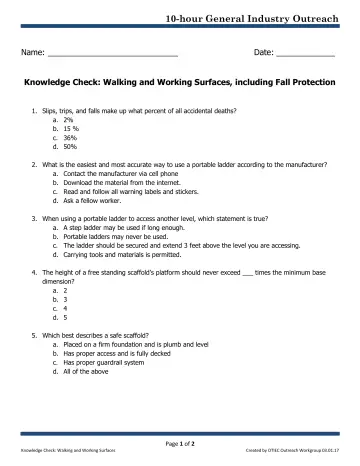
pdf
2 slidesWalking and Working Surfaces: Knowledge Check (OSHA 10-Hour General Industry Outreach)
Student knowledge-check quiz for the OSHA General Industry walking and working surfaces outreach deck.
U.S. Department of Labor, OSHA (with the OTIEC Outreach Workgroup)Public domain

pdfes
66 slidesSuperficies para caminar y trabajar (Capacitación de Extensión de 10 horas de OSHA, Industria General)
Spanish edition of OSHA's 10-hour General Industry Outreach deck on walking and working surfaces (PDF slides; OSHA does not publish an editable Spanish PowerPoint).
U.S. Department of Labor, OSHA (with the OTIEC Outreach Workgroup)Public domain