1 / 36Use ← → to flip
Slips, Trips and Falls
Slips, trips and falls deck from the University of Utah.
Slide text
· 36 slides · by University of Utah
The words on each slide as the author wrote them, read from the file by software so they can be searched. Layout, pictures and tables are not shown here: the slides above and the download are the original.
- Slide 1
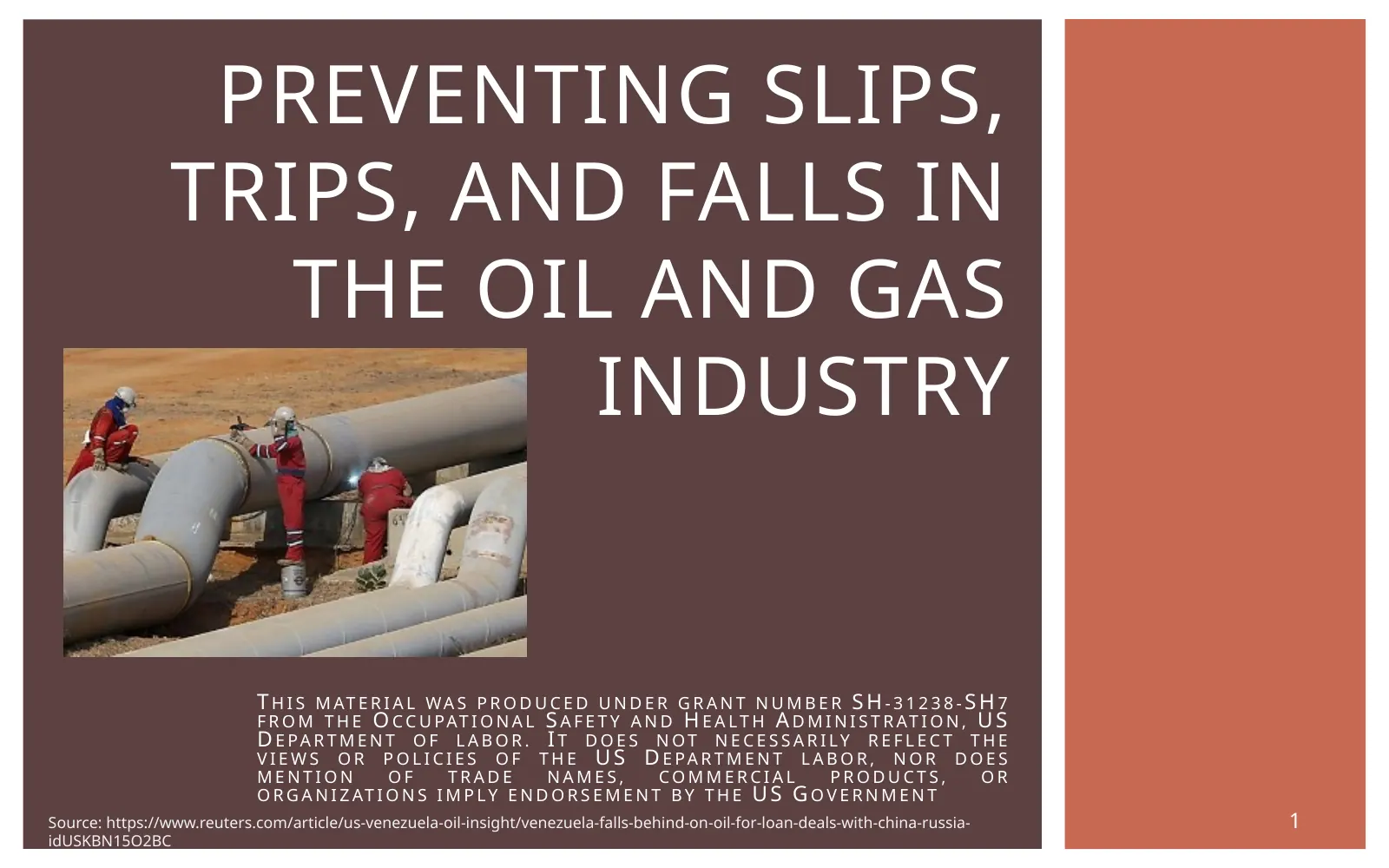
PREVENTING SLIPS, TRIPS, AND FALLS IN THE OIL AND GAS INDUSTRY
- MENTION
- OF
- TRADE
- NAMES,
- COMMERCIAL
- PRODUCTS,
- Source: https://www.reuters.com/article/us-venezuela-oil-insight/venezuela-falls-behind-on-oil-for-loan-deals-with-china-russia-idUSKBN15O2BC
- OR
- Slide 2
PRE-COURSE ASSESSMENT QUESTION 1
- 1. What are the 3 types of fall injuries?
- a. Fall from height, fall at the same level, objects falling on workers
- b. Fall from height, Fall at the same level, Slips without a fall
- c. Falls above 30 feet, Falls between 5 and 30 feet, falls below 5 feet
- d. None of the above
- Slide 3
PRE-COURSE ASSESSMENT QUESTION 2
- 2. What is the best way to prevent fall injuries?
- a. Require tie off practices for all work above 10 feet
- b. Develop, implement, and commit to a fall protection program
- c. Train all workers about fall hazards
- d. Not allow workers to work above 10 feet
- Slide 4
PRE-COURSE ASSESSMENT QUESTION 3
- 3. How many fatalities from falls were reported in the oil and gas industry between 2005 and 2014?
- a. 2
- b. 28
- c. 63
- d. 188
- Slide 5
FALLS
- A fall is defi ned as an event which results in a person coming to rest inadvertently on the ground or fl oor or other lower level.
- Source: http://www.who.int/mediacentre/factsheets/fs344/en/
- Falls are the second leading cause of accidental or unintentional injury deaths worldwide.
- Slide 6
CATEGORIES OF FALLS
- There are 3 main categories of falls:
- Falls from height
- Falls at the same level
- Slips or trips without a fall
- Source: http://sunnewsreport.com/fall-fatalities-among-oil-gas-extraction-workers/
- Source: Photos used with kind permission of Don Linville
- Slide 7
HOW BIG OF A PROBLEM ARE FALLS?
- Falls are the No. 1 cause of death in the construction industry
- Falls are the No. 2 cause of death on the job
- $70 billion annually in workers’ compensation and medical costs in the United States
- Source: U.S. Bureau of Labor Statistics 2016
- $61 billion per year is spent on disability claims in America
- $15.57 billion, or 25.1%, from falls
- $10.17 billion, or 65.3% were falls to same level
- $5.4 billion, or 34.7% were falls to a lower level
- Slips and trips without a fall cost another $2.35 billion, or 3.8%
- Slide 8
QUESTION / RESPONSE
- What category of falls cost the most money?
- 1. Falls from height
- 2. Falls at the same level
- 3. Slips or trips without a fall
- 4. None of the above
- 100%
- 80%
- 60%
- 40%
- 20%
- 0%
- 0%
- 0%
- Falls from height
- Falls at the same level
- 0%
- 0%
- Slips or None of trips
- the without above a fall
- Source: Photos used with kind permission of Don Linville
- Slide 9
OCCUPATIONAL FATALITIES BY MA JOR
- EVENT
- Source: U.S. Bureau of Labor Statistics 2016
- Slide 10
FALL INJURIES IN OIL AND GAS
- 63 oil and gas extraction
- Fall protection was
- workers died from a fall
- required for 54 (86%) of the during 2005-2014
- 63 workers, but most (56%) were not wearing it
- Most (52%) fell from a height of 30 feet
- Among the 24 fatally
- injured workers who were
- Occupations most commonly
- wearing personal fall
- involved in a fatal fall were
- protection equipment, derrickmen, working >90 feet
- 15 (63%) were not attached to
- Drilling contractor workers
- an anchor
- The largest proportion of fatal fall injuries (38; 60%)
- The highest fall-associated fatality rate (4.5 deaths per
- 100,000 workers)
- 2 (8%) were not wearing a properly fi tted harness
- Remaining 7 (29%) had equipment failure
- Source: Mason KL,. Retzer KD, Hill R, Lincoln JM. Occupational fatalities resulting from falls in the oil and gas extraction industry, United States, 2005–2014. MMWR Morb Mortal Wkly
- Rep 2017;66:417–421. DOI: Link to Morbidity and Mortality Weekly Report
- Slide 11
QUESTION / RESPONSE
- What is the most common characteristic of fatal falls in the oil and gas industry between 2005 and 2014?
- 1. Falling on the same level
- 2. Working as a drilling contractor
- 3. Falling to a lower level
- 4. Wearing fall protection
- 5. Requiring fall protection
- 100%
- 80%
- 60%
- 40%
- 20%
- 0%
- 0%
- Fa
- ng lli
- on
- e th
- g in k
- as
- 0%
- ve
- g in l
- ri
- Fa
- a tr n
- co
- ng lli
- to
- w lo
- 0%
- 0%
- el
- n io t
- ev r l
- ll fa
- ot
- in in r
- ea
- qu
- 0%
- io
- ct
- ro
- Slide 12
RISK FACTORS FOR A FALL
- Occupations at elevated heights
- Hazardous working conditions
- Time constraints/demands
- Fatigue
- Poor lighting
- Alcohol or substance use
- Side eff ects of medication
- Physical inactivity
- Loss of balance, (esp. older people)
- Poor mobility
- Poor cognition and/or vision
- Unsafe environments
- Underlying medical conditions
- Neurological
- Cardiac
- Other disabling conditions
- Unsafe acts by worker(s)
- Combinations of these factors
- Slide 13
FALLS FROM HEIGHT
- Source: https://www.ntsafety.com/product/work-zone-safety-system/ https://fall-arrest.com/fall-protection-systems/oil-gas-chemical/ https://cdn2.webdamdb.com/310th_sm_JMyRxL2dIL.jpg?1382726796 http://metroforensics.blogspot.com/2017/04/63-oil-and-gas-extraction-workers-died.html
- Slide 14
WHERE DO FALLS FROM HEIGHT HAPPEN?
- Ladders
- Scaff olding
- Elevated walkways
- Aerial lifts and mobile platforms
- Fixed platforms and areas
- Climbing on trucks or trailers
- Unprotected areas such as piping, equipment, or tanks
- Anywhere workers are more than 4 feet off the ground or above openings that are more than 4 feet deep
- Slide 15
FATAL FALLS FROM HEIGHT
- Source: U.S. Bureau of Labor Statistics 2016
- Slide 16
QUESTION / RESPONSE
- At what height did most fatal falls occur in 2015?
- 1. Less than 15
- 2. 16-30
- 3. >30
- 4. Unspecifi ed
- 100%
- 80%
- 60%
- 40%
- 20%
- 0%
- 0%
- 0%
- Less than 15 16-30
- 0%
- 0%
- >30 Unspecified
- Slide 17
DISTANCE RULES — FALL PROTECTION REQUIREMENTS
- Under OSHA regulations, fall protection is required when working:
- 4 feet off the ground with no standard hand rails present (General Industry Standard, applies to "site preparation" of oil and gas sites)
- 6 feet off the ground with no standard hand rails present (Construction Standard)
- Oil and gas drilling fall under the General Industry and/or Construction Standard
- Fall Protection should be used as a last choice
- Other options are safer
- Slide 18
COMPANY-WIDE FALL PREVENTION
- Develop, implement, and commit to a fall protection program
- Provide training on the fall protection program
- Evaluate the program on a regular basis
- Ensure the program’s eff ectiveness
- Determine whether changes or updates are needed
- Where protection is required, select fall protection systems appropriate for given situations
- Use proper construction and installation of safety systems
- Train workers in the proper selection, use, and maintenance of fall protection systems
- Supervise employees properly, using a fall protection competent person in fall protection
- Rescue Plan
- Slide 19
PREVENTING FALLS FROM HEIGHT
- Guard or cover any openings or holes as soon as they are created
- Construct all fl oor hole covers so they will eff ectively support two times the weight of employees, equipment, and materials that may be imposed on the cover at any one time
- Guardrail systems (200 # side impact — top rail only)
- Safety net systems
- Fall arrest systems
- Use of aerial lifts (e.g. JLG aerial lifts) instead of ladders or scaff olding
- In general, it is better to use fall prevention systems (e.g., guardrails) than fall protection systems (e.g., safety nets or fall arrest devices)
- Sources: http://smallbusiness.chron.com/government-agency-osha-fall-under-64161.html and https://www.osha.gov/OshDoc/data_Hurricane_Facts/fall.pdf
- Slide 20
LADDER SPECIFIC PREVENTION
- Position portable ladders so the side rails extend at least 3 feet above the landing
- Secure side rails at the top to a rigid support and use a grab device when 3 foot extension is not possible
- Make sure that the weight on the ladder will not cause it to slip off its support
- Before each use, inspect ladders for cracked, broken, or defective parts
- For portable ladders, use a 4:1 ratio, height to horizontal distance from object that ladder is secured to (i.e., 12 foot climb, set ladder out 3 feet)
- Do not apply more weight on the ladder than it is designed to support
- Use only ladders that comply with OSHA and ANSI standards
- Source: https://www.osha.gov/OshDoc/data_Hurricane_Facts/fall.pdf
- Slide 21
OPTIONS FOR CONTROLLING THE HAZARD
- Eliminate the need to climb where possible
- Use control measures (Fall Protection or Prevention)
- Protect all those exposed to the hazard
- Slide 22
WORKING AT HEIGHTS MAY BE UNAVOIDABLE
- Unfortunately, working at height is a necessity in the oil and gas industry.
- Some options to eliminate or reduce these hazards:
- Installation of equipment
- Hand rails
- Scaff olding
- Covers for openings
- Ladder safety training
- Fall protection equipment
- Fall arrester
- Full body harness
- Other equipment
- Source: Photos used with kind permission of Don
- Linville
- Slide 23
QUESTION / RESPONSE
- 0%
- 0%
- 0%
- 0%
- 1. Eliminate the hazard
- 2. Train workers
- 3. As a company develop, implement and commit to a fall protection program
- 4. Position portable ladders so the side rails extend at least 3 feet above the landing
- 5. Use fall protection
- 0%
- What is the best measure to prevent falls from height?
- Slide 24
FALLS FROM THE SAME LEVEL
- A fall from the same level is a slip, trip, or a fall in which the worker impacts either the surface or an object at the same level or above the surface on which he/she is standing.
- Source: Photo used with kind permission of Don Linville
- Source: https://nfsi.org/nfsi-research/
- Slide 25
FALLS FROM THE SAME LEVEL IN 2010
- Source: Yeoh, H. T., Lockhart, T. E., & Wu, X. (2013). Non-Fatal Occupational Falls on the Same Level. Ergonomics, 56(2), 153–165. http://doi.org/10.1080/00140139.2012.746739
- Slide 26
STANDARDS FOR SLIPPERY FLOORS
- Test Method for Measuring Wet Static Coeffi cient of Friction of Common Hard-Surface Floor Materials (ANSI/NFSI B101.1-2009)
- “. . .address the common hard-surfaced fl ooring materials such as ceramic tile, vinyl fl oor coverings, and wood laminates, as well as coatings, polishes, etc.”
- Source: https://webstore.ansi.org/RecordDetail.aspx?sku=ANSI%2fNFSI+B101.1-2009
- Slide 27
RISK REDUCTION
- Provide education and increase awareness
- Perform fall risk assessments and implement controls
- Organize sustainable housekeeping procedures for inspection, cleaning, and maintenance
- Eliminate or minimize the hazards
- Provide warning signs for slip hazards
- Mark trip hazards
- Improve and encourage use of lighting
- Discourage carrying of awkward, heavy loads
- Avoid rushing and time pressures
- Implement risk management protocols for inclement weather (i.e., ice grips for boots, etc.)
- Implement risk management protocols for individuals at increased risk of falling
- Source: Chang, W.-R., Leclercq, S., Lockhart, T. E., & Haslam, R. (2016). State of science: occupational slips, trips and falls on the same level . Ergonomics, 59(7), 861–883.
- Slide 28
ORGANIZATIONAL FACTORS
- Require use of suitable footwear
- Require use of suitable clothing, including personal protective equipment (PPE)
- Implement eye tests and require appropriate use of spectacles
- Encourage exercise for strength, coordination, and balance
- Adopt occupational health protocols to eliminate or minimize fall risk from prescribed medication
- Consider fall risk arising from shift work or unusual work schedules
- Source: Chang, W.-R., Leclercq, S., Lockhart, T. E., & Haslam, R. (2016). State of science: occupational slips, trips and falls on the same level . Ergonomics, 59(7), 861–883.
- Slide 29
PRIMARY PREVENTION
- Provide slip resistant fl ooring and surfaces where possible
- Design work/activity systems to avoid presence of fall risks (attention to environments, equipment, layouts, tasks, and people)
- Cover outside walkways to keep off rain, snow, ice, leaves
- Design walkways to exclude trip hazards
- Plan pedestrian routes to allow suffi cient space between individuals
- Separate pedestrians from moving machinery and vehicles
- Provide suffi cient, convenient space for storage
- Avoid need for walking/standing on surfaces that move unpredictably
- Install adequate lighting
- Design and select environment features to facilitate cleaning and maintenance
- Design and select environment features for durability and resistance
- to damage
- Chang, W.-R., Leclercq, S., Lockhart, T. E., & Haslam, R. (2016). State of science: occupational slips, trips and falls on the same level . Ergonomics, 59(7), 861–883.
- Slide 30
QUESTION / RESPONSE
- What can companies do to reduce falls at the same level?
- 1. Avoid rushing and time pressures
- 2. Provide slip resistant fl ooring
- 3. Mark trip hazards
- 4. Install adequate lighting
- 5. All of the above
- 100%
- 80%
- 60%
- 40%
- 20%
- 0%
- 0%
- 0%
- 0%
- 0%
- 0%
- Slide 31
SLIPS WITHOUT A FALL
- Little is known about this cause of injury
- Highly litigated
- Not well reported or tracked
- Presumed to be related to falls at the same level
- Prevention measures also presumed to be the same as for falls at the same level
- Source: https://yle.fi/uutiset/osasto/news/slip_fall_break_a_leg_-_who_pays/7753944
- Slide 32
SLIPS WITHOUT A FALL (CONT.)
- Injury types include
- Sprains and strains
- “Overexertion” type of injuries
- Body parts include
- Low back
- Shoulder
- Knee
- Other factors include
- Carrying objects
- Rushing
- Source:
- Environmental factors (wet surface, poor lighting, etc.)
- http://greenshieldfloors.com/uvcoat/
- Carelessness or unsafe acts
- Slide 33
POST-COURSE ASSESSMENT QUESTION 1
- 1. What are the 3 types of fall injuries?
- a. Fall from height, fall at the same level, objects falling on workers
- b. Fall from height, Fall at the same level, Slips without a fall
- c. Falls above 30 feet, Falls between 5 and 30 feet, falls below 5 feet
- d. None of the above
- Slide 34
POST-COURSE ASSESSMENT QUESTION 2
- 2. What is the best way to prevent fall injuries?
- a. Require tie off practices for all work above 10 feet
- b. Develop, implement, and commit to a fall protection program
- c. Train all workers about fall hazards
- d. Not allow workers to work above 10 feet
- Slide 35
POST-COURSE ASSESSMENT QUESTION 3
- 3. How many fatalities from falls were reported in the oil and gas industry between 2005 and 2014?
- a. 2
- b. 28
- c. 63
- d. 188
- Slide 36
ANY QUESTIONS?
More on Walking-Working Surfaces
pptx
66 slidesWalking and Working Surfaces (OSHA 10-Hour General Industry Outreach)
OSHA's own 10-hour General Industry Outreach deck on walking and working surfaces (v. 03-01-17), editable PowerPoint with trainer notes.
U.S. Department of Labor, OSHA (with the OTIEC Outreach Workgroup)Public domain
pdf
11 slidesWalking and Working Surfaces: Lesson Plan (OSHA 10-Hour General Industry Outreach)
Instructor lesson plan (objectives, timing, teaching steps) for the OSHA General Industry walking and working surfaces outreach deck.
U.S. Department of Labor, OSHA (with the OTIEC Outreach Workgroup)Public domain
pdf
2 slidesWalking and Working Surfaces: Knowledge Check (OSHA 10-Hour General Industry Outreach)
Student knowledge-check quiz for the OSHA General Industry walking and working surfaces outreach deck.
U.S. Department of Labor, OSHA (with the OTIEC Outreach Workgroup)Public domain