1 / 66Use ← → to flip
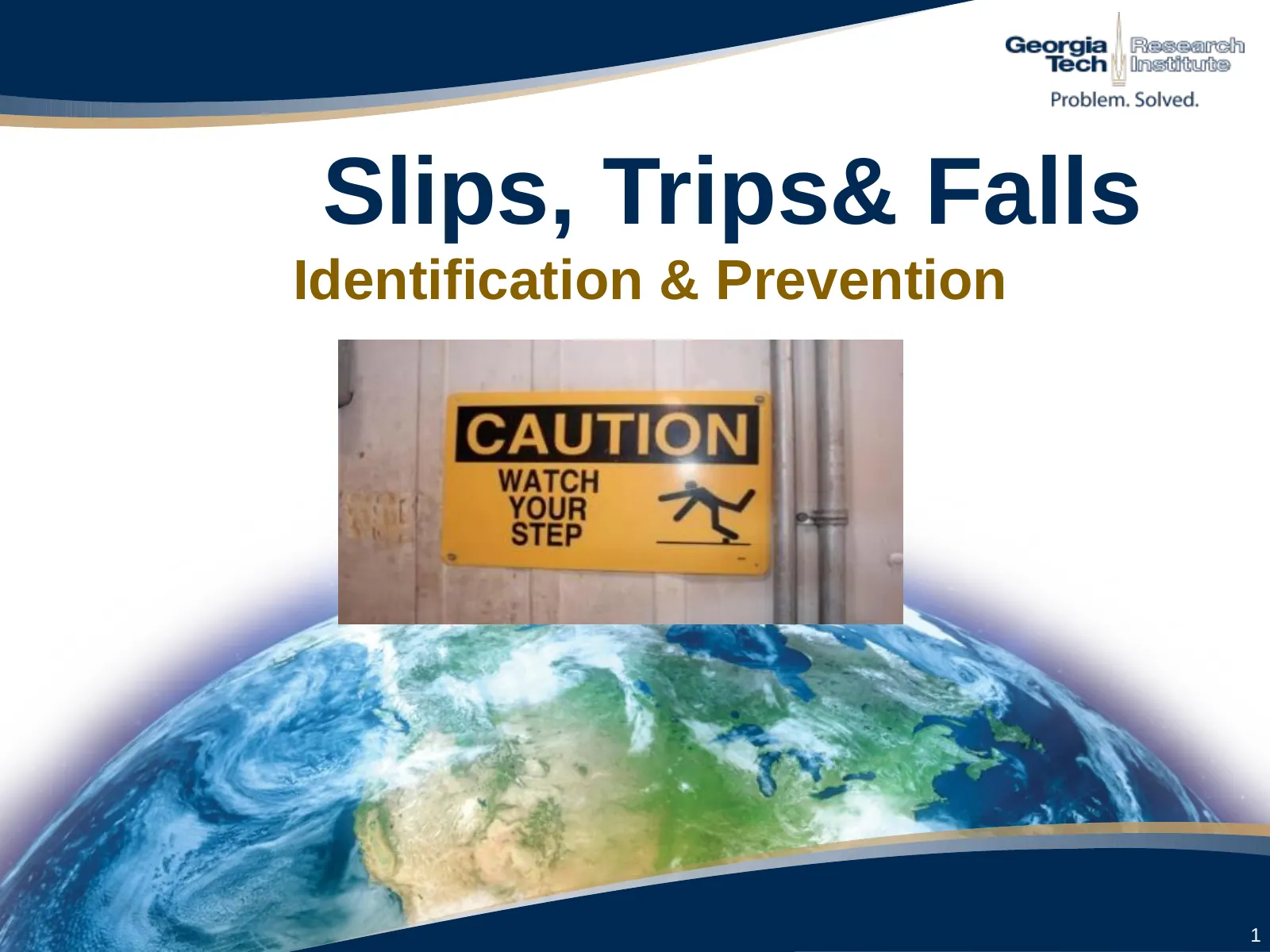
Slips, Trips and Falls
Slips, trips and falls module from the Georgia Tech poultry and meatpacking course (Subpart D).
Slide text
· 66 slides · by Georgia Tech Research Institute
The words on each slide as the author wrote them, read from the file by software so they can be searched. Layout, pictures and tables are not shown here: the slides above and the download are the original.
- Slide 1
Slips, Trips& Falls
- Identification & Prevention
- Slide 2
Disclaimer
- This material was produced under grant number SH-29660-SH6 from the Occupational Safety and Health Administration, U.S. Department of Labor. It does not necessarily reflect the views or policies of the U.S. Department of Labor, nor does mention of trade names, commercial products, or organizations imply endorsement by the U.S. Government.
- Slide 3
Objectives
- Costs of slips, trips & falls (STFs)
- Definitions
- Causes of STFs
- Risk factors
- Prevention/minimization
- Slide 4
Costs of STFs
- Slips, trips & falls can happen anywhere in your operation
- Slips & trips can result in falls, possibly disability or death
- Costs to employer & worker can be substantial
- Slide 5
Costs of STFs
- To the employer:
- Loss of productivity & business
- Increased industrial insurance premiums
- Costs associated with training replacement worker
- Slide 6
Costs of STFs
- To the worker:
- Lost wages & out-of-pocket expenses
- Pain
- Temporary or permanent disability
- Reduced quality of life
- Depression
- Death
- Slide 7
Frequency of STFs
- Slips, trips & falls make up majority of general industry accidents (USDoL)
- 15% of all accidental deaths; 2 nd leading cause behind motor vehicles
- ~12,000/year
- One of most frequently-reported injuries
- ~25% of reported claims/year
- Over 17% of all disabling occupational injuries result from falls
- Most could have been prevented
- Slide 8
STF Injuries
- Sprains & strains
- Bruises & contusions
- Fractures
- Abrasions & lacerations
- Slide 9
Typical Injury Sites
- Knee, ankle and/or foot
- Wrist &/or elbow
- Back &/or shoulder
- Hip
- Head
- Slide 10
Definitions
- Slip
- Too little friction or traction between feet (footware) & walking/working surface, resulting in loss of balance
- Slide 11
Definitions
- Trip
- Foot or lower leg hits object & upper body continues moving, resulting in loss of balance
- Stepping down to lower surface & losing balance
- Potential Trip Hazards?
- Slide 12
Definitions
- Fall
- Occurs when too far off center of balance
- Two types
- Fall at same level
- Fall to same walking or working surface, or fall into or against objects above same surface
- Fall to lower level
- Fall to level below walking or working surface
- Slide 13
Causes of Slips
- Wet product or spills on smooth floors or walking surfaces
- Water
- Mud
- Grease
- Oil
- Food
- Blood
- Offal
- Slide 14
Causes of Slips
- Dry product or spills making walking surface slippery
- Dusts
- Powders
- Granules
- Wood
- Plastic wrapping
- Slide 15
Causes of Slips
- Highly-polished floors can be slick even when dry
- Concrete
- Marble
- Ceramic tile
- Freshly-waxed surfaces
- Transitioning from one surface to another
- Carpeted to vinyl
- Grid to smooth concrete
- Slide 16
Causes of Slips
- Sloped walking surfaces
- Loose, unanchored rugs or mats
- Loose floorboards or shifting tiles
- Wet, muddy or greasy shoes
- Ramps & gang planks without skid- or slip-resistant surfaces
- Slide 17
Causes of Slips
- Metal surfaces
- Dockboards & dock plates
- Platforms
- Sidewalk & road covers
- Mounting & dismounting vehicles & equipment
- Climbing ladders
- Loose, irregular surfaces such as gravel
- Slide 18
Causes of Slips
- Sloped, uneven or muddy terrain
- Weather hazards
- Leaves, pine needles & other plant debris (wet or dry)
- Slide 19
Causes of Trips
- Uncovered hoses, cables, wires or extension cords across aisles or walkways
- Clutter, obstacles in aisles, walkway & work areas
- Open cabinet, file or desk drawers & doors
- Slide 20
Causes of Trips
- Changes in elevation or levels
- Unmarked steps or ramps
- Rumpled or rolled-up carpets/mats or carpets with curled edges
- Irregularities in walking surfaces
- Thresholds or gaps
- Missing or uneven floor tiles & bricks
- Slide 21
Causes of Trips
- Damaged steps
- Non-uniform, improper or irregular steps
- Tread
- Taller of shorter
- Shallower tread depth
- Otherwise irregular Riser
- Slide 22
Causes of Trips
- Debris, accumulated waste materials
- Trailing cables, pallets, tools in gangways
- Objects protruding from walking surface
- Uneven surfaces
- Sidewalk/curb drops
- Speed bumps
- Tire bumpers
- Wheelchair ramps & curbs
- Driveways
- Slide 23
Environmental Conditions
- Poor lighting
- Glare
- Shadows
- Bulky PPE (includes improper footwear)
- Excess noise or temperature
- Fog or misty conditions
- Poor housekeeping
- Improper cleaning methods & products
- Inadequate or missing signage
- Slide 24
Human Factors Increasing Risk of Trips & Slips - Physical
- Failing eyesight &/or visual perception
- Age
- Physical condition & fatigue
- Stress or illness
- Medications, alcohol & drug effects
- Slide 25
Human Factors Increasing Risk of Trips & Slips - Behavior
- Carrying or moving cumbersome objects or simply too many objects at one time
- Not paying attention to surroundings or walking distracted
- Taking unapproved shortcuts
- Being in a hurry and rushing
- Slide 26
STFs are Preventable
- Design of workplace & work processes-Design workplace & processes to prevent potential exposures to slip & trip hazards
- Good housekeeping-Maintain clear, tidy work areas free of clutter
- Safe walking practices
- Follow safe walking practices & routes
- Wearing proper footwear
- Wear proper footwear with good traction
- Learn to fall “properly”
- There are techniques that can minimize fall injuries
- Slide 27
Workplace/Work Process Design
- Contain work processes to prevent discharge, splatter, or spillage of liquids, oils, particles, dusts & offal onto floor
- Local exhaust ventilation
- Extraction/collection systems
- Enclosures
- Work surfaces with raised or lipped edges
- Catch/drip pans, drain-offs
- Slide 28
Workplace/Work Process Design
- Use drip trays to contain leaks of lubricant onto floor from machinery
- Perform regularly scheduled maintenance
- Use adequate ventilation to avoid smoke, steam & condensation of water & grease onto floor
- Provide adequate lighting to keep work areas, aisles & paths of travel well lit
- Slide 29
Workplace/Work Process Design
- Mark/highlight step edges & transition areas (changes in elevations)
- Use anti-skid paint, slip-resistant coatings & strips
- Make sure stairs have sufficient lighting & hand rails
- Provide effective drainage, false floors or work platforms
- Install slip-resistant floors in high risk areas
- Slide 30
OSHA’s Regulations 29 CFR 1910 Subpart D
- Slide 31
Housekeeping
- All places of employment clean and orderly and in a sanitary condition
- Workrooms clean & dry
- Platforms, mats, or other dry standing places for wet processes
- Slide 32
Sanitation process is dangerous
- Slide 33
Aisles
- Sufficient safe clearance maintained where mechanical handling equipment is used
- Aisles and passageways kept clear and in good repairs
- No obstruction across or in aisles that could create a hazard
- Slide 34
Tripping hazard on an elevated surface
- Slide 35
Aisles
- Slide 36
Floor Openings section
- Slide 37
Floor Openings
- Every ladderway floor opening or platform shall be guarded by a standard railing with standard toeboard on all exposed sides (except at entrance to opening), with the passage through the railing either provided with a swinging gate or so offset that a person cannot walk directly into the opening.
- Slide 38
Floor Openings
- Where operating conditions necessitate the feeding of material into any hatchway or chute opening, protection shall be provided to prevent a person from falling through the opening.
- Slide 39
Floor Openings
- Every pit and trapdoor floor opening, infrequently used, guarded by a floor opening cover of standard strength and construction.
- While the cover is not in place, the pit or trap opening constantly attended by someone or protected on all exposed sides by removable standard railings.
- Slide 40
Floor Openings
- Every temporary floor
- opening shall have
- standard railings, or
- shall be constantly
- attended by someone.
- Slide 41
Floor grates and drain covers
- Slide 42
Floor Openings
- Every floor hole into which persons can accidentally walk shall be guarded by either:
- A standard railing with standard toeboard on all exposed sides, or
- A floor hole cover of standard strength and construction. While the cover is not in place, the floor hole shall be constantly attended by someone or shall be protected by a removable standard railing.
- Floor opening large enough to fall through
- Slide 43
Wall Openings section
- Slide 44
Open-sided Floors
- Every open-sided floor or platform 4 feet or more guarded on all open sides except where there is entrance to a ramp, stairway, or fixed ladder.
- Slide 45
Open-sided Floors
- The railing shall be provided with a toeboard wherever, beneath the open sides,
- Persons can pass,
- There is moving machinery, or
- There is equipment with which falling materials could create a hazard
- Slide 46
Open-sided Floors
- All open-sided floors, walkways, platforms, or runways above or adjacent to dangerous equipment, guarded with a standard railing and toe board
- Slide 47
Stairways
- Every flight of stairs having with 3 or more treads and four or more risers shall be equipped with standard stair railings or standard handrails.
- Slide 48
Railings
- A standard railing consists of top rail, intermediate rail, and posts
- Have a vertical height of 42 inches (+/- 3”) nominal from upper surface of top rail to floor.
- The top rail smooth-surfaced
- The ends of the rails shall not constitute a projection hazard
- Slide 49
Railings
- Slide 50
Railings
- Wood railings, posts at least 2 by 4
- Posts < 6 feet
- Rails, at least 2 by 4
- Pipe railings at least 1 1/2 inches nominal diameter
- Posts spaced not more than 8 feet on centers.
- Slide 51
Railings
- For structural steel railings
- Posts and top and intermediate rails 2 by 2 by 3/8 inch angles
- Posts spaced not more than 8 feet on centers.
- Slide 52
Railings
- The completed structure shall be
- 200 lb.
- capable of withstanding a load of at least 200 pounds applied in any direction at any point on the top rail.
- Slide 53
Railings
- Slide 54
Railings
- Where material is piled to such height that a standard toeboard does not provide protection, paneling from floor to intermediate rail, or to top rail shall be provided.
- Slide 55
Fixed Stairs
- Provided for regular travel between levels
- Where equipment requires attention routinely
- Fixed stairs provided where access to elevations is daily
- For work around acids, caustics, gases, or other harmful substances
- Slide 56
Fixed Stairs
- Fixed stairs minimum width of 22 inches
- Slide 57
Fixed Stairs
- Stair treads." All treads shall be reasonably slip-resistant and the nosings shall be of nonslip finish.
- Rise height and tread width shall be uniform throughout any flight of stairs including any foundation structure used as one or more treads of the stairs.
- Slide 58
Fixed Stairs
- "Stairway platforms." Stairway platforms shall be no less than the width of a stairway and a minimum of 30 inches in length measured in the direction of travel.
- Slide 59
Fixed Stairs
- "Railings and handrails." Standard railings shall be provided on the open sides of all exposed stairways and stair platforms.
- Handrails shall be provided on at least one side of closed stairways preferably on the right side descending.
- No handrail on stairs leading to machine pit
- Slide 60
Portable Ladders
- Maintained in good conditions at all times
- Locks, wheels, pulleys frequent lubrication
- Worn rope replaced
- Safety feet and auxiliary equipment in good shape
- Slide 61
Portable Ladders - Inspection
- Ladders inspected frequently
- Those with defects withdrawn from service for repair or destruction and tagged or marked as "Dangerous, Do Not Use."
- Slide 62
Portable Ladders
- Ladders not placed in
- front of doors opening
- toward the ladder
- unless the door is
- blocked upon, locked, or
- guarded;
- Slide 63
Portable Ladders
- Tops or top step of the
- ordinary types of
- stepladders shall not be
- used as steps
- Slide 64
Standing on the top of the ladder
- Slide 65
Trip Hazard
- Slide 66
Discussion Points
- What are the primary hazards you experience related to slips, trips, and falls?
- What types of injuries have you experienced?
- What are some solutions you have implemented?
- Engineering controls?
- Work practices?
- PPE issues
More on Walking-Working Surfaces
pptx
66 slidesWalking and Working Surfaces (OSHA 10-Hour General Industry Outreach)
OSHA's own 10-hour General Industry Outreach deck on walking and working surfaces (v. 03-01-17), editable PowerPoint with trainer notes.
U.S. Department of Labor, OSHA (with the OTIEC Outreach Workgroup)Public domain
pdf
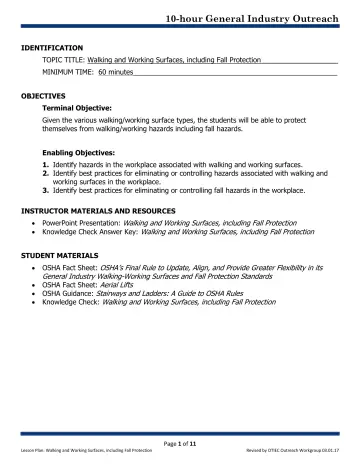
11 slidesWalking and Working Surfaces: Lesson Plan (OSHA 10-Hour General Industry Outreach)
Instructor lesson plan (objectives, timing, teaching steps) for the OSHA General Industry walking and working surfaces outreach deck.
U.S. Department of Labor, OSHA (with the OTIEC Outreach Workgroup)Public domain
pdf
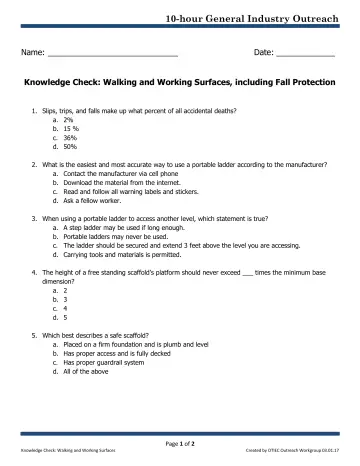
2 slidesWalking and Working Surfaces: Knowledge Check (OSHA 10-Hour General Industry Outreach)
Student knowledge-check quiz for the OSHA General Industry walking and working surfaces outreach deck.
U.S. Department of Labor, OSHA (with the OTIEC Outreach Workgroup)Public domain