One module of a small-business course on preventing slips, trips and falls. An archived deck: check it against the current standard before teaching from it.
Slide text
· 36 slides · by National Safety Council
The words on each slide as the author wrote them, read from the file by software so they can be searched. Layout, pictures and tables are not shown here: the slides above and the download are the original.
- Slide 1
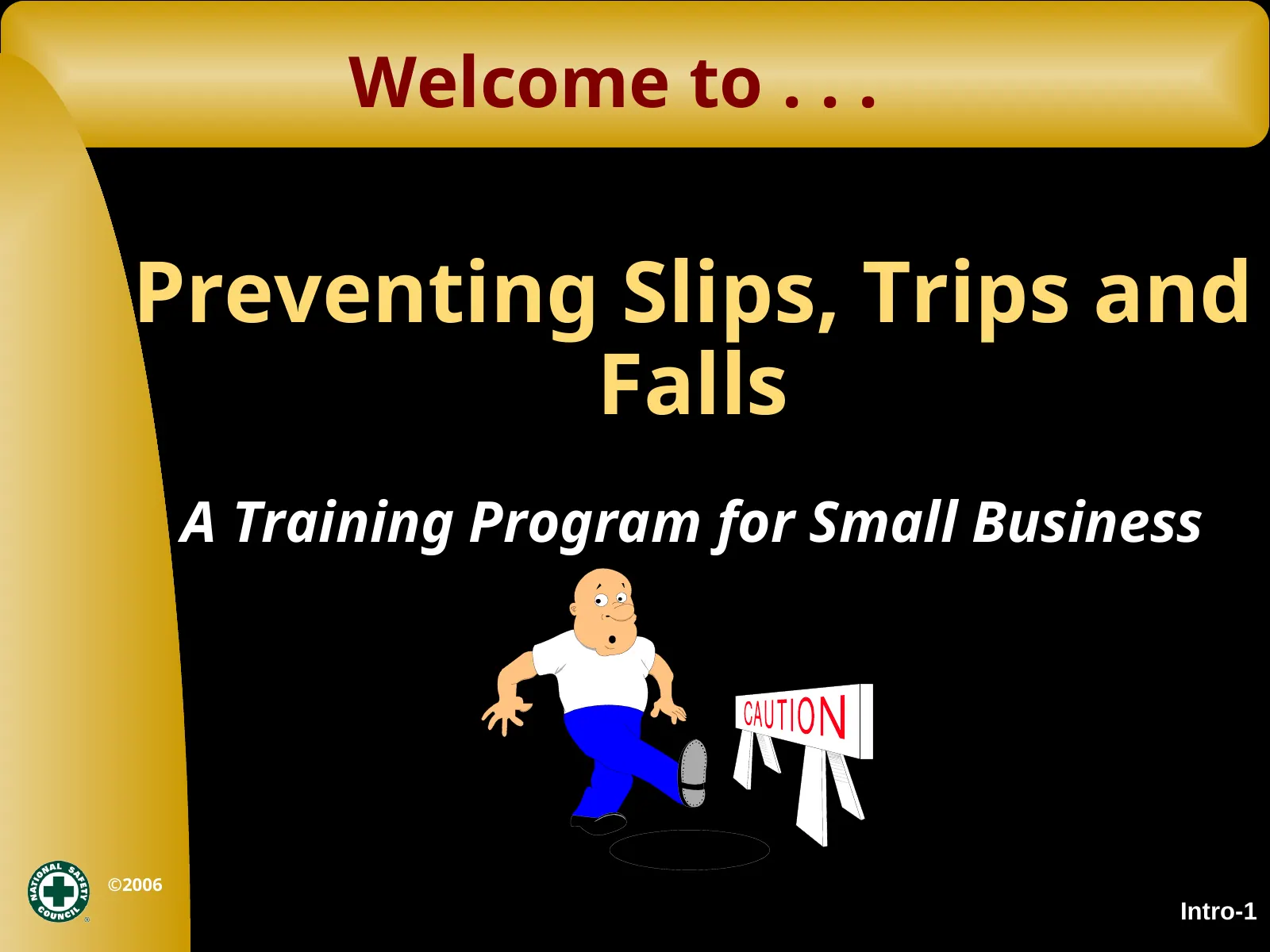
Preventing Slips, Trips and Falls
- Welcome to . . .
- A Training Program for Small Business
- Intro-1
- Slide 2
Course Information
- Emergency evacuation procedures Starting and ending times
- Breaks and lunch
- Smoking policy
- Location of rest rooms, break room, telephones, emergency exits
- Intro-2
- Slide 3
Course Information—Continued
- Electronic devices
- Messages
- Medical concerns
- Participation
- Intro-3
- Slide 4
- The Mission
- of the
- National Safety Council
- . . . is to educate and
- influence people to prevent accidental injury and death.
- Intro-4
- Slide 5
Introduction
- Name
- Where you work
- What you do
- Common slip, trip or fall
- Intro-5
- Slide 6
Learning Goal
- What is your learning goal?
- Intro-6
- Slide 7
Program Goals
- Identify the impact of slips, trips and falls on your workplace.
- Recognize the various types of slips, trips and falls.
- Recognize the OSHA regulations and other industry standards relating to slips, trips and falls.
- Recognize the slip, trip and fall hazards at your workplace.
- Intro-7
- Slide 8
Program Goals—continued
- Conduct a baseline slip, trip and fall evaluation of your workplace.
- Select controls for your organization relating to slips, trips and falls.
- Identify actions you can take to prevent slips, trips and falls when you return to your job.
- Intro-8
- Slide 9
Program Agenda
- Program Introduction
- Module 1:
- Introduction to Preventing Slips, Trips and Falls
- Module 2:
- Recognizing Slip, Trip and Fall Hazards
- Module 3:
- Evaluating Slip, Trip and Fall Hazards
- Module 4:
- Controlling Slips, Trips and Falls Module 5:
- Action Planning and Using Program Materials in Your Business
- Intro-9
- Slide 10
Module 1
- Introduction to Preventing Slips, Trips and Falls
- Slide 11
Objectives
- After completing this module, you will be able to:
- Identify the impact of slips, trips and falls on the workplace.
- Recognize key slip, trip and fall terminology.
- Recognize OSHA regulations and other standards relating to slips, trips and falls.
- Identify the various types of slips, trips and falls.
- State the three components of effective trip, slip and fall prevention.
- Slide 12
Test Your Slip, Trip and Fall IQ
- Take the quiz to determine your knowledge of slip, trip and fall facts.
- Slide 13
Did You Know
- 274,310 occupational injuries were caused by slips, trips and falls in 2004.
- Slide 14
Did You Know
- 793 occupational deaths were caused by falls in 2004.
- Slide 15
Did You Know
- In the year 2004, a median of . . .
- 14 work days were lost due to
- falls to a lower level.
- 9 work days were lost due to
- falls on the same level.
- 7 work days were lost due to
- slips and trips.
- Slide 16
Did You Know
- In the years 2002-2003 . . .
- The average workers’ compensation cost for a slip/trip/fall was $20,228 .
- Slide 17
Did You Know
- In the years 2002-2003 . . .
- The average incurred workers’ compensation cost per trip/slip/fall exceeded the average cost of other injuries by 14%.
- Slide 18
Definitions
- Loss of balance when there is too little friction between the foot and the floor
- Tr i p
- S li p
- Loss of balance when the foot collides with, strikes or hits an object in its
- path
- Slide 19
Definitions
- Fall
- To move downward, typically rapidly and freely, from a higher to a lower level
- Slide 20
Definitions
- The resistance between the shoe and the walking surface
- The resistance that one surface or object encounters when moving over another
- Slide 21
Definitions
- Tr
- y g lo
- The study of friction
- Tr i b
- An instrument for measuring friction in sliding
- om
- ete
- Slide 22
Definitions
- Foot C
- The amount of light or brightness that a birthday cake candle generates from a distance of one foot
- Slide 23
Definitions
- Lumen
- A measurement that is equal to one foot candle falling on one square foot of area
- Slide 24
- Definitions
- The relative force that resists the tendency of a shoe or foot to slide along a floor
- H on
- Tr
- Res Slip
- ista
- nce
- Amount of walkway slip resistance often associated with preventing a slip, trip or fall
- Slide 25
Definitions
- Coefficient of Friction
- A measurement that indicates how slippery a floor is under dry conditions
- Slide 26
Examples of COF
- If it takes 6 pounds of force to move a 10 pound object, then:
- 6 (horizontal force)
- 10 (vertical force)
- the coefficient of friction (COF) is 0.6. This is considered by floor experts to be a safe rating.
- Slide 27
Examples of COF
- If it takes 2 pounds of force to move a 10 pound object, then:
- 2 (horizontal force)
- 10 (vertical force)
- the COF is 0.2. This is considered by floor experts to be an unsafe, slippery rating.
- Slide 28
Examples of COF
- If it takes 15 pounds of force to move a 10 pound object, then:
- 15 (horizontal force)
- 10 (vertical force)
- the COF is 1.5. As this illustrates, it is possible to have a COF of over
- 1.0, but it is rare and considered to be a trip hazard.
- Slide 29
Two Types of COF
- Static Coefficient of Friction— the force required to initiate relative motion between an object and a surface it is resting on
- Dynamic Coefficient of Friction —the force required to keep a sliding object in motion once sliding has begun
- Slide 30
Regulations and Standards
- OSHA Regulatory Requirements
- Voluntary Consensus Standards
- NFSI
- ANSI
- ASTM
- NFPA
- Individual State Building Codes
- Slide 31
Applying the Standards
- Become familiar with the standards, especially OSHA sub-part D.
- Set a goal to learn the standards one at a time.
- Target areas that you want to improve, then learn the related standard.
- Use the Internet to do more research. Rely on your contractors, vendors and insurance company for assistance.
- Slide 32
Activity Directions
- 1. Identify two types of slips, trips
- or falls from Page 9.
- 2. Identify one or two related
- actions you can take to improve in that area.
- Slide 33
Slip, Trip and Fall Prevention
- Slide 34
Slip, Trip and Fall Prevention
- Slide 35
Slip, Trip and Fall Prevention
- Slide 36
Action Plan
- Action
- Potential Barriers
- Overcoming the Barriers