1 / 26Use ← → to flip
Preventing Slips, Trips and Falls: Module 1
Slips, trips and falls module 1 from Harper College: causes, housekeeping and walking surfaces.
Slide text
· 26 slides · by William Rainey Harper College
The words on each slide as the author wrote them, read from the file by software so they can be searched. Layout, pictures and tables are not shown here: the slides above and the download are the original.
- Slide 1
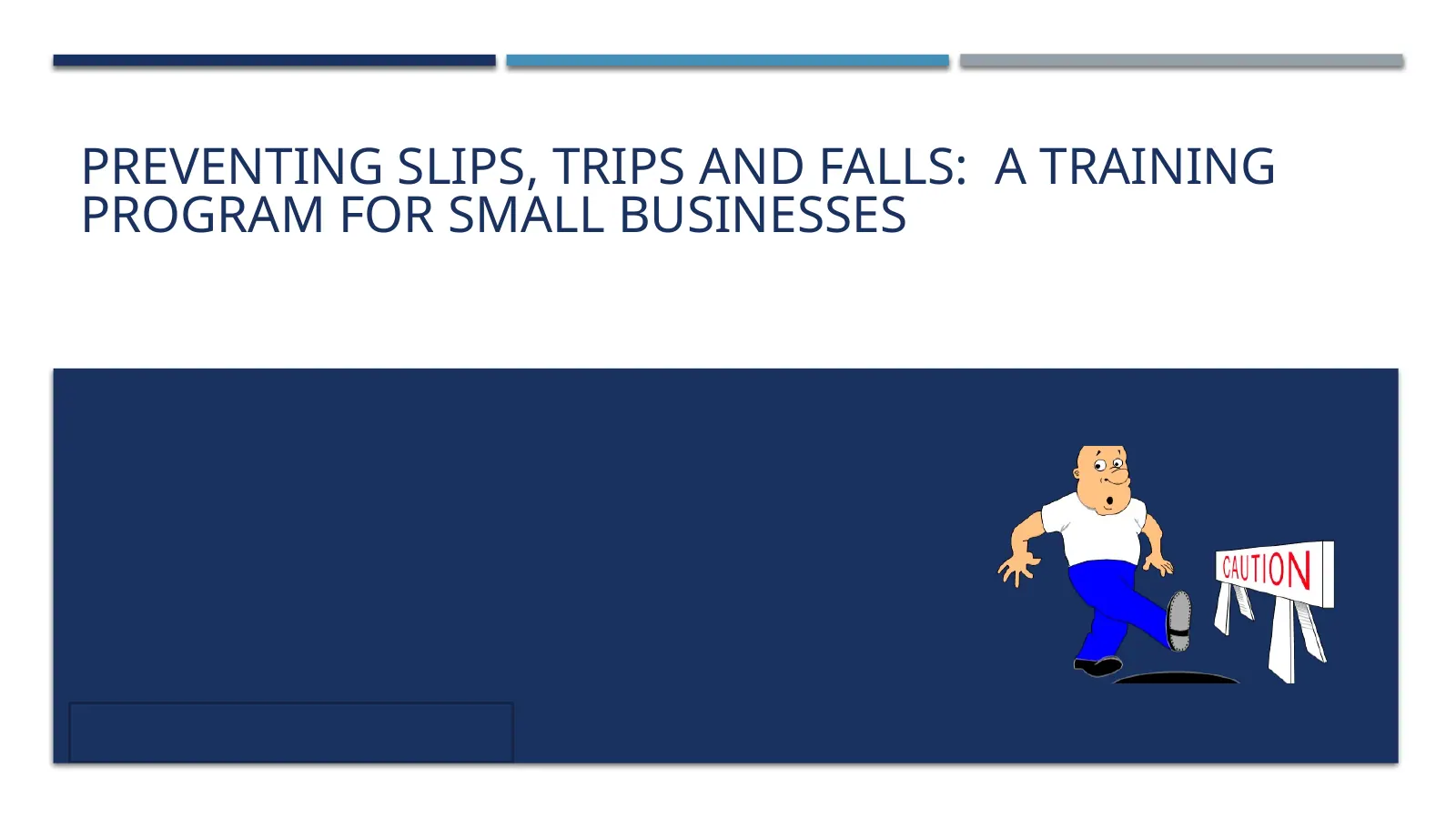
PREVENTING SLIPS, TRIPS AND FALLS: A TRAINING PROGRAM FOR SMALL BUSINESSES
- Slide 2
GRANT INFORMATION
- The free safety awareness training for small businesses, is funded by the Susan
- Harwood grant
- Originally produced under grant number 46EO-HT10 by the National Safety Council, 2006
- Harper College grant number SH05064-SH8, 2019
- Disclaimer: This material was produced under grant number 46EO-HT10 by the National Safety Council and revised under SH-05064-SH8 from the Occupational Safety and Health administration, U.S. Department of Labor. It does not necessarily reflect the views or policies of the U.S. Department of Labor, nor does mention of trade names, commercial products, or organizations imply endorsement by the U.S. government.
- Slide 3
COURSE INFORMATION
- Emergency evacuation procedures and emergency exits
- Location of rest rooms and classroom phone
- Course starting and ending times
- Break
- Campus Smoking policy
- Please silent all electronic devices
- Medical Concerns
- Participation
- Slide 4
PROGRAM AGENDA
- Program Introduction
- Module 1: Introduction to Preventing Slips, Trips and Falls
- Module 2: Recognizing Slip, Trip and Fall Hazards
- Slide 5
PROGRAM GOALS
- Identify the impact of slips, trips and falls in your workplace
- Distinguish the various types of slips, trips and falls
- Know the OSHA rule, regulations and other industry standards relating to slips, trips and falls
- Recognize the slip, trip and fall hazards at your workplace
- Conduct a baseline slip, trip and fall evaluation of your workplace
- Select controls for your organization relating to slips, trips and falls
- Identify actions you can take to prevent slips, trips and falls when you return to your job
- Slide 6
INTRODUCTION
- Name
- Where you work
- What you do
- Common slips, trips and falls
- Slide 7
LEARNING GOAL
- What is your learning goal?
- Slide 8
- MODULE 1: PREVENTING SLIPS, TRIPS AND FALLS: A FREE TRAINING PROGRAM FOR SMALL BUSINESSES
- INTRODUCTION TO PREVENTING SLIPS, TRIPS AND FALLS
- Slide 9
OBJECTIVES
- After completing this module, you will be able to:
- Identify the impact of slips, trips and falls in the workplace
- Know key slip, trip and fall terminology
- Recognize OSHA rules and regulations and other standards relating to slips, trips and falls
- State the three (3) components of effective slip, trip and fall prevention
- Slide 10
TEST YOUR SLIP, TRIP AND FALL IQ
- Take the quiz to determine your knowledge of slip, trip and fall facts
- Slide 11
BE FREE FROM RETALIATION
- Workers have the right to be free from retaliation for exercising safety and health rights
- Workers have a right to seek safety and health on the job without fear of punishment
- This right is spelled out in Section 11(c) of the OSH Act https://www.osha.gov/laws-regs/regulations/standardnumber/1977/1977.3
- Whistleblower information can be found at the following link and fact sheet
- https://www.whistleblowers.gov/ https://www.osha.gov/OshDoc/data_General_Facts/whistleblower_rights.pdf
- Workers have 30 days to contact OSHA if they feel they have been punished for exercising their safety and health rights
- Slide 12
WORKERS’ RIGHTS
- Know your rights.
- To learn more visit: osha.gov/workers
- OSHA Workers’ Safety and Health Rights on the job
- Slide 13
WHY IS OSHA IMPORTANT TO YOU?
- 5,147 workers were killed on the job in 2017
- 4.5 million work related injuries in 2017
- Cost $161.5 billion in 2017
- Slide 14
DID YOU KNOW?
- There were 882,730 occupational injuries and illnesses in 2017 that resulted in days away from work in the private industry, essentially unchanged from 2016.
- 227,716 occupational injuries were caused by slips, trips and falls in 2017.
- 697 occupational deaths were caused by falls in 2016.
- There were 882,730 occupational injures and illnesses in 2017 that resulted in days away from work in the private industry, essentially unchanged from 2016.
- Slide 15
IN THE YEAR 2017, A MEDIAN OF …
- 12 work days were lost due to falls to a lower level
- 9 work days were lost due to falls on the same level
- 9 work days were lost due to slips and trips
- Slide 16
- IN THE YEARS 2016 – 2017 ….
- The average incurred workers’ compensation cost per slip, trip and fall exceeded the average cost of other injuries by 15%.
- Slide 17
SLIP, TRIP, AND FALL DEFINITIONS
- Slip: Loss of balance when there is too little friction between the foot and the floor.
- Trip: Loss of balance when the foot collides with, strikes or hits and in its path.
- Fall: To move downward, typically rapidly and freely, from a higher to a lower level.
- Slide 18
FRICTION DEFINITIONS
- Friction: The resistance that one surface or object encounters when moving over another. The resistance between the shoe and the walking surface.
- Tribology: The study of friction.
- Tribometer: An instrument for measuring friction in sliding.
- Slide 19
SLIP RESISTANCE AND HIGH TRACTION DEFINITIONS
- Slip Resistance: The relative force that resists the tendency of a shoe or foot to slide along a floor.
- High Traction: Amount of walkway slip resistance often associated with preventing a slip, trip or fall.
- Slide 20
REGULATION 1910 OSHA SUBPART D, FINAL RULE, FACT SHEET AND OSHA PUBLICATIONS
- The Standard Regulation1910 OSHA Subpart D, Walking and Working Surfaces:
- https://www.osha.gov/laws-regs/regulations/standardnumber/1910
- Final Rule on the General Industry Walking-Working Surfaces and Fall Protection Standards:
- https://www.osha.gov/walking-working-surfaces/
- Fact Sheet:
- https://www.osha.gov/Publications/OSHA3903.pdf
- OSHA Website publications can be found at:
- https://www.osha.gov/pls/publications/publication.html
- Slide 21
ADDITIONAL REGULATIONS AND STANDARDS
- OSHA Regulatory requirements https://www.osha.gov/laws-regs
- Individual State Building Codes
- Voluntary Consensus Standards
- National Fall Safety Institute (NFSI): https://nfsi.org/
- American National Standards Institute (ANSI): https://www.ansi.org/
- American Standard for Testing Materials (ASTM): https://www.astm.org/
- National Fire Protection Association (NFPA): https://www.nfpa.org/
- Slide 22
APPLYING THE STANDARDS
- Become familiar with the standards, especially OSHA Subpart D.
- Set a goal to learn the standards one at a time.
- Target areas that you want to improve, then learn the related standard.
- Use the Internet to do more research.
- Contact your contractors, vendors and insurance company for assistance and to provide information.
- Slide 23
RECOGNIZE SLIP, TRIP AND FALL PREVENTION
- Slide 24
EVALUATE SLIP, TRIP AND FALL PREVENTION
- Slide 25
CONTROL SLIP, TRIP AND FALL PREVENTION
- Slide 26
ACTION PLAN TEMPLATE
More on Walking-Working Surfaces
pptx
66 slidesWalking and Working Surfaces (OSHA 10-Hour General Industry Outreach)
OSHA's own 10-hour General Industry Outreach deck on walking and working surfaces (v. 03-01-17), editable PowerPoint with trainer notes.
U.S. Department of Labor, OSHA (with the OTIEC Outreach Workgroup)Public domain
pdf
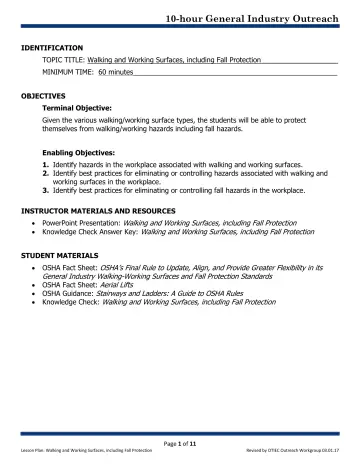
11 slidesWalking and Working Surfaces: Lesson Plan (OSHA 10-Hour General Industry Outreach)
Instructor lesson plan (objectives, timing, teaching steps) for the OSHA General Industry walking and working surfaces outreach deck.
U.S. Department of Labor, OSHA (with the OTIEC Outreach Workgroup)Public domain
pdf
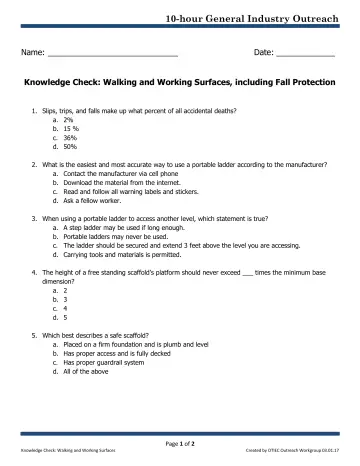
2 slidesWalking and Working Surfaces: Knowledge Check (OSHA 10-Hour General Industry Outreach)
Student knowledge-check quiz for the OSHA General Industry walking and working surfaces outreach deck.
U.S. Department of Labor, OSHA (with the OTIEC Outreach Workgroup)Public domain