1 / 44Use ← → to flip
Construction Internal Traffic Control
Internal traffic control plans for road construction: keeping workers on foot away from moving equipment. From Evergreen Safety Council.
Slide text
· 44 slides · by Evergreen Safety Council
The words on each slide as the author wrote them, read from the file by software so they can be searched. Layout, pictures and tables are not shown here: the slides above and the download are the original.
- Slide 1
Work Zone Employee Safety
- Internal Traffic Control Plans
- This material was produced under grant number SH-31248-SH7 from the Occupational Safety and Health Administration, U.S.
- Department of Labor. It does not necessarily reflect the views or policies of the U.S. Department of Labor, nor does mention of trade names, commercial products, or organizations imply endorsement by the U.S. Government.
- Slide 2
What is an INTERNAL Traffic Control Plan (ITCP)?
- Plan for coordinating the flow of construction vehicles, equipment, and workers operating within the work space
- For improved safety within the work zone
- A typical ITCP addresses
- Parking issues within the work space
- Safe entry and exit of heavy equipment, trucks and workers to and from the work space
- Interactions of heavy equipment, trucks, and on-foot workers
- Slide 3
ITCP Research Recommendations
- 1. Ensure that there is a detailed safety plan
- 2. Daily safety meetings should be conducted
- 3. Spotters should have direct communication
- 4. A crew member should be designated to communicate with the rest of the crew when the paving machine is backing up
- 5. A crew member should be designated to communicate with the rest of the crew
- 6. Truck drivers need instructions on how to enter and exit the work zone
- 7. All others on site should also be made familiar with the ITCP
- 8. For night work, light standards need to be placed
- Slide 4
ITCP Research Recommendations (cont’d)
- 9. All safety vests should be checked for reflectivity for night operations
- 10. Establish desirable operating speeds
- 11. Seat belts should be required for all vehicles
- 12. Establish a specific lock-out, tag-out program for use when servicing the machinery
- Slide 5
Responsibilities Superintendent/ Project Manager
- PRIMARY ROLE:
- OVERSIGHT
- Oversee ITCP
- Implementation
- Ensure Subcontractor
- Coordination and “Buy-in”
- Assign personnel to carry out the plan
- Slide 6
Responsibilities Supervisor and Lead Person
- PRIMARY ROLE:
- IMPLEMENTATION
- Plan and implement the ITCP site
- Responsible for coordination among personnel and subcontractors at the construction site
- Ensure changes are made to ITCP as site conditions change
- Slide 7
Responsibilities of Workers on Foot
- PRIMARY ROLE: UNDERSTAND, COMPLY and CORRECT DEFIENCIES
- Learn the elements of ITCPs and how to comply
- Understand the hazards of working around equipment
- Take responsibility for personal safety; apply safety training lessons
- Slide 8
Responsibilities of Truck Boss
- PRIMARY ROLE:
- COMMUNICATE WITH OTHER DRIVERS
- Share ITCP instruction on where drivers should operate
- Assist in communicating safe site procedures with all truck drivers
- Slide 9
Responsibilities of Truck Drivers
- PRIMARY ROLE: KEEP A SAFE DISTANCE FROM WORKERS ON FOOT
- Receive ITCP instruction on where they should operate
- Receive navigation assistance (spotters) when appropriate
- Never operate into a blind area without checking for pedestrians
- Slide 10
Responsibilities of Equipment Operators
- PRIMARY ROLE: KNOW
- THE LOCATION OF WORKERS ON FOOT
- Do not move until the blind area is checked or a spotter is designated
- Know blind area for equipment you are operating
- Stay out of areas designated for workers on foot
- Do a 360° “walk-around” before moving equipment
- Slide 11
Responsibilities of Spotters
- PRIMARY ROLE: SAFE BACKING
- Ensure operator knows where you are and will be located; make eye contact
- Ensure workers know your responsibilities and wait for permission to enter area
- Receive training in safe spotting procedures and know the signals
- Stay in continuous communication with operator and remain visible at all times
- Slide 12
Conflicting Movements of Trucks, Equipment and Workers
- Minimize conflicting interactions as much as possible
- Separation by space
- Separation by time
- Determine the locations of and design various internal movements
- Entry and exit locations for trucks and equipment
- Truck and equipment routes within work space
- Other activity locations and pedestrian paths (e.g., rest room locations, site office, etc.)
- Slide 13
Conflicting Movements of Equipment
- Separation by space
- Use channelizing devices, such as barriers
- Separate activities (e.g., excavating, grading, staging, etc.)
- Separation by time
- Schedule work with safety in mind
- Arrival and departure of trucks
- Loading and unloading
- Combination of both approaches
- Slide 14
Conflicting Movement of Trucks
- Properly design the elements of internal traffic control that cause conflicts
- Safe entry and exit points
- Speed change lanes
- Deceleration lane
- Acceleration lane
- Turning radius
- Traffic control devices
- Slide 15
Conflicting Movements of Equipment and Workers
- Design of entry and exit points
- Consideration of roadway size and type
- Locations of existing driveways
- Access design and management
- Slide 16
Traffic Flow
- Safety Points
- Vehicle traffic flow is separated from pedestrian traffic.
- Pedestrian worker free areas have been designated.
- Storage locations for material and equipment are designated.
- Worker and visitor parking areas are designated away from vehicular traffic.
- Slide 17
Summary
- Injury potential is extremely high in highway and street construction work zones
- Half of highway and street construction workers are killed by construction trucks and equipment
- Development of Internal Traffic Control Plans is essential for safe operations inside the work space
- It is imperative to eliminate conflicting movements of trucks, equipment and workers
- Most of the construction site hazards also exist inside the work space
- Slide 18
WHY INTERNAL
- TRAFFIC CONTROL?
- Slide 19
ITCPs Protect Workers on Foot
- Workers on foot are those employees who perform most of their duties outside vehicles and equipment. They are particularly vulnerable to being struck by equipment. Every person on the site has the responsibility to be vigilant and work safely.
- Require all workers to wear Hi-viz apparel.
- Slide 20
Two “Struck-By” Hazards
- Workers Killed by Motorists
- Workers Killed by Construction Trucks and Equipment
- MORE WORKERS ARE KILLED BY CONSTRUCTION VEHICLES THAN BY MOTORISTS
- Slide 21
Work Zone Crashes
- Work Zone Crash Frequency
- On average, in 2015:
- A work zone crash occurred once every 5.4 minutes.
- Every day, 70 work zone crashes occurred that resulted in at least one injury.
- Every week, 12 work zone crashes occurred that resulted in at least one fatality.
- Crash Severity
- In 2015 the distribution of work zone crashes by severity included:
- 73.0% (70,499) of work zone crashes were Property Damage Only (PDO).
- 26.4% (25,485) of work zone crashes involved at least one injured party.
- 0.7% (642) of work zone crashes involved at least one fatality
- This distribution is very similar to non-work zone crashes.
- Slide 22
Construction Vehicles are the Greatest Hazard
- Compliance with the MUTCD and OSHA regulations is a necessity
- The interaction between workers on foot and construction trucks and equipment is the single biggest hazard
- There are several hazards workers should be aware of to enable them to protect themselves against work zone hazards
- Slide 23
Vehicles Frequently Enter and Exit
- The constant movement of vehicles can create hazards
- ITCPs can communicate the need to keep entry and exit points free
- Start each day with a risk assessment discussion with workers and subcontractors (including employees)
- Slide 24
Workers on Foot Labor in Close
- Proximity to Large Vehicles
- Note the size of workers on foot in relation to the size of the construction equipment and vehicles.
- Slide 25
Blind Spots
- Blind Spots are the locations around equipment
- Behind the Vehicle
- Outside Mirror Range
- Slide 26
Workers Are Vulnerable in Blind Spots
- Slide 27
Ford 880 Rear Dump Truck
- Content source: National Institute for Occupational Safety and Health Division of Safety Research
- Slide 28
Backhoe Loader
- Content source: National Institute for Occupational Safety and Health Division of Safety Research
- Slide 29
SITUATIONAL AWARENESS – INCIDENT PREVENTION
- Stay focused
- Mind on Task
- Keep your eyes and ears open
- Eyes on Task, Line of Fire, Balance/Traction/Grip
- Identify & assess new hazards as you see them
- Be aware of change and stop to re-assess
- THINK BIG PICTURE
- Communicate with the team and others
- If in doubt stop the job and re-assess
- Slide 30
Key Elements
- Perception
- Gathering or collecting information
- Comprehension
- Interpreting information
- Projection
- Anticipating future status
- Slide 31
What is a “hazard”?
- practice
- condition
- An unsafe ___
- or ___
- injury or ___
- illness
- that could cause an ___
- to an employee.
- How can a person be a walking hazardous condition?
- Slide 32
CONDITIONS
- Mind Sets
- Hurried
- Angry
- Tired
- Complacency
- Mistakes
- Eyes not on task
- Mind not on task
- Line-of-fire
- Balance, traction, grip
- Over 90% of all injuries at home, at work or on the road are caused by these error patterns.
- Slide 33
States of Mind
- Hurried - When you exceed the pace at which you normally perform the task
- Angry - Caused by relationships inside and outside of the workplace
- Tired - Too tired to do the job safely
- Complacency - Familiar enough with the hazards to become considerably less concerned over time
- Slide 34
Eyes not looking at what you are doing
- Not looking where you are going or what is coming your way. Includes not moving your eyes before moving your body or not being able to see where you are stepping, where your hands are reaching into, etc.
- Slide 35
Not thinking of job
- Not concentrating on the job. Being unaware of dangers. Forgetting things, making more errors than usual, going on “auto-pilot”, “drifting away”.
- What time do I get the kids?
- Why can’t I break 100 for 18 holes?
- Slide 36
Standing in the Line-of-Fire
- Being conscious of where you are or where you are going in relation to the direction of the hazard.
- If the driver doesn’t see me, where does the vehicle go?
- Which way will the drunk drive?
- Slide 37
Balance/Traction/Grip
- Doing something that could cause you to lose your balance, traction, or grip. This can include not wearing good footwear/gloves, not having a good grip in the first place, or not seeing or thinking about the hazard.
- Slide 38
Workers Killed by Motorists
- As noted previously, the primary cause of worker deaths in roadway construction is caused by workers being struck by construction vehicles and equipment.
- The second highest cause is workers being struck by motorists or when a vehicle crashes.
- Slide 39
Workers Killed
- Motorists are likely to enter the work space when:
- Workers are not visible to motorists
- Motorists are surprised by the work zone and Temporary Traffic Control set up
- Motorists ignore warnings
- TTCDs are confusing/not compliant
- Slide 40
Motorists Killing Workers
- Motorists are likely to enter the work space when:
- Drivers are distracted or impaired (phones, food, drugs, alcohol, drowsy, etc.)
- Traffic is traveling at high speed through the work zone
- Equipment / work zone lighting
- Slide 41
Risky Worker Behavior
- Workers stray into traffic space
- Preoccupied by work
- Become “comfortable” in dangerous environment
- No convenient access to and from work space
- rest rooms
- food and water
- shade/breaks
- other local work areas
- staging of company and personal vehicles
- Workers cross traffic lanes (especially in high-speed locations)
- Slide 42
How Can We Prevent Deaths Caused by Motorists?
- Temporary Traffic Control Devices Must be Set Up Properly
- Comply with MUTCD or corresponding state document
- Inspect and maintain TTCDs
- Ensure only a qualified person makes necessary modifications
- Create Safe Procedures for Deployment and Retrieval of TTCDs
- Ensure sufficient TTCDs for all parts of the project (ramp geometry, exits, closures, etc.)
- Slide 43
How Can We Prevent Deaths?
- Workers Should Be Aware of TTCDs in their work location.
- Workers should be trained to notify supervisor immediately if devices are:
- Not in proper position
- Damaged or dirty
- Not being observed or recognized by motorists
- Workers may correct misaligned devices if it is safe for them to do so and they understand where the device is supposed to be situated.
- Slide 44
Thank You
- Questions????
More on Struck-By
ppt
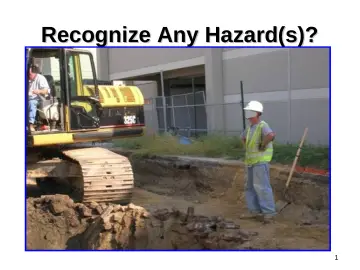
20 slidesFocus Four: Struck-By Hazard Recognition
OSHA's official Construction Focus Four slide deck on struck-by hazards: flying, falling, swinging and rolling objects, vehicles and equipment.
U.S. Department of Labor, OSHAPublic domain
pdf
65 slidesFocus Four: Struck-By Hazards Instructor Guide
OSHA instructor guide/lesson plan for the Focus Four struck-by module.
U.S. Department of Labor, OSHAPublic domain
pdf
7 slidesFocus Four: Struck-By Student Handouts
Student handouts: nail gun safety hazard alert, cranes and rigging focus, PPE for workers checklist.
U.S. Department of Labor, OSHAPublic domain