1 / 123Use ← → to flip
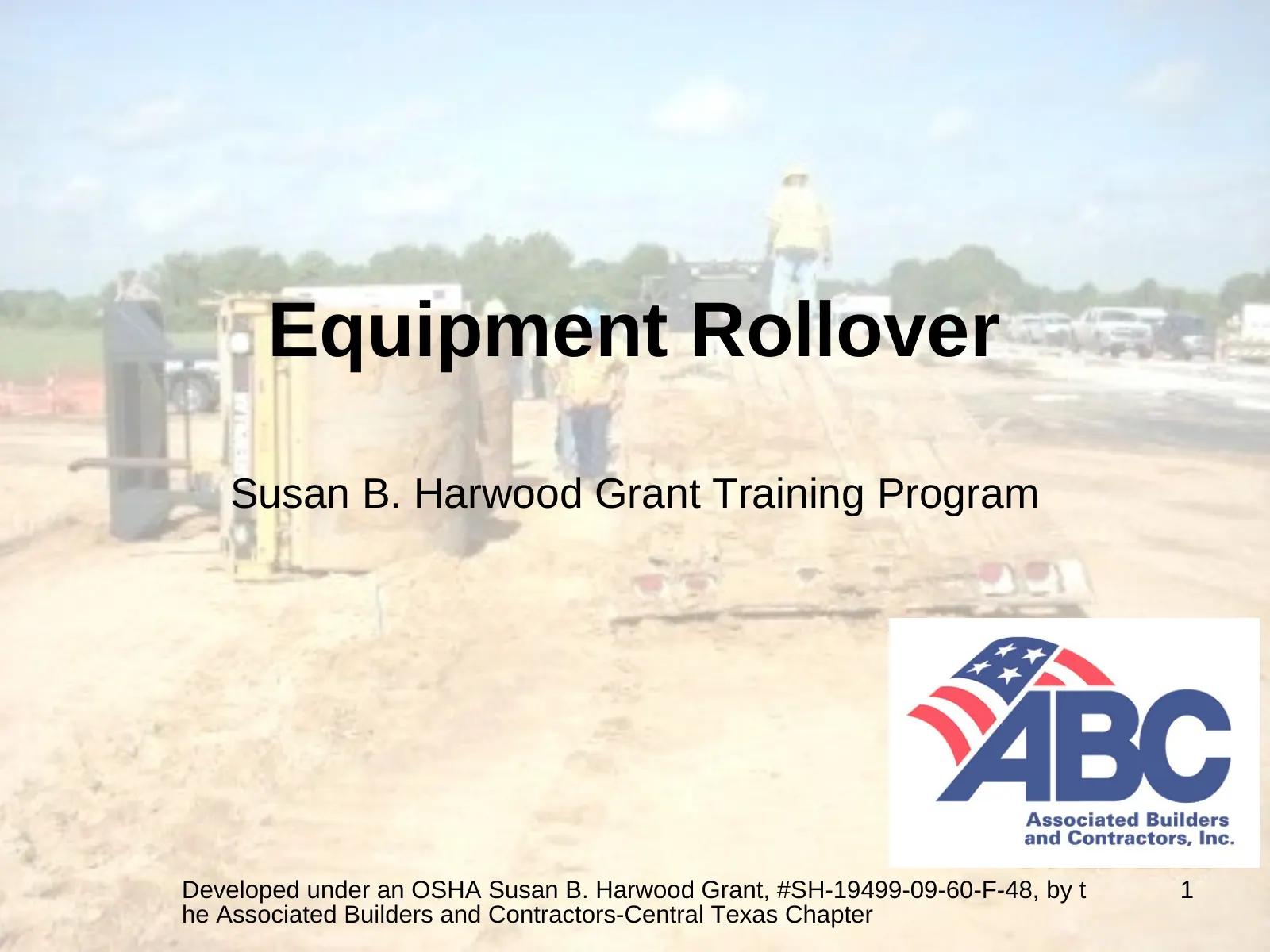
Equipment Rollover
Roller/compactor and heavy equipment rollover and run-over hazards in plain language, from ABC Central Texas (2009).
Slide text
· 116 of 123 slides · by Associated Builders and Contractors, Central Texas Chapter
The words on each slide as the author wrote them, read from the file by software so they can be searched. Layout, pictures and tables are not shown here: the slides above and the download are the original.
- Slide 1
Equipment Rollover
- Susan B. Harwood Grant Training Program
- Slide 2
Equipment Rollover
- Susan B. Harwood Grant Training Program
- Slide 3
Disclaimer/Usage Notes
- Photos shown in this presentation may depict situations that are not in compliance with applicable OSHA requirements.
- It is not the intent of the content developers to provide compliance-based training in this presentation, or to train employees how to operate the equipment depicted. The intent is more to address hazard awareness in the construction industry, and to recognize the overlapping hazards present in many construction workplaces.
- It should NOT be assumed that the suggestions, comments, or recommendations contained herein constitute a thorough review of the applicable standards, nor should discussion of “issues” or “concerns” be construed as a prioritization of hazards or possible controls. Where opinions (“best practices”) have been expressed, it is important to remember that safety issues in general and construction jobsites specifically will require a great deal of site- or hazard-specificity – a “one size fits all” approach is not recommended, nor will it likely be very effective.
- Slide 4
Disclaimer/Usage Notes
- No representation is made as to the thoroughness of the presentation, nor to the exact methods of remediation to be taken. It is understood that site conditions vary constantly, and that the developers of this content cannot be held responsible for safety problems they did not address or could not anticipate, nor those which have been discussed herein or during physical presentation. It is the responsibility of the employer, its subcontractors, and its employees to comply with all pertinent rules and regulations in the jurisdiction in which they work. Copies of all OSHA regulations are available from your local OSHA office, and many pertinent regulations and supporting documents have been provided with this presentation in electronic or printed format. This presentation is intended to discuss Federal Regulations only - your individual State requirements may be more stringent.
- It is assumed that individuals using this presentation or content to augment their training programs will be “qualified” to do so, and that said presenters will be otherwise prepared to answer questions, solve problems, and discuss issues with their audiences.
- Slide 5
Disclaimer/Usage Notes
- As a presenter, you should be prepared to discuss all of the potential issues/concerns, or problems inherent in those photos with the students
- Slide 6
Why Require Training?
- Operator training is required by:
- OSHA
- Manufacturers
- Clients
- Employers
- Slide 7
Why Is Training Needed?
- OSHA investigated two fatal accidents in 2005 in southern Colorado involving the rollover of pneumatic rubber-tired roller/compactors
- Slide 8
Accident #1
- May 2005
- Employee was fatally injured while operating a pneumatic rubber-tired roller
- Slide 9
Accident #1
- Roller ran off the road and traveled down a 22-degree embankment
- Rolled over 1½ times, stopped on its top
- Operator was thrown from the machine
- Fatally crushed between the machine and ground
- Slide 10
Accident #1
- Roller was originally equipped with a ROPS and a seatbelt
- Both had been removed prior to the accident
- Slide 11
Accident #2
- August 2005
- Employee was rolling material into the gravel using a pneumatic rubber-tired roller
- Slide 12
Accident #2
- Roller ran off the road and down a 28-degree embankment
- Compactor rolled onto its side and came to a stop
- Operator was thrown from the machine and fatally crushed
- Roller was not provided with a ROPS, operator not wearing a seatbelt
- Slide 13
Summary of Accidents
- In both cases,
- If the machine had been equipped with a ROPS system, and
- If the operator had been wearing a seatbelt,
- The operator’s survival would have increased significantly
- Slide 14
Additional Accidents
- Between 2000 and 2006
- OSHA investigated over 50 rollover incidents
- Slide 15
Total Cases Fatal Cases
- 6 6
- ROPS/Seat ROPS/No
- Belt
- Seat Belt
- 1 1
- ROPS
- Removed
- No ROPS
- Slide 16
Roller Compactor Safety
- Always be aware that a rollover hazard exists
- ROPS and seatbelts ALWAYS reduce the risk of a fatality
- Highest hazard locations were roadway or embankment edges
- Slide 17
Roller Compactor Safety
- When operating on uneven surfaces, chances of a rollover increase
- Another hazard was runaway machines, typically down slopes
- Evaluate roadways and work surfaces for dangerous inclines/declines
- Slide 18
ROPS
- A ROPS is a protective frame mounted on the machine and extends above the operator’s seat
- ROPS bear the weight of the machine during a rollover event
- ROPS minimize the likelihood that the machine will overturn completely
- Slide 19
ROPS
- A principle in ROPS design is to restrict the overturn to 90 degrees
- ROPS must to be used in combination with a seatbelt
- A ROPS only provides protection if the operator remains in the seat
- Slide 20
Roller Compactor Safety
- A number of hazards associated with rollovers were pointed out, including:
- Working near road edge or embankment was the most hazardous
- The second most hazardous were steep slopes and roadway curves
- Problems with gear-shifting and brakes resulted in runaways
- Source: Compactor Overturns and Rollover Protective Structures
- Slide 21
Roller Compactor Safety
- Compacting soil appeared to be more hazardous than other operations
- Hazards included the soil edges and soft soil pockets that could drop under the weight of the unit.
- Slide 26
Compactor Roller Safety
- Loading and unloading machines onto trailers posed a potential overturn hazard
- Hazards were caused by
- skidding on the ramps,
- using wood blocks or planks as ramps,
- or a machine that was too narrow to span both sides of the ramp
- Slide 27
What is this in the background?
- Slide 31
Need for ROPS
- Studies show that if the machines involved are equipped with ROPS, and if the operators are wearing seatbelts, the operator’s survival increases significantly
- Slide 32
Regulations
- OSHA does not have a standard requiring the use ROPS or seatbelts
- OSHA’s position is that the hazard of equipment rollover is a “recognized hazard” within the meaning of the General Duty Clause of the OSH Act
- Slide 33
General Duty Clause
- (a) Each employer --
- (1) shall furnish to each of his employees employment and a place of employment which are free from recognized hazards that are causing or are likely to cause death or serious physical harm to his employees;
- (2) shall comply with occupational safety and health standards promulgated under this Act
- Slide 34
General Duty Clause
- (b) Each employee shall comply with occupational safety and health standards and all rules, regulations, and orders issued pursuant to this Act which are applicable to his own actions and conduct
- Slide 35
Other Regulations
- 29 CFR 1926.20(b)(4), states “the employer shall permit only those employees qualified by training or experience to operate equipment and machinery.”
- Slide 36
Other Regulations
- 29 CFR 1926.21(b)(2), “Safety training and education,” states further that “the employer shall instruct each employee in the recognition and avoidance of unsafe conditions….”
- Slide 37
Compactor Roller Safety
- Employers performing construction work are required to ensure that their operators are trained;
- To use the equipment properly and
- To understand how to recognize those situations and conditions that pose a rollover hazard
- Slide 38
Compactor Roller Safety
- For example, operators need to understand that:
- Soft edges can cause one side of the equipment to sink and therefore may pose a risk of rollover;
- Turning away from a slope with articulated steering can destabilize the compactor;
- Slide 39
Compactor Roller Safety
- Improperly inflated tires can destabilize roller/compactors; and
- Rain or wet conditions can pose a hazard during unloading and loading
- and can increase the possibility of rollovers near embankments as soil conditions become unstable
- Slide 40
Roller Compactor Safety
- Leaving a compactor vibrator engaged while stationary has led to the settling of soil on one side of the unit, allowing it to overturn
- Articulation of a mobile unit with the jackknife pointed toward an edge presents a substantial overturn hazard
- Slide 41
Roller Compactor Safety
- Remember to always think safety, the life you save may be your own
- Always use ROPS and seat belts
- Now we will review as well as discuss proper procedures for operating your machine
- Slide 42
Safety is Important
- Three reasons Safety is important :
- Accidents can cause death or serious injuries, or disability,
- Accidents can cost both you, and your employer
- With proper training, and with Machine Operators making it their responsibility to work safely, accidents can be prevented
- Slide 43
Safety Alerts
- The Safety Alert
- Symbol is used to;
- Identify
- important safety messages
- Alert you to the possibility of injury or death
- Slide 44
Safety Alerts
- Follow the instructions in the safety message to prevent injury to yourself or others
- Slide 45
Manufacturer’s Manual
- States that you must be qualified and authorized to operate the machine
- YOU must
- understand the manufacturers instructions
- be trained
- demonstrate the actual operation of the machine
- know the safety rules and regulations
- Slide 46
Signal Words
- DANGER - indicates an imminently hazardous situation that will result in death or serious injury
- WARNING –indicates a potentially hazardous situation which could result in death or serious injury
- CAUTION –indicates a potentially hazardous situation that may result in minor or moderate injury
- Slide 47
A Word to the Operator
- Remember that Safety is up to YOU, only YOU can prevent serious injury or death
- Slide 48
Follow a Safety Program
- Protect yourself by wearing the appropriate PPE
- Hard hats, safety glasses, hearing protection
- WARNING! – Do not wear loose fitting or dangling clothes
- Be Careful
- Encourage those around you to act safely
- Slide 49
Safe Operation
- Drugs or alcohol use can change your alertness or coordination
- Consult with your medical advisor if you are taking prescription or over-the-counter medication
- Ensure you can safely operate the machine
- Check the label for warnings against operating machinery
- Slide 50
Know the Safety Rules
- Your employer on the job site will have rules on the proper operation of equipment
- Check with your supervisor or safety coordinator to learn the rules for your job site
- Slide 51
Safety Rules for Compactors
- Know how to operate the Machine, and the characteristics of the machine
- Never modify or remove part of the machine
- Always fasten your seat belt
- Keep other workers out of the work area
- Slide 52
Safety Rules for Compactors
- Lower the blade and all other hydraulic attachments (if equipped) to ground.
- Know the proper shut down procedure for your specific machine as this can vary from different types and models of machines
- Remove your key to keep unauthorized people from operating the machine
- Slide 53
Job Site Traffic
- You must know the rules covering traffic at your job site,
- Understand what the signs, flag signals, and markings mean,
- Know what hand, horn, whistle, siren or bell signals mean
- Use your lights, turn signals, flashers and horn
- Slide 54
Know Your Equipment
- Know how to operate the equipment on your machine
- Know the purpose of the controls, gauges, and indicators
- Speed range, braking and steering characteristics
- Know the turning radius, and operating clearances
- Slide 55
Know Your Equipment
- Rain, snow, ice, loose dirt or gravel, soft ground all change the operating capabilities of your machine
- Study the DANGER, WARNING and CAUTION signs and decals on your machine
- Slide 56
Operator’s Manual
- Study and know the manufacturer’s operations manual before starting the machine
- If there is no manual with the machine – Get One
- Ask your supervisor to explain anything that you do not understand
- Slide 57
Operator’s Manual
- If your machine is equipped with other devices,
- Read the manufacturer’s operating and safety manuals that apply to that equipment BEFORE you use the device
- Slide 58
Preparation for Use
- Check the safety equipment
- Seat Belt/Operator Restraints
- Lights
- Safety Signs/Decals
- Horn
- Back-Up Alarm
- Mirrors
- First Aid Kit
- Fire Extinguisher
- Slide 59
Preparation for Use
- Falling Object Protective Structure (FOPS)
- Roll-Over Protective Structure (ROPS)
- WARNING – NEVER remove a FOPS or ROPS structure except for service
- Slide 60
Preparation for Use
- Check the machine each day before use
- Check for broken, missing or damaged parts
- Have necessary repairs made before using
- Check Pneumatic tires (if so equipped) for cuts, bulges and correct pressure
- Replace badly worn or damaged tires
- Slide 61
Preparation for Use
- Check the machine each day before use
- Check the service and parking brakes
- Perform all maintenance procedures
- Check the hydraulic system
- Fix any leaks
- Slide 62
Preparation for Use
- WARNING – Diesel fuel or hydraulic fluid under pressure can penetrate the skin or eyes and cause serious injury
- Never use your hand to find leaks
- Wear a face shield or goggles
- Use a board or cardboard to find leaks
- Slide 63
Preparation for Use
- Check the cooling system
- WARNING – Allow the radiator to cool before checking the level
- Slide 64
Preparation for Use
- Before operating check that the steering frame lock on articulated machines has been removed
- WARNING – An articulated machine cannot be steered with a steering frame lock in place
- Slide 65
Preparation for Use
- If you find an item that needs repair during your daily inspection
- report it to your supervisor and tag the machine on the start switch or other location where it will be noticed.
- You should never operate a machine that isn’t in safe working condition.
- Slide 66
Preparation for Use
- Clean up the machine
- Windshields
- Mirrors
- All lights
- Steps and hand holds
- Remove personal items from the operators area
- Slide 67
Preparation for Use
- Use caution when fueling
- Never overfill or spill fuel
- Ground the fuel nozzle to the filler neck
- Use the correct fuel
- WARNING – Never fill when the engine is running, and never smoke while fueling up.
- Slide 68
Preparation for Use
- Know the work area:
- Inspect the Conditions of area you will be working for conditions that could be dangerous:
- Drop-offs or other obstacles
- Holes, obstructions, mud or ice
- Heavy traffic
- Thick dust, smoke or fog
- Slide 69
Preparation for Use
- When operating inside a building know your clearances
- Overhead
- Doorways
- Aisles
- Weight limitations of floors and ramps
- Slide 70
Preparation for Use
- For Landfill Compactors:
- Perform frequent checks for wire or other material wound around the axles and remove them as soon as possible,
- Travel with the blade in the low position and,
- Make sure you maintain good visibility by keeping windows free of materials that could interfere with visibility.
- Slide 71
Preparation for Use
- While operating Machine:
- Approach intersections with caution
- Observe speed limits and traffic signs
- Know your stopping distance
- Avoid panic stops and sharp turns
- Slide 72
Preparation for Use
- While operating Machine:
- Stop and clear all railroad crossings
- Never park in traffic areas
- Use appropriate lights at night
- Pull off the road and set up barricades when parking at night
- Slide 73
Preparation for Use
- If the machine will be driven over the road
- Use hand signals or turn signals when turning
- Slide 74
Starting Safely
- Mount the loader safely:
- When you get on or off the machine:
- Maintain 3 point contact with the steps and hand holds
- Face the machine
- Never jump on or off the machine
- Slide 75
Starting Safely
- Mount the Roller Compactor safely:
- When you get on or off the machine:
- Never attempt to mount/dismount a moving machine
- Do not use the steering wheel or any control lever as a hand hold
- Slide 76
Starting Safely
- Warn personnel before starting:
- Before starting, walk completely around the machine
- Make sure no one is under the machine servicing it, or close to it
- Let other workers know you are starting the machine
- Slide 77
Starting Safely
- WARNING – Start the machine from the operators seat only
- Never by-pass neutral-start circuits by jumping the starter terminals
- The machine may start in gear and injure or kill you or someone else if started in gear
- Slide 78
Starting Safely
- Know the starting procedure for your machine:
- Sit in the seat and adjust it so you can operate all controls properly
- Fasten the seat belt
- Engage the parking brake, put controls in neutral
- Slide 79
Starting Safely
- Know the starting procedure for your machine:
- Familiarize yourself with warning devices, gauges and operating controls
- Clear the area of all persons
- Start the engine
- Slide 80
Starting Safely
- WARNING – Exhaust fumes can kill
- Be positive there is adequate ventilation while operating
- Slide 81
Starting Safely
- Jumper cables
- Follow instructions on proper use of jumper cables
- Operator must remain in seat to control machine
- Jump starting is a two-person operation
- Slide 82
Starting Safely
- Ether Starting Fluid
- Ether is highly flammable and explosive
- Read the instructions on the container and in the manufacturer’s manual.
- Do NOT use ether if the machine has a pre-heater
- Slide 83
Starting Safely
- After Starting the Engine
- Observe gauges, instruments and warning lights
- Run an operating check
- Do not use a machine that is not in proper operating condition
- It is the OPERATOR’S RESPONSIBILITY to check the condition of the machine
- Slide 84
Starting Safely
- Test the Controls
- Make sure the machine is operating correctly
- Put machine in neutral, test the engine speed control
- Operate each control lever for proper function
- Slide 85
Starting Safely
- Test the Controls
- Operate the shift controls to ensure forward, neutral and reverse operate correctly
- Check the parking and service brake systems
- Test steering while moving slowly
- Slide 86
Starting Safely
- Test the Controls
- WARNING – Be certain you can control both speed and direction before moving the machine
- Slide 87
Working Safely
- Stay in the operator’s seat at all times
- Keep your seat belt fastened when you drive or operate the Roller Compactor
- Be in control of your machine at all times
- Assure yourself that the work area is clear of other persons
- Look and listen for malfunctions
- Stop if a malfunction is detected
- Do not use the machine as a ram
- Slide 88
Working Safely
- Never allow an untrained or unqualified person to operate your machine WARNING – Your Roller Compactor is a one-person machine, NEVER permit riders
- Slide 89
Working Safely
- If operating Machine on road make sure you use appropriate warning signs and emblems “Slow moving vehicle”
- Look before you back up, and make sure backup horn is working properly
- Know the pinch points and rotating parts on the machine
- Slide 90
Working Safely
- Traveling on the job site
- Take it slow and easy
- Watch out for congested areas
- Give the right-of-way to loaded machines
- Maintain a safe distance from other machines
- Pass cautiously
- Slide 91
Working Safely
- Don’t obstruct your vision when traveling
- Operate slow enough to have complete control at all times
- Travel slowly on rough, slippery ground or hillsides
- Avoid operating your machine too close to an overhang, deep ditch, or hole
- Always use service and parking brakes carefully
- Slide 92
Working Safely
- Stay in gear when traveling downhill, never shift into neutral
- Maintain engine RPM to provide steering and braking
- Use the same gear traveling down that you would use travel up a hill
- Follow manufacturer’s manuals on brake use
- Slide 93
Working Safely
- Extreme caution should be used when working along the top of a bank or slope
- Keep away from the edge
- Always look back when backing up
- Be extremely alert in hazardous areas
- Always be alert for low branches and dead trees
- Slide 94
Working Safely
- Before entering buildings, underpasses, tunnels or bunkers check for hazards or obstructions
- Check clearance height
- Avoid turning on an incline
- Use extreme caution and make the turn wide and SLOW
- Slide 95
Working Safely
- When in dust, smoke, or fog use extreme caution
- Keep speed to a minimum when visibility is poor
- Slide 96
Working Safely
- Keep the work area flat and level if possible
- Be aware of potential caving edges and,
- Always travel slowly over rough terrain or avoid it and go around it
- Slide 97
Working Safely
- WARNING – Never enter or allow anyone else to enter the Roller Compactor swing pivot area,
- Death or serious injury can result
- Always make sure you follow the manufacturer’s recommendations before you operate the Roller Compactor
- Slide 98
Working Safely
- WARNING – Never operate the controls from the ground
- Severe injury or death can result
- Always operate the Roller Compactor from the correct operating position
- Slide 99
Working Safely
- When operating your Machine on the road:
- Know your stopping distance at whatever speed you’re going
- NEVER turn corners at high speeds
- Always look in all directions before you travel forward or reverse
- Slide 100
Working Safely
- Never operate Machine when extremely tired:
- Your response time will be slower
- Your judgment will be impaired
- Remember Safety is your responsibility
- Slide 101
Working Safely
- Be Aware of :
- Trenches that may be to close to your
- Vibratory Compactor, as it could cause a collapse
- Buildings and Light Poles that might be to close to where your Vibratory Compactor is operating as damage may occur
- Always be sure workmen and others are far enough away to avoid injury
- Slide 102
Working Safely
- WARNING – Always remember that regardless of how heavy or stable your machine may feel or appear to you, there is always a chance of a rollover when working on steep slopes
- Always wear your seatbelt and make sure your ROPS is on your machine
- Slide 103
Working Safely
- Towing over-the-road is not recommended
- If your machine must be towed on the job site
- Use a rigid tow bar (not a chain or rope)
- Never allow anyone to ride on towed machine
- Slide 104
Loading and Unloading
- If the machine is equipped with a ROPS, you must wear the seat belt or restraint when loading or unloading the machine
- Follow the procedures recommended by the machine manufacturer for loading and unloading
- Slide 105
Loading and Unloading
- Several precautions are applicable to all machines
- Know the correct loading and unloading procedure
- Load and unload on a level surface
- Block the transport vehicle so it cannot move
- Slide 106
Loading and Unloading
- Several precautions are applicable to all machines:
- Never load or unload the machine by yourself
- Keep all people not involved in the loading or unloading process clear
- The ramp and trailer must provide adequate traction for loading or unloading machine
- Slide 107
Loading and Unloading
- Several precautions are applicable to all machines:
- Use ramps of adequate size and strength,
- Proper ramp angle and height
- Keep the trailer bed and ramps clear of mud, oil, ice, snow and other slippery materials
- Slide 108
Loading and Unloading
- Several precautions are applicable to all machines:
- On articulated machines, attach the steering frame lock after loading, remove before unloading
- Chain and block machine securely for transport
- Keep everyone clear of the area
- Slide 109
Loading and Unloading
- Know the overall height and width of the transporter and Roller Compactor combined to avoid overhead and narrow obstructions
- Slide 110
Safety Rules for Compactors
- Whenever you park the machine:
- Park away from road and traffic,
- Park on level, stable ground whenever possible
- When it is not possible to park on level ground park the machine at right angles to the slope
- Block your machine in both directions, and apply parking brakes
- Slide 111
Park Safely
- Safe Shutdown of the machine
- Stop the machine – use the service brake
- Lower attachments to the ground
- Shift controls to neutral/park and lock
- Engage parking brake
- Slide 112
Park Safely
- Idle engine to cool down
- Stop engine
- Cycle all hydraulic controls
- Remove the key, and
- Shut off the master switch
- Slide 113
Park Safely
- Safe Shutdown of the machine:
- Maintain three point contact when leaving the machine
- NEVER jump off the machine
- Be careful of slippery conditions
- Block wheels if on a slope or incline
- Slide 114
Maintenance
- Do not perform any work on a machine unless you are authorized and qualified to do so
- Attach a DO NOT OPERATE tag to the switch if maintenance is needed
- Remove the key if the engine should not be started
- Slide 115
Maintenance
- Never work on the machine with the engine running
- Exhaust fumes are hazardous to your health, if necessary to run the engine in an enclosed area use an exhaust pipe extension or have proper ventilation.
- Slide 116
Maintenance
- Be careful of fluids under pressure
- Use a piece of cardboard or wood to find leaks
- Never use your bare hand
- Wear a face shield or safety goggles
- If fluid is injected into any part of your body, go to a doctor for treatment immediately
- Slide 117
Maintenance
- Stop the engine while refueling
- Don’t smoke while refueling
- Don’t smoke when using starting ether
- Lead acid batteries can be explosive
- Keep arcs, sparks and flames away
- Slide 118
Maintenance
- Special tools and procedures are required for tire repair
- Call a repair service
- Maintain correct tire pressure
- Do not over-inflate
- Do not operate equipment if
- Tires are cut or damaged
- Lug bolts are missing
- Slide 119
Test Your Knowledge
- Do you understand
- Your safety program
- The machine manuals
- Proper clothing and PPE
- The machine controls, warnings and devices
- Slide 120
Test Your Knowledge
- How to inspect, mount and start your machine
- How to check for proper operation
- Your work area and any special hazards
- Proper operating procedures
- Slide 121
Test Your Knowledge
- Do you understand
- Proper parking, shutdown and dismounting
- Proper maintenance procedures
- Proper unloading and loading procedures
- The conditions where you should not operate your machine
- Slide 122
Conclusion
- It is impossible for this course to cover every hazardous situation you may encounter. Your knowledge of the safety precautions from this course and adherence to the basic rules of safety will help you use good judgment in all situations.
- Safety is your business and responsibility
- Slide 123
Questions?
- Answers to additional questions can be found in the following source materials
- 29 CFR 1926 Construction Regulations
- AEM Roller/Compactor Safety Manual
More on Struck-By
ppt
20 slidesFocus Four: Struck-By Hazard Recognition
OSHA's official Construction Focus Four slide deck on struck-by hazards: flying, falling, swinging and rolling objects, vehicles and equipment.
U.S. Department of Labor, OSHAPublic domain
pdf
65 slidesFocus Four: Struck-By Hazards Instructor Guide
OSHA instructor guide/lesson plan for the Focus Four struck-by module.
U.S. Department of Labor, OSHAPublic domain

pdf
7 slidesFocus Four: Struck-By Student Handouts
Student handouts: nail gun safety hazard alert, cranes and rigging focus, PPE for workers checklist.
U.S. Department of Labor, OSHAPublic domain