1 / 28Use ← → to flip
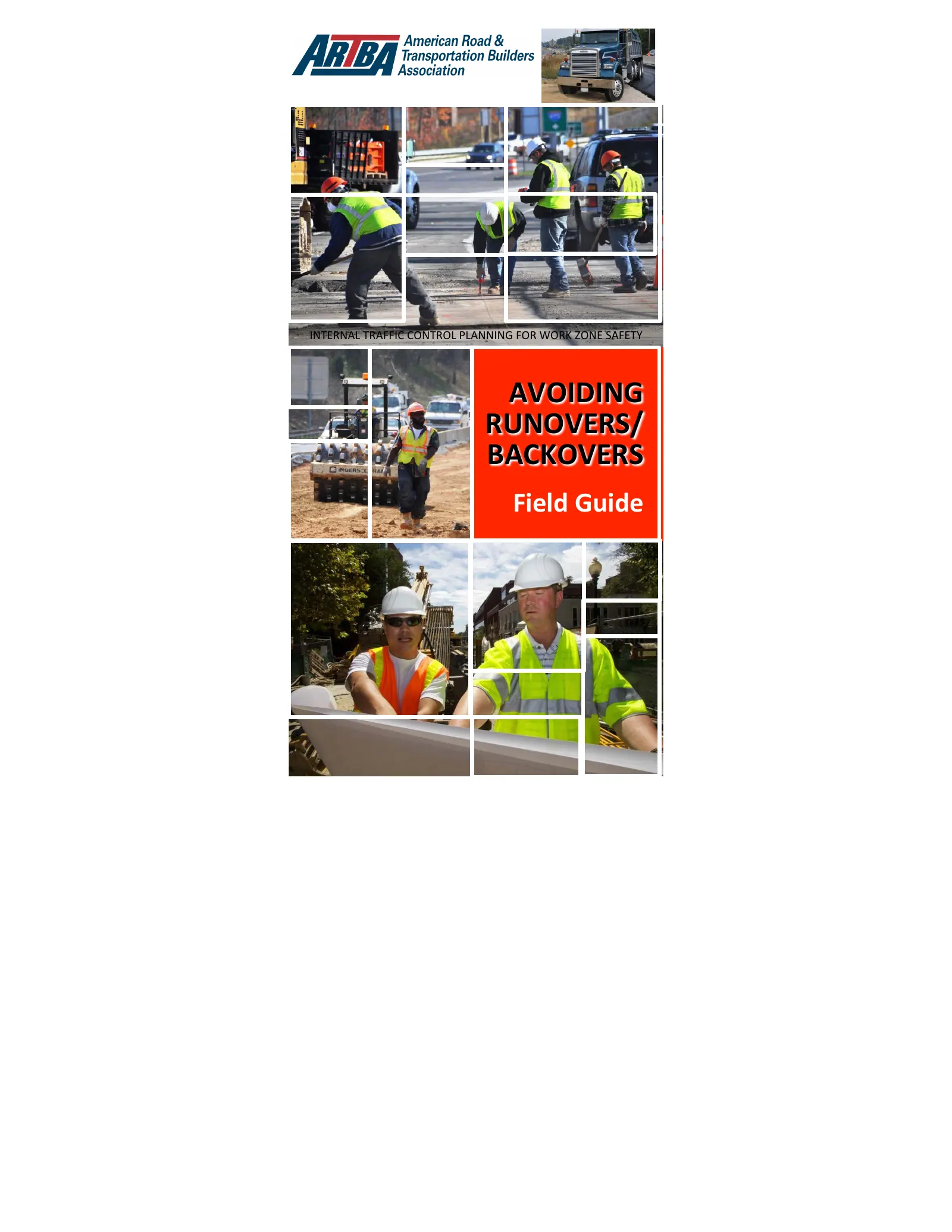
Field Guide: Avoiding Runovers and Backovers
ARTBA pocket field guide (28 pages) on internal traffic control and avoiding runovers/backovers.
Page text
· 26 of 28 pages · by American Road and Transportation Builders Association (ARTBA)
The words on each page as the author wrote them, read from the file by software so they can be searched. Layout, pictures and tables are not shown here: the pages above and the download are the original.
- Page 1
INTERNAL TRAFFIC CONTROL PLANNING FOR WORK ZONE SAFETY
- AVOIDING
- RUNOVERS/
- BACKOVERS
- Field Guide
- Page 2
Training is an important hazard control measure.
- This field guide is a supplement to ARTBA’s comprehensive course on Preventing Runovers and Backovers. The program is designed to provide comprehensive training in strategies and practices for prevention of runovers and backovers in road construction work. If you complete the training program, you will be better able to protect yourself and your coworkers as you perform your jobs each day.
- This field guide is intended as a reminder for those who have attended the course about the key practices required to keep workers from being struck by roadway construction equipment and vehicles.
- Many OSHA standards explicitly require employers to train employees in the safety and health aspects of their jobs. It is usually a good idea for the employer to keep a formal record of all safety and health training. Records can provide evidence of the employer's good faith and compliance with
- OSHA standards.
- © 2015 American Road & Transportation Builders Association This educational material was produced under the grant SH--‐ 26339--‐14--‐60--‐F--‐11 from the Occupational Safety and Health Administration, U.S. Department of Labor. It does not necessarily reflect the views or policies of the U.S. Department of Labor, nor does mention of trade names, commercial products, or organizations imply endorsement by the U.S. Government.
- Page 3
Internal Traffic Control
- Internal Traffic Control (ITC) is a process to prevent workers on foot from being struck by construction equipment and vehicles.
- ITC informs everyone working on the site about the location of workers, trucks and other equipment.
- ITC – to the extent possible – separates workers on foot from moving equipment by setting up paths and locations in which each group performs its tasks.
- Why Is ITC Important?
- Construction equipment and vehicles cause about one--‐third of all work zone fatalities. According to the U.S. Bureau of Labor Statistics, on average 130 workers are killed in struck--‐by incidents on roadway construction sites each year.
- Page 4
Construction Vehicles Are the Greatest Hazard
- The interaction between workers on foot and construction trucks and equipment is the single biggest hazard in the heavy and highway construction industry.
- Because workers are relatively short compared with construction vehicles, it can be difficult or impossible for drivers to see them, especially in areas known as blind spots.
- Page 5
Blind Spots
- A blind spot (or blind area) is the area around a vehicle or construction equipment that is not visible to the operator, either by direct line--‐of--‐ sight or indirectly by use of internal and external mirrors.
- If you cannot see the driver and the driver cannot see you, you are in a dangerous situation.
- Each vehicle has its own, unique blind spots. Operators should be familiar with the blind spots surrounding each type of equipment he or she operates.
- Be aware of blind spots for the trucks and equipment operating on your jobsite.
- Page 6
- These diagrams show the blind spots for the vehicle in the corner. The yellow areas show what can be seen using mirrors.
- Page 7
Protecting Workers on Foot
- There are four key areas to protect workers on foot:
- Worker habits and behaviors
- Worker visibility
- Communication with operators/drivers
- High risk mitigation
- Worker Habits and Behavior
- Make sure the worksite does not “entice” workers into unsafe areas. Consider safe locations and routes for areas such as:
- ─ Shade
- ─ Food and Water ─ Bathrooms
- WATER
- Do not use phones, radios or other devices that can distract you from warning alarms and approaching hazards. Move to a safe location (inside a truck) before answering a call.
- Page 8
- Workers must be visible in contrast to their surroundings with high visibility garments. Workers must be visible in a variety of conditions – especially at night, in other low--‐ light conditions, and in inclement weather. Spotters should be used when backing is required near workers on foot.
- Workers must be clearly visible to drivers and operators.
- High visibility garments are now required by both FHWA and OSHA for all workers
- In roadway construction, workers must be dressed in a minimum ANSI Class 2 vest.
- Class 3 garments are highly recommended for flaggers and for all workers during nighttime hours, inclement weather and other low--‐light conditions.
- Class 2 vest (left) can be matched with Class E pants (right) to make a Class 3 ensemble.
- Page 9
Communication between Workers and Operators/Drivers
- Workers must wait for a clear signal from the operator before approaching. Otherwise, it is difficult for workers to tell if the operator is looking at them or focused on his/her task.
- Operators must confirm with a signal to indicate it is safe to move forward.
- Workers must wait for a clear signal from the operator showing permission to approach.
- High Risk Mitigation
- The majority of construction activities are regular and relatively safe. Operations become more risky when the ordinary changes. Stop worker movement when there is a change, such as:
- Equipment breaks down
- Delays in materials delivery
- Shift changes
- Breaks
- Page 10
Safe Practices for Drivers and Operators
- There are four key safe practices for drivers and operators:
- Back up safely
- Know your surroundings
- Designate a spotter
- Walk around vehicle before backing
- Use designated vehicle pathways
- Backing is one of the most dangerous operations, especially if the equipment is a large dump truck. There are several key principles to safe backing in work zones:
- Backing should be controlled; used only when necessary; under specified conditions
- Organize the work area to minimize backing
- Page 11
Know Your Surroundings
- Establish clear communication between the operator and workers on foot before backing Understand and be aware of blind areas around the equipment
- Walk around the vehicle to check for hazards, especially if there is no spotter
- The operator needs to be fully aware of his or her surroundings. This includes:
- Objects at ground level
- Other vehicles, and
- Workers on foot.
- Communicate site conditions and safety plans with truck drivers before they enter the work space, and then continuously during operations.
- Page 12
Designate a Spotter
- Spotters are recommended by ANSI and other agencies. Spotters are required by some states, including Virginia and Washington state, when camera/radar systems are not used.
- Determine if a spotter should be designated
- Designate ONE spotter; other workers must remain clear of him or her.
- Trained spotters are essential where there are numerous workers on foot nearby, many vehicles operating in a confined area, or obstacles that may not be visible to the driver.
- A spotter can also be in danger from vehicles – who is spotting the spotter?
- If visual contact is lost, the driver/operator should stop immediately.
- Nearby workers must know the spotter’s responsibilities and not approach equipment without permission.
- Spotters should be trained in safe procedures, including continuous communication.
- Page 13
Use Vehicle Pathways
- A key element of ITC is to develop a route for vehicles entering, exiting, and traveling through the work space. This is part the Internal Traffic Control Plan, or ITCP.
- The plan must be communicated
- The plan should plot where pedestrians will be located, the types of equipment in the work area, and the path for equipment
- Vehicle pathways are most critical when deliveries are made by different subcontractors and independent drivers not familiar with the site and procedures
- Designate access and egress locations to inform drivers where they should go
- Long backing maneuvers for dump trucks should be avoided, and points of access and egress should be controlled
- When creating, ensure drivers/operators know where they should and should not go
- Route planning occurs before vehicles arrive on site
- Workers on foot should be located as far as possible from vehicle paths
- Parking, restroom, and break areas should be staged away from the principal conflict points
- Page 14
Worker--‐Free and Equipment--‐ Free Zones
- Worker--‐free zones are locations that workers on foot must avoid. These include:
- Blind areas around equipment
- Equipment travel lanes and queue areas in paving trains
- Moving equipment, including swing radius, pinch points, and moving parts
- Hazardous areas, such as near power lines
- Key principles for creating vehicle pathways are:
- Planning routes in advance
- Communicating routes to site personnel and delivery drivers
- Delineating worker--‐free zones and equipment--‐ free zones so all workers and operators know where they are expected to be
- The zones are designated in the ITC plan and can be detailed, such as a computer--‐generated drawing or as uncomplicated as a hand drawing. The only purpose is to communicate equipment paths and worker zones.
- Page 15
Control Parking and Staging of Vehicles, Vehicles Entering the Work Space, and Truck Queues
- Anticipate the locations and routes workers may take to complete their tasks.
- Set up safe locations for workers to park vehicles and access the work space
- Mark crossing points where workers on foot can cross over construction vehicle paths and
- only when absolutely necessary – open traffic lanes
- Ensure rest areas, restrooms, water coolers, etc., are located where workers can safely access them without crossing vehicle paths
- For vehicles entering the work space, plan the locations and procedures for assigned workers to approach the vehicles
- Page 16
Cameras, Radar and Sonar
- In most work zone situations, there are technological solutions that can alert drivers and operators to the presence of workers on foot.
- These include:
- Back--‐up alarms (with a range of noises)
- Cameras
- Radar and sonar, and
- Tag systems
- Each technology has unique deployment challenges, ranging from dirty lenses to high cost. As this equipment grows in use and experience, many of these challenges are being overcome.
- Page 17
Challenges in Access and Egress
- The primary challenge is safely getting materials and equipment into and/or out of the work zone. This involves acceleration and deceleration of the large, heavy trucks and equipment hauling the materials. These construction vehicles must leave and enter the traffic space, where motorists often drive at high speeds. Entering and exiting the work space can require rapid acceleration and deceleration.
- Access and egress challenges can be addressed by an ITC plan in the following ways:
- Isolating workers on foot from trucks and equipment
- Limiting/controlling vehicle access points
- Coordinating truck and equipment movements
- Providing guidance to workers on foot, truck drivers, and equipment operators
- Designating locations for parked vehicles
- Raising awareness about vehicle intrusions with workers and operators/drivers
- Page 18
Developing an Internal Traffic Control Plan (ITCP)
- The ITCP should be considered from the beginning of a project; however, it is never too late to create one. Some important elements – such as the size of the work space – will be dictated by the amount of right--‐of--‐way, number of lane closures, and other decisions that are made early in project planning.
- The first phase ( design) is when the project is developed and put out for bid. A general plan should be created at this point. The second phase ( planning) takes place when projects are being laid out by the contractor, the original plan is flushed out into phases, and plans are developed for those phases. The third phase ( pre--‐construction) is the time period before the work begins. In that phase any additional modifications should be added to that plan like other activities on site or changes to ITCP.
- The final phase ( construction) begins the day of construction; any final changes need to be communicated to everyone on site that day, and will be updated daily, as site conditions change.
- Page 19
The ITCP is implemented during the construction phase .
- It is part of the project safety plan. The site supervisor/foreman should oversee implementation and will likely develop the site plan.
- Foremen, supervisors, lead persons, and others are crucial for implementation. They will be in charge of daily set up and monitoring of the ITCP. Onsite workers are instructed in both overall ITCP concepts and site--‐specific information.
- To function properly, the ITCP must be reviewed and modified whenever there are significant changes to the site so employees can receive instruction on how it will be implemented that day. ITCPs may be modified more frequently as conditions change throughout the day.
- Communication
- A good communications plan is essential. The ITCP and site conditions must be coordinated among all those who will enter the work space. Subcontractors will need to be engaged as their
- Page 20
Creating the Plan
- operations will be impacted by the creation and implementation of the ITCP.
- Creating the plan involves these steps:
- Identify the project scope and the plan scope – as these vary from job to job
- Identify the operations to take place (e.g., paving, trenching, earthmoving, etc.)
- ─ Is there space for workers to park cars and safely access the work area?
- ─ Where will restrooms, water coolers, and break areas be located?
- ─ What equipment will be on site?
- ─ How many workers are needed?
- ─ What work will be done by workers on foot? Can they be separated from equipment areas and vehicle travel paths?
- ─ What is the Temporary Traffic Control
- Plan (TTCP)?
- ─ Review the site plan
- ─ Implement a communications plan
- ─ Identify sub--‐operations (e.g., asphalt sampling, watering rollers, maintenance)
- Page 21
Make a Drawing
- The final phase in creating the ITCP is implementing the communications plan – including training.
- Who will develop the ITCP?
- Who will review/approve it?
- Who will update the plan and stay in constant communication with site supervisors, foremen, subcontractors, workers, operators, etc.?
- Once you have the basic work area drawn out, plot the following:
- Locations where workers on foot and construction equipment will operate
- Locations of equipment and vehicles
- Paths of vehicles approaching and leaving the operation
- Locations of utilities, storage areas, other obstacles or hazards, if any
- Locations of overhead and underground utilities, storage and staging areas, and any other known obstacle or hazard. This process creates the ITCP diagram, which can be used to show workers, equipment operators,
- Page 22
Enforcing an ITCP
- dump truck drivers, and others how workers on foot and equipment will move about the site. As illustrated below, rather than taking the most direct path—placing the worker in the equipment pathway—the ITCP redirects the worker to take a safer route.
- Enforcing the ITCP should be a team effort. The safety officer, foremen, and supervisors are all responsible for maintaining work zone compliance and should be able to warn workers on foot or vehicle operators of violations of the ITCP.
- Page 23
Program Review and Checklists
- ITCP Checklist for Workers on Foot
- Be alert all the time, especially if there are changes in the routine
- Be visible all the time using PPE’s --‐ high visibility apparel
- Be aware of and avoid blind spots
- Be aware of and avoid swinging parts of construction equipment
- Be aware that operators are focused on their job and are not necessarily watching you
- Know how to communicate with operators, drivers and others on site
- Notify your supervisor if something is wrong with the ITCP or the TTCP
- Follow other rules and procedure from your site--‐specific ITCP
- ITCP Checklist for Spotters
- Avoid distractions while working
- Remain visible to the driver/operator
- Use effective communication signs or tools with the operator and other workers
- Use a different color high visibility vest than other crew members
- Keep visual and/or audible contact with the operator at all times
- Follow other rules and procedures from your site--‐specific ITCP
- Obtain training/certification
- Page 24
ITCP Checklist for Operators
- Inspect around your vehicle or equipment before moving it
- Be aware of blind spots for your vehicle
- Open the window when on site to improve communication
- Improve visibility by cleaning your window and mirrors (no stickers, repair cracks)
- Verify back up alarm and other back up technologies are working
- When parking, leave hydraulic parts on ground level and locked
- Verify vehicle/equipment is stopped and braked correctly
- Lock out/tag out when repairing vehicle or equipment
- Back up only if it is absolutely necessary
- Use spotters or technology to back up
- Park your vehicle or equipment far away from traffic or work area when not in use
- Page 25
ITCP Checklist for Foremen and Supervisors
- Implement and supervise the ITCP
- Design , communicate, implement and enforce your ITCP with workers on foot and operators each shift according to site conditions
- Consider using temporary traffic control devices (TTCDs) to create clear paths and areas to separate workers on foot from construction vehicles and equipment
- Make sure there are clear access and egress zones free of workers and parked vehicles
- Provide enough space for vehicle acceleration/deceleration for trucks entering the work space
- Locate restrooms, water, rest, shade, food, and workers’ parking areas near the work zones to avoid workers crossing open traffic lanes
- Be ready to improve your ITCP according to the circumstances
- Create a cell phone usage policy
- Share your ITCP with subcontractors, site visitors and others who will enter the site
- Page 28
For more information on this and other
- ARTBA safety training programs, contact us using the addresses below:
- American Road and Transportation Builders Association
- th
- 202--‐289--‐4434 (phone) l 202--‐289--‐4435 (fax) www.artba.org
- © 2015 American Road and Transportation
- Builders Association
More on Struck-By
ppt
20 slidesFocus Four: Struck-By Hazard Recognition
OSHA's official Construction Focus Four slide deck on struck-by hazards: flying, falling, swinging and rolling objects, vehicles and equipment.
U.S. Department of Labor, OSHAPublic domain
pdf
65 slidesFocus Four: Struck-By Hazards Instructor Guide
OSHA instructor guide/lesson plan for the Focus Four struck-by module.
U.S. Department of Labor, OSHAPublic domain

pdf
7 slidesFocus Four: Struck-By Student Handouts
Student handouts: nail gun safety hazard alert, cranes and rigging focus, PPE for workers checklist.
U.S. Department of Labor, OSHAPublic domain