1 / 54Use ← → to flip
Ladder Safety
Ladder selection, inspection, setup and safe use, from Central Georgia Technical College.
Slide text
· 54 slides · by Central Georgia Technical College
The words on each slide as the author wrote them, read from the file by software so they can be searched. Layout, pictures and tables are not shown here: the slides above and the download are the original.
- Slide 1
Ladder Safety Training
- This material was produced under grant number SH-17787-08 from the Occupational Safety and Health Administration, U.S. Department of Labor. It does not necessarily reflect the views or policies of the U.S. Department of Labor, nor does mention of trade names, commercial products, or organizations imply endorsement by the U.S. Government. Revisions were made to this material under grant number SH-05059-SH8 from the Occupational Safety and Health Administration, U.S. Department of Labor.
- Slide 2
Disclaimer
- This material was produced under grant number SH-17787-08 from the Occupational Safety and Health Administration, U.S. Department of Labor. It does not necessarily reflect the views or policies of the U.S. Department of Labor, nor does mention of trade names, commercial products, or organizations imply endorsement by the U.S. Government. Revisions were made to this material under grant number SH-05059-SH8 from the Occupational Safety and Health Administration, U.S. Department of Labor.
- This presentation is intended to discuss Federal Regulations only - your individual State requirements may be more stringent as many states operate their own state OSHA and they may have adopted construction standards that are different from information presented in this training. If you live in a state with an OSHA approved state plan, you should contact your local administrator for further information on the standards applicable in your state.
- These materials are meant for informational purposes only.
- No representation is made as to the thoroughness of the presentation.
- Slide 3
Disclaimer , cont.
- It is not the intent to provide compliance-based training in this presentation, the intent is more to address hazard awareness in the residential construction (i.e. home building) industry, and to recognize the overlapping hazards present in many construction workplaces.
- Photos shown in this presentation may depict situations that are not in compliance with applicable OSHA/safety requirements.
- No legal advice is offered or implied, and no attorney-client relationship is intended or established. If legal advice or other expert assistance is required the services of a competent professional person should be sought.
- It is the responsibility of the employer and its employees to comply with all pertinent OSHA/safety rules and regulations in the jurisdiction in which they work.
- Revisions were made to this material under grant number SH05059-SH8 from the Occupational Safety and Health Administration, U.S. Department of Labor.
- Slide 4
Introduction
- Falls from ladders are a leading cause of serious and fatal injuries in residential construction.
- The goals of this course are to help you:
- understand how to correct or eliminate fall hazards on your job sites related to ladder use.
- understand the OSHA ladder safety requirements.
- Slide 5
Course Objectives
- 1. Identify the importance of preventing falls from ladders.
- 2. Recognize fall hazards associated with ladder use.
- 3. Identify OSHA requirements for ladders.
- 4. Identify work practices for using ladders safely.
- Slide 6
Course Agenda
- Section 1: Overview
- Section 2: Ladder Safety
- Section 3: Group Workshop
- Section 4: Post Test and Review
- Slide 7
Section 1: Overview
- Slide 8
Why is Preventing Falls from Ladders Important?
- Falls continue to be the leading cause of fatalities in residential construction.
- Falls (602) were responsible for 45% of residential construction fatalities from 2003 to 2006.
- 135 (22%) were falls from ladders.
- Source: NAHB Residential Construction Industry Fatalities 2003-2006
- (www.nahb.org/fatalitystudy )
- Slide 9
Fatalities by Event or Exposure: Residential Construction
- Slide 10
Fall Fatalities: Residential Construction
- 2% 1%
- 1% 1% 1%
- Fall from roof (232)
- 8%
- Fall from ladder (135)
- Fall from scaffold, staging (89)
- 9%
- 40%
- Fall to lower level, unspecified or not elsewhere classified (57) Fall from floor, dock, or ground level (47)
- Fall from nonmoving vehicle (12)
- Fall from building girders or other structural steel (9) Fall, other or unspecified (7)
- 15%
- Fall on the same level (7)
- Fall down stairs or steps (6)
- 22%
- Source: NAHB Residential Construction Industry Fatalities 2003-2006 (www.nahb.org/fatalitystudy )
- Slide 11
Subpart L - 1926.451(g)
- OSHA Fall Protection Requirements
- Each employee on a scaffold more than 10’ (3.1M) above a lower level shall be protected from falling to a lower level.
- Subpart X – Ladders
- Fall protection is not required for workers climbing or working on portable ladders.
- Subpart X – Stairways
- Stairways having four (4) or more risers or rising more than 30 inches must be equipped with at least one handrail; and one stair rail system along each unprotected side or edge.
- Slide 12
- OSHA Fall Protection Requirements cont.
- Subpart M - 1926.501(b)(13)
- Residential construction. Each employee engaged in residential construction activities 6’ or more above lower levels must be protected by conventional or alternative fall protection:
- Exemption: When the employer can demonstrate the protection is infeasible or creates a greater hazard the employer must develop an alternative fall protection plan.
- Slide 13
How do you prevent falls from ladders?
- Implement a comprehensive safety program.
- Understand OSHA ladder regulations.
- Train workers to identify hazards associated with ladder use.
- Use safe work practices.
- Slide 14
Ladder Safety
- Section 2:
- Slide 15
Learning Objectives: Section 2
- Determine the proper ladder to use based on weight capacity and height.
- Calculate the proper pitch of extension ladders for proper set-up, and identify how to secure and stabilize ladders.
- Identify how to maintain a safe position when using a ladder.
- Slide 16
Common Ladder Hazards
- Improper set-up.
- Portable ladders not 3 feet above landing surface.
- Not securing ladder correctly.
- Standing on the top two steps of a stepladder.
- Overreaching when working from a ladder.
- Slide 17
Choosing the Right Ladder
- Before stepping onto a ladder, think about these things:
- Duty rating of the ladder—what capacity can it hold?
- Height of the ladder—too short or too tall?
- Condition of the ladder and instructions unique to the ladder selected.
- Slide 18
Proper Duty Rating/Capacity
- OSHA Requirement
- Ladders shall not be loaded beyond the maximum intended load for which they were built nor beyond their manufacturer's rated capacity.
- Slide 19
- Proper Duty Rating/Capacity, cont.
- Select a ladder with the proper duty rating for your weight and the materials you are handling.
- Slide 20
Extension Ladders
- Slide 21
Proper Ladder Set-up
- Consider placement and pitch of the ladder.
- Secure and stabilize the ladder.
- Slide 22
Pitch Extension Ladders
- Extension ladders should be used at a 4 to 1 pitch (1.2 to .3 m).
- For every 4 ft. (1.2 m) in height, the bottom of the ladder should be 1 ft. (.3 m) away from the structure.
- Example:
- 20 ft. (height) ÷ 4 ft. = 5 ft. pitch
- Slide 23
Pitch Extension Ladders, continued
- Slide 24
Proper Height Extension Ladders
- When accessing another level, the ladder must extend at least 3ft. (0.9m) above the landing to provide a hand hold for getting on and off the ladder.
- Slide 25
Proper Height for Extension Ladders, continued
- Choose the right ladder for the height you need to reach.
- Ladder
- Height (ft.)
- Maximum Reach (ft.)*
- Height to Gutter or Top Support Point+
- 9 ft. max.
- 9-13 ft.
- 13-17 ft.
- 17-21 ft.
- 21-25 ft.
- 25-28 ft.
- 28-31 ft.
- *Assume a 5 ft.-6 in. person with a vertical reach of 12 in.
- +Support points for extension ladders reflect section overlap, ladder angle, or 3-ft. extension above roof line
- Slide 26
Secure and Stabilize Ladders
- Extension ladders should be secured at the top or bottom to prevent movement.
- The base of an extension ladder must be secured in place by using the safety feet on the ladder or other effective means.
- Slide 27
Secure and Stabilize Ladders, continued
- Slide 28
Secure and Stabilize Ladders - continued
- Slide 29
`Secure and Stabilize Ladders, continued
- Slide 30
Loose Soil
- Slide 31
Step Ladders
- Slide 32
Step Ladders, continued
- Only use in the fully open position on firm level ground.
- Do not use a step ladder that is folded or in a leaning position.
- Never sit/stand on the top two rungs.
- Consider work height when selecting a step ladder.
- Slide 33
Step Ladders, continued
- Step ladders are designed for use in an opened-and-locked position.
- Slide 34
Step Ladders Hazard
- Do NOT use a step ladder that is folded or in a leaning position.
- Slide 35
Proper Height of Stepladders
- Choose a step ladder that is no more than 4ft.
- Shorter than the height you want to reach.
- Maximum Height
- You Need to Reach
- Stepladder Height
- 3 4 5 6 8 10 11 12 14 16
- Slide 36
Maintain a Safe Position on Ladders
- Face the ladder when ascending or descending.
- Maintain three points of contact at all times.
- Keep your body centered on the ladder.
- Never let your belt buckle pass either side rail.
- Slide 37
Maintain a Safe Position on a Ladder
- Slide 38
Ladder Inspections
- Ladders must be inspected before each use.
- Broken or weak ladders or ladders that are not stable must be marked or tagged as defective and taken out of service.
- Look for cracks and weak points.
- Competent person must periodically inspect ladders.
- Slide 39
Ladder Inspection, continued
- Slide 40
Review the Safety Labels on the Ladder
- Slide 41
Additional Safe Work Practices: Ladders
- Extension ladders should not be separated to create two ladders.
- Keep the areas around the tops and bottoms of all ladders clear to prevent trip-and-fall hazards.
- Avoid setting ladders up in high traffic areas or barricade the area around ladder.
- Slide 42
Additional Work Practices: Ladder Safety
- Ladders must be kept free of oil, grease, and other slipping hazards.
- Consider using a rope to raise/lower materials instead of carrying items while climbing a ladder.
- Do NOT use metal or aluminum ladders near exposed energized electrical equipment.
- Slide 43
Workshop
- Section 4:
- Group
- Workshop
- Slide 44
Hazard Violation Workshop
- Students will review a series of photographs of ladders and scaffolds in use on a jobsite. The assignment is to identify the hazards in each photo and discuss the corrective action required to correct the hazard. (Note: Some of the photos are of correct safe work practices.)
- You Play OSHA!
- Slide 45
Picture #1
- Slide 46
Picture #2
- Slide 47
Picture #3
- Slide 48
Picture #4
- Slide 49
Picture #5
- Slide 50
Picture #6
- Slide 51
Picture #7
- Slide 52
Picture #8
- Slide 53
Picture #9
- Slide 54
Questions ?
- questions
More on Ladders

pptx
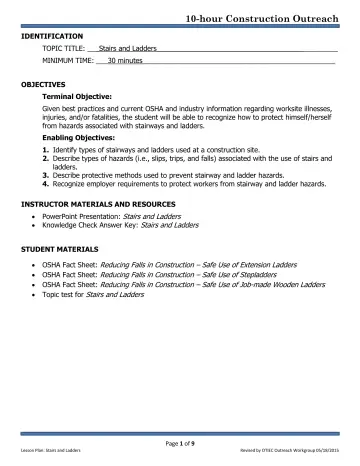
36 slidesStairways and Ladders (OSHA 10-Hour Construction Outreach)
OSHA's own 10-hour Construction Outreach deck on stairways and portable/job-made ladders (2015 edition), with case studies and a built-in knowledge check.
U.S. Department of Labor, OSHA (with the OTIEC Outreach Workgroup)ArchivedPublic domain
pdf
9 slidesStairways and Ladders: Lesson Plan (OSHA 10-Hour Construction Outreach)
Instructor lesson plan with objectives, timing and teaching procedures for the OSHA stairways and ladders outreach deck.
U.S. Department of Labor, OSHA (with the OTIEC Outreach Workgroup)ArchivedPublic domain
pdf
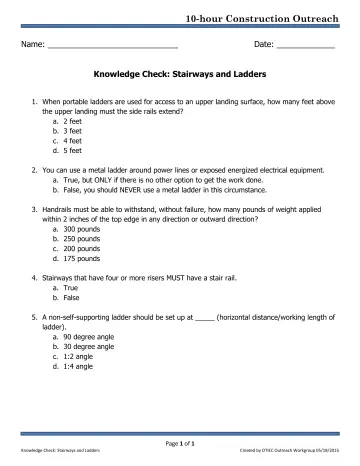
1 slidesStairways and Ladders: Knowledge Check (OSHA 10-Hour Construction Outreach)
Student knowledge-check quiz that accompanies the OSHA stairways and ladders outreach deck.
U.S. Department of Labor, OSHA (with the OTIEC Outreach Workgroup)ArchivedPublic domain