1 / 108Use ← → to flip
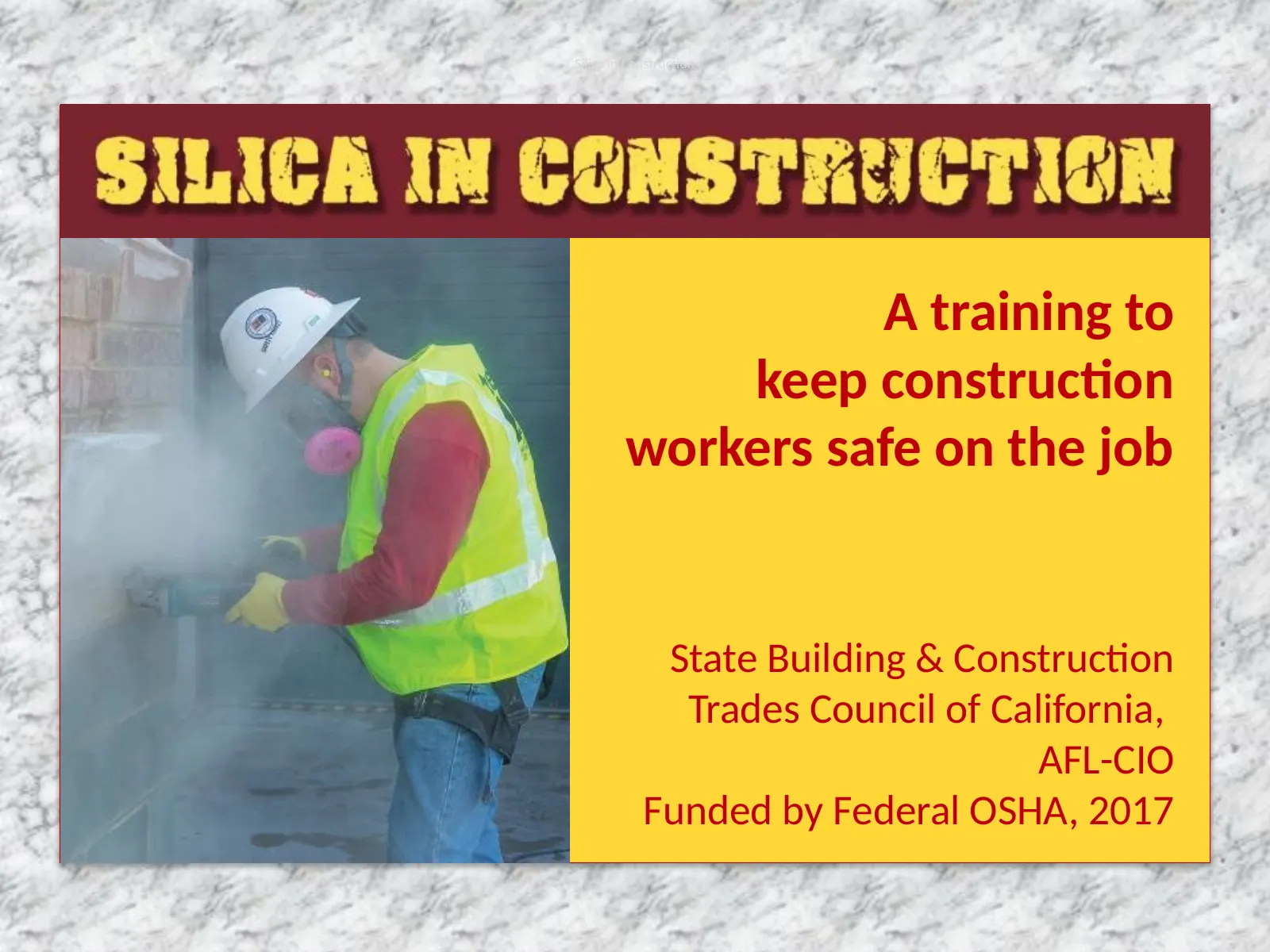
Silica in Construction
Silica in construction from the State Building and Construction Trades Council of California.
Slide text
· 108 slides · by State Building Construction Trades Council of California
The words on each slide as the author wrote them, read from the file by software so they can be searched. Layout, pictures and tables are not shown here: the slides above and the download are the original.
- Slide 1
A training to keep construction workers safe on the job
- Silica in Construction
- State Building & Construction Trades Council of California, AFL-CIO Funded by Federal OSHA, 2017
- Slide 2
Funded by OSHA
- This material was produced under grant SH29642SH6 from the Occupational Safety and Health Administration, U.S. Department of Labor. It does not necessarily reflect the views or policies of the U.S. Department of Labor, nor does mention of trade names, commercial products, or organizations imply endorsement by the U.S. Government
- Slide 3
Use of Material Duplication and Photo Credit
- Material is only to be used for non-commercial, instructional, educational purposes
- Fees may not be charged for this material
- Photo credits are given on each slide
- While every effort has been made to ensure information is current and accurate, the SBCTC does not assume any liability for errors or omissions
- Slide 4
Acknowledgements
- We thank the following organizations for:
- Providing technical assistance with developing this training:
- Center for Construction Research and Training (CPWR)
- UC Berkeley Labor Occupational Health Program (LOHP)
- Cal/OSHA
- Federal OSHA
- Sharing: photos, video, training material
- BAC –International Union of Bricklayers and Allied Crafts
- CA Dept. of Industrial Relations—Commission on Health and Safety and Workers’ Compensation (WOSHTEP program)
- West Virginia Archives
- Worksafe BC (Canada)
- Slide 5
Silica—A High Priority for Construction
- 2 million U.S. construction workers exposed to silica every year
- eLCOSH images
- Slide 6
Course Objectives for Silica Training
- By the end of this training, participants will be able to:
- Understand what it is
- Recognize hazards
- Describe health effects
- Identify controls:
- Engineering/work practice/PPE
- Understand new OSHA Standard
- Work safely around silica
- Slide 7
Section 1
- Introduction to Silica
- eLCOSH images
- Slide 8
What is silica?
- One of the most common minerals on Earth
- Photos courtesy PDPhoto.org
- Slide 9
Mineral means:
- Naturally occurring
- Inorganic—not plant or animal
- Solid form
- Definite chemical composition
- Slide 10
eLCOSH images
- Silica is found in rock, soil and sand
- Silica is composed of the elements Silicon + Oxygen = SiO 2
- Photo courtesy PDPhoto.org
- Photo: CPWR
- Slide 11
Silica naturally occurs as:
- Amorphous: no regular form
- Crystalline: well-defined arrangement, regular crystal form
- Which is hazardous?
- Photo: CPWR
- Slide 12
3 forms of crystalline silica
- Quartz—common, found in sand, gravel, clay, granite, sandstone and other rock
- Photo: CPWR
- Cristobalite and Tridymite— less common, but more toxic to workers
- Slide 13
Where is silica found in construction?
- BRAINSTORM ACTIVITY
- Based on what you just learned about where silica naturally occurs, list the building materials you think might contain crystalline silica?
- Slide 14
These materials may contain silica
- Asphalt
- Brick
- Cement
- Concrete
- Concrete block
- Drywall
- Fiber cement products (siding, cladding panels) Grout
- Gunite/Shotcrete Mortar
- Paints
- Plaster
- Refractory Mortar/Castables Refractory units
- Rock
- Roof tile (concrete)
- Sand
- Soil (fill dirt, top soil, soil w/fly ash added)
- Stone (granite, limestone, quartzite, sandstone, shale, slate, cultured, etc.) Stucco/EIFS
- Terrazzo
- Tile (clay and ceramic)
- Slide 15
How can you find out if material contains silica?
- Product label
- Safety Data Sheet
- Published data—online
- Analyze a sample of the material
- wikimedia
- Slide 16
Websites that can help you
- CPWR (Center for Construction Research and Training) Work Safely With Silica www.silica-safe.org
- Federal OSHA Silica eTool http://www.osha.gov/dsg/etools/silica
- Cal/OSHA Silica in Construction eTool http://www.dir.ca.gov/dosh/etools/08-019/index.htm
- Slide 17
Section 1 Review and Questions
- Name three important things you learned in this section.
- Slide 18
Section 2
- Silica As a Hazard
- How does silica become a construction hazard?
- Slide 19
Factors that determine potential to cause harm:
- Route of exposure
- Toxicity
- Dose and duration
- Interaction
- Individual characteristics
- Slide 20
Route of Exposure
- How does silica get into your body?
- Breathing
- eLCOSH images
- Slide 21
Size matters!
- “Respirable” silica is small enough to penetrate body’s natural defenses and get deep into your lungs
- Crystalline Silica
- Photo source: CDC
- It’s 100 times smaller than ordinary beach sand
- wikimedia
- Slide 22
Respirable Particles
- A single human hair is between
- 80 – 120 microns (µm) in diameter
- Respirable dust is less than 10 microns (µm) in diameter
- Slide courtesy of Construction Safety Council, Illinois
- Slide 23
Respirable Particles in Constructions
- Slide 24
Toxicity
- Slide 25
Dose and Duration
- Amount of substance entering body
- Amount of time you are exposed
- Slide 26
How much silica dust is too much? 3 Important terms:
- TWA
- Time weighted average
- AL
- Action Level
- PEL
- Permissible exposure limit
- Slide 27
New limits for silica
- AL = 25 micrograms per cubic meter of air (25 µg/m 3 ) calculated as 8-hour TWA
- PEL = 50 micrograms per cubic meter of air
- (50 µg/m 3 ) averaged over an 8-hour
- day
- Slide 28
What is a “microgram (µg) ”
- A metric unit of weight or mass equal to 1 millionth of a gram
- 0.000001 g
- Too small to see with the naked eye
- Slide 29
Pennies and Dollars
- Slide 30
Cubic Meter
- Slide 31
Interactions
- Some substances, in combination, will increase the chance a worker will get sick.
- Individual Characteristics
- Age, gender, diet, state of health, pregnancy, use of medication, drugs and alcohol can change toxic effects
- Slide 32
Putting it all together Silica is hazardous because:
- Found in many construction materials
- Silica dust travels deep into your lungs
- Long-time exposure to small amounts causes harm
- Airborne particles too small to see
- Short-time exposure to large amounts causes harm
- Effects worse if you also smoke
- Causes lung disease, cancer, even death
- eLCOSH images
- Slide 33
Section 2 Review and Questions
- Name three important things you learned in this section.
- Slide 34
Section 3 Tasks and Tools that Create Silica Dust
- Top photos: Cal/OSHA
- Photo: OSHA
- Photo source: elcosh
- Slide 35
- It’s dusty work…
- but somebody has to do it
- SMALL GROUP ACTIVITY
- Look at the list of construction materials that contain silica.
- What kind of work do you do with these materials that may create dust?
- Slide 36
Operations that create silica dust
- Cutting, drilling, coring
- Grinding, sanding, sandblasting
- Pulverizing
- Mixing (dry)
- Cleaning up
- eLCOSH Images
- Slide 37
Group Discussion
- Which phases of construction create the highest exposure to silica dust?
- Can you think of any crafts that are never exposed to silica dust?
- Slide 38
Tasks with high chance of exposure
- The probability (in %) of being overexposed Based on PEL of 0.1 mg/m 3
- Slide 39
“It wasn’t me!”
- Workers who are not “engaged” in the task but are working nearby may be exposed to silica hazards.
- May be covered by Multi-Employer Worksite regulations (OSHA)
- “Creating”
- “Exposing”
- “Controlling”
- “Correcting”
- Slide 40
The 5 question test
- Did your employer:
- 1. Create the hazard?
- 2. Have responsibility or authority to correct hazard?
- 3. Have ability to correct or remove the hazard?
- 4. Demonstrate that creating, controlling and/or correcting employers were notified/aware of hazards?
- 5. Take appropriate feasible steps to protect their employees from the hazard, instruct them to recognize the hazard and inform how to avoid associated dangers?
- Slide 41
Section 3 Review and Questions
- Name three important things you learned in this section.
- Slide 42
Section 4
- Health Effects of Silica Exposure
- Courtesy of: CPWR SmartMark
- Slide 43
Group Discussion
- Have you personally experienced health effects from breathing silica dust?
- Do you know someone who has?
- Slide 44
- Breathing crystalline silica puts you at risk for serious, life-threatening disease
- Photo: elCOSH images
- Slide 45
Which body part is most affected?
- Lungs
- More than 6 million breaths per year
- Slide 46
Respirable crystalline silica causes:
- Silicosis—a serious lung disease
- Lung cancer–classified as a carcinogen
- Chronic obstructive pulmonary disease
- Slide 47
And contributes to:
- Heart disease
- Kidney disease
- Vascular disease
- Autoimmune disease
- Tuberculosis (TB) and other infections
- Slide 48
Watch video:
- Silica Exposure
- by Worksafe BC http://www.youtube.com/
- watch?v=R_sC2wX9Uwc
- Slide 49
Silicosis Facts
- Permanent
- Irreversible
- No cure
- Worsens after exposure ends
- Deadly
- Preventing exposure is your best defense
- Slide 50
3 types of silicosis:
- Chronic
- Acute
- Accelerated
- Silicotic Lung
- Normal Lung
- Slide 51
Silica Table
- Slide 52
Silicosis signs and symptoms
- Slide 53
Workers speak up
- Bricklayer stories of what it’s like to live with silicosis.
- Play audio
- Slide 54
Silicosis: One of oldest occupational diseases
- Documented in 1700’s
- Chronic effects tied to crafts
- Increased with use of new power tools
- Photo: wikimedia
- Slide 55
Hawk’s Nest Tragedy
- 1930’s Tunneling project through rock containing 96-99% silica
- Few records kept but historians now believe 2000-2500 workers contracted silicosis and over 700 died.
- Photo: Google images
- Slide 56
West Virginia State Archives
- Photo courtesy of: Elkem Metals Collection, West Virginia State Archives
- Slide 57
Impact of Hawk’s Nest
- Revealed “Acute” silicosis
- Directly connected exposure and illness
- Spurred public outcry and increased demands for worker protection
- Slide 58
Watch video:
- “Silica in Construction: From danger to safety” SBCTC
- Slide 59
Section 4 Review and Questions
- Name three important things you learned in this section.
- Slide 60
Section 5
- Controlling Silica Hazards
- Photo source: elcosh
- Slide 61
Your experience on-the-job
- BRAINSTORM ACTIVITY
- List all actions you’ve used to control silica.
- Slide 62
Hierarchy of Controls
- Slide 63
Assessing risk—factors to consider
- What tool is being used?
- What is silica content of material?
- How enclosed is work area?
- Is dusty work constant or intermittent?
- Does the job take the whole shift?
- Which control methods most effective <PEL?
- Will PPE also be needed to meet the PEL?
- Slide 64
Engineering controls
- Wet methods
- Local exhaust ventilation (LEV)
- Substitution
- Isolation
- Slide 65
Examples of wet methods
- Concrete/masonry saws that provide water to blade
- Water hose to wet down dust at point of generation
- During rock drilling, flow water through drill stem
- Photos: CPWR Silica Safe
- Slide 66
Silica Dust while working
- Photos: CPWR Silica Safe
- Slide 67
Silica Dust while working
- Photos: CPWR Silica Safe
- Slide 68
Examples of LEV methods
- Photos: CPWR Silica Safe
- Vacuum system captures dust close to source
- Integrate systems onto equipment that generates dust
- Use HEPA (high-efficiency particulate air) filter
- Slide 69
Silica in Construction
- Photos: CPWR Silica Safe
- Slide 70
Examples of control combinations
- Asphalt pavement milling machines use ventilation and water-spray controls
- Slide 71
Silica at outdoor work places
- Photos: CPWR Silica Safe
- Slide 72
Are controls working?
- Follow manufacturer’s instructions/specifications
- Use tools properly
- Do required maintenance and cleaning regularly
- Test the air for contaminants
- Slide 73
Air monitoring
- Done by professionals
- Personal monitoring of workers
- Identifies/ quantifies contaminants
- Specialized, calibrated equipment
- General ambient air monitoring
- Slide 74
Air sampling equipment
- Personal Air Pump with Cyclone
- Slide 75
Personal Monitoring
- Determines individual worker exposure
- Done during a specific time period
- Pump pulls air through a filter or tube, which traps the dust or toxin.
- Slide courtesy of Construction Safety Council, Illinois
- Slide 76
Examples of substitution
- Eliminate the hazard
- Use silica-free materials when feasible
- Paints/coatings
- Abrasive blasting
- Coal slag
- Steel shot
- Corn cob
- Garnet
- Slide 77
Examples of isolation
- Separate the worker from the dust
- Enclosed cab with ventilation/filtered air
- Separate dusty operations from non-dusty areas
- Abrasive blasting containment
- Photo: eLCOSH Images
- Slide 78
Administrative controls
- OSHA standard
- Written plan
- Job/task planning
- Air monitoring
- Training
- Best work practices
- Photo source: elcosh
- Slide 79
Best practices for contractors
- Use controls to eliminate dust
- Assign competent person
- Provide proper respirators when needed
- Substitute materials
- Create a plan
- Photo source: elcosh
- Slide 80
Best practices for workers
- Use equipment and controls properly
- Be aware
- Participate
- Don’t bring dust home
- Give your doctor silica info
- Don’t eat, drink, smoke, or apply cosmetics while near silica dust—wash hands/face
- Photo source: elcosh
- Slide 81
Personal protective equipment
- Only if engineering and work practice controls aren’t enough
- Must be NIOSH approved
- Employers must comply with OSHA silica and respiratory protection standards
- Medical evaluations
- Slide 82
NIOSH-Approved Respirators
- Full Face APR
- PAPR
- Slide Courtesy of CPWR
- ½ face APR
- N 95
- Slide 83
Why is PPE less effective than engineering controls?
- Doesn’t eliminate hazard
- Can be uncomfortable
- Hard to communicate
- Limited vision/movement
- Workers must know how to use properly
- Difficult to maintain
- Photo source: elcosh
- Slide 84
Watch video:
- Eliminate the Hazard: McCarthy Drilling Project By: SBCTC
- DISCLAIMER: This is a case study that illustrates the implementation of engineering controls for silica dust and is for educational purposes only. References to a specific employer or brand of equipment do not imply endorsement by either OSHA or the SBCTC and its affiliates.
- Slide 85
Section 5 Review and Questions
- Name three important things you learned in this section.
- Slide 86
Section 6
- The New OSHA Standard
- Slide 87
New Federal Silica Standard
- Final rule published by OSHA—March 25, 2016
- Timeline courtesy of the International Union of Bricklayers and Allied Craftworkers
- Slide 88
Scope of Coverage
- Quartz, cristobalite and tridymite
- All occupational exposures to respirable crystalline silica in construction work unless below Action Level
- Photo source: elcosh
- Slide 89
Compliance Date
- Construction employers must comply with all requirements by June 23, 2017
- (except requirements for laboratory evaluation of exposure samples, which begin June 23, 2018)
- Slide 90
What does the new standard do?
- AL trigger
- 25 µg/m 3 (8-hr TWA)
- Lower PEL
- 50 µg/m 3 (8-hr TWA)
- Engineering controls and work practices to limit exposure
- Slide 91
What does the new standard do?
- Slide 92
What is “Table 1”
- Matches 18 tasks with effective dust control methods and respirator requirements
- Slide 93
Table 1 Tasks/Equipment
- Stationary masonry saws
- Handheld power saws
- Handheld power saws for fiber cement board
- Walk-behind saws
- Drivable saws
- Rig-mounted core saws or drills
- Handheld and stand-mounted drills
- Dowel drilling rigs for concrete
- Vehicle-mounted drilling rigs for rock and concrete
- Jackhammers and handheld powered chipping tools
- Slide 94
Table 1 Tasks/Equipment con’t
- Handheld grinders for mortar removal (tuckpointing)
- Handheld grinders for other than mortar removal
- Walk-behind milling machines and floor grinders
- Small drivable milling machines
- Large drivable milling machines
- Crushing machines
- Heavy equipment and utility vehicles to abrade or fracture silica materials
- Heavy equipment and utility vehicles for grading and excavating
- Slide 95
Must fully/properly implement controls
- Presence of controls not sufficient
- Employers required to ensure:
- Controls present and maintained
- Employees understand/use properly
- Slide 96
Option 2: Alternative Exposure Control
- If employers do not follow Table 1, they must comply with section (d) of the standard
- Slide 97
Section (d) requires:
- Action Level and PEL apply
- Must do exposure assessment using either:
- Performance option
- Scheduled monitoring option
- Use engineering and work practice controls
- Slide 98
OSHA Compliance Guides for Silica
- Available from OSHA website https://www.osha.gov/Publications/OSHA3902.pdf
- Slide 99
All employers must comply with these sections of new standard:
- Housekeeping
- Create written plan
- Medical surveillance
- Recordkeeping
- Haz Comm & training
- Slide 100
Housekeeping: workers need to know
- If contributes to silica exposure:
- --Dry sweeping or brushing --Use of compressed air for cleaning surfaces or clothing
- Photo source: elcosh
- NOT allowed unless used with ventilation
- Slide 101
Employers must have written plan for managing silica exposure
- Available to each employee
- Describes tasks, controls, PPE, procedures, housekeeping, restricted access to work areas
- Designates a Competent Person
- Slide 102
Duties of competent person
- Identify existing and foreseeable hazards
- Authority to take prompt corrective measures
- Frequently/regularly inspect job sites, material and equipment
- Photo source: elcosh
- Slide 103
Medical exam available at no cost
- If you wear a respirator 30 or more days/year for silica exposure
- Exam includes:
- Medical/work history
- -Physical exam
- -Chest x-ray
- -Pulmonary function test
- -Tuberculosis test
- Photo: wikimedia
- Slide 104
Exam results within 30 days
- Physician provides the following written reports:
- To employee—medical report
- To employer—medical opinion
- Slide 105
Hazard communication and training Workers must have:
- Access to:
- Labels on material containers
- Safety Data Sheets
- Photo source: elcosh
- And receive:
- Hazard information
- Training
- Slide 106
Section 6 Review and Questions
- Name three important things you learned in this section.
- Slide 107
Review Game
- Slide 108
Work safely with silica and enjoy a healthy career in the trades
- Thank you for attending this training.
- Photo source: elcosh
More on Silica
pptx
85 slidesSilica Hazards in Construction
Silica hazards and the construction silica standard (Table 1 controls) from the Chicagoland Construction Safety Council.
Chicagoland Construction Safety CouncilOSHA Harwood grant
pptxes
76 slidesPeligros de Sílice en la Construcción
Spanish edition of the Chicagoland Construction Safety Council silica deck.
Chicagoland Construction Safety CouncilOSHA Harwood grant
pptx
86 slidesSilica Training
Respirable crystalline silica training for construction from Wayne State University.
Wayne State UniversityOSHA Harwood grant