1 / 45Use ← → to flip
Personal Protective Equipment (OSHA 10-Hour Construction Outreach)
OSHA's own 10-hour Construction Outreach PPE deck: hard hats, eye/face, hearing, hand, foot and fall protection equipment (2015 edition).
Slide text
· 45 slides · by U.S. Department of Labor, OSHA (with the OTIEC Outreach Workgroup)
The words on each slide as the author wrote them, read from the file by software so they can be searched. Layout, pictures and tables are not shown here: the slides above and the download are the original.
- Slide 1
Personal Protective
- Equipment
- 10-Hour Construction Outreach
- Slide 2
Personal Protective Equipment
- Source of photos: Mount Sinai/CHEP/elcosh.org
- Slide 3
Personal Protective Equipment
- Lesson Overview
- Hierarchy of controls
- Types of PPE
- PPE Training Requirements
- Employer and Employee Responsibilities
- Hazard Recognition Activity
- Slide 4
Protecting Employees
- Employers must protect employees:
- Assess workplace
- Eliminate and reduce hazards using engineering and administrative controls
- Then use appropriate personal protective equipment (PPE)
- Remember, PPE is the last level of control!
- Slide 5
Protecting Employees
- Source: OSHA
- Slide 6
Engineering Controls
- Physical changes to workplace
- Isolation
- Ventilation
- Equipment modification
- Others
- Mount Sinai/CHEP/elcosh.org
- Slide 7
Administrative Controls
- Requires worker to do something
- Proper procedures
- Inspection and maintenance
- Housekeeping
- Supervision
- Regulated areas
- Limit exposure by time or distance
- Slide 8
Administrative Controls
- Example: Noise Exposure
- Operate noisy machines during shifts when fewer people are exposed
- Limit the amount of time a person spends at a noise source
- Provide quiet areas where workers can gain relief from hazardous noise sources
- Control noise exposure through distance
- Slide 9
Types of PPE
- Source of photos: OSHA
- Slide 10
Head Protection
- Frequent Causes of Head Injuries:
- Object striking head
- Head striking object
- Contact with exposed, energized electrical conductors
- Source: OSHA
- Slide 11
Classes of Hard Hats
- Class G (General)
- General service (e.g., building construction, shipbuilding, lumbering, and manufacturing)
- Good impact protection
- Limited voltage protection (proof-tested at 2,200 volts)
- Source: OSHA
- Slide 12
Classes of Hard Hats
- Class E (Electrical)
- Electrical work
- Protect against falling objects
- Protect against high-voltage shock/burns (proof-tested at 20,000 volts)
- Slide 13
Classes of Hard Hats
- Class C (Conductive)
- Designed for comfort, offers limited protection
- Protects heads that may bump against fixed objects
- Does not protect against falling objects or electrical hazards
- Slide 14
Eye and Face Protection
- Common Causes of Eye Injuries
- Dust
- Flying particles
- Harmful chemicals
- Intense light
- Welding
- Lasers
- Source: OSHA
- Slide 15
Safety Glasses
- Selecting eye and face protection:
- Meet requirements of ANSI Z87
- Elements to consider
- Ability to protect
- Fit and comfort
- Vision and movement not restricted
- Durable and cleanable
- Other PPE not restricted
- Slide 16
Safety Glasses
- Protect against:
- Flying particles from wood, metal, cement, plastics, or other materials
- Airborne particulates such as ashes, dust, embers, sand blast, grit, paint, or other materials
- Source: OSHA
- Slide 17
Goggles
- Protect eyes, eye sockets and facial area around eyes from impact, dust, & splashes
- Goggles or other eye protection
- may fit over corrective lenses
- may not interfere with the function of the glasses
- Source: OSHA
- Slide 18
Welding Shields
- Protect eyes from burns
- Infrared light
- intense radiant light
- Protect face and eyes from
- Source: OSHA
- flying sparks
- metal spatter slag
- Slide 19
Face Shields
- Protect face from nuisance dusts and potential splashes or sprays of hazardous liquids
- Shields do not protect from impact hazards unless so rated
- Shields are for face protection, not eye protection. To protect the eyes, wear safety glasses with side shields under the face shield.
- Source: OSHA
- Slide 20
Warning: Employees Who Wear Corrective Lenses
- Workers who wear prescription glasses must also wear required eye protection.
- NIOSH/John Rekus/elcosh.org
- Slide 21
Respiratory Protection
- Source: OSHA
- Slide 22
Hearing Protection
- Exposure to over 85 dB can cause hearing loss
- Hearing protection required at 90 dB
- Effective Hearing Conservation Program
- Source: Construction Safety Association of Ontario
- Slide 23
Hearing Protection
- Examples
- Disposable foam plugs
- Molded ear plugs
- Noise cancelling ear plugs
- Ear muffs
- NIOSH/John Rekus/elcosh.org
- Consider Noise Reduction Rating (NRR) of devices
- Slide 24
Hand and Arm Protection
- Employers must provide hand protection when employees are exposed to hazards
- Skin absorption of harmful substances
- Severe cuts or lacerations
- Severe abrasions
- Punctures
- Chemical and thermal burns
- Harmful temperature extremes
- Slide 25
Types of Gloves
- Leather Palm
- Anti-vibration
- Heat Resistant
- Permeation Resistant
- Source of photos: OSHA
- Cut Resistant
- Slide 26
Foot and Leg Protection
- Causes of Foot Injuries
- Heavy objects
- Sharp objects
- Molten metal
- Hot surfaces
- Slippery or wet surfaces
- Electrical hazards
- Slide 27
Foot and Leg Protection
- Examples
- Impact-resistant toe and/or instep
- Steel
- Composite
- Source: OSHA
- Heat-resistant soles
- Metal shanks
- Specialty footwear may be needed
- Metatarsal guards
- Liquid or chemical resistant
- Conductive or nonconductive
- Steve Clark/Laborers/elcosh.org
- Slide 28
Body Protection
- Causes of bodily injuries
- Intense heat
- Splashes of hot metals or hot liquids
- Impacts from tools, machinery, or materials
- Sharp objects
- Hazardous chemicals
- Contact with potentially infectious materials
- Radiation
- Slide 29
Body Protection
- Mount Sinai/CHEP/elcosh.org
- NIOSH/John Rekus/elcosh.org
- Slide 30
Training
- Why PPE is necessary
- How PPE will protect the employee What PPE can and cannot do When and how to wear PPE
- How to identify signs of wear and tear
- How to clean and disinfect PPE
- When PPE is worn out and how to properly dispose of PPE
- Slide 31
Responsibilities
- Employers must:
- Assess hazards
- Select appropriate PPE and determine when to use
- Provide some PPE at no cost to employee
- Make sure that employee-owned PPE is adequate, properly maintained and sanitary
- Train employees and enforce use of PPE
- Slide 32
Responsibilities
- Employees must:
- Actively participate in training
- Consistently use PPE as prescribed
- Properly maintain, inspect, clean, and store PPE
- Immediately replace damaged PPE
- Slide 33
Hazard Recognition
- Identify hazards and PPE needed
- Southwest OSHA Training Institute Education Center/elcosh.org
- Slide 34
Hazard Recognition
- Identify hazards and PPE needed
- Mount Sinai/CHEP/elcosh.org
- Slide 35
Hazard Recognition
- Identify hazards and PPE needed
- Source: OSHA
- Slide 36
Hazard Recognition
- Identify hazards and PPE needed
- Source : OSHA
- Slide 37
Always Remember
- Employers must:
- Assess the workplace for hazards
- Use engineering and work practice controls to eliminate or reduce hazards
- Select and provide appropriate PPE at no cost to employees to protect them
- Slide 38
Knowledge Check
- 1. Who is responsible for providing PPE?
- a. The employer
- b. The employee
- c. OSHA
- d. Workers’ Compensation
- Slide 39
Knowledge Check
- 2. Common causes of foot injuries include: crushing, penetration, molten metal, chemicals, slippery surfaces, and sharp objects.
- a. True
- b. False
- a. True
- Slide 40
Knowledge Check
- 3. Safety controls must meet the following order of priority:
- a. Substitution, PPE, workaround, and administrative
- b. Workaround, stop work, PPE, and engineering
- c. Stop work, PPE, engineering, and substitution
- d. Substitution, engineering, administrative, and PPE
- Slide 41
Knowledge Check
- 4. Which type of hard hat would provide the most protection from electrical hazards?
- a. Class A
- b. Class C
- c. Class E
- d. Class G
- c. Class E
- Slide 42
Knowledge Check
- 5. The need for hearing protection is triggered at which decibel level?
- a. When it exceeds 80 decibels
- b. When it exceeds 90 decibels
- c. When it exceeds 100 decibels
- d. When it exceeds 110 decibels
- Slide 43
Knowledge Check
- 6. Who is responsible for providing specialized work footwear?
- a. The employer
- b. The employee
- c. OSHA
- d. Insurance companies
- Slide 44
Knowledge Check
- 7. Which of the following is considered approved eye protection?
- a. Sun glasses
- b. Prescription glasses
- c. Reading glasses
- d. Glasses meeting ANSI standard Z87
- Slide 45
Knowledge Check
- 8. Which of the following is not considered PPE?
- a. Rubber gloves
- b. Glasses meeting ANSI Z87
- c. Sports shoes
- d. Hearing muffs
More on PPE
pdf
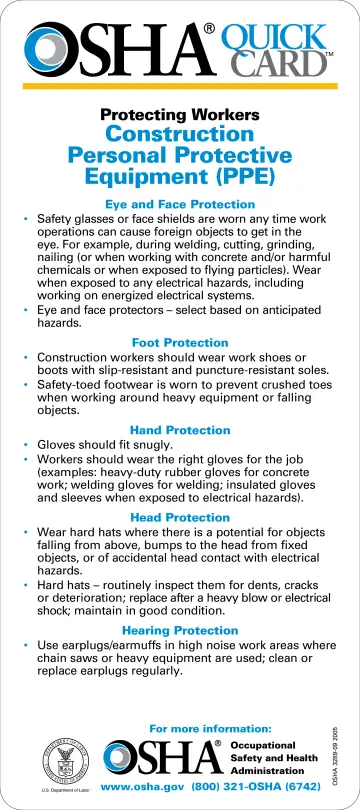
1 slidesConstruction PPE QuickCard (OSHA 3289)
Pocket card on hard hats, eye, hearing, hand and foot protection on construction sites.
U.S. Department of Labor, OSHAPublic domain
pdfes
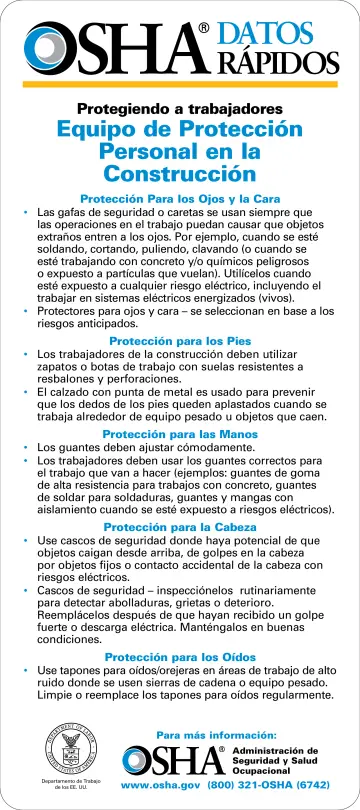
1 slidesTarjeta: EPP en la construcción (OSHA 3289)
Spanish construction PPE QuickCard.
U.S. Department of Labor, OSHAPublic domain
pdf
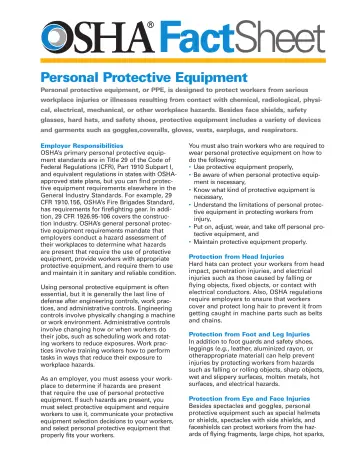
2 slidesPersonal Protective Equipment Fact Sheet
OSHA fact sheet on PPE requirements and employer responsibilities.
U.S. Department of Labor, OSHAPublic domain