1 / 5Use ← → to flip
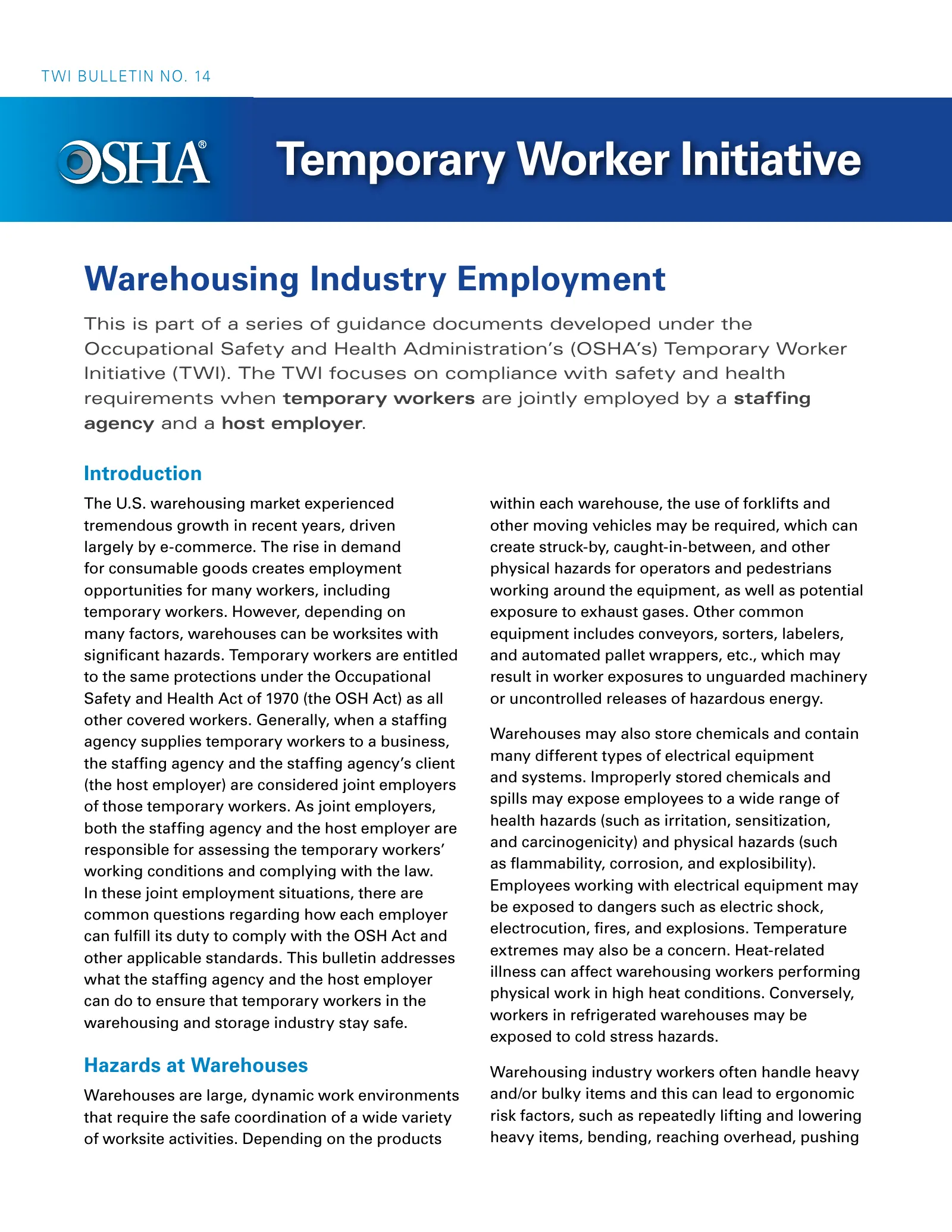
Temporary Worker Initiative (TWI) Bulletin No. 14 – Warehousing Industry Employment (OSHA 4384)
OSHA fact sheet or bulletin, for General Industry classes.
Page text
· 5 pages · by U.S. Department of Labor, OSHA
The words on each page as the author wrote them, read from the file by software so they can be searched. Layout, pictures and tables are not shown here: the pages above and the download are the original.
- Page 1
Temporary Worker Initiative
- T WI BULLETIN NO. 14
- Warehousing Industry Employment
- This is part of a series of guidance documents developed under the Occupational Safety and Health Administration’s (OSHA’s) Temporary Worker Initiative (TWI). The TWI focuses on compliance with safety and health requirements when temporary workers are jointly employed by a staffing agency and a host employer.
- Introduction
- The U.S. warehousing market experienced tremendous growth in recent years, driven largely by e-commerce. The rise in demand for consumable goods creates employment opportunities for many workers, including temporary workers. However, depending on many factors, warehouses can be worksites with significant hazards. Temporary workers are entitled to the same protections under the Occupational Safety and Health Act of 1970 (the OSH Act) as all other covered workers. Generally, when a staffing agency supplies temporary workers to a business, the staffing agency and the staffing agency’s client (the host employer) are considered joint employers of those temporary workers. As joint employers, both the staffing agency and the host employer are responsible for assessing the temporary workers’ working conditions and complying with the law.
- In these joint employment situations, there are common questions regarding how each employer can fulfill its duty to comply with the OSH Act and other applicable standards. This bulletin addresses what the staffing agency and the host employer can do to ensure that temporary workers in the warehousing and storage industry stay safe.
- Hazards at Warehouses
- Warehouses are large, dynamic work environments that require the safe coordination of a wide variety of worksite activities. Depending on the products within each warehouse, the use of forklifts and other moving vehicles may be required, which can create struck-by, caught-in-between, and other physical hazards for operators and pedestrians working around the equipment, as well as potential exposure to exhaust gases. Other common equipment includes conveyors, sorters, labelers, and automated pallet wrappers, etc., which may result in worker exposures to unguarded machinery or uncontrolled releases of hazardous energy.
- Warehouses may also store chemicals and contain many different types of electrical equipment and systems. Improperly stored chemicals and spills may expose employees to a wide range of health hazards (such as irritation, sensitization, and carcinogenicity) and physical hazards (such as flammability, corrosion, and explosibility). Employees working with electrical equipment may be exposed to dangers such as electric shock, electrocution, fires, and explosions. Temperature extremes may also be a concern. Heat-related illness can affect warehousing workers performing physical work in high heat conditions. Conversely, workers in refrigerated warehouses may be exposed to cold stress hazards.
- Warehousing industry workers often handle heavy and/or bulky items and this can lead to ergonomic risk factors, such as repeatedly lifting and lowering heavy items, bending, reaching overhead, pushing
- Page 2
Employer Responsibilities
- and pulling heavy loads, working in awkward body postures, and performing the same or similar tasks repetitively. These ergonomic stressors put workers at risk of musculoskeletal disorders, such as low back injuries.
- In summary, neither employer may avoid their responsibilities under the OSH Act by requiring another party to perform them.
- In most cases, the host employer, because it is in the best position to select and give any training required of their operations, is responsible for site-specific training, while the staffing agency is responsible for general safety and health training. However, it is the responsibility of both the staffing agency and the host employer to be familiar with applicable OSHA standards, comply with all training requirements, and delineate in their contract their respective responsibilities. The goal is to ensure that workers know how to do their work safely, can identify hazards, and understand control and protective measures.
- Goods are often stored vertically and can fall from varying heights so safe storage and handling of materials is critical. Slips, trips, and falls can be a common cause for accidents as warehouses may have poorly lit areas, litter on floors such as packaging and other items, and the environment is ever-changing. Additionally, exit routes must not be blocked by obstacles or stored materials, and exit doors should never be locked.
- Because warehouse workers face many hazards, providing proper communication, appropriately designing the facility and equipment layout, properly storing materials, and training are critical to keeping them safe. It is recommended that both the staffing agency and the host employer develop written illness and injury prevention programs outlining how each employer protect their workers. When feasible, the host employer and staffing agency should exchange and review each other’s programs.
- All employers covered under the OSH Act must ensure that their workers are provided a safe and healthy workplace and protected from recognized hazards such as those listed above.
- The staffing agency and the host employer share the responsibility for training temporary workers. Training should be completed before the worker begins work and it must be in a language and vocabulary the worker understands. Training requirements vary depending on potential hazards, location of the worksite, and assigned duties. As a recommended practice, the staffing agency and host employer should discuss responsibility for each aspect of training.
- Host Employer Responsibilities
- The host employer is usually in the best position to ensure compliance with OSHA requirements at the worksite and provide site-specific training because it generally controls the means, methods, and processes by which the work is accomplished, and so is familiar with the associated hazards. Therefore, the host employer is responsible for site-specific protections, policies, and procedures, including training. Also, while the host employer may take the lead on performing the worksite hazard assessment (or job hazard analysis), it should share the results with the staffing agency and should also allow the staffing agency to conduct its own assessment. The host employer should provide the staffing agency with all information regarding the requirements for assigned tasks. The host employer should also partner with and allow access to the staffing agency when investigations are conducted.
- The specific type of training to be provided should be done in a language and level of understanding appropriate for the workforce, which should be clearly stated in the contract between the host employer and the staffing agency. Under most circumstances, host employers are in the best position to determine and provide worksitespecific training that covers hazards and control methods present at their establishment. While employers cannot discharge or subcontract their legal responsibilities to another party, the host employer may specify the qualifications required for temporary workers in its contract with the staffing agency; however, the host employer is responsible for providing any training required by an OSHA standard that relates to the specific hazards found in the host employer’s workplace.
- Page 3
Staffing Agency Responsibilities
- The staffing agency should maintain effective communication with its workers and the host employer. Such ongoing communication also alerts the staffing agency to additional or newly created workplace hazards that may need to be addressed.
- The staffing agency has a duty to inquire into the conditions of their workers’ assigned workplaces and verify that the host employer has fulfilled its responsibilities for a safe workplace. The staffing agency is typically responsible for providing general safety and health training so that its employees have the ability to identify hazardous situations, report hazards, injuries and illnesses, and understand their rights if confronted with a hazardous situation at a warehouse worksite. The staffing agency is also responsible for ensuring that employees receive site-specific training, although the host may provide such on-site training. To fulfill this obligation, the staffing agency must inquire and verify that the host employer’s training adequately addresses the potential hazards to which employees will be exposed at the host employer’s worksite. If the staffing agency has reason to believe the site-specific training is not adequate, the agency should inform the host employer and work with the employer to provide adequate training. The staffing agency may elect to remove their workers from the host employer’s worksite if identified hazards are not corrected.
- Joint Responsibilities
- The staffing agency and the host employer should jointly assess all worksites for potential hazards to which the temporary worker might foreseeably be exposed during assigned work. These assessments (or job hazard analyses) will provide for the identification and elimination of potential safety and health hazards through training, work practices, and necessary protective equipment for each worker. Staffing agencies need not become experts on specific workplace hazards, but should determine what conditions exist at the worksite, what hazards may be encountered, and how to best ensure protection for the temporary workers. For example, see TWI Bulletin #5 – Hazard Communication for additional information for when workers may handle hazardous chemicals in the warehouse. (29 CFR 1910.1200)
- Employers must provide and ensure the proper use and maintenance of personal protective equipment (PPE) when it is required by OSHA standards or by the employer. The host employer will usually have the primary responsibility for selecting, providing, and ensuring the use of adequate PPE for each process or operation workers are assigned. For example, see TWI Bulletin #2 – Personal Protective Equipment for additional information on the types of PPE that may be needed like head, foot, or hand protection. (29 CFR 1910.132)
- Even where a staffing agency has a representative at the host employer’s worksite, the presence of that representative does not transfer responsibilities for site-specific training to the staffing agency. The staffing agency should conduct a walkthrough of the warehouse worksite to identify tasks that temporary employees will perform, and any hazards related to those tasks. However, the employer responsible for the sitespecific training (determined by supervision and control over the workers and hazards – typically the host employer) should still ensure that workers complete the training and that the training is adequate before work begins. Where the staffing agency has an on-site representative, the staffing agencies must evaluate the host employer’s worksite, ensure they understand medical screening and surveillance requirements instituted by the host employer, if appropriate, and conduct post-incident and illness investigations.
- The host employer is usually best situated to perform the hazard assessment required for determining if PPE is necessary and will likely have already done so for its permanent staff (29 CFR 1910.132(d)). See also, TWI Bulletin #7 – Powered Industrial Truck Training and TWI Bulletin #10 – The Control of Hazardous Energy (Lockout/Tagout).
- Page 4
Example Scenario*
- Fulfillment Plus owns a 200,000 square foot fulfillment warehouse that employs more than 1,500 workers. In the warehouse, workers pick, pack, and ship customer orders such as books, toys, housewares and more. In a tight labor market, Fulfillment Plus has difficulty attracting and retaining qualified hourly workers so it reaches out to W.W. Staffing, a local staffing agency with a good reputation for sourcing qualified temporary workers. After entering into a written contract, W.W. Staffing supplies 50 temporary workers to the Fulfillment Plus warehouse. The temporary workers perform a variety of work tasks, including working on a conveyer belt assembly line and with a baler machine, picking and packing shipments, and breaking down cardboard boxes. For some of the temporary workers, Spanish is their primary language. Prior to their first day at Fulfillment Plus, W.W. Staffing provided the temporary workers with information about their various jobs and gave them general safety training, but only in English, not Spanish. Prior to starting their assignments, Fulfillment Plus provided the temporary workers with general safety guidelines, in both English and Spanish, and personal protective equipment requirements and materials.
- On the third day of work, a W.W. Staffing employee who speaks Spanish only notices that her job duties were relocated to a new area of the warehouse and she’s now working close to heavy machinery, specifically forklifts, conveyors, and sorters. Late that afternoon, she is feeling physically tired and she steps away from her sorting area when she is struck by a forklift that was driving too fast in a narrow aisle. Not wanting to make a bad impression so soon into her new assignment and not knowing who specifically to raise her concerns with or how to report that she was struck by a forklift, she decides not to say anything about the new job conditions to her W.W. Staffing manager or Fulfillment Plus on-site supervisor.
- Analysis
- As the host employer, Fulfillment Plus was responsible for providing site-specific training, but did not do so. Fulfillment Plus supervises and controls the day-to-day work of the temporary employees at its warehouse. It is in the best position to provide the site-specific training and procedures applicable to its workplace. For failing to provide appropriate site-specific hazard information and training including how to report an incident, Fulfillment Plus may be subject to OSHA citations. Depending on the circumstances, Fulfillment Plus may also face citations for failure to adequately train the forklift driver and enforce site-specific safety rules related to speed limits and pedestrian traffic, ensure wide aisle space, installing protection devices such as rack rails, and reporting and recording injuries.
- The staffing agency fulfilled some of its OSHA responsibilities by providing the general safety training but did not present information in a manner that some of the employees receiving it were capable of understanding, namely in Spanish. Since the staffing agency knew the workers would be working in a warehouse with potential hazards, it should have inquired about what training the host employer had in place to ensure that W.W. Staffing’s temporary workers were adequately protected. Staffing agencies are obligated to provide their workers with training on general safety and health topics and verify that they understand the elements included in the training. Additionally, staffing agencies must inform workers that they have the right to refuse to do work they reasonably believe to be dangerous or if they have not been adequately trained, and to contact the staffing agency immediately in the event of a safety incident or if working conditions or assignments change. W.W. Staffing may, therefore, be subject to OSHA citations for not meeting its obligations as an employer.
- *Note: The company names in this scenario are fictitious. Any resemblance to real company’s name is entirely coincidental.
- Page 5
State Plans
- Section 5(a)(1) of the OSH Act requires employers to provide a safe and healthful workplace for all workers. When investigations reveal that a temporary worker is exposed to a recognized hazard, and the worker is employed by both a staffing agency and a host employer, OSHA will consider issuing citations to either or both employers, depending on the specific facts of the case. OSHA will assess whether both employers have fulfilled their respective compliance responsibilities in each individual case.
- Twenty-nine states and U.S. territories operate their own OSHA-approved occupational safety and health programs, called State Plans.
- These State Plans have and enforce their own occupational safety and health standards that must be at least as effective as OSHA’s but may have different or additional requirements. A list of the State Plans and more information are available at: www.osha.gov/stateplans.
- How Can OSHA Help?
- Workers have a right to a safe workplace. If you think your job is unsafe or you have questions, contact OSHA at 1-800-321-OSHA (6742) or visit OSHA’s main web page at www.osha.gov. It’s confidential. We can help.
- For other valuable worker protection information, such as Workers’ Rights, Employer Responsibilities and other services OSHA offers, visit OSHA’s Workers’ page www.osha.gov/workers.
- For information on Temporary Workers visit
- OSHA’s Temporary Workers’ page www.osha.gov/temporaryworkers.
- The OSH Act prohibits employers from retaliating against their employees for exercising their rights under the OSH Act. These rights include raising a workplace health and safety concern with either employer, reporting an injury or illness, filing an OSHA complaint, and participating in an inspection or talking to an inspector. If workers have been retaliated or discriminated against for exercising their rights, they must file a complaint with OSHA within 30 days of the alleged adverse action to preserve their rights under section 11(c). For more information, please visit www.whistleblowers.gov.
- OSHA also provides help to employers. OSHA’s
- On-Site Consultation Program offers free and confidential advice to small and medium-sized businesses in all states and several territories, with priority given to high-hazard worksites.
- On-Site consultation services are separate from enforcement and do not result in penalties or citations. Consultants from state agencies or universities work with employers to identify workplace hazards, provide advice on compliance with OSHA standards, and assist in establishing and improving safety and health management systems. To locate the OSHA On-Site Consultation Program nearest you, call 1-800-321-6742 (OSHA) or visit www.osha.gov/consultation.
- OSHA 4384-10 2023
- Disclaimer: This bulletin is not a standard or regulation, and it creates no new legal obligations. It contains recommendations as well as descriptions of mandatory safety and health standards. The recommendations are advisory in nature, informational in content, and are intended to assist employers in providing a safe and healthful workplace. The Occupational Safety and Health Act requires employers to comply with safety and health standards and regulations promulgated by OSHA or by a state with an OSHA-approved state plan. In addition, the OSH Act’s General Duty Clause, Section 5(a)(1), requires employers to provide their employees with a workplace free from recognized hazards likely to cause death or serious physical harm.
More on Materials Handling
pptx
41 slidesMaterials Handling, Storage, Use, and Disposal (OSHA 10-Hour General Industry Outreach)
OSHA's general industry outreach deck on materials handling (2017); useful companion slides on lifting, storage and powered industrial trucks.
U.S. Department of Labor, OSHAPublic domain
pdf
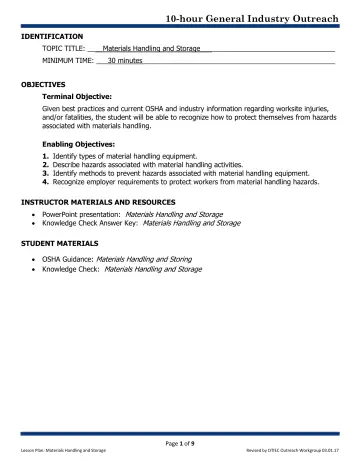
9 slidesMaterials Handling, Storage, Use, and Disposal: Lesson Plan (OSHA 10-Hour General Industry Outreach)
Instructor lesson plan (objectives, timing, teaching steps) for the OSHA General Industry materials handling, storage, use, and disposal outreach deck.
U.S. Department of Labor, OSHA (with the OTIEC Outreach Workgroup)Public domain
pdf
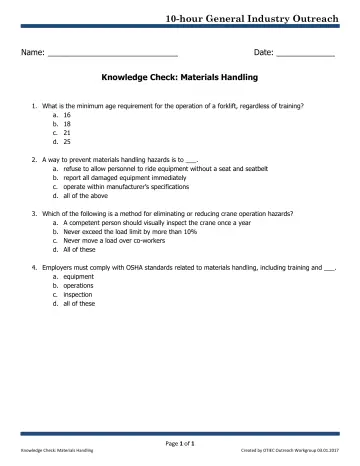
1 slidesMaterials Handling, Storage, Use, and Disposal: Knowledge Check (OSHA 10-Hour General Industry Outreach)
Student knowledge-check quiz for the OSHA General Industry materials handling, storage, use, and disposal outreach deck.
U.S. Department of Labor, OSHA (with the OTIEC Outreach Workgroup)Public domain