Materials Handling, Storage, Use, and Disposal: Lesson Plan (OSHA 10-Hour General Industry Outreach)
Instructor lesson plan (objectives, timing, teaching steps) for the OSHA General Industry materials handling, storage, use, and disposal outreach deck.
Page text
· 9 pages · by U.S. Department of Labor, OSHA (with the OTIEC Outreach Workgroup)
The words on each page as the author wrote them, read from the file by software so they can be searched. Layout, pictures and tables are not shown here: the pages above and the download are the original.
- Page 1
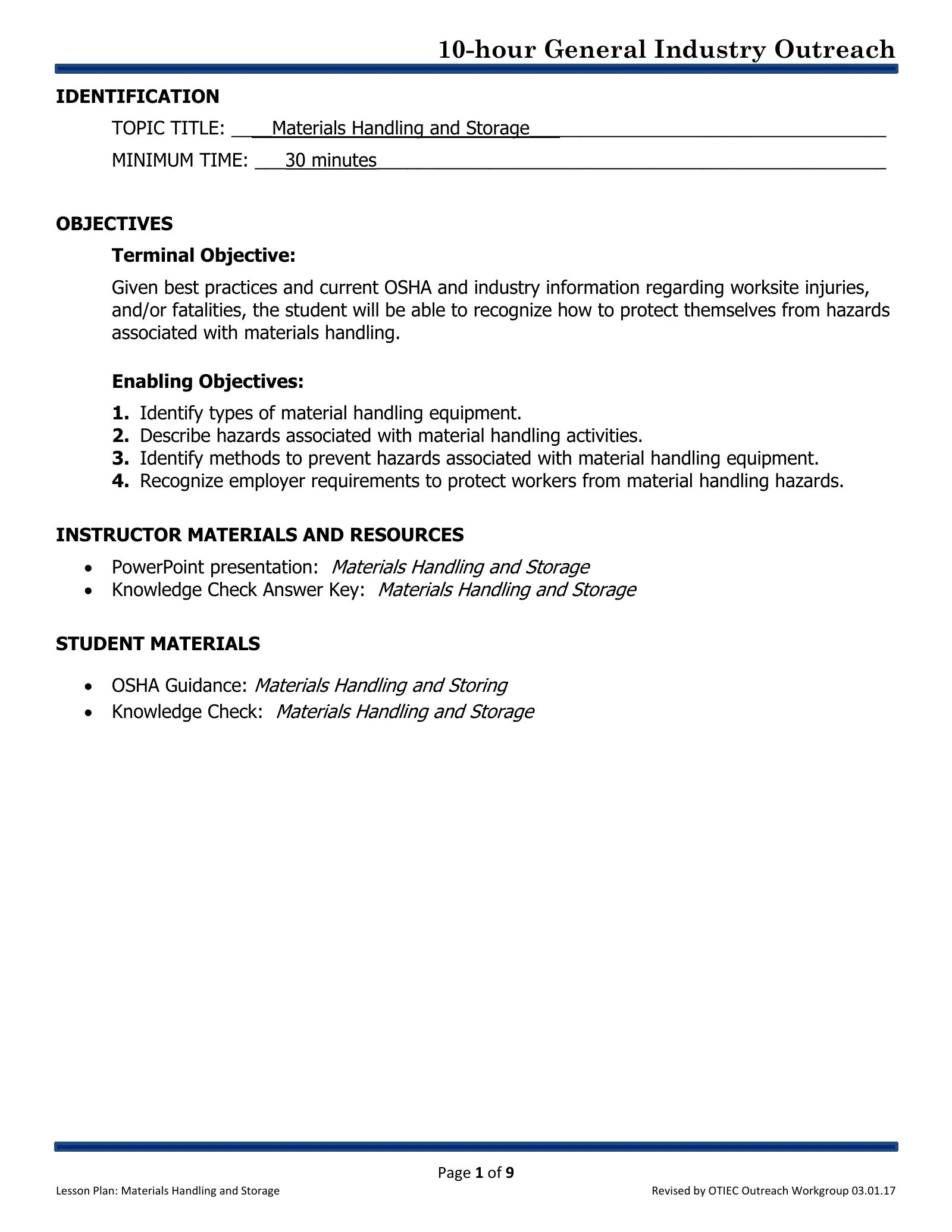
IDENTIFICATION
- TOPIC TITLE: ___Materials Handling and Storage___
- MINIMUM TIME: ___30 minutes___
- OBJECTIVES
- Terminal Objective:
- Given best practices and current OSHA and industry information regarding worksite injuries, and/or fatalities, the student will be able to recognize how to protect themselves from hazards associated with materials handling.
- Enabling Objectives:
- 1. Identify types of material handling equipment.
- 2. Describe hazards associated with material handling activities.
- 3. Identify methods to prevent hazards associated with material handling equipment.
- 4. Recognize employer requirements to protect workers from material handling hazards.
- INSTRUCTOR MATERIALS AND RESOURCES
- PowerPoint presentation: Materials Handling and Storage Knowledge Check Answer Key: Materials Handling and Storage
- STUDENT MATERIALS
- OSHA Guidance: Materials Handling and Storing
- Knowledge Check: Materials Handling and Storage
- Page 2
TEACHING PROCEDURES ---Preparation, Presentation, Application, Evaluation
- Anticipatory Set (Focus Attention/ Gain I nterest)
- Estim ated Tim e: ?? hours
- Key Points
- Methods
- Handling and storing materials involves operations such as hoisting materials with a crane, driving a truck loaded with heavy materials, manually carrying bags, and stacking drums, bags and loose materials. Improper handling and storing of materials can cause costly injuries and may even cause fatalities.
- PPT slides #1 – #2
- Workers frequently cite the weight and bulkiness of objects being lifted as causes of their injuries. Bending, twisting and turning are movements that cause back injuries. Back injuries account for over 20 percent of all occupational illnesses. The majority of over-exertion cases with lost-workdays are due to lifting, pushing/pulling, and carrying. Those cases represent 27 percent of all lost-workday cases.
- Presentation (I nstruction)___
- Key Points
- I.
- Types of Materials Handling Equipment
- A. Conveyors
- B. Cranes
- C. Rigging
- D. Powered Industrial Trucks
- II.
- Hazards Associated with Materials Handling Activities
- A. Factors cited by workers as contributors to injuries
- 1. Major contributors – weight and bulkiness of objects
- 2. Other common contributors – bending, twisting, and turning movements.
- B. Hazards
- 1. Improper operation of equipment, such as forklifts, cranes, and work trucks
- 2. Accumulated materials or clutter that present tripping hazards, fire/explosion hazards, or hazards associated with the harboring of rats and other pests
- Methods
- PPT slides #3 – #4
- PPT slides #5 - #13
- Page 3
- Unsafe conditions of materials or containers, such as protruding nails, dry rot, or deteriorated containers
- 4. Flammability or toxicity of some materials
- 5. Weight of materials in excess of capabilities of lifting equipment, floors, or storage shelves
- 6. Improperly cutting of binding ties or other devices that secure bundles or bound materials
- 7. Falling objects from improper handling or storage
- 8. Lifting, pushing, pulling, or otherwise manually moving large, heavy items
- 9. Improperly stacked materials that have a potential to slide, fall, or collapse leading to struck-by or crushedby incidents
- 10. Struck-by or caught-in/-between hazards related to equipment, machinery, or falling loads
- C. Injuries associated with materials handling
- 3. Commonly reported injuries
- a. Sprains, strains, tears
- b. Soreness and pain
- c. Bruises and contusions
- d. Cuts, lacerations, punctures, crushing, and amputation
- 4. Events or exposures leading to injuries include, but are not limited to:
- a. Contact with objects and equipment
- b. Transportation incidents
- c. Exposure to harmful substances or environments
- d. Falls, slips, trips, or loss of balance
- e. Repetitive motion
- f. Overexertion
- III.
- Preventing Hazards Associated with Material Handling Equipment
- A. Moving materials manually
- 1. Use devices to assist with holding loads
- 2. Wear PPE
- 3. Use proper lifting technique
- 4. Seek help for oversized loads
- 5. Use blocking materials
- PPT slides #14 – #32
- Page 4
B. Cranes
- 1. Operation safety
- a. Never move load over other workers; do not allow workers to walk underneath a load
- b. Return load block to designated location after use
- c. Do not leave load block low enough for someone to run into
- d. Never leave a suspended load unattended
- e. Do not leave unused slings suspended on a crane hook
- f. Store wall-mounted cranes against the wall
- g. Continuously observe equipment for any sign of problems during operation
- h. Don’t allow yourself to become distracted
- 2. Handling and storing materials often involves operations such as hoisting tons of material, with cranes. Only thoroughly trained and competent workers are permitted to operate cranes.
- 3. Use the following methods to eliminate or reduce hazards of crane operations:
- a. Operators should know how much they are lifting, how much it weighs, the rated capacity of the crane, and when a load is safe to lift.
- b. Always check for crane load chart and do not exceed load limits for the operating conditions.
- c. A qualified person must inspect equipment that has been repaired, or adjusted and must inspect equipment post-assembly and at least every 12 months; equipment not in regular use must be inspected if idle for 3 months or more.
- d. A competent person must begin visual inspection of equipment prior to each shift that must be completed before or during the shift. A monthly inspection must also be completed before equipment can be used.
- C. Rigging
- 1. Rigging connects a crane hook to a load and is an important rigging tool.
- 2. To eliminate or reduce hazards, rigging need to be:
- a. Inspected every day before they are used and
- Page 5
- whenever service conditions change that could warrant another inspection;
- b. Removed from service if they are found damaged or defective in any way; and,
- c. Lubricated in the field to lengthen its useful service.
- d. Selected for use based on the requirements of the job. Wire rope slings are used to hoist materials.
- Alloy steel chain slings are the best choice for hoisting very hot materials.
- e. Do not shorten slings with knots or bolts or other makeshift devices and do not kink sling legs.
- f. Must have manufacturers name and capacity tag and be legible
- g. All components of a rigging system must be compatible and rated to the same capacity. (a rigging system is only as good as its weakest link)
- D. Forklifts
- 1. The four main causes of injuries involving forklifts include:
- a. Forklift overturns
- b. Forklift striking workers on foot
- c. Persons crushed by forklifts
- d. Persons falling from forklifts
- 2. It is illegal for anyone to operate a forklift if they are under 18 years of age or over 18 years of age and not properly trained and certified to do so.
- 3. Use best practices for forklift operations, including:
- a. Driving the forklift
- i. Slow down and sound the horn at locations where vision is obstructed.
- ii. Look toward the travel path and keep a clear view of it.
- iii. Don’t drive up to anyone standing in front of a bench or other fixed object.
- iv. Don’t drive with the work platform elevated.
- v. Use seatbelts.
- vi. Don’t raise or lower the forks while the forklift is moving.
- vii. Maintain safe distance approximately three truck lengths from the truck ahead.
- Page 6
- b. Elevating workers
- i. Don’t use a forklift to elevate workers who are standing on the forks.
- ii. Only lift personnel with approved lift platform.
- iii. Elevate a worker on an approved lift platform only when the vehicle is directly below the work area.
- iv. Whenever a truck is used to elevate personnel, secure the elevating platform to the lifting carriage or forks of the forklift.
- v. Use a fall protection for worker(s) on the platform.
- c. Driving on grades/ramps
- i. Use extreme caution when driving on grades or ramps.
- ii. Do not turn on grades or ramps.
- iii. On grades, tilt the load back and raise it only as far as needed to clear the road surface.
- iv. When ascending or descending grades are greater than 10%, drive loaded trucks with the load upgrade, drive unloaded with counterbalance upgrade.
- d. Operating speed – operate forklift at a speed that will permit it to be stopped safely.
- e. Exiting the forklift
- i. When dismounting, set the parking brake, lower the forks or lifting carriage, and neutralize the controls.
- ii. Exit from a stand-up type forklift with rear-entry access by stepping backward if a lateral tip-over occurs.
- f. Riding on the forklift – do not allow passengers on forklift trucks unless a seat is provided by design.
- g. Avoiding excess weight – do not handle loads that are heavier than the weight capacity of the forklift.
- h. Avoiding struck-by or crushed-by hazards.
- i. Don’t jump from an overturning, sit-down type forklift.
- Page 7
- ii.
- IV.
- Stay with the truck, hold on firmly to the steering wheel, and lean in the opposite direction of the overturn.
- i. Training – do not operate a forklift without proper training and certification.
- j. Reporting damage – any damage or problems that occur to a forklift during a shift should be reported to the supervisor immediately.
- When dock boards are used to bridge a loading dock and a truck so the forklift can load or unload materials, follow these requirements:
- a. Use appropriate weight-rated platform to bridge space.
- b. Secure portable dock boards so that they will not move.
- c. Ensure that dock boards have handholds or some other effective way to lift, manage, or move them safely.
- Employer Requirements
- A. Comply with OSHA standards related to materials handling, including
- 1. Training requirements
- 2. Inspection requirements
- 3. Maintenance and repair
- B. Comply with manufacturers’ requirements and recommendations for materials handling equipment.
- Application (How students apply w hat they learn) __
- PPT slides #33 – #34
- Estim ated Tim e: ?? hours
- Key Points
- Methods
- Identify hazards in worksite photos and discuss possible solutions.
- PPT slides #35 – #37
- Using small items (little boxes, small blocks of wood, little bags of beans, or similar items) have students practice placing materials in tiers using an acceptable method to prevent sliding, falling, or collapse
- (i.e., stacked, racked, blocked, interlocked, or otherwise secured).
- Page 8
- Using empty boxes, have student demonstrate proper lifting techniques.
- Evaluation/ Sum m ary
- Estim ated Tim e: ?? hours
- Key Points
- Methods
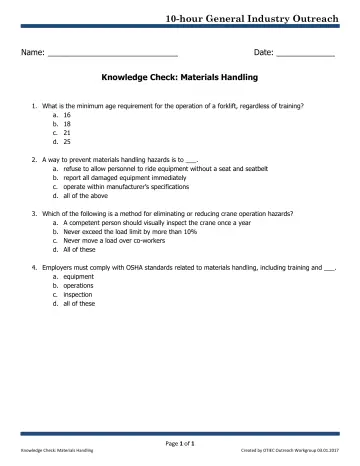
- Knowledge Check: Materials Handling, Storage, Use and Disposal .
- PPT slides #38 – #41
- References
- OSHA Standard
- 1910 Subpart N - Materials Handling and Storage o
- 1910.176 - Handling materials - general.
- 1910.177 - Servicing multi-piece and single piece rim wheels.
- 1910.177 App A - Trajectory o
- 1910.177 App B - Ordering Information for the OSHA Charts
- 1910.178 - Powered industrial trucks.
- 1910.178 App A - Powered industrial trucks.
- 1910.179 - Overhead and gantry cranes.
- 1910.180 - Crawler locomotive and truck cranes.
- 1910.181 - Derricks.
- 1910.183 - Helicopters.
- 1910.184 - Slings.
- OSHA Publications
- Material Hoist Collapse: Fatal Facts (OSHA 3718 - 2014) (English: PDF*)
- Materials Handling and Storage (OSHA 2236 - 2002) (English: PDF*)
- Hazards Associated with Operating Skid-Steer Loaders with Bypassed and/or Improperly Maintained Safety Devices (2009, January 12) (English: HTML PDF*)
- Page 9
- Hazards of Transporting, Unloading, Storing and Handling Granite, Marble and Stone Slabs
- (2008, August 12) (English: HTML)
- Sling Safety (OSHA 3072 - 1996) (English: HTML PDF*)
- Standup Forklift Under-ride Hazards (2009, July 27) (English: HTML PDF*)
- Warehousing - Pocket Guide (OSHA 3220 - 2004) (English: HTML PDF*)
- OSHA References/Resources
- Powered Industrial Trucks - Operating the Forklift , OSHA eTool, https://www.osha.gov/SLTC/etools/pit/operations/loadhandling.html
- Crane, Derrick and Hoist Safety
- Injuries associated with Materials Handling https://www.osha.gov/SLTC/cranehoistsafety/index.html https://www.osha.gov/SLTC/ergonomics/identifyprobs.html
More on Materials Handling
Materials Handling, Storage, Use, and Disposal (OSHA 10-Hour General Industry Outreach)
OSHA's general industry outreach deck on materials handling (2017); useful companion slides on lifting, storage and powered industrial trucks.
Materials Handling, Storage, Use, and Disposal: Knowledge Check (OSHA 10-Hour General Industry Outreach)
Student knowledge-check quiz for the OSHA General Industry materials handling, storage, use, and disposal outreach deck.
Manejo, almacenamiento, uso y eliminación de materiales (Capacitación de Extensión de 10 horas de OSHA, Industria General)
Spanish edition of OSHA's 10-hour General Industry Outreach deck on materials handling, storage, use, and disposal (PDF slides; OSHA does not publish an editable Spanish PowerPoint).