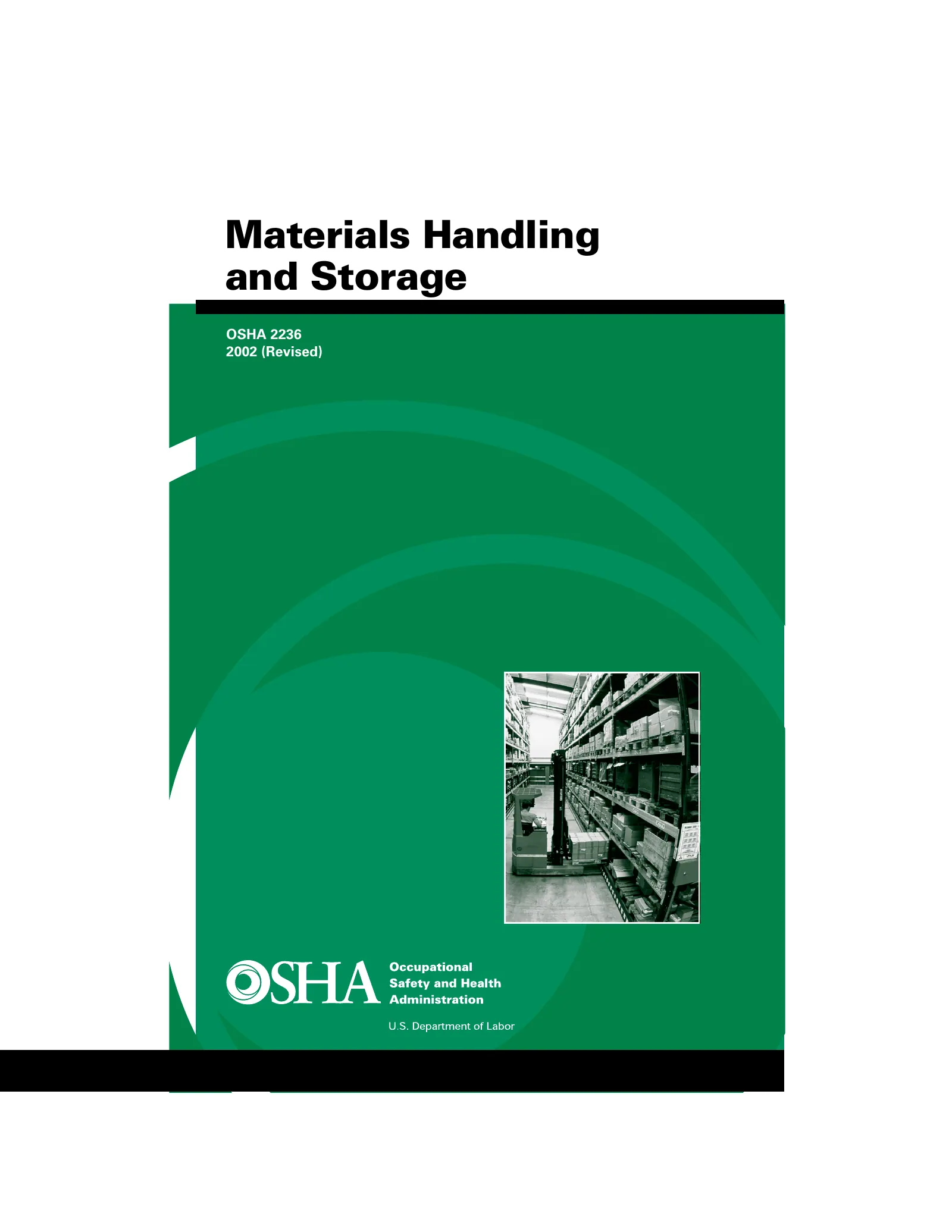
Materials Handling and Storage (OSHA 2236)
OSHA booklet on moving, handling and storing materials: manual lifting, forklifts, cranes, slings and stacking.
Page text
· 39 of 41 pages · by U.S. Department of Labor, OSHA
The words on each page as the author wrote them, read from the file by software so they can be searched. Layout, pictures and tables are not shown here, and long pages are shortened: the pages above and the download are the original.
- Page 1
Materials Handling and Storage
- OSHA 2236
- 2002 (Revised)
- Page 3
Contents
- Introduction … 1
- What should your employees know before moving, handling, and storing materials? … 1
- What are the potential hazards for workers? … 2
- What precautions should workers take when moving materials manually? … 2
- What precautions should workers take when moving materials mechanically? … 3
- What precautions must workers take to avoid storage hazards? … 4
- What safeguards must workers follow when stacking materials? … 5
- Important Safety Measures … 7
- What safety measures should employers take regarding conveyors? … 7
- What safety measures should employers take regarding cranes? … 8
- What must employers do to ensure the safe use of slings? … 10
- What must employers do to protect workers who operate powered industrial trucks? … 10
- …
- Page 4
Basic Safety and Health Principles … 16
- What is ergonomics? … 16
- What about fire safety? … 16
- What about aisles and passageways? … 17
- Training and Education … 18
- Should the prevention of some injuries receive special emphasis? … 18
- How can employers make their training programs more effective? … 19
- OSHA Assistance … 20
- What are safety and health system management guidelines? … 20
- What are state programs? … 21
- How do I obtain consultation services? … 21
- What are Voluntary Protection Programs (VPPs)? … 22
- What is the Strategic Partnership Program? … 23
- Does OSHA offer training and education? … 23
- Does OSHA provide any information electronically? … 24
- How do I learn more about related OSHA publications? … 25
- …
- Page 5
Introduction
- Handling and storing materials involve diverse operations such as hoisting tons of steel with a crane; driving a truck loaded with concrete blocks; carrying bags or materials manually; and stacking palletized bricks or other materials such as drums, barrels, kegs, and lumber.
- The efficient handling and storing of materials are vital to industry. In addition to raw materials, these operations provide a continuous flow of parts and assemblies through the workplace and ensure that materials are available when needed. Unfortunately, the improper handling and storing of materials often result in costly injuries.
- What should your employees know before moving, handling, and storing materials?
- …
- Page 6
What are the potential hazards for workers?
- Workers frequently cite the weight and bulkiness of objects that they lift as major contributing factors to their injuries. In 1999, for example, more than 420,000 workplace accidents resulted in back injuries. Bending, followed by twisting and turning, were the more commonly cited movements that caused back injuries.
- Other hazards include falling objects, improperly stacked materials, and various types of equipment. You should make your employees aware of potential injuries that can occur when manually moving materials, including the following:
- Strains and sprains from lifting loads improperly or from carrying loads that are either too large or too heavy,
- …
- Page 7
- Using the following personal protective equipment prevents needless injuries when manually moving materials:
- Hand and forearm protection, such as gloves, for loads with sharp or rough edges.
- Eye protection.
- Steel-toed safety shoes or boots.
- Metal, fiber, or plastic metatarsal guards to protect the instep area from impact or compression.
- See OSHA’s booklet, Personal Protective Equipment (OSHA 3077), for additional information.
- Employees should use blocking materials to manage loads safely. Workers should also be cautious when placing blocks under a raised load to ensure that the load is not released before removing their hands from under the load. Blocking materials and timbers should be large and strong enough to support the load safely. …
- …
- Page 8
- Although workers may be knowledgeable about powered equipment, they should take precautions when stacking and storing material. When picking up items with a powered industrial truck, workers must do the following:
- Center the load on the forks as close to the mast as possible to minimize the potential for the truck tipping or the load falling,
- Avoid overloading a lift truck because it impairs control and causes tipping over,
- Do not place extra weight on the rear of a counterbalanced forklift to allow an overload,
- Adjust the load to the lowest position when traveling,
- Follow the truck manufacturer’s operational requirements, and
- Pile and cross-tier all stacked loads correctly when possible.
- What precautions must workers take to avoid storage hazards?
- …
- Page 9
What safeguards must workers follow when stacking materials?
- Separate noncompatible material; and
- Equip employees who work on stored grain in silos, hoppers, or tanks, with lifelines and safety belts.
- In addition, workers should consider placing bound material on racks, and secure it by stacking, blocking, or interlocking to prevent it from sliding, falling, or collapsing.
- Stacking materials can be dangerous if workers do not follow safety guidelines. Falling materials and collapsing loads can crush or pin workers, causing injuries or death. To help prevent injuries when stacking materials, workers must do the following:
- Stack lumber no more than 16 feet high if it is handled manually, and no more than 20 feet if using a forklift;
- …
- Page 10
During materials stacking activities, workers must also do the following:
- Store baled paper and rags inside a building no closer than 18 inches to the walls, partitions, or sprinkler heads;
- Band boxed materials or secure them with cross-ties or shrink plastic fiber;
- Stack drums, barrels, and kegs symmetrically;
- Block the bottom tiers of drums, barrels, and kegs to keep them from rolling if stored on their sides;
- Place planks, sheets of plywood dunnage, or pallets between each tier of drums, barrels, and kegs to make a firm, flat, stacking surface when stacking on end;
- Chock the bottom tier of drums, barrels, and kegs on each side to prevent shifting in either direction when stacking two or more tiers high; and
- …
- Page 11
Important Safety Measures
- To reduce the number of accidents associated with workplace equipment, employers must train employees in the proper use and limitations of the equipment they operate. In addition to powered industrial trucks, this includes knowing how to safely and effectively use equipment such as conveyors, cranes, and slings.
- What safety measures should employers take regarding conveyors?
- When using conveyors, workers may get their hands caught in nip points where the conveyor medium runs near the frame or over support members or rollers. Workers also may be struck by material falling off the conveyor, or they may get caught in the conveyor and drawn into the conveyor path as a result. …
- …
- Page 12
What safety measures should employers take regarding cranes?
- material. (If the crossover is low enough for workers to run into it, mark the guard with a warning sign or paint it a bright color to protect employees.)
- Cover screw conveyors completely except at loading and discharging points. (At those points, guards must protect employees against contacting the moving screw. The guards are movable, and they must be interlocked to prevent conveyor movement when the guards are not in place.)
- Employers must permit only thoroughly trained and competent workers to operate cranes. Operators should know what they are lifting and what it weighs. For example, the rated capacity of mobile cranes varies with the length of the boom and the boom radius. …
- …
- Page 13
- Require workers to always check the crane’s load chart to ensure that the crane will not be overloaded by operating conditions.
- Instruct workers to plan lifts before starting them to ensure that they are safe.
- Tell workers to take additional precautions and exercise extra care when operating around power lines.
- Teach workers that outriggers on mobile cranes must rest on firm ground, on timbers, or be sufficiently cribbed to spread the weight of the crane and the load over a large enough area. (Some mobile cranes cannot operate with outriggers in the traveling position.)
- Direct workers to always keep hoisting chains and ropes free of kinks or twists and never wrapped around a load.
- …
- Page 14
What must employers do to ensure the safe use of slings?
- As an employer, you must designate a competent person to conduct inspections of slings before and during use, especially when service conditions warrant. In addition, you must ensure that workers observe the following precautions when working with slings:
- Remove immediately damaged or defective slings from service.
- Do not shorten slings with knots or bolts or other makeshift devices.
- Do not kink sling legs.
- Do not load slings beyond their rated capacity.
- Keep suspended loads clear of all obstructions.
- Remain clear of loads about to be lifted and suspended.
- Do not engage in shock loading.
- Avoid sudden crane acceleration and deceleration when moving suspended loads.
- …
- Page 15
What are the safety requirements for design?
- All new powered industrial trucks, except vehicles intended primarily for earth moving or over-the-road hauling, must meet the design and construction requirements for powered industrial trucks established in the American National Standard for Powered Industrial Trucks, Part II, ANSI B56.1-1969. Trucks approved for fire safety also must bear a label, or some other identifying mark, indicating acceptance by a nationally recognized testing laboratory.
- What are the safety requirements for modification?
- You and your employees must not make modifications and additions affecting capacity and safe operation of the trucks without the manufacturer’s prior written approval. …
- …
- Page 16
Acetaldehyde
- Cyclopropane
- Ethylene
- Isoprene
- Hydrogen (or gases or vapors equivalent in hazard to hydrogen)
- Ethylene oxide
- Propylene oxide
- Diethyl ether
- Unsymmetrical dimethyl hydrazine
- In addition, workers may not use these trucks in atmospheres containing hazardous concentrations of metal dust, including aluminum, magnesium, and other metals of similarly hazardous characteristics. In atmospheres containing carbon black, coal, or coke dust, workers may use only approved powered industrial trucks designated as EX. Where dusts of magnesium, aluminum, or bronze may be present, fuses, switches, motor controllers, and circuit breakers of trucks must have enclosures specifically approved for such locations.
- …
- Page 17
- Workers may use these specially designed powered industrial trucks in locations where volatile flammable liquids or flammable gases are handled, processed, or used. The liquids, vapors, or gases should be confined within closed containers or closed systems and not allowed to escape. These trucks are approved and generally designated as DS, DY, ES, EE, EX, GS, or LPS. See Title 29 of the Code of Federal Regulations (CFR) Part 1910.178(b) for more detail on these designations.
- What safety precautions should employers and workers observe when operating or maintaining powered industrial trucks?
- When operating or maintaining powered industrial trucks, you and your employees must consider the following safety precautions:
- …
- Page 18
- Do not place arms and legs between the uprights of the mast or outside the running lines of the truck.
- Set brakes and put other adequate protection in place to prevent movement of trucks, trailers, or railroad cars when using powered industrial trucks to load or unload materials onto them.
- Provide sufficient headroom under overhead installations, lights, pipes, and sprinkler systems.
- Provide personnel on the loading platform with the means to shut off power to the truck whenever a truck is equipped with vertical only (or vertical and horizontal) controls elevatable with the lifting carriage or forks for lifting personnel.
- Secure dockboards or bridge plates properly so they won’t move when equipment moves over them.
- Handle only stable or safely arranged loads.
- …
- Page 19
- the identity of the person(s) performing the training or evaluation. In addition, you must conduct an evaluation of each powered industrial truck operator’s performance at least once every 3 years.
- You must also conduct such an evaluation as well as refresher training if one of the following applies:
- Operator is observed operating the vehicle in an unsafe manner;
- Operator is involved in an accident or near-miss incident;
- Operator receives an evaluation revealing unsafe operation of the truck;
- Operator is assigned to drive a different type of truck; or
- Condition in the workplace changes in a manner that could affect safe operation of the truck.
- For more information contact your Regional OSHA office or visit our website at…
- …
- Page 20
Basic Safety and Health Principles
- Employers can reduce injuries resulting from handling and storing materials by using some basic safety procedures such as adopting sound ergonomics practices, taking general fire safety precautions, and keeping aisles and passageways clear.
- What Is Ergonomics?
- Ergonomics is defined as the study of work and is based on the principle that the job should be adapted to fit the person rather than forcing the person to fit the job. Ergonomics focuses on the work environment, such as its design and function, as well as items—such as the design and function of work stations, controls, displays, safety devices, tools, and lighting to fit the employees’ physical requirements and to ensure their health and well being.
- …
- Page 21
What About Aisles and Passageways?
- where smoking and using an open flame or a spark-producing device is prohibited. Dissimilar materials that are dangerous when they come into contact with each other must be stored apart.
- When using aisles and passageways to move materials mechanically, workers must allow sufficient clearance for aisles at loading docks, through doorways, wherever turns must be made, and in other parts of the workplace. Providing sufficient clearance for mechanically-moved materials will prevent workers from being pinned between the equipment and fixtures in the workplace, such as walls, racks, posts, or other machines. Sufficient clearance also will prevent the load from striking an obstruction and falling on an employee.
- …
- Page 22
Training and Education
- OSHA recommends that employers establish a formal training program to teach workers how to recognize and avoid materials handling hazards. Instructors should be well-versed in safety engineering and materials handling and storing. The training should reduce workplace hazards by emphasizing the following factors:
- Dangers of lifting without proper training.
- Avoidance of unnecessary physical stress and strain.
- Awareness of what a worker can comfortably handle without undue strain.
- Use of equipment properly.
- Recognition of potential hazards and how to prevent or correct them.
- Should the prevention of some injuries receive special emphasis?
- Yes. Because of the high incidence of back injuries, both supervisors and employees should demonstrate…
- …
- Page 23
How can employers make their training programs more effective?
- Safe postures for lifting and timing for smooth, easy lifting.
- Aids such as stages, platforms, or steps, trestles, shoulder pads, handles, and wheels.
- Body responses—warning signals—to be aware of when lifting.
- To have an effective safety and health program covering materials handling and storing, your managers must take an active role in its development. You must convince first-line supervisors of the importance of controlling hazards associated with materials handling and storing and hold them accountable for employee training. An ongoing safety and health management system can motivate employees to continue using necessary protective gear and observing proper job procedures. …
- …
- Page 24
OSHA Assistance
- OSHA can provide extensive help through a variety of programs, including technical assistance about effective safety and health programs, state plans, workplace consultations, voluntary protection programs, strategic partnerships, and training and education, and more. Safety and health add value to your business, to your work, and to your life.
- What are safety and health system management guidelines?
- Effective management of worker safety and health protection is a decisive factor in reducing the extent and severity of work-related injuries and illnesses and their related costs. In fact, an effective safety and health program forms the basis of good worker protection and can save time and money–about $4 for every dollar spent–and increase…
- …
- Page 25
What are state programs?
- health program. The Federal Register notice is available online at www.osha.gov.
- The Occupational Safety and Health Act of 1970 (OSH Act) encourages states to develop and operate their own job safety and health plans. OSHA approves and monitors these plans. There are currently 26 state plans: 23 cover both private and public (state and local government) employment; 3 states, Connecticut, New Jersey, and New York, cover the public sector only. States and territories with their own OSHA-approved occupational safety and health plans must adopt standards identical to, or at least as effective as, the federal standards.
- How do I obtain consultation services?
- Consultation assistance is available on request to employers who want help in…
- …
- Page 26
What are Voluntary Protection Programs (VPPs)?
- Under the consultation program, certain exemplary employers may request participation in OSHA’s Safety and Health Achievement Recognition Program (SHARP). Eligibility for participation in SHARP includes receiving a comprehensive consultation visit, demonstrating exemplary achievements in workplace safety and health by abating all identified hazards, and developing an excellent safety and health program.
- Employers accepted into SHARP may receive an exemption from programmed inspections (not complaint or accident investigation inspections) for a period of 1 year. For more information concerning consultation assistance, see the list of consultation projects listed at the end of this publication.
- …
- Page 27
What is the Strategic Partnership Program?
- OSHA’s Strategic Partnership Program, the newest member of OSHA’s cooperative programs, helps encourage, assist, and recognize the efforts of partners to eliminate serious workplace hazards and achieve a high level of worker safety and health. Whereas OSHA’s Consultation Program and VPP entail one-on-one relationships between OSHA and individual worksites, most strategic partnerships seek to have a broader impact by building cooperative relationships with groups of employers and employees. These partnerships are voluntary, cooperative relationships between OSHA, employers, employee representatives, and others (e.g., trade unions, trade and professional associations, universities, and other government agencies).
- …
- Page 28
Does OSHA provide any information electronically?
- OSHA also provides funds to nonprofit organizations, through grants, to conduct workplace training and education in subjects where OSHA believes there is a lack of workplace training. Grants are awarded annually. Grant recipients are expected to contribute 20 percent of the total grant cost.
- For more information on grants, training, and education, contact the OSHA Training Institute, Office of Training and Education, 1555 Times Drive, Des Plaines, IL 60018, (847) 297-4810. For further information on any OSHA program, contact your nearest OSHA area or regional office listed at the end of this publication.
- OSHA has a variety of materials and tools available on its website–www.osha.gov. …
- …
- Page 29
How do I learn more about related OSHA publications?
- OSHA has an extensive publications program. For a listing of free or sales items, visit OSHA’s website at www.osha.gov or contact the OSHA Publications Office , U.S. Department of Labor, OSHA/OSHA Publications, P.O. Box 37535, Washington, DC 20013-7535. Telephone (202) 693-1888 or fax to (202) 693-2498.
- How do I contact OSHA about emergencies, complaints, or further assistance?
- To report an emergency, file a complaint, or seek OSHA advice, assistance, or products, call 1-800-321-OSHA or contact your nearest OSHA regional or area office listed at the end of this publication. The teletypewriter (TTY) number is 1-877-889-5627.
- You can also file a complaint online and obtain more information on OSHA federal and…
- …
- Page 30
Glossary
- Boom - A long, straight beam hinged at one end and used for lifting heavy objects by means of cables and/or hydraulics. Booms can be of lattice construction or be made of heavy tubular material.
- Boom radius - The horizontal distance from the axis of rotation of a crane or derrick boom to the boom tip.
- Bracing - A diagonal piece of structural material that serves to strengthen something.
- Chassis - The frame upon which a vehicle’s body is mounted.
- Chock - A wedge or block for steadying a body and holding it motionless, for filling in excess space, or for preventing the movement of a wheel.
- Competent person - one who can identify health and safety hazards in the workplace and has the authority to correct them.
- …
- Page 31
Related Publications
- Single free copies of the following publications can be obtained from the U.S. Department of Labor, OSHA/OSHA Publications Office, P.O. Box 37535, Washington, DC 20013- 7535. Send a self-addressed mailing label with your request. Publications may also be ordered from www.osha.gov.
- All About OSHA – OSHA 2056
- Concrete and Masonry Construction – OSHA 3106
- Consultation Services for the Employer – OSHA 3047
- Control of Hazardous Energy (Lockout/Tagout) – OSHA 3120
- Crane or Derrick Suspended Platforms – OSHA 3100
- Personal Protective Equipment – OSHA 3077
- Sling Safety – OSHA 3072
- The following publications are available from the Superintendent of Documents, U.S. Government Printing Office, P.O Box 371954, Pittsburgh, PA 15250-7954. …
- …
- Page 32
OSHA Office Directory
- OSHA Regional Offices
- Region I
- Region VI
- (CT,* ME, MA, NH, RI, VT*)
- JFK Federal Building, Room E340
- Boston, MA 02203
- (617) 565-9860
- (AR, LA, NM,* OK, TX)
- 525 Griffin Street, Room 602
- Dallas, TX 75202
- (214) 767-4731 or 4736 x224
- Region II
- Region VII
- (NJ,* NY,* PR,* VI*)
- 201 Varick Street, Room 670
- New York, NY 10014
- (212) 337-2378
- (IA,* KS, MO, NE)
- City Center Square
- 1100 Main Street, Suite 800
- Kansas City, MO 64105
- (816) 426-5861
- Region III
- (DE, DC, MD,* PA,* VA,* WV) The Curtis Center
- 170 S. Independence Mall West Suite 740 West
- Philadelphia, PA 19106-3309 (215) 861-4900
- Region VIII
- (CO, MT, ND, SD, UT,* WY*)
- 1999 Broadway, Suite 1690
- PO Box 46550
- Denver, CO 80202-5716
- (303) 844-1600
- Region IV
- Region IX
- …
- Page 33
OSHA Area Offices
- Birmingham, AL … (205) 731-1534 Mobile, AL … (251) 441-6131 Anchorage, AK … (907) 271-5152 Little Rock, AR … (501) 324-6291(5818) Phoenix, AZ … (602) 640-2348 San Diego, CA … (619) 557-5909 Sacramento, CA … (916) 566-7471 Denver, CO … (303) 844-5285 Greenwood Village, CO … (303) 843-4500 Bridgeport, CT … (203) 579-5581 Hartford, CT … (860) 240-3152 Wilmington, DE … (302) 573-6518 Fort Lauderdale, FL … (954) 424-0242 Jacksonville, FL … (904) 232-2895 Tampa, FL … (813) 626-1177 Savannah, GA … (912) 652-4393 Smyrna, GA … (770) 984-8700 Tucker, GA … (770) 493-6644/6742/8419 Des Moines, IA … (515) 284-4794 Boise, ID … (208) 321-2960 Calumet City, IL … (708) 891-3800 Des Plaines, IL … (847) 803-4800 Fairview Heights, IL … (618) 632-8612 North…
- …
- Page 34
- August, ME … (207) 622-8417 Lansing, MI … (517) 327-0904 Minneapolis, MN … (612) 664- 5460 Kansas City, MO … (816) 483-9531 St. Louis, MO … (314) 425-4249 Jackson, MS … (601) 965-4606 Billings, MT … (406) 247-7494 Raleigh, NC … (919) 856-4770 Omaha, NE … (402) 221-3182 Bismark, ND … (701) 250-4521 Concord, NH … (603) 225-1629 Avenel, NJ … (732) 750-3270 Hasbrouck Heights, NJ … (201) 288-1700 Marlton, NJ … (856) 757-5181 Parsippany, NJ … (973) 263-1003 Carson City, NV … (775) 885-6963 Albany, NY … (518) 464-4338 Bayside, NY … (718) 279-9060 Bowmansville, NY … (716) 684-3891 New York, NY … (212) 337-2636 North Syracuse, NY … (315) 451-0808 Tarrytown, NY … (914) 524-7510 Westbury, NY … (516) 334-3344 Cincinnati, OH … (513) 841-4132 Cleveland, OH … (216) 522-3818…
- …
- Page 35
- Columbia, SC … (803) 765-5904 Nashville, TN … (615) 781-5423 Austin, TX … (512) 916-5783 (5788) Corpus Christi, TX … (361) 888-3420 Dallas, TX … (214) 320-2400 (2558) El Paso, TX … (915) 534-6251 Fort Worth, TX … (817) 428-2470 (485-7647) Houston, TX … (281) 591-2438 (2787) Houston, TX … (281) 286-0583/0584 (5922) Lubbock, TX … (806) 472-7681 (7685) Salt Lake City, UT … (801) 530-6901 Norfolk, VA … (757) 441-3820 Bellevue, WA … (206) 553-7520 Appleton, WI … (920) 734-4521 Eau Claire, WI … (715) 832-9019 Madison, WI … (608) 264-5388 Milwaukee, WI … (414) 297-3315 Charleston, WV … (304) 347-5937
- Page 36
OSHA-Approved State Plans
- Commissioner
- Alaska Department of Labor
- 1111 W. 8th Street, Room 308
- P.O. Box 21149
- Juneau, AK 99802-1149
- (907) 465-2700
- Director
- Industrial Commission of Arizona
- 800 W. Washington
- Phoenix, AZ 85007
- (602) 542-5795
- Director
- California Department of Industrial Relations
- 455 Golden Gate Avenue - 10 th floor
- San Francisco, CA 94102 (415) 703-5050
- Connecticut Department of Labor
- 200 Folly Brook Boulevard
- Wethersfield, CT 06109
- (860) 263-6505
- Director
- Hawaii Department of Labor and Industrial Relations
- 830 Punchbowl Street
- Honolulu, HI 96831
- (808) 586-8844
- Iowa Division of Labor 1000 E. Grand Avenue Des Moines, IA 50319 (515) 281-3447
- Indiana Department of Labor State Office Building
- 402 West Washington Street - Room W195
- …
- Page 37
Commissioner
- North Carolina Department of Labor
- 4 West Edenton Street
- Raleigh, NC 27601-1092
- (919) 807-2900
- New Jersey Department of Labor John Fitch Plaza - Labor Building Market and Warren Streets
- P.O. Box 110
- Trenton, NJ 08625-0110
- (609) 292-2975
- Secretary
- New Mexico Environment
- Department
- 1190 St. Francis Drive
- P.O. Box 26110
- Santa Fe, NM 87502
- (505) 827-2850
- New York Department of Labor
- W. Averell Harriman State Office Building-12, Room 500
- Albany, NY 12240
- (518) 457-2741
- Administrator
- Nevada Division of Industrial
- Relations
- 400 West King Street, Suite 400
- Carson City, NV 89703
- (775) 684–7260
- Oregon Department of Consumer and Business Services Occupational Safety and Health Division (OR-OSHA)
- 350 Winter Street, N.E. Room 430 Salem, OR 97310-3882
- …
- Page 38
Commissioner
- Virgin Islands Department of Labor
- 2203 Church Street
- Christiansted, St. Croix, VI
- 00820-4660
- (340) 773-1990
- Vermont Department of Labor and Industry
- National Life Building—Drawer 20 120 State Street
- Montpelier VT 05620-3401
- (802) 828-2288
- Director
- Washington Department of Labor and Industries
- P.O. Box 44001
- Olympia, WA 98504-4001
- (360) 902-4200
- (360) 902-5430
- Administrator
- Worker’s Safety and Compensation Division (WSC)
- Wyoming Department of Employment
- Herschler Building, 2 nd Floor East
- 122 West 25 th Street
- Cheyenne, WY 82002
- (307) 777-7786
- Page 39
OSHA Consultation Projects
- Anchorage, AK … (907) 269-4957 Tuscaloosa, AL … (205) 348-3033 Little Rock, AR … (501) 682-4522 Phoenix, AZ … (602) 542-1695 Sacramento, CA … (916) 263-2856 Fort Collins, CO … (970) 491-6151 Wethersfield, CT … (860) 566-4550 Washington, DC … (202) 541-3727 Wilmington, DE … (302) 761-8219 Tampa, FL … (813) 974-9962 Atlanta, GA … (404) 894-2643 Tiyam, GU … 9-1-(671) 475-1101 Honolulu, HI … (808) 586-9100 Des Moines, IA … (515) 281-7629 Boise, ID … (208) 426-3283 Chicago, IL … (312) 814-2337 Indianapolis, IN … (317) 232-2688 Topeka, KS … (785) 296-2251 Frankfort, KY … (502) 564-6895 Baton Rouge, LA … (225) 342-9601 West Newton, MA … (617) 727-3982 Laurel, MD … (410) 880-4970 Augusta, ME … (207) 624-6400 Lansing, MI … (517) 322-1809…
- …
- Page 40
- Albany, NY … (518) 457-2238 Henderson, NV … (702) 486-9140 Columbus, OH … (614) 644-2631 Oklahoma City, OK … (405) 528-1500 Salem, OR … (503) 378-3272 Indiana, PA … (724) 357-2396 Hato Rey, PR … (787) 754-2171 Providence, RI … (401) 222-2438 Columbia, SC … (803) 734-9614 Brookings, SD … (605) 688-4101 Nashville, TN … (615) 741-7036 Austin, TX … (512) 804-4640 Salt Lake City, UT … (801) 530-6901 Montpelier, VT … (802) 828-2765 Richmond, VA … (804) 786-6359 Christiansted St. Croix, VI … (809) 772-1315 Olympia, WA … (360) 902-5638 Madison, WI … (608) 266-9383 Waukesha, WI … (262) 523-3044 Charleston, WV … (304) 558-7890 Cheyenne, WY … (307) 777-7786
More on Materials Handling
Materials Handling, Storage, Use, and Disposal (OSHA 10-Hour General Industry Outreach)
OSHA's general industry outreach deck on materials handling (2017); useful companion slides on lifting, storage and powered industrial trucks.
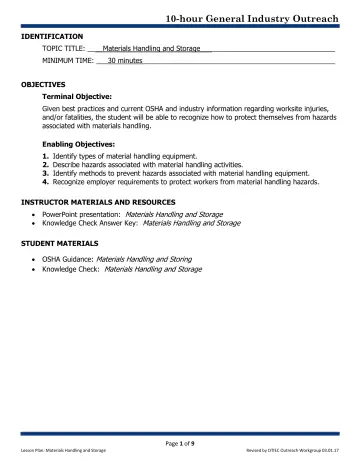
Materials Handling, Storage, Use, and Disposal: Lesson Plan (OSHA 10-Hour General Industry Outreach)
Instructor lesson plan (objectives, timing, teaching steps) for the OSHA General Industry materials handling, storage, use, and disposal outreach deck.
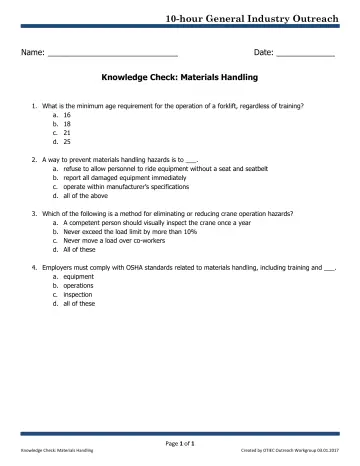
Materials Handling, Storage, Use, and Disposal: Knowledge Check (OSHA 10-Hour General Industry Outreach)
Student knowledge-check quiz for the OSHA General Industry materials handling, storage, use, and disposal outreach deck.