1 / 61Use ← → to flip
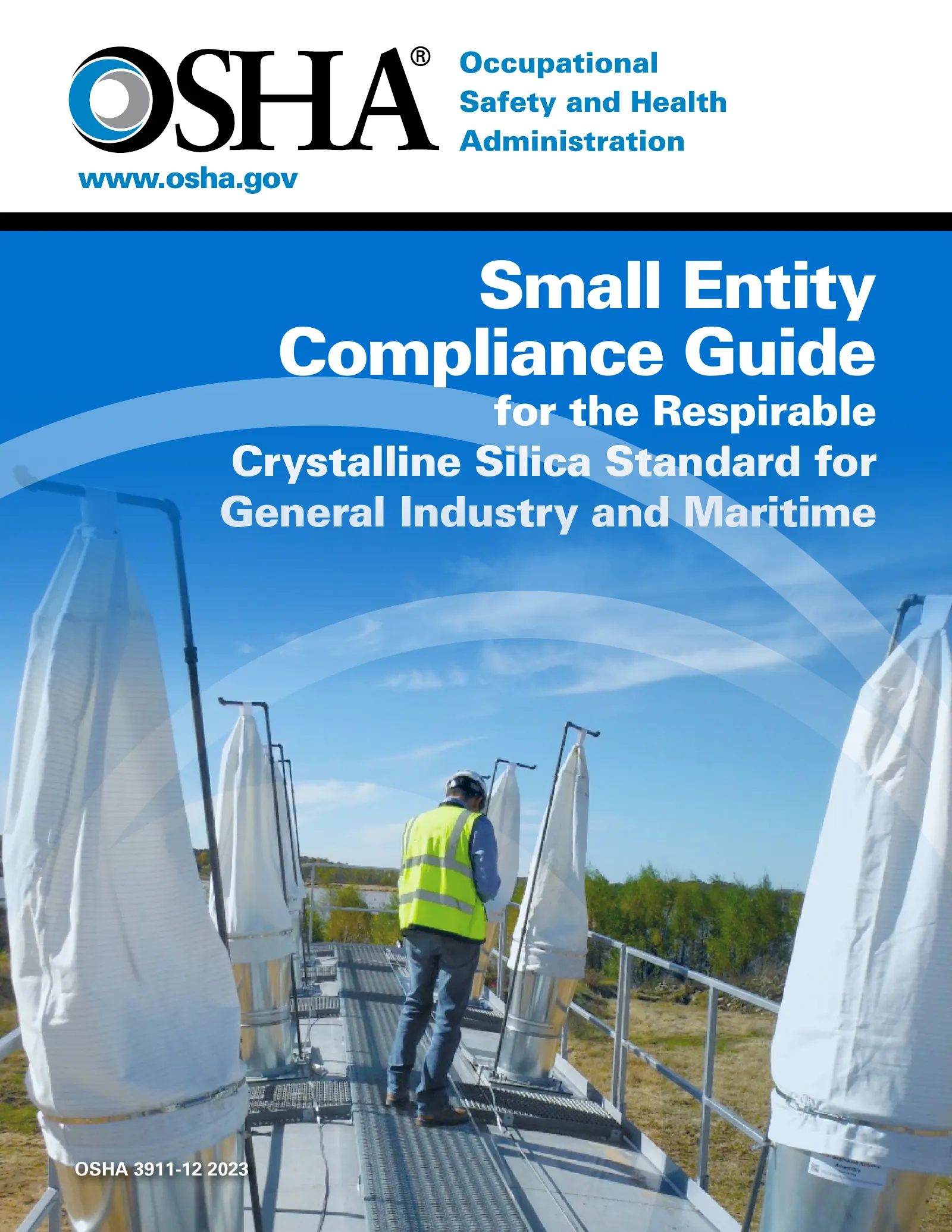
Silica: Small Entity Compliance Guide for the Respirable Crystalline Silica Standard for General Industry and Maritime (OSHA 3911)
OSHA booklet, for General Industry classes.
Page text
· 61 pages · by U.S. Department of Labor, OSHA
The words on each page as the author wrote them, read from the file by software so they can be searched. Layout, pictures and tables are not shown here, and long pages are shortened: the pages above and the download are the original.
- Page 1
Small Entity Compliance Guide
- for the Respirable
- Crystalline Silica Standard for General Industry and Maritime
- OSHA 3911-12 2023
- Page 2
Occupational Safety and Health Act of 1970
- “To assure safe and healthful working conditions for working men and women; by authorizing enforcement of the standards developed under the Act; by assisting and encouraging the States in their efforts to assure safe and healthful working conditions; by providing for research, information, education, and training in the field of occupational safety and health.”
- Material contained in this publication is in the public domain and may be reproduced…
- …
- Page 3
Small Entity Compliance Guide
- for the Respirable Crystalline Silica Standard for General Industry and Maritime
- Occupational Safety and Health Administration
- U.S. Department of Labor
- OSHA 3911-12 2023
- Page 4
- This guidance document provides an overview of OSHA’s Respirable Crystalline Silica Standard for General Industry and Maritime. It is advisory in nature and informational in content. It is not a standard or regulation, and it neither creates new legal obligations nor alters existing obligations created by the Occupational Safety and Health Administration (OSHA) standards or the Occupational Safety and Health Act of 1970 (OSH Act). …
- …
- Page 5
TABLE OF CONTENTS
- INTRODUCTION … 1
- SCOPE – PARAGRAPH (A) OF THE STANDARD … 1
- Exposures from Sorptive Clay Processing … 2
- Exposures Below 25 μg/m 3 Under Any Foreseeable Conditions … 2
- General Industry and Maritime Work Indistinguishable from Table 1 Construction Work … 2
- DEFINITIONS – PARAGRAPH (B) OF THE STANDARD … 3
- PERMISSIBLE EXPOSURE LIMIT (PEL) – PARAGRAPH (C) OF THE STANDARD … 3
- EXPOSURE ASSESSMENT – PARAGRAPH (D) OF THE STANDARD … 4
- …
- Page 6
INTRODUCTION
- This guide is intended to help small businesses understand and comply with the Occupational Safety and Health Administration’s (OSHA) Respirable Crystalline Silica standard for General Industry and Maritime. Employees exposed to respirable crystalline silica are at increased risk of developing serious adverse health effects including silicosis, lung cancer, chronic obstructive pulmonary disease, and kidney disease. …
- …
- Page 7
Exposures from Sorptive Clay Processing
- Exposures from the processing of sorptive clays are excluded from this standard. Sorptive clays such as bentonite are specific types of clay found in a few geologic deposits in the country that are used in a range of consumer products and industrial applications, such as pet litter and sealants for landfills. …
- …
- Page 8
DEFINITIONS – PARAGRAPH (B) OF THE STANDARD
- Definitions are included in the standard to describe the meaning of terms used. Some of these terms are further explained as follows:
- Action level means an airborne concentration of 25 μg/m 3 calculated as an 8-hour TWA. Exposures at or above the action level trigger requirements for exposure assessment and medical surveillance.
- Employee exposure means the exposure to airborne respirable crystalline silica that would occur if the employee were…
- …
- Page 9
Calculation of TWA Exposures
- Both the PEL and the action level are expressed as TWA exposures. TWA measurements account for variable exposure levels over the course of a work shift by averaging periods of higher and lower exposures. The TWA exposure for an 8-hour work shift is calculated using a simple formula:
- TWA = (Ca Ta + Cb Tb . . . Cn Tn) ÷ 8
- Where:
- TWA is the time-weighted average exposure for the work shift
- …
- Page 10
- Air monitoring data are any results of air monitoring (analyzed according to the procedures and requirements in Appendix
- A) that the employer has done to meet the requirements of the standard.
- Objective data is information that demonstrates employee exposure to respirable crystalline silica associated with a particular product or material or a specific process, task, or activity. …
- …
- Page 11
Scheduled Monitoring Option
- conducting air monitoring on two employees who perform the same job on different shifts, the employer could determine that there are no differences in exposure between those two employees, and characterize the exposure of the second employee based on the air monitoring results of the first employee.
- Under the performance option, employers can characterize employee exposure within a range to account for exposure variability. …
- …
- Page 12
Reassessment of Exposures
- may stop monitoring for employees represented by those results, as long as no changes occur that could reasonably be expected to result in new or additional exposures at or above the action level.
- The employer must reassess exposures whenever a change in production, process, control equipment, personnel, or work practices may reasonably be expected to result in new or additional exposures to respirable crystalline silica at or above the action level, or when the…
- …
- Page 13
REGULATED AREAS – PARAGRAPH (E) OF THE STANDARD
- Observation of Monitoring
- The employer must let affected employees or their designated representatives observe any air monitoring of employee exposure to respirable crystalline silica. When observation of monitoring requires entry into an area where use of protective clothing or equipment, such as a respirator, is required, the employer must provide the observer with that protective clothing or equipment. …
- …
- Page 14
Limiting Access to Regulated Areas
- Employers must limit access to regulated areas to:
- Persons authorized by the employer and required by work duties to be present in the regulated area. This includes persons whose work is with or near the respirable crystalline silica-producing materials, but may also include maintenance and repair personnel, management, quality control engineers, or other employees if their job duties require them to be in the regulated area;
- …
- Page 15
- The main types of engineering controls for silica are wet methods and local exhaust ventilation. Wet methods involve applying water or foam at the point of dust generation to keep dust from getting into the air. An example is a grinder that delivers water at the point of contact. Local exhaust ventilation removes dust by capturing it at or near the point where it is created. An example is an exhaust hood that captures dust at the point where it is created.
- …
- Page 16
Example:
- Written Exposure Control Plan
- All employers covered by the standard must develop and implement a written exposure control plan. Written exposure control plans describe workplace exposures and ways to reduce those exposures, such as engineering controls, work practices, and housekeeping methods. The plans improve employee protections by making sure that employers identify all exposures and controls to prevent overexposures. …
- …
- Page 17
- can become airborne and expose them to silica. In this part of the written exposure control plan, employers must list acceptable cleaning methods that will be used to prevent employees from being exposed and any protections that are needed if certain cleaning methods have to be used.
- The Housekeeping section of the standard requires that, when cleaning up dust that can contribute to employee exposures to respirable crystalline silica, employers must:
- …
- Page 18
Written Exposure Control Plan
- Unions, trade associations or professional groups may offer sample written exposure control plans or other assistance to employers, which might be helpful, especially if written exposure control plans are tailored to a particular type of work performed. Although such general guidance may be helpful, employers must make sure that any plan they use is tailored to address all the information required by the standard and all tasks, tools, and controls used by…
- …
- Page 19
RESPIRATORY PROTECTION – PARAGRAPH (G) OF THE STANDARD
- Abrasive Blasting
- In addition to complying with requirements to use engineering controls and work practices according to the hierarchy of controls, employers that conduct abrasive blasting operations using crystalline silica-containing blasting agents or conduct abrasive blasting on substrates that contain crystalline silica must also comply with other relevant standards. …
- …
- Page 20
Feasibility of Cleaning Methods
- into the air and be inhaled by employees. Therefore, the silica standard limits the use of these cleaning methods to prevent unnecessary exposures to employees. Employers are required to use other cleaning methods such as wet sweeping and HEPAfiltered vacuums, whenever feasible, because such methods reduce employee exposures by preventing silica-containing dust from getting into the air.
- …
- Page 21
Which Employees Must be Offered Medical Surveillance
- Tests that Must be Included in the Examination
- Employers must make an initial or periodic medical examination available to employees who meet the exposure trigger. The triggers for medical surveillance are:
- An initial medical examination provided under the silica standard must consist of:
- 1. Exposures above the PEL for 30 or more days a year from June 23, 2018 through June 22, 2020;
- …
- Page 22
Medical Evaluation Requirements under the Respiratory Protection Standard
- Employees who must be offered medical surveillance are at risk of developing respirable crystalline silica-related diseases, and the required tests are the minimum tests needed to look for those diseases. More tests may also be needed to address an employee’s medical complaint or a finding related to respirable crystalline silica exposure, such as abnormal lung function. …
- …
- Page 23
The PLHCP’s Written Medical Opinion for the Employer
- crystalline silica (any health condition that might make the employee more sensitive to exposure). The report must also describe any medical conditions that require further evaluation or treatment; Any recommended limitations on the employee’s use of respirators;
- Any recommended limitations on respirable crystalline silica exposure; and A statement that the employee should be examined by a specialist if the B-reader classifies the…
- …
- Page 24
Small Entity Compliance Guide for General Industry and Maritime
- Draft – Do not Quote or Cite
- 2/22/2017
- SAMPLE FORM 1: WRITTEN MEDICAL REPORT FOR EMPLOYEE
- EMPLOYEE NAME: Joe Smith
- DATE OF EXAMINATION: July 1, 2018
- TYPE OF EXAMINATION:
- [x] Initial examination
- [ ] Periodic examination
- [ ] Specialist examination
- [ ] Other: ___
- RESULTS OF MEDICAL EXAMINATION: Physical Examination –
- [x] Normal Chest X-Ray –
- [x] Normal Breathing Test (Spirometry) – [ ] Normal Test for Tuberculosis –
- …
- Page 25
Small Entity Compliance Guide for General Industry and Maritime
- Draft – Do not Quote or Cite
- 2/22/2017
- SAMPLE FORM 2: WRITTEN MEDICAL OPINION FOR EMPLOYER
- EMPLOYER: _Glass, Inc.___
- EMPLOYEE NAME: __Joe Smith___
- DATE OF EXAMINATION: July 1, 2018___
- TYPE OF EXAMINATION:
- [x] Initial examination
- [ ] Periodic examination
- [ ] Specialist examination
- [ ] Other: ___
- USE OF RESPIRATOR:
- [ ] No limitations on respirator use
- …
- Page 26
Small Entity Compliance Guide for General Industry and Maritime
- Draft – Do not Quote or Cite
- 2/22/2017
- SAMPLE FORM 3: AUTHORIZATION FOR CRYSTALLINE SILICA OPINION TO EMPLOYER
- This medical examination for exposure to crystalline silica could reveal a medical condition that results in recommendations for (1) limitations on respirator use, (2) limitations on exposure to crystalline silica, or (3) examination by a specialist in pulmonary disease or occupational medicine. …
- …
- Page 27
Additional Examinations by a Specialist
- The employer must make the specialist examination available within 30 days of receiving the written medical opinion that includes the PLHCP’s recommendation for a specialist examination. The specialists must be either an American Board Certified Specialist in Pulmonary Disease or an American Board Certified Specialist in Occupational Medicine.
- The employer must ensure the specialist:
- …
- Page 28
COMMUNICATION OF HAZARDS – PARAGRAPH (J) OF THE STANDARD
- Employers must train and inform employees covered by the silica standard about respirable crystalline silica hazards and the methods the employer uses to limit their exposures to those hazards. Employers must cover the cost of training and must pay employees for the time spent in training.
- OSHA’s Hazard Communication Standard
- Employers must also comply with OSHA’s Hazard Communication standard (HCS) (29 CFR 1910.1200). …
- …
- Page 29
- 3. Specific measures the employer is implementing to protect employees from respirable crystalline silica exposure, including engineering controls, work practices, and respirators to be used. This training must be specific for the workplace and task that each employee performs. In general industry and maritime, training subjects would commonly include:
- 4. The contents of the Respirable Crystalline Silica standard. This would involve a description of the standard’s requirements.
- …
- Page 30
Training Methods
- The silica standard does not require the employer to use any particular method for training employees. Employers could use hands-on training, videotapes, slide presentations, classroom instruction, informal discussions during safety meetings, written materials, or any combination of these methods to train employees.
- In order for employees to demonstrate knowledge and understanding of the training subjects, training must be done in a manner and language that employees…
- …
- Page 31
OSHA’s Access to Employee Exposure and Medical Records Regulation
- Medical Surveillance
- The employer must make and keep an accurate record for each employee provided medical surveillance under the standard.
- The record must include the following information about the employee:
- Name and social security number;
- A copy of the PLHCPs’ and specialists’ written opinions; and
- A copy of the information that the employer is required to provide to the PLHCPs and specialists (i.e., a description of…
- …
- Page 32
APPENDIX I: OSHA RESPIRABLE CRYSTALLINE SILICA STANDARD FOR GENERAL INDUSTRY AND MARITIME
- §1910.1053 Respirable crystalline silica
- (a) Scope and application. (1) This section applies to all occupational exposures to respirable crystalline silica, except:
- (i) Construction work as defined in 29 CFR 1910.12(b) (occupational exposures to respirable crystalline silica in construction work are covered under 29 CFR 1926.1153);
- (ii) Agricultural operations covered under 29
- CFR part 1928; and
- …
- Page 33
- respirable by a sampling device designed to meet the characteristics for respirableparticle-size-selective samplers specified in the International Organization for Standardization (ISO) 7708:1995: Air Quality –
- Particle Size Fraction Definitions for Health-
- Related Sampling.
- Specialist means an American Board
- Certified Specialist in Pulmonary Disease or an American Board Certified Specialist in Occupational Medicine.
- …
- Page 34
- of this section are evaluated by a laboratory that analyzes air samples for respirable crystalline silica in accordance with the procedures in Appendix A to this section.
- (6) Employee notification of assessment results. (i) Within 15 working days after completing an exposure assessment in accordance with paragraph (d) of this section, the employer shall individually notify each affected employee in writing of the results of that assessment or post the results in an appropriate location…
- …
- Page 35
- (2) Written exposure control plan. (i) The employer shall establish and implement a written exposure control plan that contains at least the following elements:
- (A) A description of the tasks in the workplace that involve exposure to respirable crystalline silica;
- (B) A description of the engineering controls, work practices, and respiratory protection used to limit employee exposure to respirable crystalline silica for each task; and
- …
- Page 36
- (ii) The employer shall ensure that all medical examinations and procedures required by this section are performed by a PLHCP as defined in paragraph (b) of this section.
- (2) Initial examination. The employer shall make available an initial (baseline) medical examination within 30 days after initial assignment, unless the employee has received a medical examination that meets the requirements of this section within the last three years. The examination shall consist of:
- …
- Page 37
- (iii) Any recommended limitations on the employee’s exposure to respirable crystalline silica; and
- (iv) A statement that the employee should be examined by a specialist (pursuant to paragraph (i)(7) of this section) if the chest
- X-ray provided in accordance with this section is classified as 1/0 or higher by the B Reader, or if referral to a specialist is otherwise deemed appropriate by the PLHCP.
- (6) PLHCP’s written medical opinion for the employer. (i) The employer shall obtain a…
- …
- Page 38
- (2) Signs. The employer shall post signs at all entrances to regulated areas that bear the following legend:
- DANGER
- RESPIRABLE CRYSTALLINE SILICA
- MAY CAUSE CANCER
- CAUSES DAMAGE TO LUNGS
- WEAR RESPIRATORY PROTECTION IN THIS AREA
- AUTHORIZED PERSONNEL ONLY
- (3) Employee information and training. (i) The employer shall ensure that each employee covered by this section can demonstrate knowledge and understanding of at least the following:
- …
- Page 39
Appendix A to § 1910.1053 – Methods of Sample Analysis.
- (3) Medical surveillance. (i) The employer shall make and maintain an accurate record for each employee covered by medical surveillance under paragraph (i) of this section.
- (ii) The record shall include the following information about the employee:
- (A) Name and social security number;
- (B) A copy of the PLHCPs’ and specialists’ written medical opinions; and
- (C) A copy of the information provided to the PLHCPs and specialists.
- …
- Page 40
Appendix B to § 1910.1053 – Medical Surveillance Guidelines.
- 6.2 Uses five or more calibration standard levels to prepare calibration curves and ensures that standards are distributed through the calibration range in a manner that accurately reflects the underlying calibration curve; and
- 6.3 Optimizes methods and instruments to obtain a quantitative limit of detection that represents a value no higher than 25 percent of the PEL based on sample air volume.
- Introduction
- …
- Page 41
- However, it is critical to recognize all cases of accelerated and acute silicosis because these are life-threatening illnesses and because they are caused by substantial overexposures to respirable crystalline silica. Although any case of silicosis indicates a breakdown in prevention, a case of acute or accelerated silicosis implies current high exposure and a very marked breakdown in prevention.
- In addition to silicosis, employees exposed to respirable crystalline silica, especially…
- …
- Page 42
- 1.3.5. Clinical Course - accelerated silicosis has a rapid, severe course. Under the respirable crystalline silica standard, the PLHCP can recommend referral to a Board Certified Specialist in either Pulmonary Disease or Occupational Medicine, as deemed appropriate, and referral to a Specialist is recommended whenever the diagnosis of accelerated silicosis is being considered.
- 1.4. Acute Silicosis. Acute silicosis is a rare disease caused by inhalation of extremely high levels of…
- …
- Page 43
- 1.7. TB and Other Infections. Silica-exposed employees with latent TB are 3 to 30 times more likely to develop active pulmonary
- TB infection (ATS 1997; Rees and Murray 2007). Although respirable crystalline silica exposure does not cause TB infection, individuals with latent TB infection are at increased risk for activation of disease if they have higher levels of respirable crystalline silica exposure, greater profusion of radiographic abnormalities, or a diagnosis of silicosis. …
- …
- Page 44
- 2.1.2.4. Information from records of employment-related medical examinations previously provided to the employee and currently within the control of the employer.
- skin tests (TST). The interpretation and documentation of TST reactions should be performed within 48 to 72 hours of administration by trained PLHCPs.
- 2.1.3. Additional guidance and recommendations: A history is particularly important both in the initial evaluation and in periodic examinations. …
- …
- Page 45
- (2) Prevention of TB spread to close contacts of active TB cases;
- (3) Prevention of active TB in people with latent TB through targeted testing and treatment; and
- (4) Identification of settings at high risk for TB transmission so that appropriate infectioncontrol measures can be implemented.
- 2.4. Pulmonary Function Testing.
- 2.4.1. The respirable crystalline silica standard requires the following: Pulmonary function testing must be performed on the initial examination and every three…
- …
- Page 46
- comparable to film-based ILO classifications. Current ILO guidance on radiography for pneumoconioses and B-reading should be reviewed by the PLHCP periodically, as needed, on the ILO or NIOSH websites (See Section 5 of this Appendix).
- 2.6. Other Testing. Under the respirable crystalline silica standards, the PLHCP has the option of ordering additional testing he or she deems appropriate. …
- …
- Page 47
- helpful to employees, such as construction employees, who may change employers frequently. The written medical opinion can be used by the employee as proof of upto-date medical surveillance. The following lists the elements of the written medical report for the employee and written medical opinion for the employer. …
- …
- Page 48
- 3.2.1. The employer must provide the following information to the Board Certified
- Specialist in Pulmonary Disease or Occupational Medicine:
- 3.2.1.1. A description of the employee’s former, current, and anticipated duties as they relate to the employee’s occupational exposure to respirable crystalline silica;
- 3.2.1.2. The employee’s former, current, and anticipated levels of occupational exposure to respirable crystalline silica;
- …
- Page 49
- 3.2.6. After evaluating the employee, the Board Certified Specialist in Pulmonary Disease or Occupational Medicine should provide feedback to the PLHCP as appropriate, depending on the reason for the referral. OSHA believes that because the PLHCP has the primary relationship with the employer and employee, the Specialist may want to communicate his or her findings to the PLHCP and have the PLHCP simply update the original medical report for the employee and medical opinion for the…
- …
- Page 50
- The PLHCP should discuss the implication of signing or not signing the authorization with the employee (in a manner and language that he or she understands) so that the employee can make an informed decision regarding the written authorization and its consequences. The discussion should include the risk of ongoing silica exposure, personal risk factors, risk of disease progression, and possible health and economic consequences. …
- …
- Page 51
5.3. International Labour Organization
- International Labour Office (ILO).
- (2011) Guidelines for the use of the ILO International Classification of Radiographs of Pneumoconioses, Revised edition 2011. Occupational Safety and Health Series No. 22: http://www.ilo.org/safework/info/publications/WCMS_168260/lang--en/index.htm
- 5.4. National Institute of Occupational Safety and Health (NIOSH)
- NIOSH B Reader Program webpage. (Information on interpretation of X-rays for silicosis and a list of…
- …
- Page 52
- and Mortality Weekly Report (MMWR), 54(RR12), 1-81. Accessed at: http://www.cdc.gov/mmwr/preview/mmwrhtml/rr5412a1.htm
- Brown, T. (2009). Silica exposure, smoking, silicosis and lung cancer – complex interactions. Occupational Medicine, 59, 89‑95.
- Halldin, C. N., Petsonk, E. L., and Laney,
- A. S. (2014). Validation of the International Labour Office digitized standard images for recognition and classification of radiographs of pneumoconiosis. Acad Radiol, 21,305-311.
- …
- Page 53
- technical standards: spirometry in the occupational setting. Am J Respir Crit Care
- Med; 189, 984-994.
- Rees, D. and Murray, J. (2007). Silica, silicosis and tuberculosis. Int J Tuberc Lung Dis, 11(5), 474-484.
- Shtraichman, O., Blanc, P. D., Ollech, J. E., Fridel, L., Fuks, L., Fireman, E., and Kramer,
- M. R. (2015). Outbreak of autoimmune disease in silicosis linked to artificial stone. Occup Med, 65, 444-450.
- …
- Page 54
WRITTEN MEDICAL REPORT FOR EMPLOYEE
- EMPLOYEE NAME: ___
- DATE OF EXAMINATION: ___
- TYPE OF EXAMINATION:
- [ ] Initial examination
- [ ] Periodic examination
- [ ] Specialist examination
- [ ] Other: ___
- RESULTS OF MEDICAL EXAMINATION: Physical Examination –
- [ ] Normal Chest X-Ray –
- [ ] Normal Breathing Test (Spirometry) – [ ] Normal Test for Tuberculosis –
- [ ] Normal Other:___ [ ] Normal
- [ ] Abnormal (see below) [ ] Abnormal (see below) [ ] Abnormal (see below) [ ] Abnormal (see below) [ ] Abnormal…
- …
- Page 55
Small Entity Compliance Guide for Construction
- Draft – Do not Quote or Cite
- 2/22/2017
- WRITTEN MEDICAL OPINION FOR EMPLOYER
- EMPLOYER: ___
- EMPLOYEE NAME: ___
- DATE OF EXAMINATION: ___
- TYPE OF EXAMINATION:
- [ ] Initial examination
- [ ] Periodic examination
- [ ] Specialist examination
- [ ] Other: ___
- USE OF RESPIRATOR:
- [ ] No limitations on respirator use
- [ ] Recommended limitations on use of respirator:___
- Dates for recommended limitations, if applicable:
- ___ to ___
- MM/DD/YYYY
- MM/DD/YYYY
- …
- Page 56
Small Entity Compliance Guide for Construction
- Draft – Do not Quote or Cite
- 2/22/2017
- AUTHORIZATION FOR CRYSTALLINE SILICA OPINION TO EMPLOYER
- This medical examination for exposure to crystalline silica could reveal a medical condition that results in recommendations for (1) limitations on respirator use, (2) limitations on exposure to crystalline silica, or (3) examination by a specialist in pulmonary disease or occupational medicine. …
- …
- Page 57
WORKERS’ RIGHTS
- Workers have the right to:
- Working conditions that do not pose a risk of serious harm.
- Receive information and training (in a language and vocabulary the worker understands) about workplace hazards, methods to prevent them, and the OSHA standards that apply to their workplace. Review records of work-related injuries and illnesses.
- File a complaint asking OSHA to inspect their workplace if they believe there is a serious hazard or that their employer is not following…
- …
- Page 58
Cooperative Programs
- OSHA offers cooperative programs under which businesses, labor groups and other organizations can work cooperatively with OSHA. To find out more about any of the following programs, visit www.osha.gov/cooperativeprograms.
- Strategic Partnerships and Alliances
- The OSHA Strategic Partnerships (OSP) provide the opportunity for OSHA to partner with employers, workers, professional or trade associations, labor organizations, and/ or other interested stakeholders. …
- …
- Page 59
OSHA REGIONAL OFFICES
- Region 1
- Boston Regional Office
- (CT*, ME*, MA*, NH, RI, VT*)
- JFK Federal Building
- 25 New Sudbury Street, Room E340
- Boston, MA 02203
- (617) 565-9860 (617) 565-9827 Fax
- Region 7
- Kansas City Regional Office
- (IA*, KS, MO, NE)
- Two Pershing Square Building
- 2300 Main Street, Suite 1010
- Kansas City, MO 64108-2416
- (816) 283-8745 (816) 283-0547 Fax
- Region 2
- New York Regional Office
- (NJ*, NY*, PR*, VI*)
- Federal Building
- 201 Varick Street, Room 670
- New York, NY 10014
- …
- Page 60
HOW TO CONTACT OSHA
- Under the Occupational Safety and Health Act of 1970, employers are responsible for providing safe and healthful workplaces for their employees. OSHA’s role is to help ensure these conditions for America’s workers by setting and enforcing standards, and providing training, education and assistance. For more information, visit www.osha.gov or call OSHA at 1-800-321-OSHA (6742), TTY 1-877-889-5627.
- For assistance, contact us. We are OSHA. We can help.
- Page 61
U.S. Department of Labor
- For more information:
- Occupational
- Safety and Health Administration www.osha.gov (800) 321-OSHA (6742)
More on Industrial Hygiene
pptx
66 slidesIntroduction to Industrial Hygiene (OSHA 10-Hour General Industry Outreach)
OSHA's outreach deck introducing chemical, physical, biological and ergonomic health hazards and controls (2017).
U.S. Department of Labor, OSHAPublic domain
pdf
19 slidesIntroduction to Industrial Hygiene: Lesson Plan (OSHA 10-Hour General Industry Outreach)
Instructor lesson plan (objectives, timing, teaching steps) for the OSHA General Industry introduction to industrial hygiene outreach deck.
U.S. Department of Labor, OSHA (with the OTIEC Outreach Workgroup)Public domain
pdf
1 slidesIntroduction to Industrial Hygiene: Knowledge Check (OSHA 10-Hour General Industry Outreach)
Student knowledge-check quiz for the OSHA General Industry introduction to industrial hygiene outreach deck.
U.S. Department of Labor, OSHA (with the OTIEC Outreach Workgroup)Public domain