1 / 2Use ← → to flip
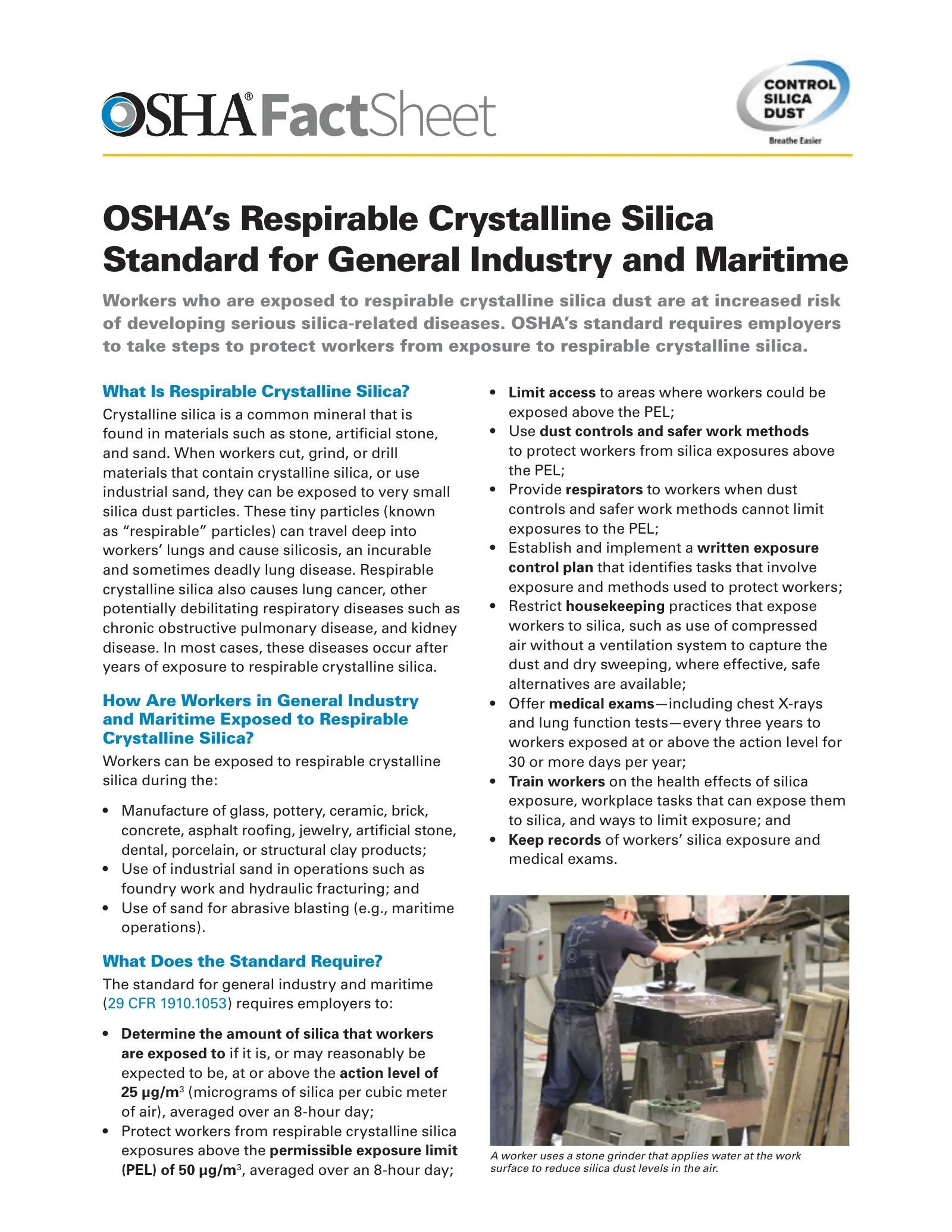
OSHA's Respirable Crystalline Silica Standard for General Industry and Maritime Fact Sheet (OSHA FS 3682)
OSHA fact sheet or bulletin, for General Industry classes.
Page text
· 2 pages · by U.S. Department of Labor, OSHA
The words on each page as the author wrote them, read from the file by software so they can be searched. Layout, pictures and tables are not shown here: the pages above and the download are the original.
- Page 1
FactSheet
- OSHA’s Respirable Crystalline Silica Standard for General Industry and Maritime
- Workers who are exposed to respirable crystalline silica dust are at increased risk of developing serious silica-related diseases. OSHA’s standard requires employers to take steps to protect workers from exposure to respirable crystalline silica.
- What Is Respirable Crystalline Silica?
- Crystalline silica is a common mineral that is found in materials such as stone, artificial stone, and sand. When workers cut, grind, or drill materials that contain crystalline silica, or use industrial sand, they can be exposed to very small silica dust particles. These tiny particles (known as “respirable” particles) can travel deep into workers’ lungs and cause silicosis, an incurable and sometimes deadly lung disease. Respirable crystalline silica also causes lung cancer, other potentially debilitating respiratory diseases such as chronic obstructive pulmonary disease, and kidney disease. In most cases, these diseases occur after years of exposure to respirable crystalline silica.
- How Are Workers in General Industry and Maritime Exposed to Respirable Crystalline Silica?
- Workers can be exposed to respirable crystalline silica during the:
- Manufacture of glass, pottery, ceramic, brick, concrete, asphalt roofing, jewelry, artificial stone, dental, porcelain, or structural clay products;
- Use of industrial sand in operations such as foundry work and hydraulic fracturing; and
- Use of sand for abrasive blasting (e.g., maritime operations).
- Limit access to areas where workers could be exposed above the PEL;
- Use dust controls and safer work methods to protect workers from silica exposures above the PEL;
- Provide respirators to workers when dust controls and safer work methods cannot limit exposures to the PEL;
- Establish and implement a written exposure control plan that identifies tasks that involve exposure and methods used to protect workers;
- Restrict housekeeping practices that expose workers to silica, such as use of compressed air without a ventilation system to capture the dust and dry sweeping, where effective, safe alternatives are available;
- Offer medical exams—including chest X-rays and lung function tests—every three years to workers exposed at or above the action level for 30 or more days per year;
- Train workers on the health effects of silica exposure, workplace tasks that can expose them to silica, and ways to limit exposure; and
- Keep records of workers’ silica exposure and medical exams.
- What Does the Standard Require?
- The standard for general industry and maritime
- (29 CFR 1910.1053) requires employers to:
- Determine the amount of silica that workers are exposed to if it is, or may reasonably be expected to be, at or above the action level of 25 μg/m 3 (micrograms of silica per cubic meter of air), averaged over an 8-hour day;
- Protect workers from respirable crystalline silica exposures above the permissible exposure limit (PEL) of 50 μg/m 3 , averaged over an 8-hour day;
- A worker uses a stone grinder that applies water at the work surface to reduce silica dust levels in the air.
- Page 2
Photo: New Jersey Department of Health
- Examples—Dust Control Methods
- Employers can protect workers from silica exposures by using dust controls such as:
- Wet methods that apply water at the point where silica dust is made;
- Local exhaust ventilation that removes silica dust at or near the point where it is made; and
- Enclosures that isolate the work process or the worker.
- Medical surveillance must be offered to employees who will be exposed at or above the action level for 30 or more days a year starting on June 23, 2020. (Medical surveillance must be offered to employees who will be exposed above the PEL for 30 or more days a year starting on June 23, 2018.)
- Hydraulic fracturing operations in the oil and gas industry must implement dust controls to limit exposures to the new PEL by June 23, 2021.
- Additional Information
- While grinding stone, a worker uses local exhaust ventilation to remove silica dust and reduce his exposure.
- While abrasive blasting dental castings, a worker uses an enclosure that isolates silica dust.
- When Are Employers Required to Comply with the Standard?
- General industry and maritime employers must comply with all requirements of the standard by June 23, 2018, except for the following:
- Additional information on OSHA’s silica standard can be found at www.osha.gov/silica. OSHA can provide compliance assistance through a variety of programs, including technical assistance about effective safety and health programs, workplace consultations, and training and education.
- OSHA’s On-Site Consultation Program offers free, confidential occupational safety and health services to small and medium-sized businesses in all states and several territories across the country, with priority given to high-hazard worksites. On-Site consultation services are separate from enforcement and do not result in penalties or citations. Consultants from state agencies or universities work with employers to identify workplace hazards, provide advice on compliance with OSHA standards, and assist in establishing and improving safety and health management systems. To locate the OSHA On-Site Consultation Program nearest you, call 1-800-321-OSHA or visit www.osha.gov/consultation.
- How to Contact OSHA
- Under the Occupational Safety and Health Act of 1970, employers are responsible for providing safe and healthful workplaces for their employees. OSHA’s role is to ensure these conditions for America’s working men and women by setting and enforcing standards, and providing training, education and assistance. For more information, visit www.osha.gov or call OSHA at 1-800-321- OSHA (6742), TTY 1-877-889-5627.
- This is one in a series of informational fact sheets highlighting OSHA programs, policies or standards. It does not impose any new compliance requirements. For a comprehensive list of compliance requirements of OSHA standards or regulations, refer to Title 29 of the Code of Federal Regulations. This information will be made available to sensory-impaired individuals upon request. The voice phone is (202) 693-1999; teletypewriter (TTY) number: (877) 889-5627.
- DSG FS-3682 02/2018
More on Industrial Hygiene
pptx
66 slidesIntroduction to Industrial Hygiene (OSHA 10-Hour General Industry Outreach)
OSHA's outreach deck introducing chemical, physical, biological and ergonomic health hazards and controls (2017).
U.S. Department of Labor, OSHAPublic domain
pdf
19 slidesIntroduction to Industrial Hygiene: Lesson Plan (OSHA 10-Hour General Industry Outreach)
Instructor lesson plan (objectives, timing, teaching steps) for the OSHA General Industry introduction to industrial hygiene outreach deck.
U.S. Department of Labor, OSHA (with the OTIEC Outreach Workgroup)Public domain
pdf
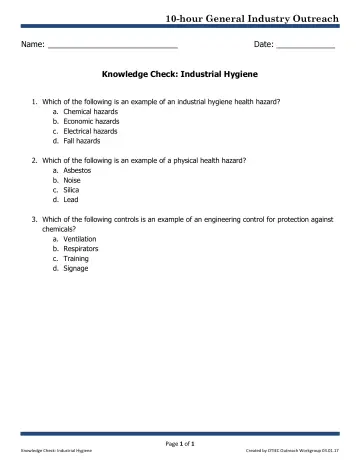
1 slidesIntroduction to Industrial Hygiene: Knowledge Check (OSHA 10-Hour General Industry Outreach)
Student knowledge-check quiz for the OSHA General Industry introduction to industrial hygiene outreach deck.
U.S. Department of Labor, OSHA (with the OTIEC Outreach Workgroup)Public domain