1 / 26Use ← → to flip
Methylene Chloride (OSHA 3144)
OSHA booklet, for General Industry classes.
Page text
· 26 pages · by U.S. Department of Labor, OSHA
The words on each page as the author wrote them, read from the file by software so they can be searched. Layout, pictures and tables are not shown here, and long pages are shortened: the pages above and the download are the original.
- Page 1
Methylene Chloride
- www.osha.gov
- OSHA 3144-06R 2003
- Page 2
- This informational booklet provides a general overview of a particular topic related to OSHA standards. It does not alter or determine compliance responsibilities in OSHA standards or the Occupational Safety and Health Act of 1970. Because interpretations and enforcement policy may change over time, you should consult current OSHA administrative interpretations and decisions by the Occupational Safety and Health Review Commission and the Courts for additional guidance on OSHA compliance requirements.
- This publication is in the public domain and may be reproduced, fully or partially, without permission. Source credit is requested but not required.
- This information is available to sensory impaired individuals upon request.
- Voice phone: (202) 693-1999; teletypewriter (TTY) number: (877) 889-5627.
- Page 3
Methylene Chloride
- U.S. Department of Labor Elaine L. Chao, Secretary
- Occupational Safety and Health Administration John L. Henshaw, Assistant Secretary
- OSHA 3144-06R
- 2003
- Page 4
Contents
- Introduction…3
- OSHA’s Methylene Chloride Standard…3
- Exposure Monitoring…5
- Medical Surveillance…8
- Control Measures…11
- Respiratory Protection…13
- Hygiene Facilities and Protective
- Clothing and Equipment…15
- Recordkeeping Requirements…16
- Information and Training…17
- OSHA Assistance …18
- OSHA Regional Offices…24
- Page 5
Introduction
- Methylene chloride and its uses
- Methylene chloride, also called dichloromethane, is a volatile, colorless liquid with a chloroform-like odor. Methylene chloride is used in various industrial processes in many different industries: paint stripping, pharmaceutical manufacturing, paint remover manufacturing, metal cleaning and degreasing, adhesives manufacturing and use, polyurethane foam production, film base manufacturing, polycarbonate resin production, and solvent distribution and formulation.
- Employee exposure and health consequences
- The predominant means of exposure to methylene chloride is inhalation and skin exposure.
- OSHA considers methylene chloride to be a potential occupational carcinogen. Short-term exposures to high concentrations may cause mental confusion, lightheadedness, nausea, vomiting, and headache. Continued exposure may also cause eye and respiratory tract irritation. Exposure to methylene chloride may make symptoms of angina more severe. Skin exposure to liquid methylene chloride may cause irritation or chemical burns.
- OSHA’s Methylene Chloride Standard
- Industries covered
- …
- Page 6
Requirements for regulated areas
- The action level for airborne methylene chloride is set at a concentration of 12.5 ppm, calculated as an eight-hour TWA. Reaching or exceeding the action level signals that employers must begin compliance activities such as exposure monitoring and medical surveillance. There is also a short-term exposure limit (STEL) of 125 ppm, as measured over a 15-minute period.
- The standard requires that the employer establish a regulated area where exposure to airborne concentrations of methylene chloride exceeds or can be expected to exceed either the PEL or the STEL. Employers must mark regulated areas to alert employees to the hazard and minimize the number of authorized employees exposed to methylene chloride.
- Employers at multi-employer worksites must notify other employers at the workplace of the locations of all regulated areas and access restrictions. The employer must supply appropriate respiratory protection for each person entering a regulated area. …
- …
- Page 7
Exposure Monitoring
- These requirements are consistent with those in OSHA’s hazard communication standard—29 CFR 1910.1200, 29 CFR 1915.1200, and 29 CFR 1926.59.
- Benefits
- Through air sampling and monitoring, employers can better determine methylene chloride exposure, identify the source, and select the proper control methods—resulting in better protection for employees. Exposure monitoring also is key to helping employers determine which other requirements of the standard need to be met.
- Measuring employee exposures
- To measure an employee’s exposure to methylene chloride, the employer must use breathing zone air samples representative of the employee’s eight-hour TWA as well as a short-term, 15-minute exposure. To determine eight-hour TWA exposures by representative sampling, employers must take one or more personal breathing zone air samples covering the full-shift exposure for each shift for at least one employee in each job classification in each work area. Employees sampled must be those who are expected to have the highest exposure.
- To determine how employee exposures relate to the STEL through representative sampling, employers…
- …
- Page 8
Requirements for periodic monitoring
- determine each affected employee’s exposure. However, initial monitoring can be waived when
- Objective data—representing the highest methylene chloride exposure likely to occur during processing, using, or handling— demonstrate that methylene chloride cannot be released in airborne concentrations above the action level or the STEL, or
- Employees are exposed to methylene chloride for fewer than 30 days per year (for example, on a construction site) and the employer uses direct-reading instruments such as a detector tube that gives immediate results, providing enough information to determine what control measures are necessary to reduce exposure to acceptable levels.
- The employer must begin an exposure monitoring program for all tasks where initial monitoring shows that employee exposures are above the action level or STEL. (See Table 1 for monitoring requirements in the standard.) If employee exposure is above the action level, but at or below both the PEL and STEL, employers must monitor employees at least every six months. …
- …
- Page 9
Table 1: Monitoring Requirements
- Employers must notify employees of all monitoring results, in writing, either individually or by posting the results in an accessible location, within 15 working days after receipt. When monitoring results show exposures above the PEL or STEL, the notification also must describe the corrective action being taken to reduce exposures to or below these limits.
- Employers must allow affected employees or their designated representatives to observe any monitoring. The employer also must provide employees with appropriate protective clothing or equipment needed to enter regulated areas where the monitoring is performed. Employees and their designated representatives must wear the protective clothing and equipment provided and must comply with all other applicable safety and health procedures.
- Exposure Scenario
- Required Monitoring Activity
- Below the action level (12.5 ppm) and at or below the STEL (125 ppm)
- No eight-hour TWA or STEL monitoring required
- Below the action level (12.5 ppm) and above the STEL (125 ppm)
- No eight-hour TWA monitoring required; monitor STEL exposures every three months.
- …
- Page 10
Medical Surveillance
- Employer responsibility
- Medical surveillance is a comprehensive way to determine if exposure to workplace hazards adversely affects employee health. Frequent, required medical exams or tests can lead to early detection of occupational diseases so preventive measures can be taken to curtail overexposure.
- Employers must put a medical surveillance program in place for all employees exposed to methylene chloride. The only exception is when affected employees will be exposed to methylene chloride at or above
- The action level for fewer than 30 days per year, and
- The PEL or STEL for fewer than 10 days during the year.
- Employers also must provide medical surveillance to
- Any employee exposed above the PEL or STEL whom a physician or other licensed health-care professional has identified as being at risk for cardiac disease or some other serious methylene chloride-related health condition and who requests inclusion, regardless of the duration of methylene chloride exposure; and
- All employees during an emergency.
- Employers must provide medical surveillance at no cost to the employee, without loss of pay, and at a reasonable…
- …
- Page 11
Requirements for medical surveillance
- At the end of employment or reassignment to an area where methylene chloride exposure is consistently below the action level and STEL, if six months or more have elapsed since the last medical surveillance.
- When recommended in the physician’s or other licensed healthcare professional’s 3 written opinion.
- For employees working in an atmosphere with methylene chloride concentrations that require them to use a respirator, the examining physician or licensed health-care professional must determine their ability to wear an air-supplied respirator in a negative-pressure mode or a gas mask with an organic vapor canister for emergency escape. The examiner must state this in a written opinion to both the employee and employer.
- A physician or licensed health-care professional must perform all medical surveillance procedures. Medical exams 4 must include at least
- A comprehensive medical and work history; 5 and
- A physical exam with special emphasis on the lungs, cardiovascular system including blood pressure and pulse, liver, nervous system, and skin.
- …
- Page 12
Information for examiners
- Employers must ensure that medical emergency exams are available in emergency situations and include, at a minimum,
- The appropriate medical treatment and decontamination of the exposed employee;
- A comprehensive physical exam with special emphasis on the nervous system, cardiovascular system including blood pressure and pulse, lungs, liver, and skin;
- An updated medical history as appropriate for the employee’s medical condition; and
- Laboratory surveillance as indicated by the employee’s health status.
- The employer must provide the examining physician or other licensed health-care professional who is involved in the diagnosis of methylene chloride-induced health effects with
- A copy of the methylene chloride standard and its appendices;
- A description of the affected employee’s past, current, and anticipated future duties relating to methylene chloride exposure;
- The employee’s former or current methylene chloride exposure levels or anticipated levels, their frequency, and anticipated exposure levels associated with emergencies;
- A description of any personal protective equipment (such as respirators) used or to be…
- …
- Page 13
- The physician or licensed health-care professional’s opinion whether the employee has any detected medical conditions that would increase the risk of impairment from exposure to methylene chloride;
- Any recommended limitations on employee exposure to methylene chloride and on the use of personal protective clothing or equipment and a respirator;
- A statement that the physician or licensed health-care professional has informed the employee that methylene chloride is a potential carcinogen, of the risk factors for heart disease, and of the potential exacerbation of underlying heart disease from methylene chloride exposure and its metabolism to carbon monoxide; and
- A statement that the physician or licensed health-care professional has informed the employee of medical exam results and any medical conditions resulting from methylene chloride exposure requiring further explanation or treatment.
- The examining physician or licensed health-care professional must not reveal to the employer, orally or in writing, any specific records, findings, or diagnoses that have no bearing on occupational exposures to methylene chloride.
- Control Measures
- …
- Page 14
Work practice controls
- These controls reduce employee exposure in the workplace by either removing or isolating the hazard or isolating the worker from it. By reducing or removing contaminants from the air, engineering controls reduce or eliminate exposure hazards.
- Work practice controls reduce the likelihood of exposure by altering the way a task is performed. One example is having a worker keep his or her face out of the methylene chloride vapor zone above a dip tank. Another safe practice is to prohibit employees from eating, drinking, smoking, taking medication, or applying cosmetics inside the work area where methylene chloride is used.
- Administrative controls
- An administrative control removes the worker from exposure. For example, one method of controlling worker exposure to contaminants involves scheduling operations that pose the highest risk of exposure when the fewest employees are present.
- However, employee rotation—for example, scheduling several employees to perform work in the exposure area for shorter time limits—is not an effective way to control methylene chloride exposure. …
- …
- Page 15
Respiratory Protection
- Employers covered by this standard also may be covered by the provisions of 29 CFR 1910.120(q), Emergency Response to Hazardous Substance Releases.
- When respiratory protection is required
- Employers must institute engineering, work practice, and administrative controls and maintain their effectiveness to reduce employee exposure to or below the PEL. When this combination of controls does not reduce methylene chloride exposure to or below the PEL and STEL, employers must supplement these controls by providing employees respirators that offer the additional protection.
- Respirators protect employees individually by extracting methylene chloride from the air as it is about to be inhaled, or by providing an alternate, non-contaminated source of breathable air. The employer must provide respirators at no cost to each affected employee and ensure their use when
- An employee’s exposure to methylene chloride is likely to exceed the PEL and STEL;
- Feasible engineering and work practice controls are being installed or implemented;
- The employer demonstrates that engineering and work practices controls are infeasible, such as in…
- …
- Page 16
Table 2: Minimum Requirements for Respiratory Protection for Airborne Methylene Chloride
- Occupational Safety and Health (NIOSH). Employers may provide NIOSH-approved gas masks with organic vapor canisters, but only for use in emergency escape. The canisters must be replaced after each use before the respirator is returned to service.
- Methylene Chloride Airborne
- Concentration (ppm)
- or Condition of Use
- Minimum Respirator
- Required*
- Up to 625 ppm (25 X PEL)
- Continuous flow supplied-air respirator, hood, or helmet
- Up to 1,250 ppm (50 X PEL)
- (1) Full facepiece supplied-air respirator operated in negativepressure (demand) mode
- (2) Full facepiece self-contained breathing apparatus (SCBA) operated in negative-pressure (demand) mode
- Up to 5,000 ppm (200 X PEL)
- (1) Continuous flow supplied-air respirator, full facepiece
- (2) Pressure demand supplied-air respirator, full facepiece
- (3) Positive-pressure full facepiece SCBA
- Unknown concentration, or above 5,000 ppm (Greater than 200 X PEL)
- (1) Positive-pressure full facepiece SCBA
- (2) Full facepiece pressure
- (demand) supplied-air respirator with an auxiliary self-contained air supply
- Firefighting
- …
- Page 17
Hygiene Facilities and Protective Clothing and Equipment
- Where respirators are used, the employer must institute a comprehensive respiratory protection program that complies with 29 CFR 1910.134, Respiratory Protection.
- Each respirator issued must be fitted properly to ensure the least possible facepiece leakage. For negative-pressure respirators used during emergencies, the employer must perform either qualitative or quantitative fit tests at the initial fitting and then, at least annually. The employer must ensure that employees leave the regulated area to wash their faces and respirator facepieces as necessary to prevent eye or skin irritation associated with respirator use, or if they detect changes in breathing resistance or leakage of the respirator facepiece. If an employee leaves the regulated area because the respirator is malfunctioning, the employer must correct the problem before allowing the employee to return to the regulated area.
- Hygiene facilities employers must provide
- In cases where employees could possibly have skin contact with solutions containing 0.1 percent or more methylene chloride through splashes, spills, or…
- …
- Page 18
Recordkeeping Requirements
- clean, launder, and repair the protective clothing and equipment to keep it effective, and when necessary, replace and dispose of it properly.
- Records employers must keep
- The employer must establish and keep accurate records for all objective data, exposure monitoring, and medical surveillance in accordance with Access to Employee Exposure and Medical Records, 29 CFR 1910.1020. Employee exposure and objective data records must be available for examining and copying by
- Affected employees,
- Former employees,
- Designated employee representatives,
- Anyone who has that employee’s written consent,
- The Assistant Secretary of Labor for Occupational Safety and Health, and
- The Director of NIOSH.
- Objective data records
- If an employer relies on objective data to show that initial monitoring is unnecessary, the record supporting that exemption must include information on
- The methylene chloride-containing material in question;
- The source of the objective data;
- The testing protocol, results, and/or analysis of the material for the release of methylene chloride;
- …
- Page 19
Exposure measurement records
- Employers must keep records of employee exposure measurements for at least 30 years. These records must include the
- Date of measurement for each sample taken;
- Monitored operation involving methylene chloride exposure;
- Sampling and analytical methods used and evidence of their accuracy;
- Number, duration, and results of samples taken;
- Type of personal protective equipment (for example, respirators) worn; and
- Name, social security number, job classification, and exposure monitoring data for all represented employees, indicating which employees were actually monitored.
- Medical surveillance records
- The employer must keep medical surveillance records for the duration of each affected employee’s employment, plus 30 years. These records must include the
- Name and social security number of each affected employee and a description of duties,
- Physician’s or other licensed health-care professional’s written medical opinions, and
- Employee medical conditions related to methylene chloride exposure.
- Information and Training
- Information and training employers must provide
- …
- Page 20
- 1910.1200, 1915.1200, or 1926.59, as appropriate, the employer must inform each affected employee of
- Requirements of the standard, information available in the standard’s appendices, and how to access a copy of it in the workplace;
- The quantity, location, manner of use, release, and storage of methylene chloride in cases where exposures could exceed the action level, and the specific nature of operations that could result in such exposure; and
- Where exposures may be above the eight-hour TWA PEL or STEL.
- The employer must retrain employees as needed to ensure that each worker exposed at or above the action level or STEL maintains a good understanding of the principles of safe use and handling of methylene chloride in the workplace. Also, when changes in workplace procedures could potentially increase employee exposures so that they might exceed the action level, the employer must update the training to ensure a continued understanding of hazards and control measures. Employers at multi-employer worksites must notify other employers onsite about methylene chloride use in accordance with OSHA’s hazard communication standard.
- …
- Page 21
State programs
- ment is a comprehensive safety and health management system.
- OSHA has electronic compliance assistance tools, or eTools, on its website that walks users through the steps required to develop a comprehensive safety and health program. The eTools are posted at www.osha.gov, and are based on guidelines that identify four general elements critical to a successful safety and health management system:
- Management leadership and employee involvement,
- Worksite analysis,
- Hazard prevention and control, and
- Safety and health training.
- The Occupational Safety and Health Act of 1970 (OSH Act) encourages states to develop and operate their own job safety and health plans. OSHA approves and monitors these plans and funds up to 50 percent of each program’s operating costs. State plans must provide standards and enforcement programs, as well as voluntary compliance activities, that are at least as effective as federal OSHA’s.
- Currently, 26 states and territories have their own plans. Twentythree cover both private and public (state and local government) employees and three states, Connecticut, New Jersey, and New York, cover only the…
- …
- Page 22
Safety and Health Achievement Recognition Program
- Under the consultation program, certain exemplary employers may request participation in OSHA’s Safety and Health Achievement Recognition Program (SHARP). Eligibility for participation includes, but is not limited to, receiving a full-service, comprehensive consultation visit, correcting all identified hazards, and developing an effective safety and health management system.
- Employers accepted into SHARP may receive an exemption from programmed inspections (not complaint or accident investigation inspections) for 1 year initially, or 2 years upon renewal. For more information about consultation assistance, visit www.osha.gov
- Voluntary Protection Programs
- Voluntary Protection Programs (VPP) are designed to recognize outstanding achievements by companies that have developed and implemented effective safety and health management programs. There are three VPP programs: Star, Merit, and Demonstration.
- All are designed to
- Recognize employers who that have successfully developed and implemented effective and comprehensive safety and health management programs;
- …
- Page 23
Cooperative partnerships
- life at work; positive community recognition and interaction; further improvement and revitalization of already-good safety and health programs; and a positive relationship with OSHA.
- After a site applies for the program, OSHA reviews an employer’s VPP application and conducts a VPP onsite evaluation to verify that the site’s safety and health management programs are operating effectively. OSHA conducts onsite evaluations on a regular basis.
- Sites participating in VPP are not scheduled for regular, programmed inspections. OSHA does, however, handle any employee complaints, serious accidents, or significant chemical releases that may occur at VPP sites according to routine enforcement procedures.
- Additional information on VPP is available from OSHA regional offices listed at the end of this booklet and at www.osha.gov.
- OSHA has learned firsthand that voluntary, cooperative partnerships with employers, employees, and unions can be a useful alternative to traditional enforcement and an effective way to reduce worker deaths, injuries, and illnesses. …
- …
- Page 24
Strategic Partnership Program
- There are few formal program requirements for alliances, which are less structured than other cooperative agreements, and the agreements do not include an enforcement component. However, OSHA and the participating organizations must define, implement, and meet a set of short- and long-term goals that fall into three categories: training and education; outreach and communication; and promotion of the national dialogue on workplace safety and health.
- OSHA Strategic Partnerships are agreements among labor, management, and government to improve workplace safety and health. These partnerships encourage, assist, and recognize the efforts of the partners to eliminate serious workplace hazards and achieve a high level of worker safety and health. Whereas OSHA’s Consultation Program and VPP entail one-on-one relationships between OSHA and individual worksites, most strategic partnerships build cooperative relationships with groups of employers and employees.
- For more information about this program, contact your nearest OSHA office or visit www.osha.gov.
- Occupational safety and health training
- …
- Page 25
Other assistance materials
- OSHA expects each grantee to develop a program that addresses a safety and health topic named by OSHA, recruit workers and employers for the training, and conduct the training. Grantees are also expected to follow up with students to find out how they applied the training in their workplaces.
- For more information contact OSHA Office of Training and Education, 2020 Arlington Heights Rd., Arlington Heights, IL 60005; or call (847) 297-4810.
- OSHA has a variety of materials and tools on its website at www.osha.gov. These include eTools such as Expert Advisors and Electronic Compliance Assistance Tools, information on specific health and safety topics, regulations, directives, publications, videos, and other information for employers and employees.
- OSHA also has an extensive publications program. For a list of items, visit OSHA’s website at www.osha.gov or contact the OSHA Publications Office, U.S. Department of Labor, 200 Constitution Avenue, NW, N-3101, Washington, DC 20210. Telephone (202) 693- 1888 or fax to (202) 693-2498.
- In addition, OSHA’s CD-ROM includes standards, interpretations, directives, and more. …
- …
- Page 26
OSHA Regional Offices
- Region I
- (CT,* ME, MA, NH, RI, VT*)
- Boston, MA 02203
- (617) 565-9860
- Region II
- (NJ,* NY,* PR,* VI*)
- 201 Varick Street, Room 670
- New York, NY 10014
- (212) 337-2378
- Region III
- (DE, DC, MD,* PA,* VA,* WV)
- The Curtis Center
- 170 S. Independence Mall West
- Suite 740 West
- Philadelphia, PA 19106-3309
- (215) 861-4900
- Region IV
- (AL, FL, GA, KY,* MS, NC,* SC,*
- TN*)
- Atlanta Federal Center
- 61 Forsyth Street SW, Room 6T50
- Atlanta, GA 30303
- (404) 562-2300
- Region V
- (IL, IN,* MI,* MN,* OH, WI) 230 South Dearborn Street, Room 3244
- Chicago, IL 60604
- (312) 353-2220
- Region VI
- (AR, LA, NM,* OK, TX)
- 525 Griffin Street, Room 602 Dallas, TX 75202
- (214) 767-4731 or 4736 x224
- Region VII
- (IA,* KS, MO, NE)
- City Center Square
- 1100 Main Street, Suite 800
- Kansas City, MO 64105
- (816) 426-5861
- Region VIII
- (CO, MT, ND, SD, UT,* WY*)
- 1999 Broadway, Suite 1690
- PO Box 46550
- Denver, CO 80202-5716
- (303) 844-1600
- Region IX
- (American Samoa, AZ,* CA,* HI, NV,* Northern Mariana Islands) 71 Stevenson Street, Room 420 San Francisco, CA 94105
- (415) 975-4310
- Region X
- (AK,* ID, OR,* WA*)
- 1111 Third Avenue, Suite 715
- Seattle, WA 98101-3212
- (206) 553-5930
- …
More on Industrial Hygiene
pptx
66 slidesIntroduction to Industrial Hygiene (OSHA 10-Hour General Industry Outreach)
OSHA's outreach deck introducing chemical, physical, biological and ergonomic health hazards and controls (2017).
U.S. Department of Labor, OSHAPublic domain
pdf
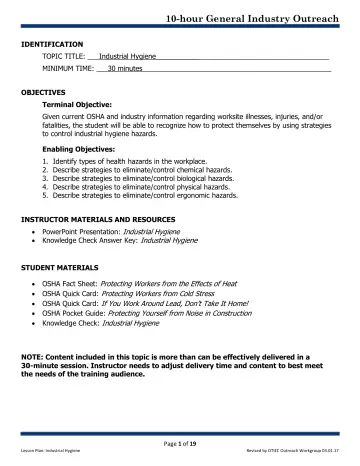
19 slidesIntroduction to Industrial Hygiene: Lesson Plan (OSHA 10-Hour General Industry Outreach)
Instructor lesson plan (objectives, timing, teaching steps) for the OSHA General Industry introduction to industrial hygiene outreach deck.
U.S. Department of Labor, OSHA (with the OTIEC Outreach Workgroup)Public domain
pdf
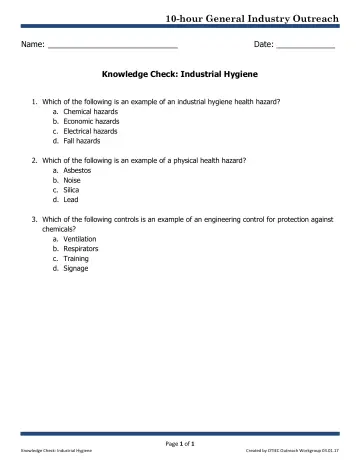
1 slidesIntroduction to Industrial Hygiene: Knowledge Check (OSHA 10-Hour General Industry Outreach)
Student knowledge-check quiz for the OSHA General Industry introduction to industrial hygiene outreach deck.
U.S. Department of Labor, OSHA (with the OTIEC Outreach Workgroup)Public domain