1 / 32Use ← → to flip
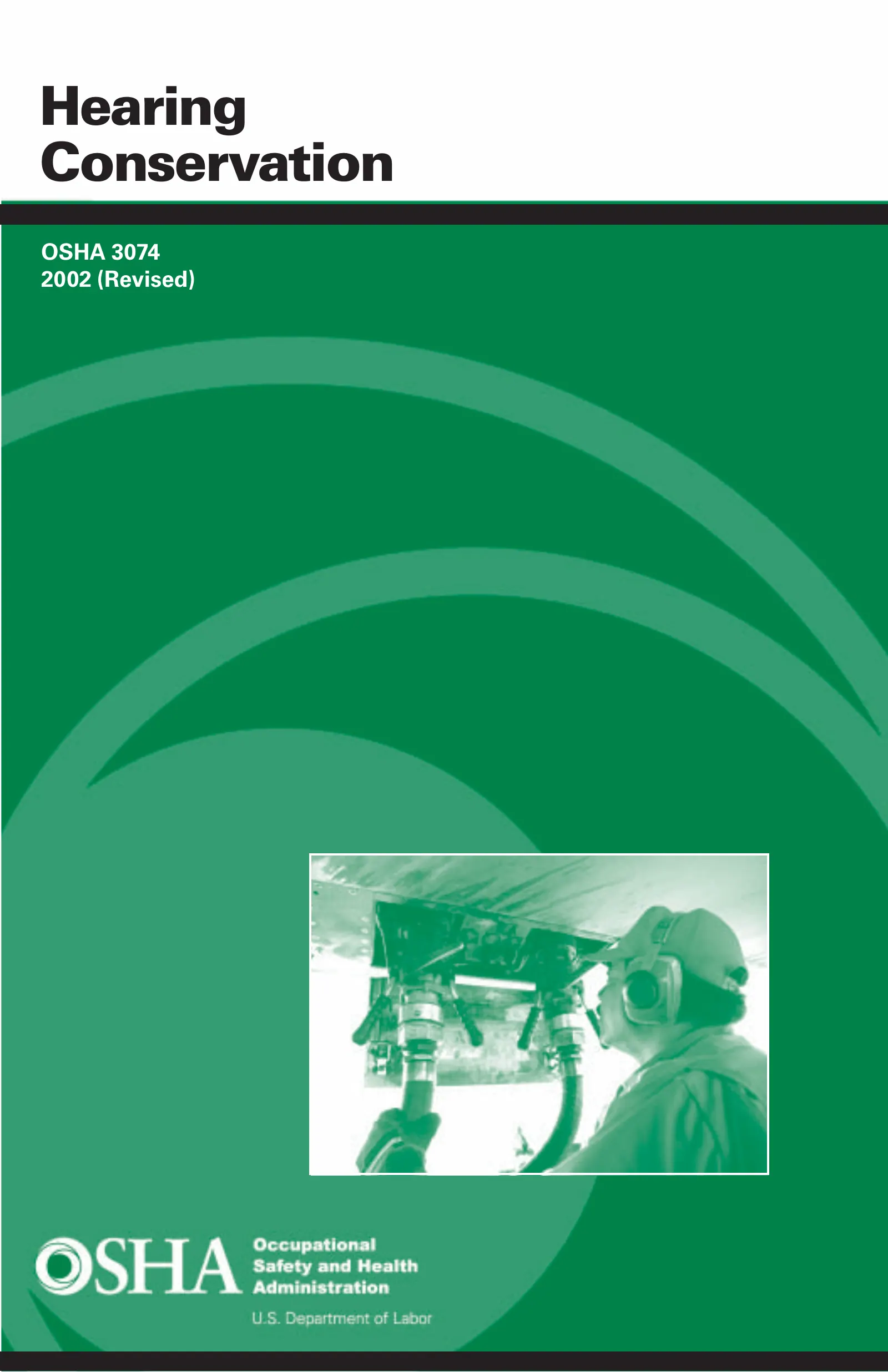
Hearing Conservation (OSHA 3074)
OSHA booklet, for General Industry classes.
Page text
· 31 of 32 pages · by U.S. Department of Labor, OSHA
The words on each page as the author wrote them, read from the file by software so they can be searched. Layout, pictures and tables are not shown here, and long pages are shortened: the pages above and the download are the original.
- Page 1
Hearing
- Conservation
- OSHA 3074
- 2002 (Revised)
- Page 2
- This informational booklet provides a generic, non-exhaustive overview of a particular topic related to OSHA standards. It does not alter or determine compliance responsibilities in OSHA standards or the Occupational Safety and Health Act of 1970. Because interpretations and enforcement policy may change over time, you should consult current administrative interpretations and decisions by the Occupational Safety and Health Review Commission and the Courts for additional guidance on OSHA compliance requirements.
- This publication is in the public domain and may be reproduced, fully or partially, without permission. Source credit is requested but not required.
- This information is available to sensory impaired individuals upon request.
- Voice phone: (202) 693–1999;
- Teletypewriter (TTY) number: (877) 889–5627.
- Page 3
Hearing Conservation
- U.S. Department of Labor Elaine L. Chao, Secretary
- Occupational Safety and Health Administration John L. Henshaw, Assistant Secretary
- OSHA 3074
- 2002 (Revised)
- Page 4
- ii
- Page 5
Contents
- Hearing Conservation
- What is occupational noise exposure? … 1
- What monitoring is required? … 2
- What is audiometric testing? … 3
- What is a baseline audiogram? … 4
- What are annual audiograms? … 4
- What is an employer required to do following an audiogram evaluation? … 5
- When is an employer required to provide hearing protectors? … 6
- What training is required? … 7
- What exposure and testing records must employers keep? … 7
- OSHA Assistance, Services, and Programs
- How can OSHA help me? … 9
- How does safety and health management system assistance help employers and employees? … 9
- What are state programs? … 10
- What is consultation assistance? … 10
- What is the Safety and Health Achievement
- Recognition Program (SHARP)? … 10
- What are the Voluntary Protection
- Programs (VPPs)? … 11
- How can a partnership with OSHA improve worker safety and health? … 12
- What is OSHA’s Strategic
- Partnership Program (OSPP)? … 13
- …
- Page 6
What is the OSHA Training Grant Program? … 14
- What other assistance materials does OSHA have available? … 14
- What do I do in case of an emergency or to file a complaint? … 15
- OSHA Regional and
- Area Office Directory … 16
- OSHA-Approved
- Safety and Health Plans … 20
- OSHA Consultation Projects … 24
- iv
- Page 7
Hearing Conservation
- What is occupational noise exposure?
- Noise, or unwanted sound, is one of the most pervasive occupational health problems. It is a by-product of many industrial processes. Sound consists of pressure changes in a medium (usually air), caused by vibration or turbulence. These pressure changes produce waves emanating away from the turbulent or vibrating source. Exposure to high levels of noise causes hearing loss and may cause other harmful health effects as well. The extent of damage depends primarily on the intensity of the noise and the duration of the exposure.
- Noise-induced hearing loss can be temporary or permanent. Temporary hearing loss results from short-term exposures to noise, with normal hearing returning after period of rest. Generally, prolonged exposure to high noise levels over a period of time gradually causes permanent damage.
- OSHA’s hearing conservation program is designed to protect workers with significant…
- …
- Page 8
What monitoring is required?
- The hearing conservation program requires employers to monitor noise exposure levels in a way that accurately identifies employees exposed to noise at or above 85 decibels (dB) averaged over 8 working hours, or an 8-hour time-weighted average (TWA). Employers must monitor all employees whose noise exposure is equivalent to or greater than a noise exposure received in 8 hours where the noise level is constantly 85 dB.
- The exposure measurement must include all continuous, intermittent, and impulsive noise within an 80 dB to 130 dB range and must be taken during a typical work situation. This requirement is performance-oriented because it allows employers to choose the monitoring method that best suits each individual situation.
- Employers must repeat monitoring whenever changes in production, process, or controls increase noise exposure. These changes may mean that more employees need to be included in the program or that their…
- …
- Page 9
What is audiometric testing?
- Audiometric testing monitors an employee’s hearing over time. It also provides an opportunity for employers to educate employees about their hearing and the need to protect it.
- The employer must establish and maintain an audiometric testing program. The important elements of the program include baseline audiograms, annual audiograms, training, and followup procedures. Employers must make audiometric testing available at no cost to all employees who are exposed to an action level of 85 dB or above, measured as an
- 8-hour TWA.
- The audiometric testing program followup should indicate whether the employer’s hearing conservation program is preventing hearing loss. A licensed or certified audiologist, otolaryngologist, or other physician must be responsible for the program. Both professionals and trained technicians may conduct audiometric testing.
- The professional in charge of the program does not have to be present when a…
- …
- Page 10
What is a baseline audiogram?
- The baseline audiogram is the reference audiogram against which future audiograms are compared. Employers must provide baseline audiograms within 6 months of an employee’s first exposure at or above an 8-hour TWA of 85 dB. An exception is allowed when the employer uses a mobile test van for audiograms. In these instances, baseline audiograms must be completed within 1 year after an employee’s first exposure to workplace noise at or above a TWA of 85 dB. Employees, however, must be fitted with, issued, and required to wear hearing protectors whenever they are exposed to noise levels above a TWA of 85 dB for any period exceeding 6 months after their first exposure until the baseline audiogram is conducted.
- Baseline audiograms taken before the hearing conservation program took effect in 1983 are acceptable if the professional supervisor determines that the audiogram is valid. …
- …
- Page 11
What is an employer required to do following an audiogram evaluation?
- The employer must fit or refit any employee showing an STS with adequate hearing protectors, show the employee how to use them, and require the employee to wear them. Employers must notify employees within 21 days after the determination that their audiometric test results show an STS. Some employees with an STS may need further testing if the professional determines that their test results are questionable or if they have an ear problem thought to be caused or aggravated by wearing hearing protectors. If the suspected medical problem is not thought to be related to wearing hearing protection, the employer must advise the employee to see a physician. If subsequent audiometric tests show that the STS identified on a previous audiogram is not persistent, employees whose exposure to noise is less than a TWA of
- 90 dB may stop wearing hearing protectors.
- …
- Page 12
When is an employer required to provide hearing protectors?
- Employers must provide hearing protectors to all workers exposed to 8-hour TWA noise levels of 85 dB or above. This requirement ensures that employees have access to protectors before they experience any hearing loss.
- Employees must wear hearing protectors:
- For any period exceeding 6 months from the time they are first exposed to 8-hour TWA noise levels of 85 dB or above, until they receive their baseline audiograms if these tests are delayed due to mobile test van scheduling;
- If they have incurred standard threshold shifts that demonstrate they are susceptible to noise; and
- If they are exposed to noise over the permissible exposure limit of 90 dB over an 8-hour TWA.
- Employers must provide employees with a selection of at least one variety of hearing plug and one variety of hearing muff. Employees should decide, with the help of a person trained to fit hearing protectors, which size and type…
- …
- Page 13
- conditions may make it inadequate. If workplace noise levels increase, employees must give employees more effective protectors. The protector must reduce employee exposures to at least 90 dB and to 85 dB when an STS already has occurred in the worker’s hearing. Employers must show employees how to use and care for their protectors and supervise them on the job to ensure that they continue to wear them correctly.
- What training is required?
- Employee training is very important. Workers who understand the reasons for the hearing conservation programs and the need to protect their hearing will be more motivated to wear their protectors and take audiometric tests. Employers must train employees exposed to TWAs of 85 dB and above at least annually in the effects of noise; the purpose, advantages, and disadvantages of various types of hearing protectors; the selection, fit, and care of protectors; and the purpose and procedures of audiometric testing.
- …
- Page 14
- Beginning January 1, 2003, employers also will be required to record work-related hearing loss cases when an employee’s hearing test shows a marked decrease in overall hearing. Employers will be able to make adjustments for hearing loss caused by aging, seek the advice of a physician or licensed health-care professional to determine if the loss is work-related, and perform additional hearing tests to verify the persistence of the hearing loss.
- Page 15
OSHA Assistance, Services, and Programs
- How can OSHA help me?
- OSHA can provide extensive help through a variety of programs, including assistance about safety and health programs, state plans, workplace consultations, voluntary protection programs, strategic partnerships, alliances, and training and education. An overall commitment to workplace safety and health can add value to your business, to your workplace, and to your life.
- How does safety and health management system assistance help employers and employees?
- Working in a safe and healthful environment can stimulate innovation and creativity and result in increased performance and higher productivity. The key to a safe and healthful work environment is a comprehensive safety and health management system.
- OSHA has electronic compliance assistance tools, or eTools, on its website that “walk” users through the steps required to develop a comprehensive safety and health program. …
- …
- Page 16
What are state programs?
- The Occupational Safety and Health Act of 1970 (OSH Act) encourages states to develop and operate their own job safety and health plans. OSHA approves and monitors these plans and funds up to 50 percent of each program’s operating costs. State plans must provide standards and enforcement programs, as well as voluntary compliance activities, that are at least as effective as Federal OSHA’s.
- Currently, 26 states and territories have their own plans. Twenty-three cover both private and public (state and local government) employees and three states, Connecticut,
- New Jersey, and New York, cover only the public sector. For more information on state plans, see the list at the end of this publication, or visit OSHA’s website at www.osha.gov.
- What is consultation assistance?
- Consultation assistance is available on request to employers who want help establishing and maintaining a safe and healthful workplace. …
- …
- Page 17
- Employers accepted into SHARP may receive an exemption from programmed inspections (not complaint or accident investigation inspections) for 1 year initially, or 2 years upon renewal. For more information about consultation assistance, see the list of consultation projects at the end of this publication.
- What are the Voluntary Protection Programs (VPPs)?
- Voluntary Protection Programs are designed to recognize outstanding achievements by companies that have developed and implemented effective safety and health management programs. There are three levels of VPPs: Star, Merit, and Demonstration. All are designed to achieve the following goals:
- Recognize employers that have successfully developed and implemented effective and comprehensive safety and health management programs;
- Encourage these employers to continuously improve their safety and health management programs;
- Motivate other employers to achieve excellent safety and health results in the same…
- …
- Page 18
- community recognition and interaction; further improvement and revitalization of already-good safety and health programs; and a positive relationship with OSHA.
- After a site applies for the program, OSHA reviews an employer’s VPP application and conducts a VPP onsite evaluation to verify that the site’s safety and health management programs are operating effectively. OSHA conducts onsite evaluations on a regular basis, annually for participants at the demonstration level, every 18 months for Merit, and every 3 to 5 years for Star. Once a year, all participants must send a copy of their most recent annual internal evaluation to their OSHA regional office. This evaluation must include the worksite’s record of injuries and illnesses for the past year.
- Sites participating in VPP are not scheduled for regular, programmed inspections. OSHA does, however, handle any employee complaints, serious accidents, or significant chemical releases that may occur at VPP…
- …
- Page 19
What is OSHA’s Strategic Partnership Program (OSPP)?
- OSHA Strategic Partnerships are agreements among labor, management, and government to improve workplace safety and health. These partnerships encourage, assist, and recognize the efforts of the partners to eliminate serious workplace hazards and achieve a high level of worker safety and health. Whereas OSHA’s Consultation Program and VPP entail one-on-one relationships between OSHA and individual worksites, most strategic partnerships build cooperative relationships with groups of employers and employees.
- There are two major types of OSPPs. Comprehensive partnerships focus on establishing comprehensive safety and health management systems at partnering worksites. Limited partnerships help identify and eliminate hazards associated with worker deaths, injuries, and illnesses, or have goals other than establishing comprehensive worksite safety and health programs.
- …
- Page 20
What is the OSHA Training Grant Program?
- OSHA awards grants to nonprofit organizations to provide safety and health training and education to employers and workers in the workplace. Grants often focus on high-risk activities or hazards or may help nonprofit organizations in training, education, and outreach.
- OSHA expects each grantee to develop a program that addresses a safety and health topic named by OSHA, recruit workers and employers for the training, and conduct the training. Grantees are also expected to follow up with students to find out how they applied the training in their workplaces.
- For more information contact OSHA Office of Training and Education, 2020 Arlington Heights Road, Arlington Heights, IL 60005; or call (847) 297– 4810.
- What other assistance materials does OSHA have available?
- OSHA has a variety of materials and tools on its website at www.osha.gov. These include eTools such as Expert Advisors and Electronic Compliance Assistance…
- …
- Page 21
- from the U.S. Government Printing Office. To order, write to the Superintendent of Documents, U.S. Government Printing Office, Washington, DC 20402, or phone (202) 512–1800.
- What do I do in case of an emergency or to file a complaint?
- To report an emergency, file a complaint, or seek OSHA advice, assistance, or products, call (800) 321– OSHA or contact your nearest OSHA regional, area, state plan, or consultation office listed at the end of this publication. The teletypewriter (TTY) number is (877) 889–5627.
- Employees can also file a complaint online and get more information on OSHA federal and state programs by visiting OSHA’s website at www.osha.gov.
- Page 22
OSHA Regional and Area Office Directory
- OSHA Regional Offices
- Region I
- Region VI
- (CT,* MA, ME, NH, RI, VT*)
- JFK Federal Building, Room E340
- Boston, MA 02203
- (617) 565–9860
- (AR, LA, NM,* OK, TX) 525 Griffin Street, Room 602 Dallas, TX 75202
- 214) 767–4731 or 4736 x224
- Region II
- Region VII
- (NJ,* NY,* PR,* VI*)
- 201 Varick Street, Room 670
- New York, NY 10014
- (212) 337–2378
- (IA,* KS, MO, NE)
- City Center Square
- 1100 Main Street, Suite 800
- Kansas City, MO 64105
- (816) 426–5861
- Region III
- (DE, DC, MD,* PA,* VA,* WV) The Curtis Center
- 170 S. Independence Mall West Suite 740 West
- Philadelphia, PA 19106-3309 (215) 861–4900
- Region VIII
- Region IV
- Region IX
- (AL, FL, GA, KY,* MS,
- NC,* SC,* TN*)
- SNAF
- 61 Forsyth Street SW, Room 6T50
- Atlanta, GA 30303
- (404) 562–2300
- (American Samoa, AZ,*
- CA,* HI, NV,* Northern
- Mariana Islands)
- 71 Stevenson Street, Room 420 San Francisco, CA 94105
- (415) 975–4310
- Region V
- Region X
- (IL, IN,* MI,* MN,* OH, WI)
- …
- Page 23
OSHA Area Offices
- Anchorage, AK (907) 271–5152
- Savannah, GA (912) 652–4393
- Birmingham, AL (205) 731–1534
- Smyrna, GA
- (770) 984–8700
- Mobile, AL (251) 441–6131
- Tucker, GA
- (770) 493–6644 / 6742 / 8419
- Little Rock, AR
- (501) 324–6291 / 5818
- Des Moines, IA (515) 284–4794
- Phoenix, AZ
- (602) 640–2348
- Boise, ID
- (208) 321–2960
- Sacramento, CA (916) 566–7471
- Calumet City, IL (708) 891–3800
- San Diego, CA (415) 975–4310
- Des Plaines, IL (847) 803–4800
- Denver, CO
- (303) 844–5285
- Fairview Heights, IL
- (618) 632–8612
- Greenwood Village, CO
- (303) 843–4500
- North Aurora, IL (630) 896–8700
- Bridgeport, CT (203) 579–5581
- Peoria, IL
- (309) 671–7033
- Hartford, CT
- (860) 240–3152
- Indianapolis, IN (317) 226–7290
- Wilmington, DE (302) 573–6518
- Wichita, KS
- (316) 269–6644
- Fort Lauderdale, FL
- (954) 424–0242
- Frankfort, KY
- (502) 227–7024
- Jacksonville, FL (904) 232–2895
- Baton Rouge, LA (225) 389–0474 / 0431)
- Tampa, FL
- Braintree, MA (617) 565–6924
- Page 24
Methuen, MA
- (617) 565–8110
- Hasbrouck Heights, NJ (201) 288–1700
- Springfield, MA (413) 785–0123
- Marlton, NJ
- (856) 757–5181
- Linthicum, MD
- (410) 865–2055 / 2056
- Parsippany, NJ (973) 263–1003
- Bangor, ME
- (207) 941–8177
- Carson City, NV (775) 885–6963
- Portland, ME
- (207) 780–3178
- Albany, NY
- (518) 464–4338
- Lansing, MI
- (517) 327–0904
- Bayside, NY
- (718) 279–9060
- Minneapolis, MN
- (612) 664–5460
- Bowmansville, NY
- (716) 684–3891
- Kansas City, MO
- (816) 483–9531
- New York, NY (212) 337–2636
- St. Louis, MO (314) 425–4249
- North Syracuse, NY
- (315) 451–0808
- Jackson, MS
- (601) 965–4606
- Tarrytown, NY (914) 524–7510
- Billings, MT
- (406) 247–7494
- Westbury, NY
- (516) 334–3344
- Raleigh, NC
- (919) 856–4770
- Cincinnati, OH (513) 841–4132
- Bismark, ND
- (701) 250–4521
- Cleveland, OH (216) 522–3818
- Omaha, NE
- (402) 221–3182
- Columbus, OH (614) 469–5582
- Concord, NH
- (603) 225–1629
- Toledo, OH
- (419) 259–7542
- Avenel, NJ
- Oklahoma City, OK
- Page 25
Portland, OR (503) 326–2251
- El Paso, TX
- (915) 534–6251
- Allentown, PA
- (610) 776–0592
- Fort Worth, TX (817) 428–2470 (817) 485–7647
- Erie, PA
- (814) 833–5758
- Harrisburg, PA (717) 782–3902
- Philadelphia, PA (215) 597–4955
- Pittsburgh, PA
- (412) 395–4903
- Wilkes–Barre, PA (570) 826– 6538
- Guaynabo, PR (787) 277–1560
- Providence, RI (401) 528–4669
- Columbia, SC
- (803) 765–5904
- Nashville, TN (615) 781–5423
- Austin, TX
- (512) 916–5783 / 5788
- Corpus Christi, TX
- (361) 888–3420
- Dallas, TX
- (214) 320–2400 / 2558
- Houston, TX
- (281) 591–2438 / 2787
- Houston, TX
- (281) 286–0583 / 0584 / 5922
- Lubbock, TX
- (806) 472–7681 / 7685
- Salt Lake City, UT
- (801) 530–6901
- Norfolk, VA
- (757) 441–3820
- Bellevue, WA
- (206) 553–7520
- Appleton, WI
- (920) 734–4521
- Eau Claire, WI (715) 832–9019
- Madison, WI
- (608) 264–5388
- Milwaukee, WI (414) 297–3315
- Charleston, WV (304) 347–5937
- Page 26
OSHA-Approved Safety and Health Plans
- Alaska Department of Labor and Workforce Development
- Hawaii Department of Labor and Industrial Relations
- Commissioner
- (907) 465–2700
- FAX: (907) 465–2784
- Director
- (808) 586–8844
- FAX: (808) 586–9099
- Program Director
- (907) 269–4904
- FAX: (907) 269– 4915
- Administrator
- (808) 586–9116
- FAX: (808) 586–9104
- Industrial Commission of Arizona
- Indiana Department of Labor
- Director, ICA
- (602) 542–4411
- FAX: (602) 542–1614
- (602) 542–5795
- (317) 232–2378
- FAX: (317) 233–3790
- Deputy Commissioner (317) 232–3325
- Iowa Division of Labor
- California Department of Industrial Relations
- Director
- (415) 703–5050
- FAX: (415) 703–5114
- Chief
- (415) 703–5100
- Manager, Cal / OSHA Program Office
- (415) 703–5177
- Connecticut Department of Labor
- (860) 566–5123
- FAX: (860) 566–1520
- Conn–OSHA Director (860) 566–4550
- FAX: (860) 566–6916
- (515) 281–6432
- FAX: (515) 281–4698
- (515) 281–3469
- FAX: (515) 281–7995
- Kentucky Labor Cabinet
- Secretary
- (502) 564–3070
- …
- Page 27
- Maryland Division
- of Labor and Industry
- Commissioner
- (410) 767–2999
- FAX: (410) 767–2300
- Deputy Commissioner
- (410) 767–2992
- FAX: 767–2003
- Assistant Commissioner, MOSH
- (410) 767–2215
- New Jersey Department
- of Labor
- (609) 292–2975
- FAX: (609) 633–9271
- Assistant Commissioner
- (609) 292–2313
- FAX: (609) 292–1314
- Program Director, PEOSH
- (609) 292–3923
- FAX: (609) 292–4409
- Michigan Department of Consumer and Industry Services
- Director
- (517) 322–1814
- FAX: (517) 322–1775
- New Mexico Environment
- Department
- Secretary
- (505) 827–2850
- FAX: (505) 827–2836
- Chief
- (505) 827– 4230
- FAX: (505) 827– 4422
- Minnesota Department
- (651) 296–2342
- FAX: (651) 282–5405
- (651) 296–6529
- FAX: (651) 282–5293
- Administrative Director, OSHA Management Team
- (651) 282–5772
- FAX: (651) 297–2527
- Nevada Division
- of Industrial Relations Administrator
- (775) 687–3032
- FAX: (775) 687–6305
- Chief Administrative Officer (702) 486–9044
- FAX: (702) 990–0358
- [Las Vegas (702) 687–5240]
- …
- Page 28
Oregon Occupational Safety and Health Division
- Administrator
- (503) 378–3272
- FAX: (503) 947–7461
- Deputy Administrator for Policy
- Deputy Administrator for Operations
- Tennessee Department of Labor
- Commissioner
- (615) 741–2582
- FAX: (615) 741–5078
- Acting Program Director
- (615) 741–2793
- FAX: (615) 741–3325
- Utah Labor Commission
- (801) 530–6901
- FAX: (801) 530–7906
- Puerto Rico Department of Labor and Human Resources
- (801) 530–6898
- FAX: (801) 530–6390
- Secretary
- (787) 754–2119
- FAX: (787) 753–9550
- Vermont Department of Labor and Industry
- Assistant Secretary for Occupational Safety and Health (787) 756–1100 / 1106, 754–2171 FAX: (787) 767–6051
- Deputy Director for Occupational Safety and Health (787) 756–1100, 1106/754–2188 FAX: (787) 767–6051
- South Carolina Department of Labor, Licensing, and Regulation
- Director
- (803) 896–4300
- FAX: (803) 896–4393
- Program Director
- (803) 734–9644
- FAX: (803) 734–9772
- (802) 828–2288
- FAX: (802) 828–2748
- Project Manager
- (802) 828–2765
- …
- Page 29
Virginia Department of Labor and Industry
- Commissioner
- (804) 786–2377
- FAX: (804) 371–6524
- Director, Office of Legal Support (804) 786–9873
- FAX: (804) 786–8418
- Washington Department of Labor and Industries
- Director
- (360) 902–4200
- FAX: (360) 902–4202
- Assistant Director
- [PO Box 44600]
- (360) 902–5495
- FAX: (360) 902–5529
- Program Manager, Federal–State Operations
- (360) 902–5430
- Wyoming Department of Employment
- Safety Administrator
- (307) 777–7786
- FAX: (307) 777–3646
- Page 30
OSHA Consultation Projects
- Anchorage, AK (907) 269–4957
- Indianapolis, IN (317) 232–2688
- Tuscaloosa, AL (205) 348–3033
- Topeka, KS
- (785) 296–2251
- Little Rock, AR (501) 682–4522
- Frankfort, KY
- (502) 564–6895
- Phoenix, AZ
- (602) 542–1695
- Baton Rouge, LA (225) 342–9601
- Sacramento, CA (916) 263–2856
- West Newton, MA
- (617) 727–3982
- Fort Collins, CO (970) 491–6151
- Laurel, MD
- (410) 880–4970
- Wethersfield, CT (860) 566–4550
- Augusta, ME
- (207) 624–6400
- Washington, DC (202) 541–3727
- Lansing, MI
- (517) 322–1809
- Wilmington, DE (302) 761–8219
- Saint Paul, MN (651) 284–5060
- Tampa, FL
- (813) 974–9962
- Jefferson City, MO
- (573) 751–3403
- Atlanta, GA
- (404) 894–2643
- Pearl, MS
- (601) 939–2047
- Tiyam, GU
- 9–1–(671) 475–1101
- Helena, MT
- (406) 444–6418
- Honolulu, HI
- (808) 586–9100
- Raleigh, NC
- (919) 807–2905
- Des Moines, IA (515) 281–7629
- Bismarck, ND (701) 328–5188
- Boise, ID
- (208) 426–3283
- Lincoln, NE
- (402) 471–4717
- Chicago, IL
- Concord, NH
- Page 31
Trenton, NJ
- (609) 292–3923
- Nashville, TN (615) 741–7036
- Santa Fe, NM (505) 827–4230
- Austin, TX
- (512) 804–4640
- Albany, NY
- (518) 457–2238
- Salt Lake City, UT
- (801) 530–6901
- Henderson, NV (702) 486–9140
- Montpelier, VT (802) 828–2765
- Columbus, OH (614) 644–2631
- Richmond, VA (804) 786–6359
- Oklahoma City, OK
- (405) 528–1500
- Christiansted St. Croix, VI (809) 772–1315
- Salem, OR (503) 378–3272
- Olympia, WA (360) 902–5638
- Indiana, PA
- (724) 357–2396
- Madison, WI
- (608) 266–9383
- Hato Rey, PR
- (787) 754–2171
- Waukesha, WI (262) 523–3044
- Providence, RI (401) 222–2438
- Charleston, WV (304) 558–7890
- Columbia, SC
- (803) 734–9614
- Cheyenne, WY (307) 777–7786
- Brookings, SD
- (605) 688– 4101
More on Industrial Hygiene
pptx
66 slidesIntroduction to Industrial Hygiene (OSHA 10-Hour General Industry Outreach)
OSHA's outreach deck introducing chemical, physical, biological and ergonomic health hazards and controls (2017).
U.S. Department of Labor, OSHAPublic domain
pdf
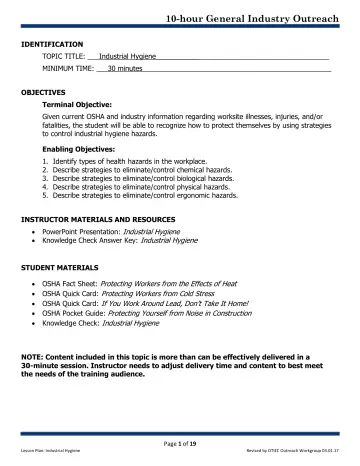
19 slidesIntroduction to Industrial Hygiene: Lesson Plan (OSHA 10-Hour General Industry Outreach)
Instructor lesson plan (objectives, timing, teaching steps) for the OSHA General Industry introduction to industrial hygiene outreach deck.
U.S. Department of Labor, OSHA (with the OTIEC Outreach Workgroup)Public domain
pdf
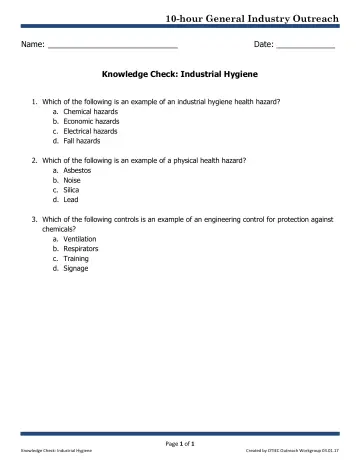
1 slidesIntroduction to Industrial Hygiene: Knowledge Check (OSHA 10-Hour General Industry Outreach)
Student knowledge-check quiz for the OSHA General Industry introduction to industrial hygiene outreach deck.
U.S. Department of Labor, OSHA (with the OTIEC Outreach Workgroup)Public domain