1 / 3Use ← → to flip
Do You Have Work-Related Asthma? A Guide for You and Your Healthcare Provider Fact Sheet (OSHA FS 3707)
OSHA fact sheet or bulletin, for General Industry classes.
Page text
· 3 pages · by U.S. Department of Labor, OSHA
The words on each page as the author wrote them, read from the file by software so they can be searched. Layout, pictures and tables are not shown here: the pages above and the download are the original.
- Page 1
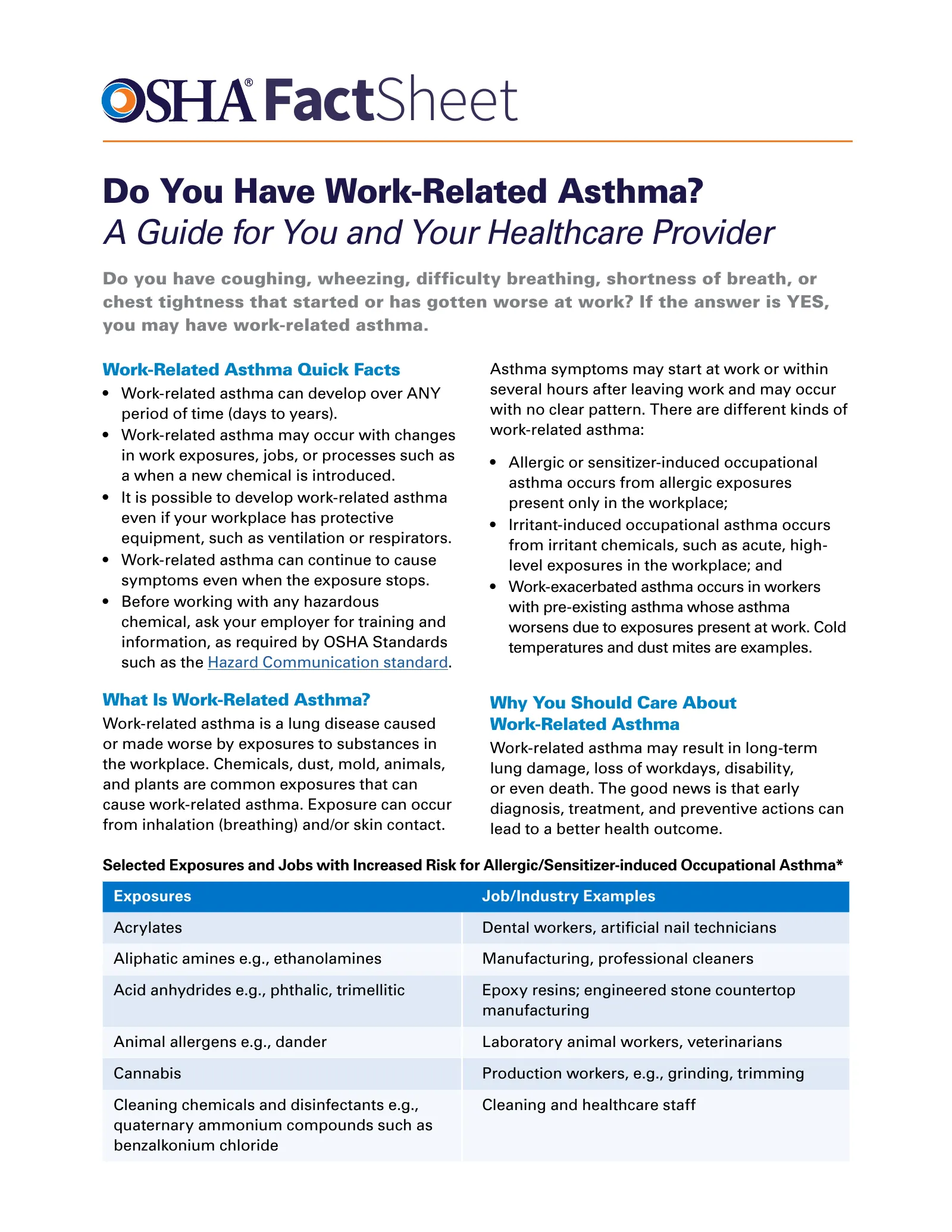
FactSheet
- Do You Have Work-Related Asthma?
- A Guide for You and Your Healthcare Provider
- Do you have coughing, wheezing, difficulty breathing, shortness of breath, or chest tightness that started or has gotten worse at work? If the answer is YES, you may have work-related asthma.
- Work-Related Asthma Quick Facts
- Work-related asthma can develop over ANY period of time (days to years).
- Work-related asthma may occur with changes in work exposures, jobs, or processes such as a when a new chemical is introduced.
- It is possible to develop work-related asthma even if your workplace has protective equipment, such as ventilation or respirators.
- Work-related asthma can continue to cause symptoms even when the exposure stops.
- Before working with any hazardous chemical, ask your employer for training and information, as required by OSHA Standards such as the Hazard Communication standard.
- What Is Work-Related Asthma?
- Work-related asthma is a lung disease caused or made worse by exposures to substances in the workplace. Chemicals, dust, mold, animals, and plants are common exposures that can cause work-related asthma. Exposure can occur from inhalation (breathing) and/or skin contact.
- Asthma symptoms may start at work or within several hours after leaving work and may occur with no clear pattern. There are different kinds of work-related asthma:
- Allergic or sensitizer-induced occupational asthma occurs from allergic exposures present only in the workplace;
- Irritant-induced occupational asthma occurs from irritant chemicals, such as acute, high-level exposures in the workplace; and
- Work-exacerbated asthma occurs in workers with pre-existing asthma whose asthma worsens due to exposures present at work. Cold temperatures and dust mites are examples.
- Why You Should Care About
- Work‑Related Asthma
- Work-related asthma may result in long-term lung damage, loss of workdays, disability, or even death. The good news is that early diagnosis, treatment, and preventive actions can lead to a better health outcome.
- Selected Exposures and Jobs with Increased Risk for Allergic/Sensitizer-induced Occupational Asthma*
- Exposures
- Job/Industry Examples
- Acrylates
- Dental workers, artificial nail technicians
- Aliphatic amines e.g., ethanolamines
- Manufacturing, professional cleaners
- Acid anhydrides e.g., phthalic, trimellitic
- Epoxy resins; engineered stone countertop manufacturing
- Animal allergens e.g., dander
- Laboratory animal workers, veterinarians
- Cannabis
- Production workers, e.g., grinding, trimming
- Cleaning chemicals and disinfectants e.g., quaternary ammonium compounds such as benzalkonium chloride
- Cleaning and healthcare staff
- Page 2
Exposures
- Job/Industry Examples
- Green coffee bean, roasted coffee and tea dust
- Processing workers, e.g., grinding
- Diisocyanates
- Polyurethane foam insulators, spray painters, e.g., automotive, spray-on truck bed liner applicators, polyurethane glues and adhesives, building construction
- Enzymes e.g., α-amylase
- Detergent manufacture, bakers
- Formaldehyde
- Healthcare workers, hairdressers, particle board manufacturing
- Glutaraldehyde
- Healthcare workers
- Grains and flours
- Bakers, grain elevator workers, farmers
- Latex
- Latex products manufacture, latex glove users
- Metals e.g., chromium, nickel, platinum salts
- Platinum refining, metal plating, cement workers
- Persulfate salts as bleaching agents
- Hairdressers
- Psyllium
- Wood dust e.g., western red cedar
- Wood workers, forestry and sawmill workers
- *Additional exposures and/or industries not listed may cause work-related asthma.
- What To Do If You Think You Have
- Work‑Related Asthma
- If you think you have work-related asthma, you should report this to your employer and see a healthcare provider as soon as possible. Bring this fact sheet with you. Also, bring the safety data sheet(s) for any chemicals you use at work that you think may be causing your asthma.
- Helpful Resources for Workers
- If you have a workplace health and safety question, contact the Occupational Safety and Health Administration (OSHA) at 1-800-321- OSHA (6742) or go to OSHA’s Workers web page
- Additional information can be found on OSHA’s Occupational Asthma Safety and Health Topics page.
- Diagnosis of Work-Related Asthma: A Guide for Clinicians
- Consider work-related asthma in ALL adults with new-ons et asthma or aggravation of previously controlled asthma.
- Obtain a detailed medical history that documents the patient’s asthma symptoms, allergies, and the relationship of t he symptoms to work (onset, timing, severity).
- Key Questions:
- Do your symptoms change when you are away from work (evenings, weekends, vacation)?
- Did you have any unusual exposures or changes in your job processes before your symptoms started?
- Do you have any allergy symptoms, such as runny nose, nasal congestion, itchy, watery eyes, or hives/rash? If yes, are these symptoms worse at work?
- Document a history of occupational exposures.
- ¶ Electronic occupational history exposure form (Agency for Toxic Substances and Disease
- Registry; ATSDR)
- ¶ Case Study on Taking an Exposure History (ATSDR)
- ¶ Occupational exposures database (Association of Occupational and Environmental Clinics; AOEC)
- ¶ You or your patient may also request a safety data sheet (SDS) for chemicals in the workplace from your patient’s employer, as per the OSHA Hazard Communication standard, 29 CFR 1910.1200 .
- Page 3
- Perform pulmonary function testing (PFT) in accord with American Thoracic Society
- Standards to determine asthma and work‑relatedness.
- ¶ Spirometry AND peak expiratory flow rates
- (PEFRs) may assist with diagnosis.
- ¶ For strategies on using spirometry or serial peak flow to diagnose work-related asthma, consult Diagnosis and management of work-related asthma: American College Of Chest Physicians Consensus Statement
- ¶ Spirometry Testing in Occupational Health
- Programs: Best Practices for Healthcare
- Professionals (OSHA guidance)
- ¶ A normal spirometry result does NOT exclude the possibility of work-related asthma.
- Refer to an occupational medicine, pulmonary and/or allergy specialist for supplemental testing and assistance with determining work-relatedness, reducing exposures, and protecting the worker’s employment status.
- ¶ To find an occupational and environmental medicine provider or clinic, visit:
- A merican College of Occupational and Environmental Medicine (ACOEM) Find a Provider
- OEC Member Clinics
- Helpful Resources for Clinicians
- Henneberger PK., et al. Workplace interventions for treatment of occupational asthma. Cochrane Database Syst Rev. 2019 Oct 8;10(10):CD006308.
- Jolly AT, et al. Work-Related Asthma. J Occup Environ Med. 2015 Oct;57(10):e121-9.
- About Work-related Asthma (National Institute for Occupational Safety and Health; NIOSH)
- Occupational Respiratory Disease – State‑Based Surveillance Programs for Work‑related Asthma (NIOSH)
- Clinicians’ web page (OSHA)
- OSHA Safety and Health Topic Pages: ¶ Isocyanates
- ¶ Formaldehyde
- ¶ Occupational Asthma
- Tarlo SM, et al. Diagnosis and management of work-related asthma: American College Of Chest Physicians Consensus Statement. Chest. 2008 Sep;134(3 Suppl):1S-41S. doi: 10.1378/ chest.08-0201. (includes a work-related asthma diagnosis and management algorithm)
- This guidance document is advisory in nature and informational in content. It is not a standard or regulation, and it neither creates new legal obligations nor alters existing obligations created by OSHA standards or the Occupational Safety and Health Act (OSH Act). Pursuant to the OSH Act, employers must comply with safety and health standards and regulations issued and enforced either by OSHA or by an OSHA-approved State Plan (a list of State Plans is available at www.osha.gov/stateplans). In addition, the Act’s General Duty Clause, Section 5(a)(1), requires employers to provide their employees with a workplace free from recognized hazards likely to cause death or serious physical harm. The mention of any nongovernmental organization or link to its web site in this guidance document does not constitute an endorsement by OSHA of that organization or its products, services, or web site.
- This is one in a series of informational fact sheets highlighting OSHA programs, policies or standards. It does not impose any new compliance requirements. For a comprehensive list of compliance requirements of OSHA standards or regulations, refer to Title 29 of the Code of Federal Regulations. This information will be made available to sensory-impaired individuals upon request. The voice phone is (202) 693-1999.
- DTSEM FS-3707 08/2026
More on Industrial Hygiene
pptx
66 slidesIntroduction to Industrial Hygiene (OSHA 10-Hour General Industry Outreach)
OSHA's outreach deck introducing chemical, physical, biological and ergonomic health hazards and controls (2017).
U.S. Department of Labor, OSHAPublic domain
pdf
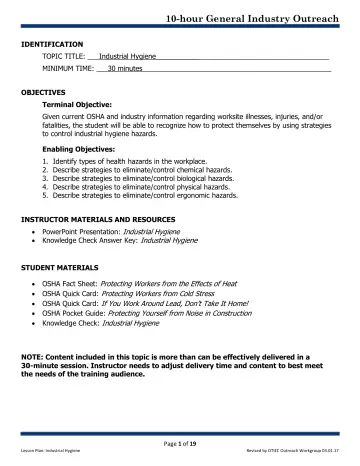
19 slidesIntroduction to Industrial Hygiene: Lesson Plan (OSHA 10-Hour General Industry Outreach)
Instructor lesson plan (objectives, timing, teaching steps) for the OSHA General Industry introduction to industrial hygiene outreach deck.
U.S. Department of Labor, OSHA (with the OTIEC Outreach Workgroup)Public domain
pdf
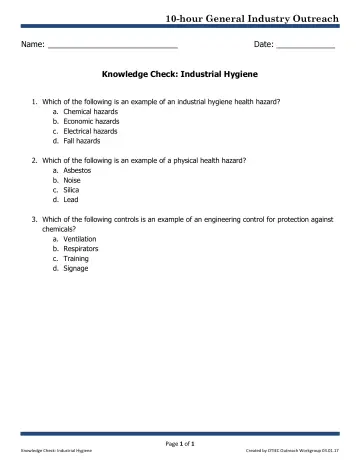
1 slidesIntroduction to Industrial Hygiene: Knowledge Check (OSHA 10-Hour General Industry Outreach)
Student knowledge-check quiz for the OSHA General Industry introduction to industrial hygiene outreach deck.
U.S. Department of Labor, OSHA (with the OTIEC Outreach Workgroup)Public domain