1 / 6Use ← → to flip
Temporary Worker Initiative (TWI) Bulletin No. 12 – Exposure to Outdoor and Indoor Heat-Related Hazards (OSHA 4185)
OSHA fact sheet or bulletin, for General Industry classes.
Page text
· 6 pages · by U.S. Department of Labor, OSHA
The words on each page as the author wrote them, read from the file by software so they can be searched. Layout, pictures and tables are not shown here: the pages above and the download are the original.
- Page 1
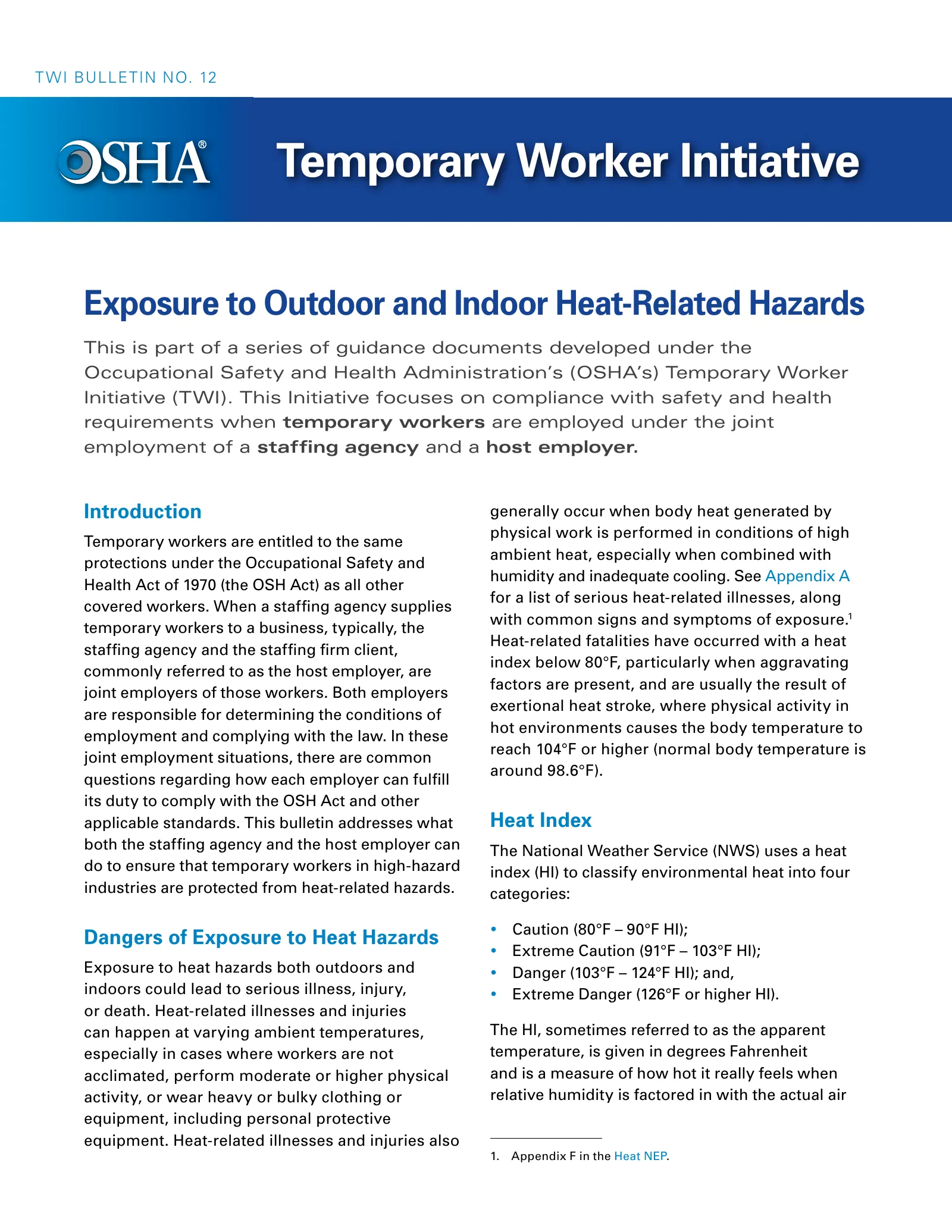
Temporary Worker Initiative
- T WI BULLE TIN NO. 12
- Exposure to Outdoor and Indoor Heat‑Related Hazards
- This is part of a series of guidance documents developed under the Occupational Safety and Health Administration’s (OSHA’s) Temporary Worker Initiative (TWI). This Initiative focuses on compliance with safety and health requirements when temporary workers are employed under the joint employment of a staffing agency and a host employer.
- Introduction
- Temporary workers are entitled to the same protections under the Occupational Safety and Health Act of 1970 (the OSH Act) as all other covered workers. When a staffing agency supplies temporary workers to a business, typically, the staffing agency and the staffing firm client, commonly referred to as the host employer, are joint employers of those workers. Both employers are responsible for determining the conditions of employment and complying with the law. In these joint employment situations, there are common questions regarding how each employer can fulfill its duty to comply with the OSH Act and other applicable standards. This bulletin addresses what both the staffing agency and the host employer can do to ensure that temporary workers in high-hazard industries are protected from heat-related hazards.
- Dangers of Exposure to Heat Hazards
- Exposure to heat hazards both outdoors and indoors could lead to serious illness, injury, or death. Heat-related illnesses and injuries can happen at varying ambient temperatures, especially in cases where workers are not acclimated, perform moderate or higher physical activity, or wear heavy or bulky clothing or equipment, including personal protective equipment. Heat-related illnesses and injuries also generally occur when body heat generated by physical work is performed in conditions of high ambient heat, especially when combined with humidity and inadequate cooling. See Appendix A for a list of serious heat-related illnesses, along with common signs and symptoms of exposure. 1 Heat-related fatalities have occurred with a heat index below 80°F, particularly when aggravating factors are present, and are usually the result of exertional heat stroke, where physical activity in hot environments causes the body temperature to reach 104°F or higher (normal body temperature is around 98.6°F).
- Heat Index
- The National Weather Service (NWS) uses a heat index (HI) to classify environmental heat into four categories:
- Caution (80°F – 90°F HI);
- Extreme Caution (91°F – 103°F HI);
- Danger (103°F – 124°F HI); and, Extreme Danger (126°F or higher HI).
- The HI, sometimes referred to as the apparent temperature, is given in degrees Fahrenheit and is a measure of how hot it really feels when relative humidity is factored in with the actual air
- 1. Appendix F in the Heat NEP.
- Page 2
Employers Responsibilities
- temperature. 2 When the HI is 80°F or higher, serious occupational heat-related illnesses and injuries become more frequent, especially in workplaces where unacclimatized workers are performing strenuous work (e.g., intense arm and back/lifting work, carrying, shoveling, manual sawing, pushing and pulling heavy loads, and walking at a fast pace), without easy access to cool water, or cool/ shaded areas, when working in direct sunlight or areas where other radiant heat sources are present.
- All employers covered under the OSH Act must ensure that workers are protected from heat-related hazards. To protect their workers, employers should implement the following:
- y Develop a program that outlines the steps the employer will take to protect their workers from heat hazards.
- y Provide regular access to cool water and to cool and/or shaded areas for rest.
- y Allow new and returning workers to acclimatize to working in the heat.
- The OSHA-NIOSH Heat Safety Tool App is a resource for finding the forecasted and current heat index near your location. The Heat App indicates the hazard levels using the HI as:
- Acclimatization is a process by which a person gradually increases their exposure time to hot environmental conditions, causing beneficial physiological changes that improve body temperature regulation and minimize risk of HRIs by properly regulating body temperature that minimizes heat-related illnesses. It is therefore essential for employers to train new or returning workers on heatrelated hazards including heat stress, gradually increase their workloads, ensure more frequent breaks as they acclimatize to ambient conditions, and monitor them for signs of heat illness.
- y Caution less than 80°F HI;
- y Warning 80°F to 94°F HI; and, y Danger at 95°F HI or higher.
- Currently OSHA does not have a specific standard addressing heat-related hazards. However, the agency recently issued an Exposure to Outdoor and Indoor Heat-Related Hazards National Emphasis Program (NEP) to protect workers from such hazards. The Heat NEP outlines policies and procedures to identify and eliminate or reduce worker exposures to occupational heatrelated illnesses and injuries in general industry, construction, maritime, and agriculture. It targets specific high-hazard industries expected to have the highest exposures to heat-related hazards and resulting illnesses and deaths. On any day that the NWS announces a heat warning or advisory for the local area, compliance safety and health Officers (CSHOs) will conduct on-site inspections at these targeted high-hazard industries. Likewise, on a heat priority day, a day when the heat index for the day is expected to be 80°F or more, CSHOs will provide compliance assistance to employers when conducting on-site inspections, even if the establishment is not on the high-hazard industries list. On heat priority days, CSHOs are encouraged to be aware of heat hazards they may observe in their job-related travel and conduct compliance assistance or self-referrals for inspections.
- y Implement a “buddy” system.
- y Buddy system entails pairing the workers so that they can recognize when symptoms are observed in each other and take the necessary steps before heat illness develops.
- y Implement administrative controls (e.g., earlier start times, and employee/job rotation) to limit heat exposures.
- y Train workers on heat illness signs, how to report signs and symptoms, first aid, how to contact emergency personnel, prevention methods, and the importance of hydration.
- y Train supervisors on the Heat Illness Prevention Plan to include monitoring workers for signs and symptoms of HRIs, to monitor temperatures of outdoor sites, to remind workers to stay hydrated, and to establish and enforce rest and cool-down breaks.
- Training must be done in a language the workers will understand.
- See www.weather.gov/bgm/heat.
- Page 3
Host Employer Responsibilities
- y Inform temporary workers of the heat-related hazards they may encounter;
- y Instruct temporary workers that they must follow all safety and health rules (i.e., taking required breaks/hydrating) required by the host employer; y Train the workers on how to identify signs and symptoms of exposure to heat and use of a buddy system; and y Review and confirm that the host employer has a Heat Illness and Injury Program in place.
- The host employer has the primary responsibility of developing a Heat Illness and Injury Program for the worksite, providing cool water and cool, shaded areas for rest, and training and implementing acclimatization procedures for new workers, including temporary workers, and returning workers. In addition, the host employer should become familiar with available tools (i.e., OSHA- NIOSH Heat Safety Tool App and the NWS website) that permit regular evaluation of workplace heat hazards at their worksite for determining local forecasts and current heat index.
- The staffing agency is also responsible for maintaining communication with its workers and the host employer regarding acclimatization procedures for new and/or returning workers, heat exposures, and any signs or symptoms the temporary workers are exhibiting. Such ongoing communication alerts the staffing agency and temporary workers to additional or newly discovered heat-related hazards that may need to be addressed and ensures that responsibilities of the host employer’s Heat Illness and Injury Program are understood and implemented.
- The host employer should maintain the appropriate surveillance of workplace conditions and the degree of worker exposure(s). Therefore, upon identifying heat priority days the host employer is in a position to implement the program, adjust the work times (i.e., schedule work during the cooler times of day) and take steps to reduce the risk of health hazards associated with heat exposures. That is because the host employer is most familiar with and has control over the processes, workload, and equipment that may contribute to high heat hazards that the temporary workers will encounter. Therefore, the host employer is responsible for site-specific policies and procedures including training and should afford temporary workers the same training and protections as permanent workers.
- For a listing of best practices on worker acclimatization, visit the American Conference of Governmental Industrial Hygienists (ACGIH ® ) website at www.acgih.org to obtain information on the Action Limit (AL) for unacclimatized workers, a Threshold Limit Value (TLV ® ) for acclimatized workers and see Heat Stress and Strain: TLV ®
- Physical Agents 2022 Edition.
- Staffing Agency Responsibilities
- Joint Responsibilities
- The staffing agency shares responsibility for its workers’ safety and health and has an obligation to become familiar with the various tools mentioned above and to review the host employer’s worksite policies and procedures to control heat hazards prior to assigning workers. As a recommended practice, the staffing agency should take reasonable steps to:
- The OSH Act under section 5(a)(1) requires employers to provide a safe and healthful workplace for all workers. When investigations reveal that a temporary worker is exposed to a recognized hazard, and the worker is employed by both a staffing agency and a host employer, OSHA will consider issuing citations to either or both of the employers, depending on the specific facts of the case. OSHA will make an assessment of whether both employers have fulfilled their respective compliance responsibilities in each individual case.
- y Ensure that the host employer provides cool shade, acclimatization procedures, and has existing procedures for new or returning workers, access to adequate cool water, use of administrative controls, and site-specific training for temporary workers in the same manner in which the host’s employees are protected;
- Page 4
Example Scenario*
- The example provided below describes what may occur when temporary workers exposed to heat hazards are not provided with a work/rest schedule, cool water, cool break area, and the benefit of training on the effects of heat for their job assignments by the staffing agency and a host employer.
- Scenario
- A commercial laundry facility, Clean Wash, services several businesses in a busy industrial area. Clean Wash occupies an old building. The building is supplied with exhaust fans that bring in outside air into the facility creating a similar environment inside as outside. The facility’s main floor is divided into multiple rooms that hold washers, dryers, ironing machines, soil sorting, and folding areas. The basement floor is another area for folding and ironing and this area has neither windows nor a cool break area. Clean Wash needed additional workers to fill a backlog of laundering beach towels due to a new contract they acquired from a nearby hotel during a summer heat wave.
- Clean Wash has a contract with Weather Staffing, a staffing agency, to provide the extra workers to perform ironing and folding in the basement. Weather Staffing hired six workers, and informed them of the various jobs operating the laundry equipment, ironing, and folding laundry, and also gave them general safety training (e.g., personal protective equipment, hazard communication) before sending them to Clean Wash.
- When the temporary workers arrived, Clean Wash informed them of the hot (i.e., radiant heat/ steam) environment and told them that fans for cooling off were available at the facility, but did not provide site-specific training on heat hazards and heat illness prevention methods or provide them with a break schedule, cool water, or a cool break area. Weather conditions included an NWS ongoing heat advisory in effect for the local area. On the first day, one of the temporary workers began to experience fatigue, thirst, and dizziness. As more days passed, other workers developed similar symptoms, and some even experienced muscle cramps and periods of dizziness. When the temporary workers complained, Clean Wash provided floor fans. However, on the third day, three temporary employees collapsed. They were taken to the hospital where they were diagnosed with heat exhaustion.
- Analysis
- As the host employer, Clean Wash was responsible for providing site-specific training on preventing heat hazards, including, but not limited to, a work/rest regimen, and for providing access to cool water, and a cool break area. Clean Wash supervises and controls the day-to-day work of the temporary workers t its facility and was clearly aware of the growing risk for heat-related illness. It is in the best position to provide the site-specific training and implement procedures to control heat hazards applicable to its workplace. For this failure to provide appropriate site-specific heat-related information and training, and not implementing a work/rest regimen with access to cool water and cool break area, Clean Wash may be subject to OSHA citations.
- Staffing agency Weather Staffing fulfilled some of its OSHA responsibilities by providing the general safety training but did not provide heat-related training addressing issues such as health effects associated with heat stress, symptoms of heat induced illnesses, methods of preventing such illnesses, and the need to be acclimatized. Since the staffing agency knew the workers would be working in a heat-generating environment, it should have inquired about what provisions the
- Page 5
State Plans
- host employer had in place to ensure that Weather Staffing workers were adequately protected. Further, the staffing agency failed to ensure and confirm that Clean Wash had provided site-specific heat-related training to the temporary workers. Weather Staffing may therefore be subject to OSHA citations for not providing general heat-related training.
- *Note: The company names in this scenario are fictitious. Any resemblance to real companies is entirely coincidental.
- Under OSHA’s Heat NEP, CSHOs will evaluate worker exposure to heat hazards and contributing factors and inquire about any heat illness and injury programs. The host employer’s Heat Illness and Injury Program should outline the procedures that are to be implemented to protect all workers from suffering heat-related illnesses and injuries. In cases where temporary workers work for multiple host employers for short periods of time (i.e., seasonal, monthly), the staffing agency should coordinate employee protections with all host employers.
- For information on Temporary Workers visit
- OSHA’s Temporary Workers’ page www.osha.gov/temporaryworkers.
- The OSH Act prohibits employers from retaliating against their employees for exercising their rights under the OSH Act. These rights include raising a workplace health and safety concern with either employer, reporting an injury or illness, filing an OSHA complaint, and participating in an inspection or talking to an inspector. If workers have been retaliated or discriminated against for exercising their rights, they must file a complaint with OSHA within 30 days of the alleged adverse action to preserve their rights under section 11(c). For more information, please visit www.whistleblowers.gov.
- Twenty-eight states and U.S. territories operate their own OSHA-approved occupational safety and health programs, called State Plans.
- These State Plans have and enforce their own occupational safety and health standards that must be at least as effective as OSHA’s but may have different or additional requirements. A list of the State Plans and more information are available at: www.osha.gov/stateplans.
- OSHA also provides help to employers. OSHA’s
- On-Site Consultation Program offers free and confidential advice to small and medium-sized businesses in all states and several territories, with priority given to high-hazard worksites.
- On-Site consultation services are separate from enforcement and do not result in penalties or citations. Consultants from state agencies or universities work with employers to identify workplace hazards, provide advice on compliance with OSHA standards, and assist in establishing and improving safety and health management systems. To locate the OSHA On-Site Consultation Program nearest you, call 1-800-321-6742 (OSHA) or visit www.osha.gov/consultation.
- How Can OSHA Help?
- Workers have a right to a safe workplace. If you think your job is unsafe or you have questions, contact OSHA at 1-800-321-OSHA (6742) or visit OSHA’s main web page at www.osha.gov. It’s confidential. We can help.
- For other valuable worker protection information, such as Workers’ Rights, Employer Responsibilities and other services OSHA offers, visit OSHA’s Workers’ page www.osha.gov/workers.
- Page 6
Appendix A: Description of Serious Heat-related Illnesses and Common Symptoms
- The table below describes serious heat-related illnesses and common signs and symptoms. Please note that this list is not exhaustive. For additional information including new campaign products visit: www.osha.gov/heat.
- SYMPTOMS AND SIGNS
- Heat stroke
- Confusion
- Slurred speech
- Unconsciousness
- Seizures
- Heavy sweating or hot, dry skin
- Very high body temperature
- Rapid heart rate
- Heat exhaustion
- Fatigue
- Irritability
- Thirst
- Nausea or vomiting
- Dizziness or lightheadedness
- Heavy sweating
- Elevated body temperature or fast heart rate
- Heat cramps
- Muscle spasms or pain
- Usually in legs, arms, or trunk
- Heat syncope
- Fainting
- Dizziness
- Heat rash
- Clusters of red bumps on skin
- Often appears on neck, upper chest, and skin folds
- Rhabdomyolysis (muscle breakdown)
- Muscle pain
- Dark urine or reduced urine output
- Weakness
- Heat-related injury means an injury linked to heat exposure that is not considered one of the typical symptoms of heat-related illness (with the exception of kidney injury), such as a fall or cut.
- OSHA 4185-07 2022
- Disclaimer: This bulletin is not a standard or regulation, and it creates no new legal obligations. It contains recommendations as well as descriptions of mandatory safety and health standards. The recommendations are advisory in nature, informational in content, and are intended to assist employers in providing a safe and healthful workplace. The Occupational Safety and Health Act requires employers to comply with safety and health standards and regulations promulgated by OSHA or by a state with an OSHA-approved state plan. In addition, the OSH Act’s General Duty Clause, Section 5(a)(1), requires employers to provide their employees with a workplace free from recognized hazards likely to cause death or serious physical harm.
More on Heat
pdf
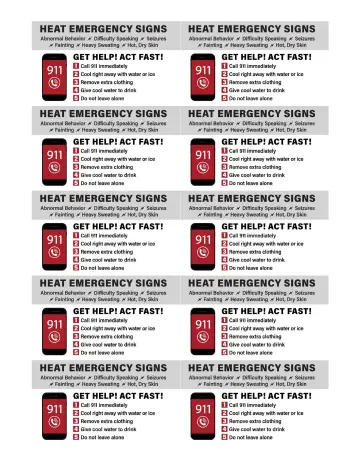
2 slidesHeat Emergency Wallet Card (OSHA 4403)
OSHA card or poster, for General Industry classes.
U.S. Department of Labor, OSHAPublic domain
pdfes
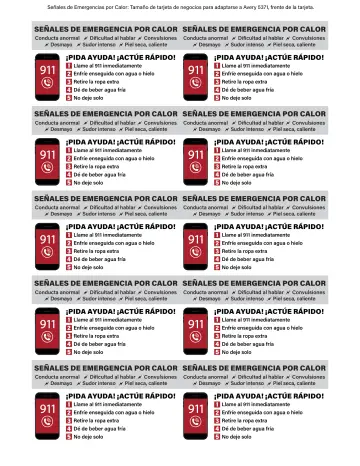
2 slidesHeat Emergency Wallet Card (OSHA 4404) (en español)
OSHA card or poster, in Spanish, for General Industry classes.
U.S. Department of Labor, OSHAPublic domain
pdf
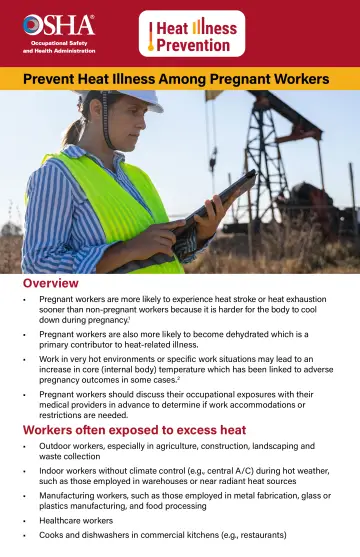
4 slidesHeat Illness Prevention: Prevent Heat Illness Among Pregnant Workers Fact Sheet (OSHA 4376)
OSHA fact sheet or bulletin, for General Industry classes.
U.S. Department of Labor, OSHAPublic domain